This software developer CV template follows a developer with experience building and maintaining business applications in C#, React and SQL Server. The example connects technical decisions with improvements for users and the development team. Download the Word CV and use the guide to choose useful project evidence, explain your contribution and present the skills relevant to your next role.
Filename: FreeCVDownload_Software_Developer.docx
Content of this CV template
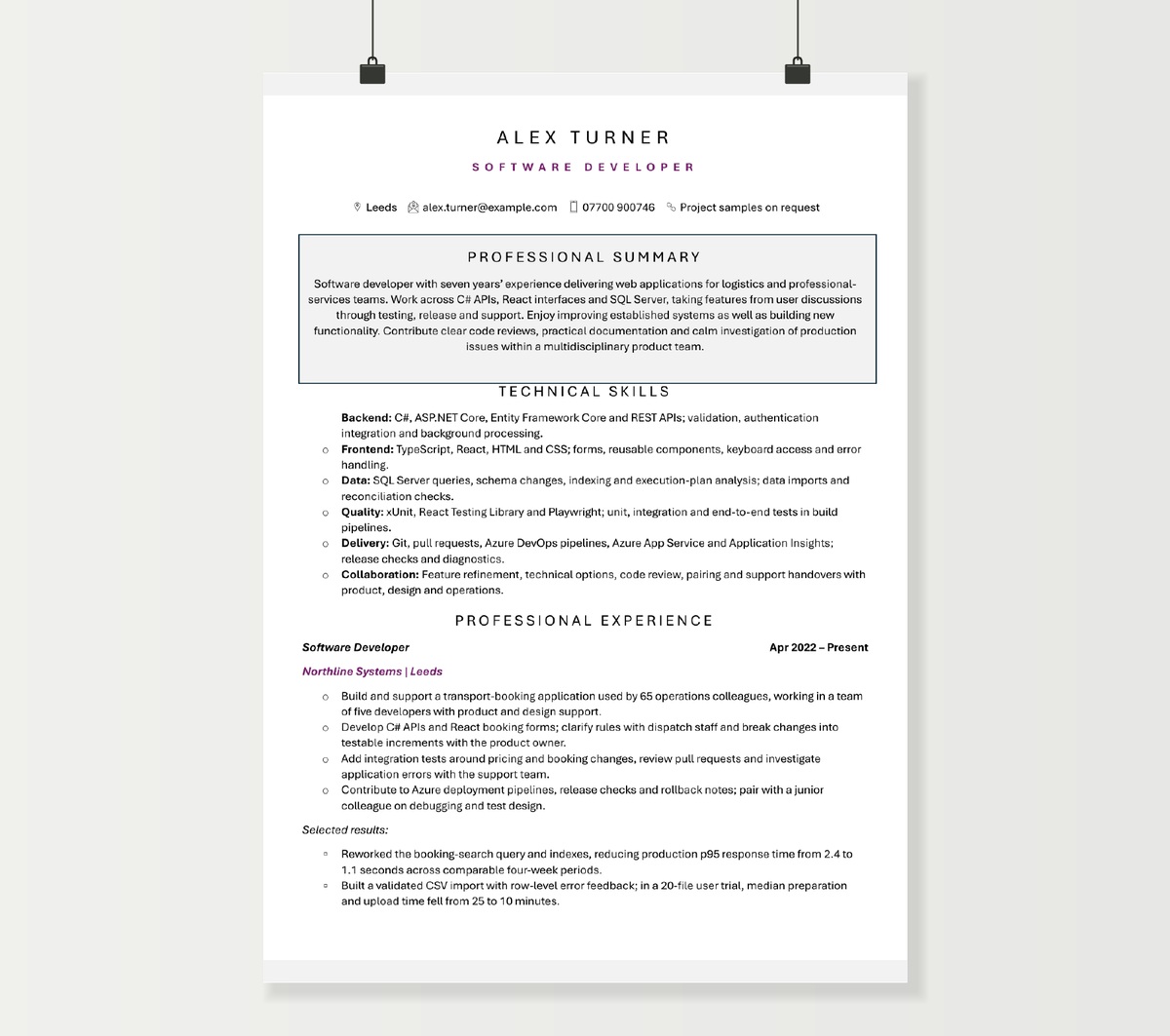
Alex Turner
SOFTWARE DEVELOPER
Leeds | [email protected] | 07700 900746 | Project samples on request
Professional summary
Software developer with seven years’ experience delivering web applications for logistics and professional-services teams. Work across C# APIs, React interfaces and SQL Server, taking features from user discussions through testing, release and support. Enjoy improving established systems as well as building new functionality. Contribute clear code reviews, practical documentation and calm investigation of production issues within a multidisciplinary product team.
Technical skills
- Backend: C#, ASP.NET Core, Entity Framework Core and REST APIs; validation, authentication integration and background processing.
- Frontend: TypeScript, React, HTML and CSS; forms, reusable components, keyboard access and error handling.
- Data: SQL Server queries, schema changes, indexing and execution-plan analysis; data imports and reconciliation checks.
- Quality: xUnit, React Testing Library and Playwright; unit, integration and end-to-end tests in build pipelines.
- Delivery: Git, pull requests, Azure DevOps pipelines, Azure App Service and Application Insights; release checks and diagnostics.
- Collaboration: Feature refinement, technical options, code review, pairing and support handovers with product, design and operations.
Professional experience
Software Developer | Apr 2022 – Present
Northline Systems | Leeds
- Build and support a transport-booking application used by 65 operations colleagues, working in a team of five developers with product and design support.
- Develop C# APIs and React booking forms; clarify rules with dispatch staff and break changes into testable increments with the product owner.
- Add integration tests around pricing and booking changes, review pull requests and investigate application errors with the support team.
- Contribute to Azure deployment pipelines, release checks and rollback notes; pair with a junior colleague on debugging and test design.
Selected results:
- Reworked the booking-search query and indexes, reducing production p95 response time from 2.4 to 1.1 seconds across comparable four-week periods.
- Built a validated CSV import with row-level error feedback; in a 20-file user trial, median preparation and upload time fell from 25 to 10 minutes.
Developer / Junior Developer | Sep 2019 – Mar 2022
Westbrook Digital | Leeds
- Developed client portals and internal tools for small professional-services firms, progressing from Junior Developer to Developer in September 2020.
- Implemented C# and SQL Server features alongside HTML, CSS and JavaScript interfaces; introduced React components on two portal projects.
- Worked with the account team to clarify change requests, demonstrate completed work and prepare release notes for clients.
- Fixed production defects, added regression tests and documented setup steps so colleagues could reproduce issues locally.
Selected results:
- Replaced a manual document-status spreadsheet with a portal view used by 18 case administrators, including filters and an audit trail of status changes.
- Added automated checks for six critical client-portal journeys, reducing the team’s routine pre-release manual check from 90 to 35 minutes.
Education & development
BSc (Hons) Computer Science, 2:1 – University of York, 2019
Microsoft Azure Fundamentals – AZ-900, 2022
Accessible web interfaces workshop – Internal training, 2025
Secure application development – Internal workshop, 2026
Projects & interests
- Personal project: Built a small walking-route log in React and ASP.NET Core, with map links, search and automated API tests.
- Project notes: Design decisions, setup guide and code samples available on request.
- Interests: Hillwalking, board games and playing bass guitar.
How to write a software developer CV
A software developer CV needs to show what you can build, how you work with other people and what happens after your code is released. A list of languages gives the reader a starting point. Your experience should then explain the applications, decisions and results behind that list.
Give the application a clear direction. A backend developer maintaining business systems, a frontend developer improving customer journeys and an engineer building embedded software have different evidence to offer. Use the vacancy to decide which part of your experience deserves the most space, while keeping enough context for the reader to understand the product and your contribution.
Make your technical focus clear in the first few lines
Use the profile to establish your level, main area of development and the kind of software you have worked on. The example CV identifies web applications, a focused C# and React background, and responsibility from user discussions through support. That is a clearer introduction than a paragraph describing enthusiasm for every stage of technology.
For a backend role, you might lead with APIs, data processing or services and then explain the environment in which they run. For frontend work, mention the interfaces and users as well as the framework. For desktop, mobile or embedded roles, name the relevant platform and the practical constraints that shaped your work, such as offline use, device integration or release compatibility.
Your employment title and the target role may use different terms. Keep the actual title in the employment history, then use a short description to clarify the work. A “Systems Developer” who builds C# web applications can make that immediately apparent without relying on the title alone.
Organise technical skills around useful evidence
A compact skills section helps a recruiter locate the main requirements. Group related capabilities: languages and frameworks, data, testing, and delivery are often useful categories. Choose categories that fit your work; a mobile developer may need a platform and release-tooling group, while a systems programmer may need one for operating systems and debugging.
Give depth through context. “SQL Server: queries, schema changes, indexing and execution-plan analysis” tells the reader more than a five-star SQL rating. “React: forms, reusable components and keyboard access” suggests how you use the framework. The employment section can then demonstrate those capabilities through specific changes.
Separate your main working stack from additional experience where it helps the reader. A short “Earlier experience” or “Project use” line can make a second language visible without suggesting that it is your current specialism. Versions are useful when a migration or compatibility requirement matters; they rarely need to accompany every tool.
Keep the list selective enough to be meaningful. Git, a test framework and a deployment platform can earn their place through regular use. A long inventory of editors, ticketing systems and briefly tried libraries can obscure the expertise the employer is trying to find.
Turn employment entries into evidence of software delivery
Begin each role with the application and its users. Explain whether you worked on a customer product, an internal tool, a client project or a shared platform. Add scale when it helps: team size, number of users, transaction volume or the number of systems integrated. A small but business-critical application can provide excellent evidence.
Then select changes that show your contribution. A useful entry connects the need, your work and the result. For example, an import feature can demonstrate requirements discussion, API validation, useful error messages, tests and a reduction in preparation time. The reader should be able to see why the work mattered without needing to understand the whole codebase.
Use the right level of detail for the decision you made. “Built a REST API” leaves several questions unanswered. “Added a booking API with validation and integration tests, replacing manual re-entry between two systems” explains the purpose and some of the engineering work. Where the architecture was already established, focus on the feature or improvement you delivered within it.
Technical decisions are especially valuable for experienced applicants. You might describe why you extended an existing service, introduced a queue, changed a data model or phased a migration. A sentence covering the constraint and outcome is usually enough for the CV; the full trade-off discussion belongs in the interview.
For consultancy and agency work, group projects under the employer and choose the most relevant assignments. Give each selected project enough context to distinguish it, then identify your role. This preserves a readable career history while showing the variety of products or clients you supported.
Make testing and maintainability visible
Testing deserves more than a tool name when it is a substantial part of your work. Explain what the tests protected: pricing rules, permissions, a checkout journey, a data import or a recurring defect. Distinguish unit, integration and end-to-end work where that distinction helps explain your contribution.
An effective bullet might describe adding regression tests after investigating a production problem, or introducing integration checks around a third-party API. If you improved the test suite itself, give the practical result: more reliable builds, shorter feedback time or less repetitive manual checking before release.
Coverage figures need context to be useful. State the component or service and the improvement achieved, rather than allowing one percentage to stand for overall software quality. A focused description of important cases covered can be stronger than a high number with no explanation.
Code review, refactoring and documentation also count as development evidence. Show what changed for the team: clearer interfaces, removal of duplicated logic, a reproducible local setup or a safer migration path. Maintenance work can demonstrate judgement particularly well because it involves improving a system while preserving the behaviour people rely on.
Show that you can work with live software
Describe your part in releases and ongoing support. You may maintain a build pipeline, prepare database migrations, carry out release checks, investigate logs, review monitoring or help resolve incidents. The useful detail is what you were responsible for and how it supported the application.
Cloud experience can mean several things. Developing an application hosted on Azure, configuring its deployment and designing its infrastructure are different contributions. State the service and activity together so the employer can judge the fit. The same applies to containers: local development, packaging applications and operating a cluster involve different work.
Production support can supply strong examples of problem-solving. Explain the symptom or user impact, your investigation and the durable change that followed. A fix that prevented repeated failed imports may be more persuasive than a broad claim that you “resolved technical issues”.
If your career is moving towards platform ownership, infrastructure automation or reliability engineering, the DevOps engineer CV example offers a more relevant emphasis for that part of the application. A software developer CV can still show release and operational experience while keeping the application work central.
Choose measures that explain the improvement
Good development results are not limited to revenue. Useful measures include response time, failure rates, processing duration, support demand, time spent on a user task or time required for a release check. Choose the measure that reflects the problem you worked on.
Explain the measurement briefly. The example CV gives a p95 response-time result across comparable periods, and identifies a 20-file trial for its import improvement. Those details help the reader interpret the figures. A test-environment benchmark should be described as such; a user trial and a production result each provide useful but different evidence.
Keep scope clear when a result belongs to a wider team. You can name the component you implemented, the investigation you led or the migration stage you owned, then describe the resulting improvement. That makes a team achievement more informative and gives the interviewer a natural place to explore your contribution.
Some valuable work has no convenient before-and-after figure. A successful migration, an accessible form, a documented support process or a feature adopted by a named user group can still be a concrete outcome. Explain what became possible or easier rather than forcing every entry into a percentage.
Give collaboration the same specificity as your code
Software work involves translating needs into something the team can build and support. Show how you clarified requirements, discussed options with product colleagues, worked through a design issue or demonstrated a feature to users. “Worked in an agile team” becomes more useful when the CV identifies your contribution to decisions and delivery.
For frontend applications, collaboration with design and user research can be particularly relevant. Describe implementation decisions around error states, keyboard use, responsive behaviour or feedback from testing when these were part of your work. For backend and integration roles, useful examples may involve agreeing API behaviour or resolving data definitions with another team.
Senior applicants should show how their work improved the team’s decisions and delivery. This could include leading a design review, mentoring a colleague, planning a difficult migration or coordinating a change across services. Technical leadership and people management can both be valuable; describe each responsibility in its own terms.
Remote or distributed work can add useful context where the vacancy calls for it. Written decision records, clear handovers and collaboration across time zones are more informative than simply stating that you are comfortable working remotely.
Select projects that add something to the CV
A project earns space when it demonstrates relevant work that the employment section does not already show. For a first developer role, that might be a substantial course project, an apprenticeship assignment, a contribution to an existing application or a small tool with real users. Experienced applicants can use a project to show a new area or a particular technical interest.
Describe the purpose, your contribution and the most useful engineering evidence. A small scheduling app with validation, tests, deployment and a clear explanation of its design can be more informative than a much larger project described only through its technology stack.
For a team project, explain the part you built and how the pieces fitted together. For a tutorial-based starting point, focus on the changes you developed beyond the initial exercise: a different use case, additional features, improved testing or feedback from users. This gives the project an individual story.
GitHub or another code host is useful when it gives the reader a clear route to that evidence. Link directly to a small selection of relevant repositories and provide a README covering purpose, setup, design decisions and what is complete. A short demonstration can complement the code when the application needs specialist setup.
A public portfolio is optional for many experienced developers. Detailed descriptions of commercial work can carry the application when code is private. Selected project notes or a discussion of technical decisions can provide further evidence without requiring a public copy of the application.
Balance experience, education and your next step
For an entry-level application, bring relevant projects, placements and training higher on the page. A degree, apprenticeship or intensive course is most useful when the CV also shows what you built and how you approached problems. Select modules or assignments that connect with the role instead of listing the full syllabus.
Career changers can make earlier experience work for them. Domain knowledge, customer support, process improvement or responsibility for a business system may explain why you understand the users of the software. Pair that background with recent development evidence so the reader can see both the transition and your current capability.
Once you have several years of development experience, education usually becomes shorter. Relevant certifications can remain, with their exact title and completion date. Internal training is also useful when it supports the work described, but it can be labelled simply as training rather than given the same presentation as a professional certification.
Choose a layout from the CV template collection that gives your strongest evidence enough room. The balance may change as your career develops: projects can lead a first application, shipped work can lead an experienced one, and technical decisions and team contribution become increasingly important for senior roles.
Software Developer CV FAQs
Use the vacancy’s terminology in your introductory heading where it accurately describes the work you are applying for, and retain your employment titles in the career history. Employers use these labels in different ways. A brief description of your application, technical focus and responsibilities usually explains the fit more effectively than the title alone.
Use a permitted description of the sector, application and your contribution. You can often explain the type of problem, the technologies and the decisions involved without naming the client or revealing proprietary details. Where commercial figures cannot be shared, describe the outcome in operational terms and use an approved case study if one is available.
Yes. It can demonstrate debugging, compatibility decisions, risk management and understanding of a live business. Explain the improvements you made, such as adding regression tests, replacing one component or preparing a staged migration. If you are applying for a newer stack, connect this experience with recent work or projects using the target technologies.
Include it when its use is relevant to the role and you can explain the workflow it supported, such as exploring tests or reviewing an unfamiliar area of a codebase. The stronger evidence remains the software you delivered and the engineering decisions you made. Building an AI-enabled product is a separate capability: describe its purpose, integrations, evaluation and operational behaviour as project experience.
Make the transferable engineering work visible: APIs, data modelling, tests, debugging and delivery. Add a focused project or recent contribution in the target language so the employer can assess your current familiarity. Keep your main commercial experience clear, then explain the connection between that experience and the new role in the profile or covering letter.
Label them as contracts and give clear dates, then summarise the product, your assignment and what you delivered. Consecutive engagements through the same consultancy can sit under one employer with selected projects beneath it. This helps the reader distinguish planned assignments from unexplained moves and makes completed migrations, releases or handovers visible.
They can support an early-career application or a role where algorithmic problem-solving is especially relevant. Give the platform or competition, result and date in one short line. Once you have substantial project or commercial evidence, prioritise that work unless the ranking adds a distinctive achievement the employer is likely to value.