This commissioning engineer CV template follows a building-controls specialist with an electrical background. The Word example brings together BMS commissioning, fault diagnosis, witnessed testing and client handover. The guide explains how to present commissioning experience in building services, water, industrial controls and other engineering environments, with the equipment and responsibilities that matter to your next employer.
Filename: FreeCVDownload_Commissioning_Engineer.docx
Content of this CV template
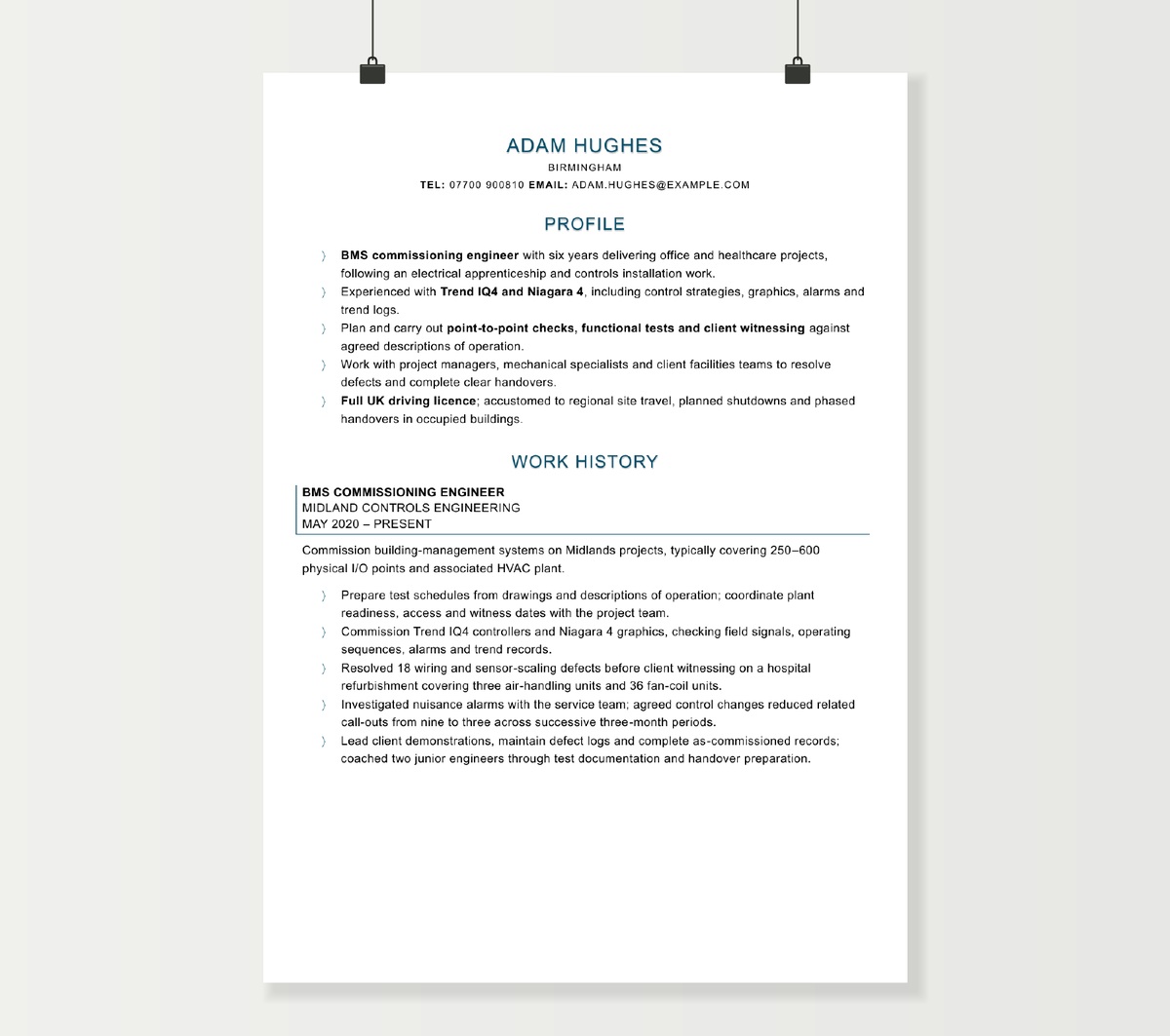
ADAM HUGHES
BIRMINGHAM
tel: 07700 900810 email: [email protected]
PROFILE
- BMS commissioning engineer with six years delivering office and healthcare projects, following an electrical apprenticeship and controls installation work.
- Experienced with Trend IQ4 and Niagara 4, including control strategies, graphics, alarms and trend logs.
- Plan and carry out point-to-point checks, functional tests and client witnessing against agreed descriptions of operation.
- Work with project managers, mechanical specialists and client facilities teams to resolve defects and complete clear handovers.
- Full UK driving licence; accustomed to regional site travel, planned shutdowns and phased handovers in occupied buildings.
WORK HISTORY
BMS COMMISSIONING ENGINEER
MIDLAND CONTROLS ENGINEERING
MAY 2020 – PRESENT
Commission building-management systems on Midlands projects, typically covering 250–600 physical I/O points and associated HVAC plant.
- Prepare test schedules from drawings and descriptions of operation; coordinate plant readiness, access and witness dates with the project team.
- Commission Trend IQ4 controllers and Niagara 4 graphics, checking field signals, operating sequences, alarms and trend records.
- Resolved 18 wiring and sensor-scaling defects before client witnessing on a hospital refurbishment covering three air-handling units and 36 fan-coil units.
- Investigated nuisance alarms with the service team; agreed control changes reduced related call-outs from nine to three across successive three-month periods.
- Lead client demonstrations, maintain defect logs and complete as-commissioned records; coached two junior engineers through test documentation and handover preparation.
ELECTRICAL APPRENTICE / CONTROLS TECHNICIAN
AVON BUILDING CONTROLS
SEPTEMBER 2011 – APRIL 2020
Completed an electrical apprenticeship in 2015, then installed and tested controls wiring for commercial heating and ventilation systems.
- Read panel schematics, checked field wiring and assisted engineers with point-to-point testing and plant start-up.
- Traced wiring faults, corrected drawing discrepancies and recorded changes for the panel designer and commissioning team.
- Coordinated access with mechanical contractors and site supervisors during school and office refurbishment programmes.
- Supported six controls-panel factory tests, recording observations and checking agreed corrections before despatch.
QUALIFICATIONS & DEVELOPMENT
HNC ELECTRICAL AND ELECTRONIC ENGINEERING
SOLIHULL COLLEGE – 2017
Completed part-time study alongside controls installation and site-testing work.
LEVEL 3 ELECTRICAL APPRENTICESHIP
COMPLETED 2015
RECENT DEVELOPMENT
TREND IQ4 TRAINING – 2022; NIAGARA 4 WORKSHOP – 2024; SITE SAFE-ISOLATION REFRESHER – 2026
INTERESTS
Mountain biking, cooking and watching live football.
How to write a commissioning engineer CV
A commissioning engineer CV should make it easy to see what you have brought into service, how you established that it worked as intended and what you handed over. The job title covers very different work. Building-management controls, water-treatment instrumentation, electrical distribution and production machinery each call for distinct knowledge. Lead with your own systems and sector, then show the testing, diagnosis and coordination behind a completed project.
Identify the equipment and environment you know
Use the opening profile to establish your engineering discipline, principal systems and working environment. “BMS commissioning engineer with experience of Trend controls in occupied healthcare and office buildings” immediately gives a reader more than “experienced commissioning professional”. For another applicant, the equivalent might be water-sector ICA, industrial PLC-controlled machinery or electrical protection systems.
Add the level at which you work. You may execute approved test procedures, develop commissioning plans, lead a particular system or coordinate several specialist contractors. That responsibility is as useful as the number of years in your career. If you progressed from installation, maintenance or service, a short reference to that background explains the practical knowledge you bring.
The environment provides important context: a live production plant, phased refurbishment, new-build facility or remote pumping station creates different delivery demands. Name the ones relevant to the vacancy. Travel, shutdown work and overnight stays can be covered in one practical line where they are part of the role.
Turn each project into evidence of commissioning work
For a current role, start with a brief description of the typical projects and then develop one or two examples. State the system, scale, your responsibility and the stage you took it to. Useful measures include plant items, panels, instruments, physical I/O points, buildings, sites or production lines. Choose a measure a fellow engineer could interpret.
Be precise about the unit. A BMS point count may include physical inputs and outputs, software values or both. A panel count says little without the type of plant it controls. “Commissioned controls for three air-handling units and 36 fan-coil units” describes a recognisable scope. On a water project, the equivalent detail might be a pumping station upgrade with instrumentation, telemetry and operational interfaces.
For major programmes, focus on your system or work package. Explain how it connected with the wider project and who owned adjacent areas. This helps a hiring manager assess where you could work independently and how you collaborate across disciplines. An experienced lead can add the team size, witness programme, subcontractor coordination or technical review responsibility.
Describe testing through its purpose and acceptance evidence
Factory acceptance testing and site acceptance testing are useful terms when they describe your actual involvement. Expand FAT and SAT on first use if the CV will be read by a general recruiter. Then explain whether you prepared procedures, executed tests, attended as a client witness, resolved findings or assembled the acceptance records.
A commissioning CV can show progression through readiness checks, functional testing, integrated operation and handover. Select the stages you handled. An industrial-controls engineer may give prominence to sequence testing and interfaces; a BMS engineer may emphasise field points, plant operation, alarms and graphics; a power specialist may foreground protection and control tests appropriate to the equipment involved.
Connect the tests to their reference and result: an approved description of operation, a functional specification, agreed performance requirements or a client acceptance schedule. This demonstrates that testing had a defined purpose. The CV needs the scope and evidence, while the detailed procedure belongs in project documentation.
Where a project used integrated systems testing or a particular client’s commissioning stages, explain the relevant system interfaces and your role. The stage name alone may not mean the same thing to another employer.
Use fault finding to show engineering judgement
One well-chosen defect example can demonstrate more than a list of instruments or software. Describe the symptom or failed requirement, the part you investigated, the people involved and how the correction was verified. Wiring discrepancies, incorrect scaling, sequencing conflicts, network faults and incomplete design information can all produce useful examples when they match your specialism.
The example CV identifies wiring and sensor-scaling defects resolved before witnessing. Another applicant might describe tracing an intermittent interface problem with a controls supplier or resolving a discrepancy between a drawing and the installed equipment. Give enough technical context to make the work credible, then finish with the effect on testing, operation or acceptance.
Separate a diagnosis from a design change when different people owned them. Coordinating an approved correction and proving it through retesting is a meaningful achievement. For senior engineers, reviewing the proposed solution or deciding how it affected the commissioning programme may be the more relevant contribution.
Present software, instruments and documentation together
A technical-skills section is easiest to read when it follows the way the work is done. Group platform knowledge, test equipment and delivery documents, and support the most important items in your employment history.
- Controls and software: name the platforms and describe whether you configure, program, diagnose, test or review them. PLC programming, online fault diagnosis and witnessing a supplier’s software tests are distinct forms of experience.
- Test equipment: identify instruments that matter to the target role, linked to the measurements or tests you carry out. A selective list is more useful than every tool encountered during an apprenticeship.
- Engineering information: describe your work with schematics, I/O schedules, control philosophies, specifications or drawings, including any preparation or revision responsibility.
- Completion records: show test sheets, defect lists, witness packs, as-commissioned information and operating or maintenance documentation where these were part of your remit.
Written records are part of the engineering result. A well-structured defect log, traceable test evidence or complete handover pack can make an achievement even when there is no convenient percentage saving. Explain what the records enabled, such as a client review, a planned system release or a clear transition to the service team.
Show how you organised work around the site
Commissioning depends on installation readiness, power or utilities, access, specialist attendance and the availability of the client’s operating team. Use a project bullet to show how you handled these dependencies. Coordinating a witness date after resolving incomplete installation work is more informative than “excellent time management”.
Site communication should appear through its purpose. You might have explained findings to an installer, raised a technical query with the designer, agreed outstanding items with a client or briefed operators before a handover. For work in occupied buildings or live facilities, explain how commissioning was fitted into access and shutdown arrangements.
Include safety responsibilities at the level you held: contributing to risk assessments and method statements, working within permit arrangements, planning isolations with authorised colleagues or supervising a defined activity. Training and site appointments can be listed separately with their relevant scope. This gives the employer a clear picture of both your preparation and your responsibilities.
Choose achievements that survive an engineering conversation
The most useful result is often acceptance of a functioning system, closure of a defined set of defects or successful completion of an agreed operational trial. State what was achieved and the evidence behind it. Where you improved a recurring problem, add a meaningful comparison: related call-outs across equal periods, repeat test failures before and after a correction, or missing handover items across comparable packages.
Schedule achievements need context. Identify the milestone and the contribution that helped achieve it, such as coordinating supplier attendance or resolving a blocking interface issue. For energy or performance results, explain the conditions and period used for the comparison if those are available. That makes the figure useful to a technical reader.
Scope can also demonstrate progression. Moving from assisting with panel tests to leading client witnessing, or from one system to coordinating several packages, gives a strong career story. The CV does not need a financial saving for every project.
Give qualifications the right weight for your route
List your engineering qualification, apprenticeship or degree with the discipline and completion date. Follow it with relevant manufacturer training, specialist courses and current site credentials. For commissioning, the exact subject is often more helpful than a general statement that you are technically qualified.
An apprentice-trained applicant can connect installation and fault-finding experience to testing and system operation. A graduate should draw on laboratory work, a final-year project, a placement or supervised site activity: the system investigated, the requirements, the measurements and the findings. These are stronger evidence than simply listing modules. The mechanical engineer CV example may help applicants whose strongest early evidence comes from mechanical projects and testing.
Experienced engineers should give greater space to completed work and increasing responsibility. Professional membership or registration can be included where relevant, alongside the practical evidence. When moving from electrical installation, the electrician CV example offers a useful comparison for presenting the underlying trade experience while giving commissioning its own prominence.
Commissioning Engineer CV FAQs
List each contract with the employer or agency, project context, dates and commissioning scope. Where several assignments were through one employer, group them beneath that employer and use short project subheadings. Marking roles as fixed-term or project contracts makes the pattern easy to understand. Give the most relevant projects detail and summarise older assignments with similar equipment or responsibilities.
Yes, particularly where the equipment and sector overlap. Bring forward installation changes, system upgrades, return-to-service testing, control adjustments and customer demonstrations from your existing work. Explain which activities involved proving performance against requirements. This gives an employer a clearer picture of your starting point than changing a maintenance job title to commissioning engineer.
Make factory acceptance work a clear strength: the equipment, test procedures, customer witnessing, findings and verification of corrections. Add any installation support, site visits or interface testing that extends that experience. A role involving supplier equipment or factory-to-site delivery may provide a closer match than one requiring independent site leadership from the outset.
Prioritise credentials relevant to the vacancy and its sites, giving current status or expiry dates where useful. Keep engineering qualifications, manufacturer training and site cards in clearly labelled groups. A site-specific appointment can be described with the project and scope it covered; that context helps distinguish it from a transferable qualification or training course.
Start with the overlap in systems, tests and delivery: controls, instrumentation, drawings, defect resolution, client witnessing and documentation. Then show any direct exposure to the new sector through projects or training. Explain the plant you know rather than assuming that the same platform means the same process knowledge. A targeted application can make the transferable engineering evidence easy to assess.
It is useful for experienced contractors or engineers with a broad installation history. A compact project list can show sector, equipment, platform, dates, test stages and your responsibility, while the main CV develops the strongest examples. It works best as a supplement that answers technical matching questions quickly, rather than a duplicate of every employment bullet.