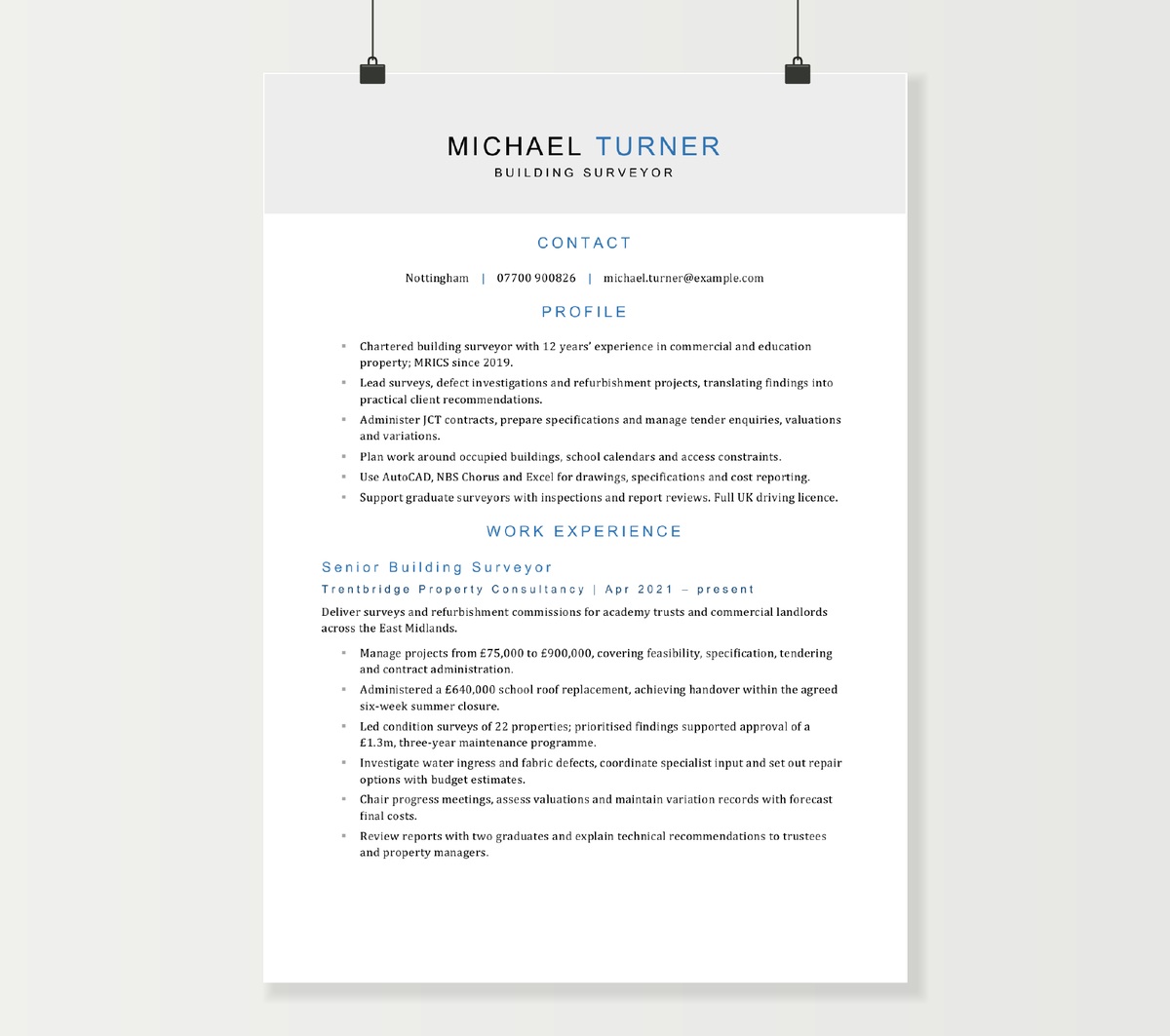
This building surveyor CV template follows a chartered surveyor working on commercial and education properties. The Word example combines defect investigation, planned maintenance and refurbishment delivery, with clear evidence of project responsibility. The guide covers both professional surveying and project work, including how to present APC progress, technical reports and client advice.
Filename: FreeCVDownload_Building_Surveyor.docx
Content of this CV template
Michael Turner
Building Surveyor
Contact
Nottingham | 07700 900826 | [email protected]
Profile
- Chartered building surveyor with 12 years’ experience in commercial and education property; MRICS since 2019.
- Lead surveys, defect investigations and refurbishment projects, translating findings into practical client recommendations.
- Administer JCT contracts, prepare specifications and manage tender enquiries, valuations and variations.
- Plan work around occupied buildings, school calendars and access constraints.
- Use AutoCAD, NBS Chorus and Excel for drawings, specifications and cost reporting.
- Support graduate surveyors with inspections and report reviews. Full UK driving licence.
Work experience
Senior Building Surveyor
Trentbridge Property Consultancy | Apr 2021 – present
Deliver surveys and refurbishment commissions for academy trusts and commercial landlords across the East Midlands.
- Manage projects from £75,000 to £900,000, covering feasibility, specification, tendering and contract administration.
- Administered a £640,000 school roof replacement, achieving handover within the agreed six-week summer closure.
- Led condition surveys of 22 properties; prioritised findings supported approval of a £1.3m, three-year maintenance programme.
- Investigate water ingress and fabric defects, coordinate specialist input and set out repair options with budget estimates.
- Chair progress meetings, assess valuations and maintain variation records with forecast final costs.
- Review reports with two graduates and explain technical recommendations to trustees and property managers.
Building Surveyor
Trentbridge Property Consultancy | Sep 2017 – Mar 2021
Progressed from supporting project delivery to managing smaller commissions independently; achieved MRICS in 2019.
- Prepared condition reports, repair specifications and tender comparisons for offices, schools and community premises.
- Administered JCT Minor Works contracts for roof repairs, internal alterations and external maintenance.
- Completed inspection schedules for a 14-site client, giving its facilities team a consistent record of maintenance priorities.
- Coordinated contractor access with occupiers and followed up defects through completion inspections.
Graduate Building Surveyor
Mercia Building Consultants | Sep 2014 – Aug 2017
Supported senior surveyors on commercial inspections and refurbishment work while developing APC evidence.
- Produced measured drawings in AutoCAD and assembled photographic schedules of condition.
- Drafted survey reports and tender schedules for review; recorded site progress and outstanding works.
Qualifications
BSc (Hons) Building Surveying, 2:1
Nottingham Trent University | 2011–2014
Professional development
MRICS, Building Surveying pathway | 2019. Recent CPD: JCT contract updates, moisture investigation and refurbishment design risk, 2025–2026.
Interests
Cycling, local history and restoring second-hand furniture.
How to write a building surveyor CV
A building surveyor CV should make your area of practice clear. A surveyor carrying out residential inspections, one advising commercial landlords and one delivering a council refurbishment programme may share technical foundations, but their day-to-day evidence will be different. Give the reader a clear picture of the buildings you work on, the services you provide and the decisions you are trusted to make.
Start with the work the employer needs. For a project-led vacancy, bring contract administration and completed schemes forward. For a professional-services role, give more space to inspections, defect diagnosis, technical due diligence, dilapidations or other relevant instructions. Your CV can show breadth while still having a clear centre of gravity.
Establish your professional position and service mix
Your opening paragraph should identify your level, professional status, principal sectors and strongest services. “MRICS building surveyor delivering refurbishment and planned maintenance for education and commercial clients” immediately tells the reader more than “experienced construction professional with excellent attention to detail”. Follow it with one indication of the responsibility you hold, such as managing your own commissions, advising an estate team or reviewing junior surveyors’ reports.
Place chartered status near your name or in the profile, with the membership body and date in the qualifications section. If you are working towards the Assessment of Professional Competence (APC), give your pathway and current stage. An assessment date can be useful when it is booked; otherwise, describe your progress through the experience you are developing. Associate membership, chartership and an academic qualification each deserve their own clear description.
Retain your employment history in date order, but change the emphasis within each role to suit the instruction mix. A short scope sentence can explain that you split your time between professional surveys and project delivery, or that your portfolio consists mainly of occupied schools, housing or commercial premises.
Make inspection and defect experience tangible
“Undertook building surveys” leaves the reader with several unanswered questions. What type of property? What was the purpose of the inspection? What did your report allow the client to do? Answer the questions that matter most to the vacancy within the same bullet.
For condition surveys and planned maintenance, useful detail includes the number or variety of buildings, the way findings were prioritised and the programme or investment decision that followed. The example CV links a 22-property survey programme to an approved three-year maintenance plan. That connects the inspection work with its practical use.
For building pathology, select a case that shows your judgement. Identify the defect, the investigation you undertook or coordinated and the recommendation you made. For instance, a water-ingress investigation might involve comparing inspection findings with maintenance records, arranging specialist opening-up and presenting repair options. The CV needs the reasoning and outcome in a few lines; the technical investigation itself can be discussed at interview.
When your experience includes specialist input, show how you brought it together. Coordinating a structural engineer’s investigation and explaining its implications to a property owner is a useful contribution in its own right. The reader should be able to follow your part in the instruction from inspection through advice.
Describe contract administration through the work you owned
JCT or NEC experience becomes informative when attached to a project and a role. State the form of contract where relevant, then identify the activities you undertook: preparing tender documents, assessing submissions, issuing instructions, reviewing valuations, handling variations, monitoring progress or dealing with completion and defects.
The distinction between a named contract administrator, an employer’s agent and a surveyor supporting either role matters to the reader. Use the appointment or responsibility you held, then make your contribution visible. A junior applicant’s preparation of valuation records and site reports can be strong evidence when the review arrangements are clear.
A useful project bullet might read: “Administered a £420,000 office refurbishment under a JCT Intermediate contract, coordinating phased access, monthly valuations and variation reporting through practical completion.” A following bullet can cover the particularly difficult decision or result. This gives the employer a basis for judging your experience beyond the contract acronym.
For earlier-stage work, explain the deliverable and its purpose. A specification issued for tender, an options appraisal approved by the client or a coordinated drawing package all demonstrate progress even when the construction stage is still underway.
Choose projects that show the demands of the role
Project value is useful context, but the largest scheme is not automatically your best example. A relatively small repair to an occupied school can demonstrate access planning, stakeholder communication and programme judgement that a larger, straightforward vacant-building project does not.
Choose two or three commissions that reveal different strengths. Under the relevant employer, give enough information to establish:
- The property type and client or occupier context.
- The purpose and approximate scale of the work.
- Your role and the stages you covered.
- A constraint, decision or outcome that makes the example worth including.
For a council or housing role, this could mean a planned improvement programme, a difficult defect case and work in occupied premises. For consultancy, it might be a refurbishment contract, a pre-acquisition instruction and a landlord-and-tenant service. Select the services that match the vacancy rather than trying to give every instruction equal space.
Where a job combines surveying with operational estate responsibilities, the facilities manager CV example also shows ways to describe maintenance programmes, contractors and building users. Keep your own CV centred on the surveying responsibilities you want the employer to recognise.
Show the advice behind the report
Technical writing is a central part of building surveying. Explain what you produced and who used it: a defect report for a managing agent, a maintenance forecast for trustees, a tender recommendation for an estate director or a schedule of condition supporting a property transaction.
The strongest communication examples involve a decision. Presenting repair options with costs and disruption implications, agreeing access with tenants or explaining a change in scope to a client shows more than describing yourself as a good communicator. Include the audience when it adds complexity: residents, school leaders, leaseholders, committees and contractors have different information needs.
For occupied properties, show how you made the work deliverable. Evidence might include coordinating inspections around teaching, maintaining access to operational areas or providing residents with clear updates. A concise example can demonstrate both technical delivery and the care taken with people using the building.
Use results that fit surveying work
Good results are not limited to cost savings. A report delivered in time for a client’s decision, a school ready for the start of term, an agreed maintenance plan or a successful completion inspection can all be meaningful outcomes.
Give financial figures a label. Contract value, total programme budget, your fee income and a saving against an approved alternative describe different things. Similarly, distinguish a forecast from a completed result. This lets a reader understand the commercial significance without needing to decode the numbers.
Where you can quantify an improvement, provide its basis. A shorter reporting turnaround is clearer as “reduced the average issue period from ten working days to seven across the team’s monthly condition reports” than as an isolated percentage. For consultancy leadership, repeat instructions, fee recovery and the development of junior staff may be useful measures. For an estate role, maintenance priorities, budget forecasting and closure of outstanding works may be more relevant.
Connect technical knowledge and software to outputs
A compact skills section helps the reader find relevant services and systems quickly. Pair software with the work you use it for: AutoCAD for measured drawings and alteration details, NBS Chorus for specifications, Excel for tender comparisons and cost forecasts, or an asset system for condition records and maintenance planning.
If you use Revit, a common data environment or digital survey tools, describe the part of the workflow you handle. Producing drawings, reviewing models and managing project information are distinct capabilities. The description is more useful than a row of proficiency bars.
Present regulatory knowledge through relevant responsibilities. A refurbishment CV might mention design-risk coordination, planning or building-control submissions, or working with specialist fire and asbestos advisers. Identify your appointment and the work delivered when you have a formal dutyholder role. This gives context to the knowledge without turning the skills section into a list of legislation.
For sustainability or conservation work, include the recommendation or assessment you contributed to: comparing refurbishment options, specifying suitable repairs or bringing energy improvements into a maintenance programme. Recent CPD can support that experience, particularly when you are moving into a new property type or service.
Adjust the evidence as your career develops
Graduate and assistant surveyors can give more space to placements, relevant degree projects and supervised work. State what you inspected, measured, drafted or analysed, and how it was reviewed. A well-described inspection and report can demonstrate more readiness than an extensive list of modules. Include your degree, institution, dates and classification, plus APC development where relevant.
For an experienced surveyor, recent instructions should carry the CV. Earlier graduate work can be shorter once independent delivery and advice are established. Progression is visible when your examples move from producing information to managing commissions, advising clients and reviewing others’ work.
Senior and associate applicants should also show the practice or team contribution. Include the scale of staff supervision, responsibility for quality, client relationships and commercial activity where these form part of the role. A change of title is stronger when the reader can see what changed in your responsibility.
For an application requiring a separate statement, use the CV to make the career and project evidence easy to locate. The statement can then explain the examples against the employer’s criteria in more depth. This is particularly helpful for public-sector applications where the requested format may separate work history from technical questions.
Building Surveyor CV FAQs
Yes. Requirements vary by employer and level: some roles require MRICS, while others welcome applicants progressing towards it or accept other relevant qualifications and experience. Make your current professional position easy to find and use your work examples to show the responsibility you already handle. For a chartership-supported post, experience that will broaden your surveying work is especially relevant to the application.
It can help when your strongest commissions need more detail than the CV allows, particularly for consultancy or senior project roles. Keep the CV understandable on its own, then use a short attachment for selected projects, your role and outcomes. A few focused descriptions usually give a recruiter more useful evidence than a large collection of site photographs. Follow any attachment or page limits in the application.
Lead with the transferable inspection, pathology, reporting and client-advice work, then identify experience relevant to the new instruction mix. Commercial employers may also want schedules of condition, planned maintenance, contract administration or landlord-and-tenant work. Relevant supervised commissions, previous project work or focused development can help explain the move. Give the reader a clear view of your starting strengths and the services you are developing.
It can provide the career-history structure, but the technical emphasis needs to change. Building control recruitment focuses on its own regulatory responsibilities and may require specific registration and competence details. Use the vacancy’s requirements to frame your evidence, particularly inspections, assessment work and the decisions you were responsible for. A general building-surveying service list will not answer those questions by itself.
Keep the actual title in your employment history and add a short scope sentence explaining the building-surveying work within it. For example, identify condition inspections, defect investigations, maintenance planning or refurbishment contracts. This makes the experience recognisable to a recruiter even where organisations use different titles for similar work.
Use the property type, broad location, scale and your role: for example, an occupied regional office, a multi-academy trust estate or a residential block refurbishment. An approximate value or size can add context where appropriate. Your judgement, deliverables and results can usually be explained clearly without identifying the client or publishing project documents.