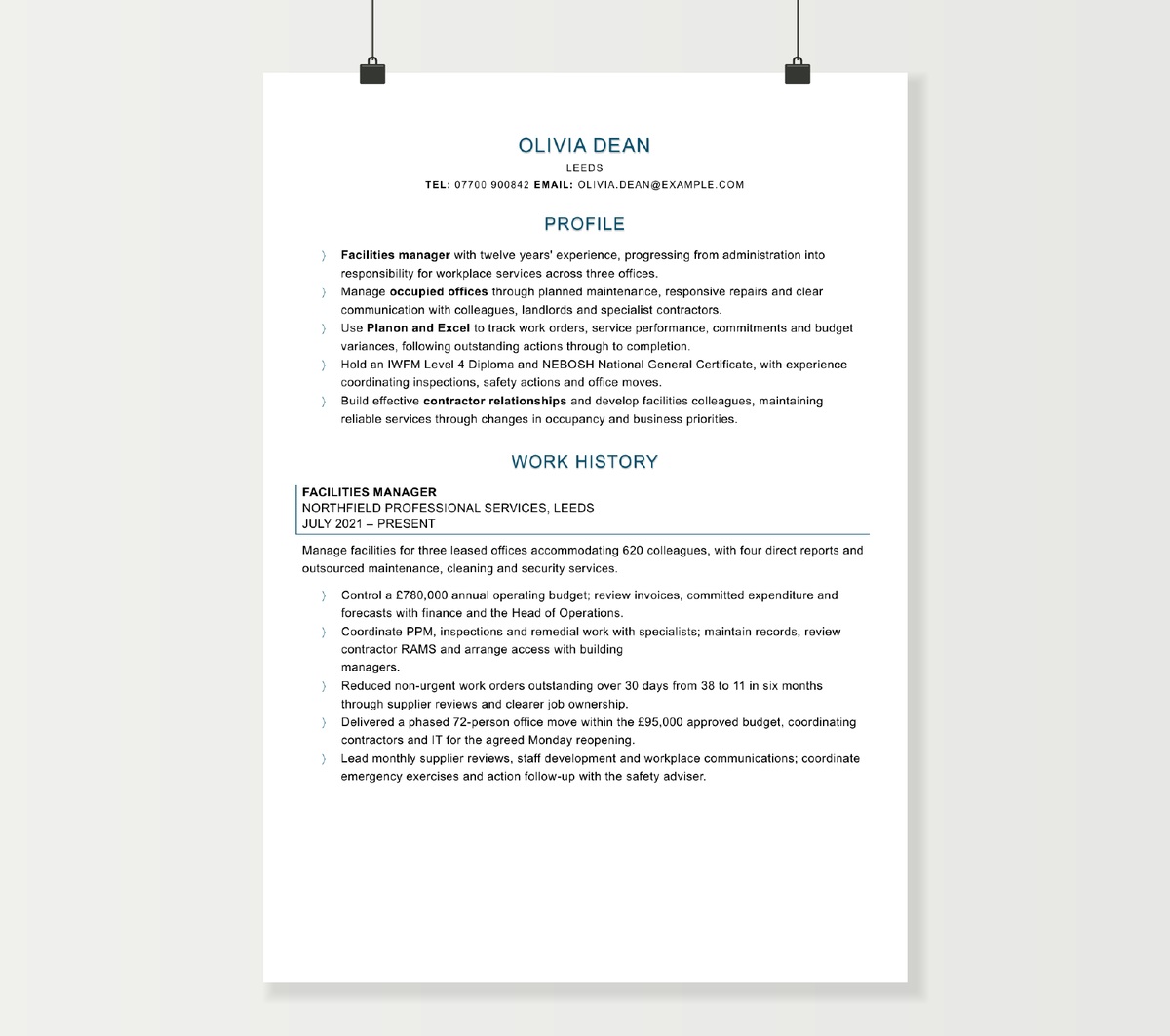
This facilities manager CV template follows a career from facilities administration into responsibility for three occupied offices. The Word example combines maintenance and contractor management with budgets, team leadership and office moves. The guide explains how to present the scope of your facilities work and the improvements you have delivered, whether your background is in-house or with a service provider.
Filename: FreeCVDownload_Facilities_Manager.docx
Content of this CV template
OLIVIA DEAN
LEEDS
tel: 07700 900842 email: [email protected]
PROFILE
- Facilities manager with twelve years' experience, progressing from administration into responsibility for workplace services across three offices.
- Manage occupied offices through planned maintenance, responsive repairs and clear communication with colleagues, landlords and specialist contractors.
- Use Planon and Excel to track work orders, service performance, commitments and budget variances, following outstanding actions through to completion.
- Hold an IWFM Level 4 Diploma and NEBOSH National General Certificate, with experience coordinating inspections, safety actions and office moves.
- Build effective contractor relationships and develop facilities colleagues, maintaining reliable services through changes in occupancy and business priorities.
WORK HISTORY
FACILITIES MANAGER
NORTHFIELD PROFESSIONAL SERVICES, LEEDS
JULY 2021 – PRESENT
Manage facilities for three leased offices accommodating 620 colleagues, with four direct reports and outsourced maintenance, cleaning and security services.
- Control a £780,000 annual operating budget; review invoices, committed expenditure and forecasts with finance and the Head of Operations.
- Coordinate PPM, inspections and remedial work with specialists; maintain records, review contractor RAMS and arrange access with building managers.
- Reduced non-urgent work orders outstanding over 30 days from 38 to 11 in six months through supplier reviews and clearer job ownership.
- Delivered a phased 72-person office move within the £95,000 approved budget, coordinating contractors and IT for the agreed Monday reopening.
- Lead monthly supplier reviews, staff development and workplace communications; coordinate emergency exercises and action follow-up with the safety adviser.
FACILITIES COORDINATOR
PARKSIDE BUSINESS SERVICES, LEEDS
SEPTEMBER 2014 – JUNE 2021
Joined as Facilities Administrator in 2014 and progressed to Coordinator in 2017, supporting two offices and their reception teams.
- Managed the facilities helpdesk, allocated requests and updated colleagues on repairs, contractor visits and temporary service arrangements.
- Maintained planned-maintenance records and asset information, collecting service reports and escalating overdue remedial actions to the facilities manager.
- Raised purchase orders, checked invoices against completed work and gathered quotations for furniture, cleaning supplies and minor improvements.
- Introduced a shared move checklist covering access passes, furniture and IT readiness, used for subsequent departmental relocations.
QUALIFICATIONS & DEVELOPMENT
IWFM LEVEL 4 DIPLOMA IN FACILITIES MANAGEMENT
COMPLETED 2020
Completed alongside facilities coordinator responsibilities, with work-based study in service delivery, budgets and contract management.
NEBOSH NATIONAL GENERAL CERTIFICATE
IN OCCUPATIONAL HEALTH AND SAFETY – 2022
FURTHER TRAINING AND EDUCATION
FIRE WARDEN REFRESHER – 2025; THREE A LEVELS – 2014
INTERESTS
Swimming, baking and visiting independent cinemas. Full UK driving licence.
How to write a facilities manager CV
A facilities manager CV needs to show what you kept running, how much responsibility you held and what improved under your management. A regional office portfolio, a hospital and a contracted maintenance service may all employ a facilities manager, but they involve different buildings, users, risks and commercial arrangements. Make that context clear before describing your achievements.
Define the operation behind your job title
Open each recent role with a short description of the estate or contract. Useful facts include the number and type of premises, approximate floor area or occupancy, operating hours, direct team, outsourced services and budget. Choose the measures that explain complexity: a single building serving patients around the clock may need more explanation than the number of sites alone provides.
Identify your position in the service arrangement. An in-house manager may represent the occupier and coordinate landlord services; a managing agent may deliver services for several occupiers; a contractor’s facilities manager may be accountable for an agreed service specification and contract margin. Naming your employer and describing the client environment helps a recruiter understand where your authority sat.
For example: “Manage facilities for three leased offices accommodating 620 colleagues, with four direct reports and outsourced maintenance, cleaning and security services.” This establishes the scale and delivery model in one sentence. The following bullets can then concentrate on decisions and results rather than repeatedly explaining the setting.
Use the profile to establish your kind of facilities experience
Bring together your sector, level of responsibility and strongest evidence. An operational office manager might lead with workplace services, contractors and multi-site coordination. A technical FM applicant could place building-services experience, engineering qualifications and asset reliability first. Someone applying to manage a healthcare site could foreground experience coordinating non-clinical services around patient needs.
Make the profile selective. Four or five useful points about the operation you can manage are more informative than a paragraph combining every possible FM discipline. Match its emphasis to the vacancy, then provide supporting examples in your employment history. For an application centred on the condition and use of a wider property portfolio, the property manager example offers another way to present responsibility for buildings and occupiers.
Show how you manage planned and reactive work
“Responsible for maintenance” leaves most of the useful evidence unstated. Explain the part you played in planned preventive maintenance, inspections, reactive requests and remedial work. This might include reviewing schedules, agreeing access windows, prioritising faults, checking completion evidence and escalating work that could affect operations.
Distinguish coordination from direct technical delivery through the verbs you use. “Coordinated statutory inspections and tracked remedial actions with specialist contractors” describes a different contribution from diagnosing a control fault or completing an electrical test. Both can be valuable, and each points to a different type of vacancy.
Give a practical example of following work through. A manager who investigated recurring comfort complaints, brought the maintenance contractor and occupier together, agreed corrective work and monitored subsequent calls has demonstrated more than someone who simply lists HVAC. If you introduced a work-order review or improved access planning, explain the service problem it resolved.
CAFM experience belongs alongside this evidence. Name the computer-aided facilities management system, then state what you used it for: asset records, job allocation, PPM schedules, overdue actions, contractor performance or reporting. A sentence about keeping completion records usable for monthly reviews gives the software name a clear purpose.
Make contractor management tangible
State the services involved and your role across their delivery. Preparing a specification, comparing quotations, supporting a tender, mobilising a supplier and running performance reviews are separate contributions. The most relevant ones depend on whether the job emphasises procurement, daily operations or recovery of a struggling contract.
Include the measures you used to judge service. For cleaning, that might be inspection results and repeat complaints. For maintenance, it could be response times, overdue jobs, repeat attendance or completion of agreed remedial work. Security or reception contracts may place greater weight on coverage, incident handling and the experience of visitors.
A strong bullet connects the review to action: “Introduced weekly reviews with the maintenance supplier, assigning owners to ageing requests and reducing non-urgent jobs over 30 days from 38 to 11 in six months.” It explains the management intervention, the scope of the measure and the result. “Managed SLAs and KPIs” is best supported by evidence of this kind.
Present safety and compliance through your responsibilities
Explain which arrangements you managed and how you worked with competent specialists. Relevant examples may include maintaining inspection records, reviewing contractor risk assessments and method statements, coordinating permits, managing access, tracking fire-risk-assessment actions or arranging emergency exercises. The useful detail is your responsibility for progressing and documenting the work.
Choose examples suited to the premises. School FM can involve arranging works around pupils and safeguarding arrangements. Healthcare experience may include coordinating maintenance with clinical teams and supporting cleaning or catering services against the organisation’s standards. A corporate workplace role may require evidence of workstation adjustments, evacuation arrangements and communication during disruption.
Where you held a formal appointment, give its title and relevant scope. Where an adviser, engineer or senior manager made the technical or statutory decision, describe how you supported implementation. This helps an employer distinguish your operational management experience from specialist qualifications or delegated appointments they may also need.
Explain the money you controlled
Show the budget or contract value and what you did with it. Preparing an annual operating budget, forecasting expenditure, checking invoices and approving work within a delegated limit demonstrate different levels of financial responsibility. For a service-provider role, contract profitability, variations, chargeable work and client reporting may be more relevant than the occupier’s total facilities spend.
Keep operating expenditure and capital projects understandable. For example, an annual £780,000 services budget and a £95,000 office move can appear in separate bullets. Include your part in obtaining approval, comparing options, monitoring commitments and reporting variances where it strengthens the application.
When presenting savings, explain what changed and the period measured. A reduction in cleaning costs after a smaller office footprint has a different meaning from a comparable service delivered more efficiently. Useful context might include unchanged service hours, revised specifications or the effect of a supplier consolidation. A proposal, an approved saving and a reduction visible in expenditure are different stages of achievement; naming the stage makes the result easier to assess.
Select projects that show control of occupied premises
Moves, refurbishments, plant replacements and changes in service provider can be excellent CV evidence. Select projects that reveal the kind of coordination the next employer needs. Give the size, your role, the main operational constraint and the outcome.
For an office move, the important story may be sequencing furniture, access control, IT readiness and colleague communications so the business could reopen as planned. For a plant replacement, it may be the outage window, contractor coordination, temporary arrangements and handover records. A new supplier may require a mobilisation plan, induction, asset information and a clear route for resolving early service issues.
Show what you personally managed within the project team. “Coordinated the facilities workstream for a 72-person move” can be more useful than the broad label “project managed relocation” when a separate project manager owned the overall programme. Results can include an agreed reopening date, delivery within the approved budget, completion of defects or a smoother operational handover.
Include the people using and delivering the service
Facilities management involves sustained relationships as well as buildings. Describe the team you led, including supervisors or specialists, and how you organised cover, priorities and development. Distinguish your direct reports from a contractor’s workforce so the reader can see your line-management and supplier-management experience.
Workplace service deserves evidence too. Explain how you handled recurring complaints, communicated planned disruption, coordinated adjustments or improved the route for reporting problems. An example in which you balanced operational needs with a workable maintenance window demonstrates judgement, especially where several departments had competing priorities.
For multi-site roles, show how you maintained consistency away from your main base. Site visits, shared reporting, local contacts and escalation arrangements are useful when connected to an improvement, such as identifying recurring faults earlier or giving regional offices clearer service ownership.
Choose measures that explain a better service
The strongest facilities achievements often come from ordinary operating records. Consider:
- Work orders: ageing, repeat calls, response or completion against defined service targets.
- Service quality: inspection scores, recurring complaints or agreed corrective actions completed.
- Financial control: expenditure against budget, validated savings or fewer invoice discrepancies.
- Projects: premises, people or assets affected, delivery dates and approved expenditure.
- Resources: energy or water use over a stated period, with material changes in occupancy or operating hours explained.
Select a few meaningful results and give the starting point where it helps. A lower number of overdue jobs is useful only when the reader understands what counted as overdue. Energy performance is clearer in consumption terms than in bills alone, because prices can change independently of the work you did. Where a numerical comparison is unavailable, a completed handover, resolved recurring issue or documented service improvement can still make a strong bullet.
Make qualifications and progression easy to follow
Give the full qualification title, awarding body, level and completion year. IWFM qualifications come in different levels and sizes, so “IWFM Level 4 Diploma in Facilities Management” is more informative than “IWFM qualified”. List an active professional membership separately from the qualification. Use the exact name of safety training or an engineering award rather than a broad “health and safety” heading with no further detail.
The qualifications that deserve prominence depend on the post. A technical or healthcare facilities role may specify an engineering qualification or trade background. A workplace-services vacancy may place more weight on operational experience, team management and safety learning. Recent development in contract management, fire arrangements or building services can support established experience without becoming a catalogue of every course attended.
If you are moving up from facilities coordinator or assistant manager, use examples of increasing responsibility: taking ownership of a supplier review, managing a small works budget, covering the manager, resolving a recurring service issue or coordinating an office move. Show your earlier title and progression within the employer entry, as the example CV does. Applicants with longer management careers can give more space to portfolio scale, financial decisions and sustained service improvements, while keeping early administration concise.
For schools or public bodies that require an application form, use the CV as a structured record of this evidence and develop the relevant examples against their person specification. If you are comparing presentation options, the CV template collection includes other layouts for different amounts of employment history.
Facilities Manager CV FAQs
Compare the vacancy's technical requirements with how its services are delivered. Some total facilities management roles need an engineering background; others need a manager who can coordinate qualified specialists alongside cleaning, security and workplace services. Put your strongest service responsibilities first, then show any experience managing maintenance suppliers, asset records, projects or technical escalations. This lets the employer assess how your existing breadth fits the operation.
Make both the employment history and site continuity clear. You can use a shared site heading with separate employer names and dates underneath, or separate entries that state you continued on the same contract following transfer. Explain any change in your title, service scope or reporting responsibility. This shows continuous site knowledge without making the transfers look like a series of unrelated short appointments.
Yes, when they were part of your responsibility and relevant to the next role. State whether you prepared budgets, monitored expenditure, explained variances or supplied information for reconciliation. In a multi-occupancy building, this can be important evidence of financial and occupier-facing work. For an internal workplace role without service-charge responsibility, the operating budgets and supplier costs you actually managed are usually more useful.
They demonstrate different things. CAFM experience usually concerns work orders, assets, planned tasks and facilities records. A building management system, or BMS, relates to monitoring or controlling building services. On the CV, name each system and the activities you carried out: reviewing alarms or schedules is different from programming controls, just as reviewing CAFM reports is different from configuring the system. A short description makes your level of involvement clear.
Include regular on-call responsibility in the relevant employment entry if it demonstrates experience handling incidents or coordinating recovery outside normal hours. Practical availability for a new role can sit in a brief additional-information line, alongside a driving licence where relevant. For regional positions, describe the area or number of sites you covered; that gives more useful context than simply saying you are willing to travel.