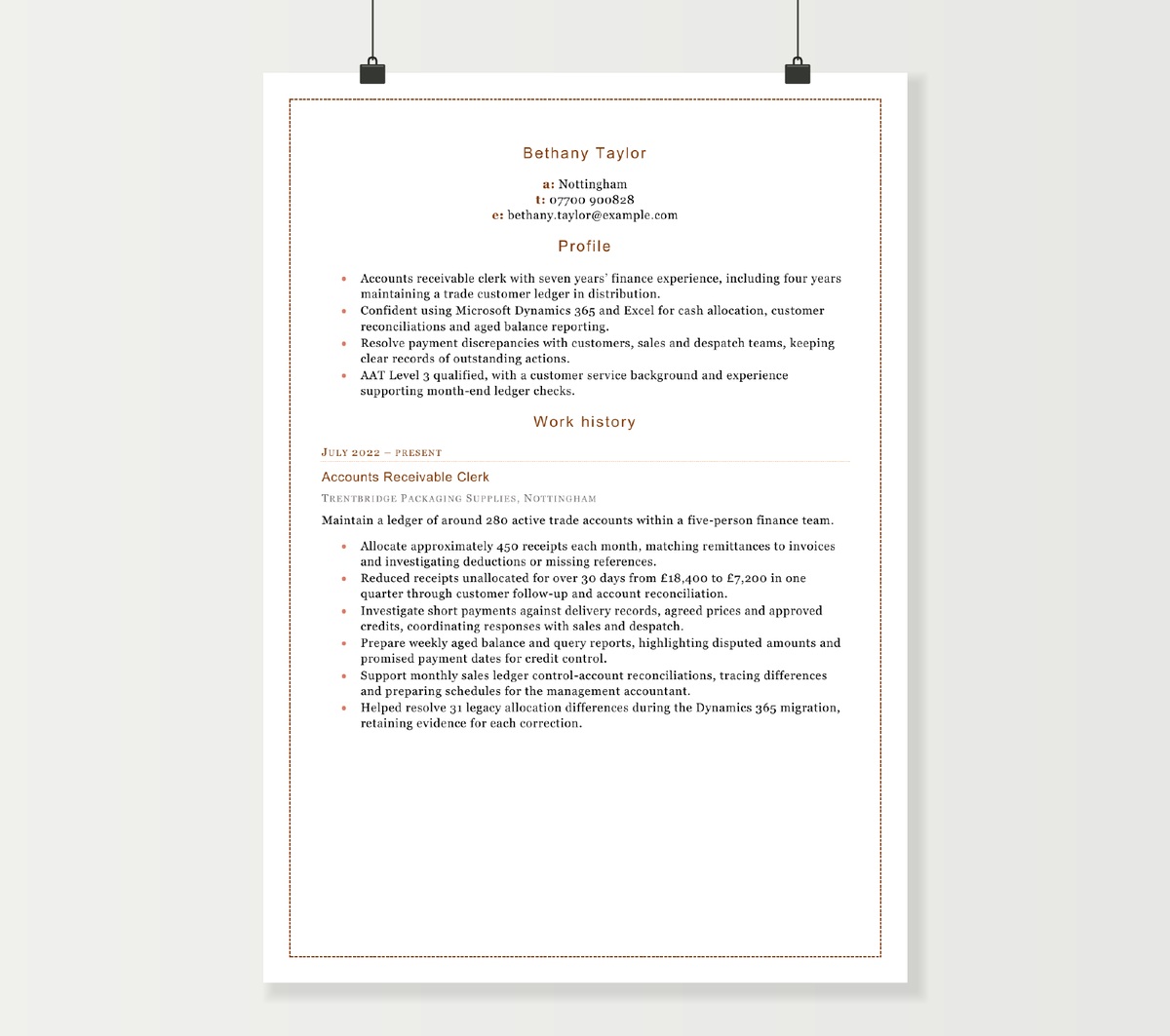
This accounts receivable clerk CV example follows a move from customer service into finance and then a dedicated sales ledger role. The downloadable Word template shows cash allocation, customer account reconciliations and query resolution in context, with a guide to presenting the detail behind an accurate receivables ledger.
Filename: FreeCVDownload_Accounts_Receivable_Clerk.docx
Content of this CV template
Bethany Taylor
a: Nottingham
t: 07700 900828
Profile
- Accounts receivable clerk with seven years’ finance experience, including four years maintaining a trade customer ledger in distribution.
- Confident using Microsoft Dynamics 365 and Excel for cash allocation, customer reconciliations and aged balance reporting.
- Resolve payment discrepancies with customers, sales and despatch teams, keeping clear records of outstanding actions.
- AAT Level 3 qualified, with a customer service background and experience supporting month-end ledger checks.
Work history
July 2022 – present
Accounts Receivable Clerk
Trentbridge Packaging Supplies, Nottingham
Maintain a ledger of around 280 active trade accounts within a five-person finance team.
- Allocate approximately 450 receipts each month, matching remittances to invoices and investigating deductions or missing references.
- Reduced receipts unallocated for over 30 days from £18,400 to £7,200 in one quarter through customer follow-up and account reconciliation.
- Investigate short payments against delivery records, agreed prices and approved credits, coordinating responses with sales and despatch.
- Prepare weekly aged balance and query reports, highlighting disputed amounts and promised payment dates for credit control.
- Support monthly sales ledger control-account reconciliations, tracing differences and preparing schedules for the management accountant.
- Helped resolve 31 legacy allocation differences during the Dynamics 365 migration, retaining evidence for each correction.
May 2019 – June 2022
Finance Assistant
Eastbank Office Products, Nottingham
Supported daily transaction processing for a regional office supplies business.
- Raised sales invoices from confirmed orders and despatch records.
- Posted customer receipts and checked remittance totals against bank entries.
- Reconciled customer statements and requested missing payment references.
- Used Excel lookups to match invoice exports with order records.
- Processed approved credit notes and maintained supporting documents.
- Prepared weekly lists of unmatched receipts for the finance supervisor.
September 2017 – April 2019
Customer Service Assistant
Eastbank Office Products, Nottingham
Handled trade customer enquiries by telephone and email.
- Entered orders and confirmed product availability with the warehouse.
- Checked customer prices against agreed account terms.
- Traced delivery discrepancies using order and courier records.
- Logged returns and obtained approval for replacement goods.
- Provided invoice copies and referred payment queries to accounts.
- Kept customer contact details and enquiry records up to date.
Qualifications and training
AAT Level 3 Advanced Diploma in Accounting, 2021.
Dynamics 365 finance user training, 2022; Excel PivotTables and lookups workshop, 2024.
3 A levels, 2017; 9 GCSEs including English and Mathematics, 2015.
Interests
Swimming, weekend walks and cooking for friends.
How to write an accounts receivable clerk CV
An accounts receivable CV needs to show what happened between an invoice being raised and the customer account being settled. Employers want to understand the ledger you worked on, how you dealt with receipts and discrepancies, and whether colleagues could rely on your records at month-end. The strongest evidence often lies in a payment you traced, a disputed balance you resolved or a reconciliation you brought up to date.
Make the scope of your ledger clear
Start your current role with a short description of the business and your workload. A trade distribution ledger, a property portfolio and project-based agency billing involve different patterns of receipts and queries. Useful context includes the number of active accounts, typical monthly receipt or invoice volume, customer type, currencies and the part of the process you handled.
Choose figures that explain the work. A ledger with 280 active accounts and 450 receipts a month tells the reader more than “worked in a busy finance department”. If a few large customers created complex remittances covering hundreds of invoices, explain that instead. Distinguish your own allocation queue or portfolio from the whole team’s ledger.
Your profile can then identify your level and specialism in three or four lines: receivables experience, the environment, your principal accounting system and one useful strength. For example, experience investigating short payments in distribution is more informative than a string of attributes such as reliable, organised and hardworking.
Show the work behind cash allocation
“Allocated cash” is a starting point. Develop it with the payment information you used and the exceptions you handled. Employers can assess your experience more readily when you mention remittance matching, consolidated payments, missing references, deductions, customer overpayments or receipts sitting on account.
A useful bullet connects volume with judgement: “Allocated around 450 monthly receipts, matching customer remittances to invoices and investigating short payments with the sales team.” For a more complex role, explain how you reconciled a payment covering several accounts or cleared a backlog of unidentified receipts.
Keep the result tied to the work. Reducing unallocated cash means money already received has been matched or otherwise resolved in the ledger. It is a different achievement from collecting additional money. Naming the measure precisely makes the improvement more persuasive and gives you a clear example to discuss at interview.
Specify which reconciliations you prepared
“Responsible for reconciliations” leaves a large part of the story untold. Customer account reconciliations, bank reconciliations, intercompany reconciliations and reconciling the sales ledger to its control account are distinct activities. Name the relevant ones, their frequency and what you did with differences.
For customer accounts, you might describe comparing statements, invoices, credits and receipts, then agreeing the remaining balance with the customer. For month-end, say whether you prepared the reconciliation, investigated reconciling items or supplied schedules to the accountant who completed the review. That detail helps a hiring manager place you accurately within their team.
Use one example of a difficult difference if it adds substance: a receipt posted to the wrong customer, an approved credit missing from the account or a balance carried over during a migration. The useful CV evidence is your investigation and the corrected record, rather than a lengthy explanation of double-entry bookkeeping.
Turn invoice queries into evidence of follow-through
Receivables queries often move between customer finance teams, sales, despatch and billing. Show how you helped reach a resolution. Identify the underlying issue, the evidence you obtained and the next action you coordinated. Delivery records, agreed prices, purchase-order references and approved credit notes are all meaningful details when they relate to your experience.
For example: “Resolved disputed delivery charges by checking despatch evidence with logistics and agreeing corrections with account managers.” A stronger version might add a measured reduction in the old-query queue or the time taken to resolve a recurring type of discrepancy.
If you maintained a query log, explain what it enabled: named owners, follow-up dates, clear disputed amounts or visibility of stalled cases. “Liaised with stakeholders” becomes much more convincing when the CV shows the question you helped answer and the effect on the account.
Present collections and reporting at the right level
Some receivables clerks also chase payments; others support a separate credit control team. Set out your part in the sequence. Sending statements, making collection calls, recording promises to pay, supplying evidence for disputes and escalating overdue balances are all useful responsibilities. The relevant emphasis depends on the vacancy.
Describe reports by their purpose. A weekly aged receivables report might help credit controllers prioritise overdue accounts. An unallocated-cash report might highlight receipts needing customer information. An invoice-query report might identify a recurring pricing problem. Include the analysis or explanation you added if your work went beyond exporting the report.
Where you contributed to a team collection target, give your portfolio or actions alongside the team outcome. A business-wide days sales outstanding figure has more value when the reader also understands the period, customer mix and your contribution. For many clerk-level CVs, a specific resolved backlog is clearer evidence than a headline company cash-flow figure.
Make systems and Excel skills practical
Name the accounting or ERP systems you have used and connect each important one to a task. “Microsoft Dynamics 365 — customer receipt posting, account enquiries and aged balance reporting” is easier to assess than “ERP proficient”. SAP, Oracle, Sage or another package can be presented in the same way, with the actual scope of your work.
For Excel, select the functions and features that support your receivables experience. Lookups used to match invoice references, PivotTables used to analyse overdue balances and filters used to identify unmatched receipts give useful evidence. Power Query merits a place where you used it to combine or clean regular bank, ledger or customer exports. A short work example is more informative than an unsupported advanced/intermediate rating.
System change experience can distinguish an application. State whether you checked migrated opening balances, tested a cash-allocation process, logged defects, helped colleagues with a new workflow or documented procedures. Explain the contribution and scale: “Checked 120 customer balances against the legacy ledger and logged differences for resolution before go-live.”
Give month-end and control work enough detail
Receivables vacancies can include credit notes, refunds, master-data maintenance, cut-off checks and audit support. Select the duties that demonstrate your understanding of how transactions reach the accounts. Examples include checking that credits had approval, retaining evidence for adjustments, reviewing invoices around month-end or preparing debtor schedules by the agreed deadline.
Describe the boundary of your responsibility naturally. “Prepared refund documentation for approval” and “processed approved refunds” communicate different experience. Similarly, supporting revenue cut-off is clearer when you state that you checked despatch dates or supplied an unbilled-item schedule. This gives employers a useful picture of the training and supervision you would need.
Sector details belong here where they affect the role. Client billing portals and purchase-order limits matter in some service businesses; delivery evidence and deductions may dominate a distribution ledger. Give space to the processes used by the employer you are approaching.
Choose results that make sense for receivables
Good measures include the value or number of receipts cleared from an allocation backlog, aged queries resolved, reconciliation differences reduced, invoice rejections prevented or month-end schedules completed sooner. Pair each result with a period and an action so the reader can judge its significance.
The example CV uses “receipts unallocated for over 30 days” and gives the starting and finishing amounts over one quarter. That wording defines the queue being improved. Other useful evidence could be a reduction from 42 to 16 unresolved customer queries over eight weeks, or a regular statement run brought back onto its weekly schedule after a backlog.
Volume is also useful even when no before-and-after figure exists. Handling a complex national-account remittance every week, keeping reconciliations current or providing dependable cover at month-end can demonstrate value through scope, timeliness and the kind of problem you handled.
Build an application from adjacent experience
If you are moving from customer service or administration, bring forward the work closest to receivables: tracing payments, checking invoices, resolving order discrepancies, maintaining account records and communicating with customers about balances. Explain the records you compared and how you followed a query through. Those are more relevant than a long description of general office duties.
A broader accounts assistant CV can help you organise mixed purchase ledger, sales ledger and bank work. For a dedicated receivables application, move the customer ledger evidence ahead of less relevant tasks. If your strongest experience is producing invoices, the billing administrator example shows how to explain invoice preparation and checks; add your own receipt, reconciliation and account-query experience to establish the receivables fit.
List completed accounting qualifications with their level, awarding body and date. For current study, give the qualification and progress clearly, such as the level being studied and expected completion date. AAT study, a finance degree or relevant accounting modules can strengthen an early-career application. Experienced applicants should lead with their ledger work, then use qualifications and recent systems training to support it.
Accounts Receivable Clerk CV FAQs
Yes. Sales ledger and accounts receivable titles often cover closely related work. Keep your actual title in the employment history and use the profile or role description to identify your accounts receivable responsibilities. Where a title is unusual, a short clarification such as “Finance Administrator — sales ledger team” helps the reader connect it with the vacancy.
Use the agency as the main heading where it makes the timeline easier to follow, then give the client assignments and dates beneath it. Explain the purpose of each assignment: absence cover, a cash-allocation backlog, year-end support or a system migration. One useful achievement or scope statement per assignment will show how quickly you became effective without repeating the same duties several times.
Yes, if it formed a useful part of your receivables work. Name the currencies or markets and the transactions you handled, such as allocating euro receipts, checking bank charges or investigating differences on customer accounts. That describes relevant operational experience without suggesting that your role included treasury decisions or setting exchange-rate policy.
Name your own system and show the relevant workflows: customer account enquiries, posting receipts, raising credits, reconciliations and reporting. Add a concise example of learning a new system if you have one. If SAP is listed as desirable, this gives the employer a practical basis for assessing transferability; if it is essential, address any relevant training or exposure clearly in the application.
Use the customer type, portfolio size and nature of the issue rather than customer names or account-level details. For example, you can describe reconciling multi-site trade accounts or resolving historic deductions for a national customer. Aggregated workload or backlog figures can explain the scale while keeping the focus on your contribution.