This billing administrator CV template shows a progression from customer service through finance administration into a dedicated billing role. The Word example covers recurring and ad hoc invoices, rate checks, customer queries and month-end work. Use the accompanying guide to present your billing experience, systems knowledge and contribution to an accurate, timely invoicing process.
Filename: FreeCVDownload_Billing_Administrator.docx
Content of this CV template
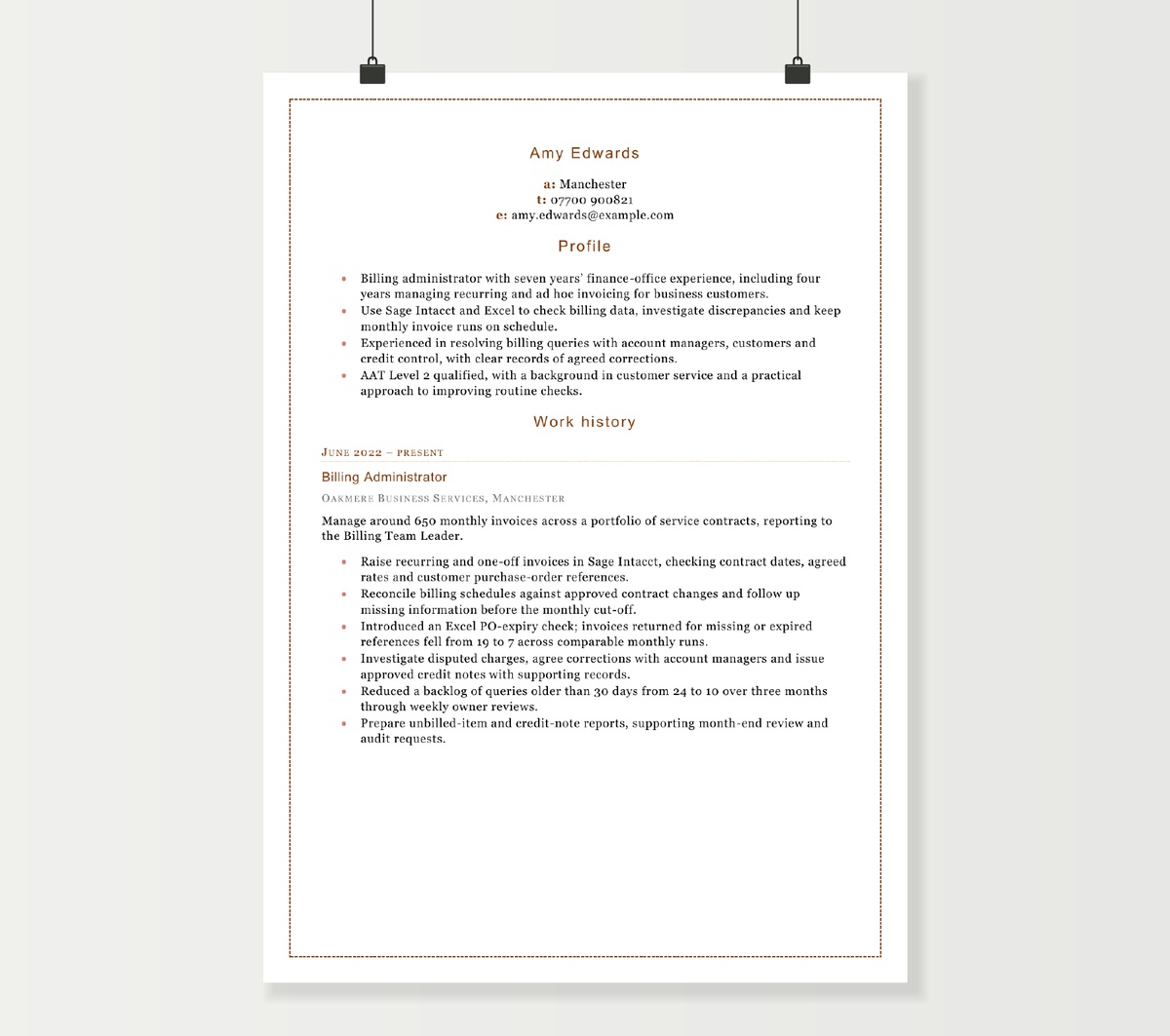
Amy Edwards
a: Manchester
t: 07700 900821
Profile
- Billing administrator with seven years’ finance-office experience, including four years managing recurring and ad hoc invoicing for business customers.
- Use Sage Intacct and Excel to check billing data, investigate discrepancies and keep monthly invoice runs on schedule.
- Experienced in resolving billing queries with account managers, customers and credit control, with clear records of agreed corrections.
- AAT Level 2 qualified, with a background in customer service and a practical approach to improving routine checks.
Work history
June 2022 – present
Billing Administrator
Oakmere Business Services, Manchester
Manage around 650 monthly invoices across a portfolio of service contracts, reporting to the Billing Team Leader.
- Raise recurring and one-off invoices in Sage Intacct, checking contract dates, agreed rates and customer purchase-order references.
- Reconcile billing schedules against approved contract changes and follow up missing information before the monthly cut-off.
- Introduced an Excel PO-expiry check; invoices returned for missing or expired references fell from 19 to 7 across comparable monthly runs.
- Investigate disputed charges, agree corrections with account managers and issue approved credit notes with supporting records.
- Reduced a backlog of queries older than 30 days from 24 to 10 over three months through weekly owner reviews.
- Prepare unbilled-item and credit-note reports, supporting month-end review and audit requests.
April 2019 – May 2022
Finance Administrator
Pennine Workplace Supplies, Salford
Supported a four-person accounts team serving trade customers.
- Created sales invoices from despatch records and checked delivery charges.
- Set up customer accounts using approved details and payment terms.
- Matched remittance advice to receipts and investigated allocation differences.
- Used Excel lookups to compare order references with invoice exports.
- Supplied invoice copies and delivery evidence to credit control.
- Helped clear 36 unmatched receipts during a quarterly ledger review.
September 2016 – March 2019
Customer Service Administrator
Pennine Workplace Supplies, Salford
Handled telephone and email enquiries for the trade sales office.
- Entered customer orders and checked prices against current quotations.
- Confirmed delivery details with warehouse and transport colleagues.
- Investigated missing items using order and despatch records.
- Logged returns and passed agreed adjustments to accounts.
- Maintained contact details and records of customer discussions.
- Prepared weekly summaries of unresolved order queries.
Qualifications and training
AAT Level 2 Foundation Certificate in Accounting, 2020.
Sage Intacct billing training, 2022; Excel PivotTables and lookups workshop, 2024.
3 A levels, 2016; 9 GCSEs including English and Mathematics, 2014.
Interests
Badminton, live music and trying new baking recipes.
How to write a billing administrator CV
A billing administrator CV needs to show what happens between a service being delivered and an accurate invoice reaching the customer. Employers want to see that you can gather the right information, meet billing deadlines, investigate discrepancies and keep a clear record of changes. Your experience becomes more convincing when you explain the checks and decisions behind the invoices you produce.
Start with the billing environment you know. Recurring service contracts, legal fees, patient charges and operational tickets create different kinds of work. Identify the closest match to the vacancy and give that experience the most space. A short profile can bring together your sector, level of responsibility and strongest systems or query-resolution experience.
Describe the billing workload you handle
Give each recent role a brief scope statement before the detailed bullets. Useful context includes the number of invoices you handle, the billing frequency, the type of customer and the team you work within. A monthly portfolio of recurring contracts is different from a daily queue of individually prepared invoices, even when the invoice count is similar.
Explain your part in the process: preparing drafts, checking inputs, producing invoices, submitting them through customer portals or managing the full cycle for assigned accounts. If someone else approves adjustments or releases the final run, your wording can make that workflow clear. This helps the reader understand the responsibility you are ready to take on.
The example CV opens its current role with a portfolio of around 650 monthly invoices. The following bullets then establish the work involved: contract dates, rates, purchase-order references, disputed charges and month-end reporting. That combination is more informative than a volume figure on its own.
Show how you get invoices right
“Accurate invoicing” becomes useful evidence when you name what you check. Depending on your role, this might be:
- Agreed rates, discounts and effective dates against the contract or approved change.
- Service records, completed jobs or delivery information against the proposed charge.
- Customer details, billing addresses and purchase-order references.
- The billing period, start or end dates and any agreed part-period adjustment.
- Required supporting documents before an invoice is released or submitted.
Select the checks central to your work, then connect them to a result or a reason they mattered. For example, identifying expiring purchase orders before the monthly run can reduce returned invoices. Resolving a mismatch between a service record and a contract can allow an outstanding item to be billed correctly.
Master-data work also deserves a place. Maintaining customer or matter records, updating approved rates and checking account changes can prevent repeat problems across many invoices. State the information you maintained and how you checked the update, particularly if this was a substantial part of your job.
Make billing deadlines and month-end work concrete
Employers need to know how you manage a timetable when information arrives from several teams. Describe the cut-offs you worked to, the outstanding items you monitored and how you obtained missing approvals or documents. A bullet about following up contract changes with account managers before the run shows both organisation and an understanding of the dependencies.
For month-end, name your actual contribution. You might prepare unbilled-item reports, reconcile a billing schedule to invoices raised, review credit notes or provide supporting documents for the finance team. If your role includes journals or accrual schedules, explain those separately so the extent of your accounting work is visible.
Where you helped recover a delayed run or clear a backlog, describe the starting position, your action and the outcome. The strongest examples show how you restored an orderly process while keeping the necessary checks in place.
Use queries and corrections to demonstrate judgement
A disputed invoice is a useful way to show investigative and communication skills together. Describe the kind of query, the records you compared and the colleagues you involved. Examples might concern a rate change, duplicate charge, service date, missing purchase order or a bill sent to the wrong entity.
Make the resolution visible. You may have explained a valid charge, obtained a missing document, arranged an approved credit and rebill, or corrected the source record so the issue did not recur. This gives substance to claims about customer service and problem-solving.
For credit notes, reversals and write-offs, identify what you processed and how approval and supporting evidence were recorded. In legal billing, adjustments to time, disbursements or matter budgets may be especially relevant. A short example of handling these accurately can carry more weight than a long list of finance terminology.
Present systems through the tasks you perform
Name the billing or finance system and the functions you use. “Sage Intacct: recurring invoices, credit notes and account enquiries” is much clearer than “Sage”. For a practice-management system, mention the relevant client, matter, rate or billing work. If you use a separate service desk or customer portal, explain its place in handling requests or submitting invoices.
Excel skills should be equally specific. Useful examples include comparing invoice exports with contract schedules using lookups, summarising aged queries with PivotTables, identifying duplicate references or checking totals across a billing file. Describe a real task in your employment section and keep the skills summary brief.
If you helped test a new system or migration, state what you checked: customer records, rates, invoice outputs, credit-note handling or reconciliation totals. Explain how you recorded and followed up differences. This shows practical systems experience without requiring a technical implementation role.
Adapt the evidence to the billing sector
For legal or professional-services billing, highlight client and matter setup, fee-earner liaison, agreed rates, time and disbursement adjustments, bill reversals and e-billing requirements where these form part of your experience. Knowledge of the firm’s billing workflow is often as important as the software name.
For healthcare billing, relevant detail may include self-pay and insurer accounts, fee schedules, service records, remittances and communication with patients or clinical administrators. Show how you handled sensitive records and resolved enquiries professionally. Use the terminology of the UK vacancy you are applying for.
For service, utilities or operational billing, bring out the connection between source data and charges. This could involve contracts, usage data, job records, tickets, service changes or site information. An example of tracing and correcting an input problem helps the reader understand your value beyond entering figures.
You can move between sectors by making the shared process easy to recognise. Keep the useful detail about your previous environment, then emphasise transferable work such as rate checks, deadlines, account setup, query investigation and clear records.
Choose measures that explain your contribution
Billing achievements often concern fewer corrections, shorter queues or more timely completion. Useful measures include returned invoices, unresolved queries, unbilled items, processing time and completion against the billing timetable. Include the period and enough context for the comparison to make sense.
In the example, invoices returned for missing or expired purchase-order references fall from 19 to 7 across comparable monthly runs. The CV identifies the check that helped achieve this. Its separate aged-query result shows the effect of regular reviews with the colleagues responsible for each answer.
Keep invoice value, revenue and cash collection distinct when describing results. “Processed £250,000 of monthly invoices” establishes workload; “resolved queries on £18,000 of disputed invoices” describes a contribution to removing a payment obstacle. If the resulting cash was subsequently collected, that can be stated with the relevant team context. These details help an employer understand the result precisely.
Build a convincing route into billing
For a first billing role, look for evidence of checking numerical information, maintaining records, working to deadlines and resolving customer enquiries. Sales administration can supply examples involving quotations, order details, delivery charges and returns. Customer service may show how you investigated a disputed transaction or kept track of an unresolved request.
Finance study or training can sit near the top when it is your strongest relevant evidence. Give the full qualification title, level and completion date, or your current study stage. Add practical spreadsheet or bookkeeping work from the course if it helps demonstrate what you can do. AAT study is useful context for some applicants; many billing roles also provide a route through office experience and workplace training.
As experience grows, give more space to billing ownership, difficult queries, improvements and support for colleagues. Keep earlier customer-service roles concise while retaining the parts that explain your progression. If your target vacancy covers a wider finance remit, the accounts assistant CV example can help you decide how to balance billing with other accounts duties. For an administration-led entry route, see the sales administrator example.
Billing Administrator CV FAQs
Yes. Matching documents, investigating discrepancies, maintaining account records and working to finance deadlines all transfer well. Make the change of perspective clear: purchase ledger concerns supplier invoices, while billing usually concerns charges to customers. In your profile, connect the checking and query work you already do to the sales-billing role you want. Any experience with customer accounts, sales invoices or cross-team cover is worth bringing forward.
Keep the job title and add a short scope line explaining the billing focus. For example, describe responsibility for the monthly invoice run or an assigned group of customer accounts. Lead the bullets with that work, followed by other finance duties. Your profile can also describe your billing experience, allowing an employer to recognise the match without needing your previous title to be identical.
Explain the activity and platform. Uploading invoices to a customer procurement portal, checking submission status and resolving rejection messages is useful experience. In legal services, e-billing may also involve client-specific formats, coding and billing rules. State the stages you handled, such as preparing files, submitting bills or correcting rejected items, so the reader can distinguish these from emailing PDF invoices.
Some roles welcome broader billing experience; others ask for knowledge of legal finance systems and matter-based billing. For a vacancy open to a sector move, emphasise rate maintenance, adjustments, customer queries, approval records and confidential data. Experience supporting professional clients or several internal stakeholders can also help. Use the advert's essential requirements to decide whether your background is a close match or whether an entry-level legal finance role offers a better route.
Give the employer or agency, assignment dates and a brief description of each billing environment. Highlight the purpose of the assignment, such as covering leave, clearing an invoice backlog or supporting a system change. Similar short placements can sit under one agency heading with distinct dated entries. The useful evidence is how quickly you learned the workflow and what you completed before the assignment ended.