This sales administrator CV template follows a candidate who progressed from office support into sales administration for trade suppliers. The Word example covers quotations, order processing, customer updates and coordination with warehouse and finance colleagues. The guide explains how to present this experience for goods-based and service businesses, including roles with a stronger commercial focus.
Filename: FreeCVDownload_Sales_Administrator.docx
Content of this CV template
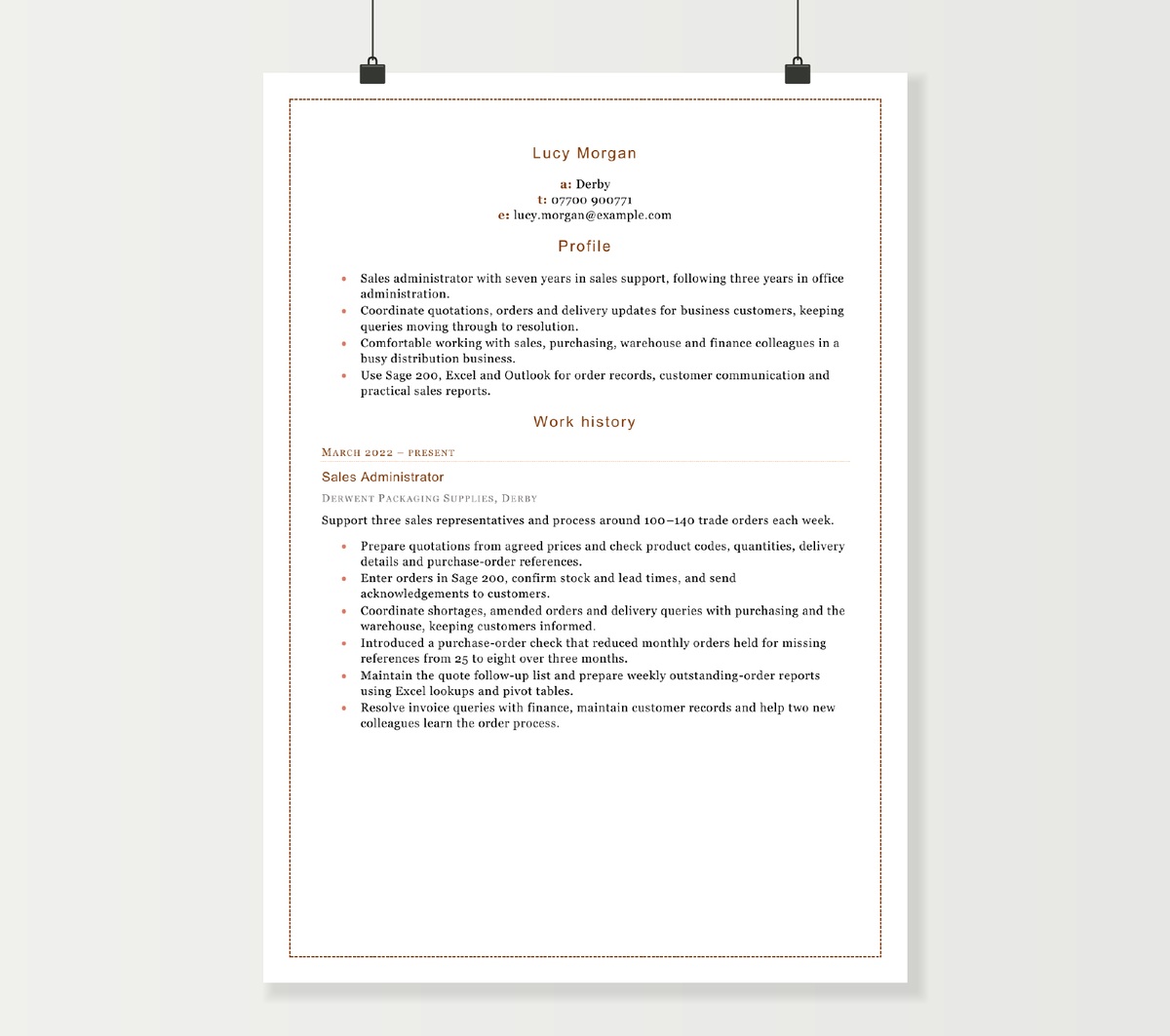
Lucy Morgan
a: Derby
t: 07700 900771
Profile
- Sales administrator with seven years in sales support, following three years in office administration.
- Coordinate quotations, orders and delivery updates for business customers, keeping queries moving through to resolution.
- Comfortable working with sales, purchasing, warehouse and finance colleagues in a busy distribution business.
- Use Sage 200, Excel and Outlook for order records, customer communication and practical sales reports.
Work history
March 2022 – present
Sales Administrator
Derwent Packaging Supplies, Derby
Support three sales representatives and process around 100–140 trade orders each week.
- Prepare quotations from agreed prices and check product codes, quantities, delivery details and purchase-order references.
- Enter orders in Sage 200, confirm stock and lead times, and send acknowledgements to customers.
- Coordinate shortages, amended orders and delivery queries with purchasing and the warehouse, keeping customers informed.
- Introduced a purchase-order check that reduced monthly orders held for missing references from 25 to eight over three months.
- Maintain the quote follow-up list and prepare weekly outstanding-order reports using Excel lookups and pivot tables.
- Resolve invoice queries with finance, maintain customer records and help two new colleagues learn the order process.
September 2019 – February 2022
Sales Support Assistant
Amber Office Products, Derby
Supported a small sales office serving local business customers.
- Processed telephone and email orders and issued confirmations.
- Prepared repeat-order quotations using agreed customer prices.
- Checked delivery progress with warehouse staff and couriers.
- Logged returns and gathered paperwork for credit-note requests.
- Cut overdue returns files from 18 to five in six weeks by chasing missing paperwork.
- Prepared weekly outstanding-quote lists for the sales manager.
August 2016 – August 2019
Office Assistant
Amber Office Products, Derby
Joined after college and developed into a customer-facing support role.
- Answered calls and directed product enquiries to sales colleagues.
- Updated customer addresses and contact information.
- Filed delivery notes and retrieved records for customer queries.
- Prepared product information packs for sales appointments.
- Helped maintain the shared enquiry inbox during busy periods.
- Learned order entry and provided cover before promotion.
Qualifications and training
3 A levels: Business Studies, English Language and Geography | 2016
Excel reporting and Sage 200 order processing — workplace training | 2024
9 GCSEs, including Maths and English at grade B | Derby | 2014
Interests
I enjoy walking, baking and going to the cinema.
How to write your CV
A sales administrator CV should show how you keep customer requests, records and orders moving. Employers need someone who can pick up an enquiry, establish what is needed, produce accurate information and follow through with the people who can fulfil it. Your experience is strongest when the reader can see that process in action.
Start with the kind of sales operation you have supported. A trade supplier, a service business, a publisher and a homebuilder all employ sales administrators, but their paperwork and deadlines differ. Give the CV enough context to show where your experience will be immediately useful.
Make your place in the sales process clear
Your profile can identify the customers, the main work you handle and the systems you use. For example, experience supporting trade customers through quotations, orders and delivery queries tells the reader considerably more than “experienced administrator with excellent communication skills”.
Under each employer, add a short description of the sales environment. Useful details include business or consumer customers, goods or services, repeat accounts, the number of sales colleagues supported and your usual order volume. The example CV uses weekly order volume to establish the workload, alongside the three sales representatives Lucy supports.
Explain the extent of your involvement. Some administrators prepare quotations and pass confirmed orders to another team. Others stay involved through dispatch, invoicing, returns and aftercare. A clear account of the stages you handle helps an employer assess how your experience fits its own operation.
Job titles vary considerably. Sales Support Assistant, Sales Coordinator and Sales Order Processor may cover closely related work. Keep the employment title and use the description underneath to make the relevant responsibilities visible.
Turn order processing into useful evidence
“Processed orders” is a sound starting point, but it leaves out most of the skill involved. Show where orders arrive, what you check, which system you use and how you confirm that the next team has the information it needs.
For a distributor, this could include product codes, quantities, agreed prices, delivery addresses, customer purchase-order references and stock availability. For a service provider, it might mean the location, agreed scope, booking requirements and the information needed to prepare a quotation. Select the details that matter in your own setting.
The best experience points often connect a routine task with a practical reason. Checking a purchase-order reference may prevent an order being held. Confirming a lead time may let a customer agree a different delivery date. Updating an amendment accurately may help the warehouse dispatch the correct item.
If you handled a large volume, give a typical daily or weekly range and identify whether it describes your own workload or the wider team. Add complexity where it matters: multi-line orders, customer-specific pricing, timed deliveries or several enquiries progressing at once. Volume alone does not explain the work.
Show how you prepare and progress quotations
Quotation work can involve gathering requirements, selecting the right price list, checking stock or service availability, obtaining technical input and sending a complete response. Describe the steps you personally handle, particularly where the role calls for numerical confidence or product knowledge.
Make the pricing context clear. You may quote from agreed customer terms, use a standard schedule, obtain a manager’s approval for an exception or coordinate a bespoke proposal with a sales colleague. That tells the reader more about your level of responsibility than “managed pricing”.
Follow-up is also useful evidence. Explain how you maintained outstanding-quote lists, recorded customer responses, flagged questions needing a salesperson’s attention or kept the next action visible. In a more commercial role, include how this work helped progress enquiries into orders.
Where you contributed to bids or tender submissions, focus on the administrative contribution: collecting supporting documents, keeping versions organised, monitoring deadlines or coordinating input. The reader should be able to see the part you played within the larger sales effort.
Give customer service a sales-office setting
Sales administrators often become the person customers contact when they need a clear answer. Choose examples that show how you obtained that answer and kept the customer informed, especially when the original plan changed.
Useful situations include a shortage, a delayed delivery, an order amendment, a return or a disputed invoice. Explain your action and the outcome: checked the warehouse position, agreed the next update, obtained missing paperwork, coordinated a replacement or helped finance resolve the charge.
For instance, a line about “liaising with departments” becomes more useful when it says which departments and why. Working with purchasing to establish a revised lead time and updating the customer before the expected delivery shows both coordination and service judgement.
Telephone and email experience can appear together, with any relevant use of a shared inbox or customer portal. Where you supported repeat customers, mention the continuity involved: recognising their ordering patterns, keeping their account instructions current or making sure colleagues could pick up an enquiry during your absence.
Describe systems through the work you carry out
Name the order-processing, ERP or CRM systems you have used, then explain the functions relevant to the vacancy. An ERP entry might cover sales orders, stock checks and account records. A CRM entry might cover contacts, enquiries, quotation status and follow-up activity.
In the example, Sage 200 supports the order and customer records, while Excel is used for outstanding-order and quotation reporting. This is a realistic division of work. Your employer may use a different arrangement, so describe the tasks and the system names together.
For Excel, identify a useful output and the features behind it. Filters, lookups, pivot tables or conditional formatting might help you compare order lists, identify missing information or prepare a weekly report. A short, concrete description is easier to assess than an unexplained “advanced Excel” rating.
Include Word, Outlook, Google Workspace or specialist platforms when they have a clear role in the work. Shared inbox organisation, document templates and customer meeting materials can all be relevant. Give the most space to the tools that the employer will expect you to use regularly.
Demonstrate accuracy and priorities through examples
Accuracy in sales administration is about complete, usable information. Show the checks you applied and what they helped the business achieve. The example’s purchase-order check reduces the number of orders held for missing references; it gives “attention to detail” a specific business meaning.
Other examples might include resolving inconsistent customer records, matching an order amendment to its original quotation, checking an invoice query against delivery paperwork or making a handover list easier for colleagues to use. Choose work where your contribution is clear.
Prioritisation also deserves context. An order close to the dispatch cut-off, a quotation promised that afternoon and an unresolved delivery query may all need attention. Your CV can show how you kept time-sensitive work visible, coordinated cover or followed up the item preventing progress.
A short description of an improvement can be valuable even without a percentage. A shared query list, clearer order notes or a regular check of outstanding items may demonstrate initiative if you explain the problem it solved. Keep the emphasis on the result for customers and colleagues.
Choose achievements that fit an administrative role
Strong results do not have to be revenue figures. Consider fewer orders held for missing details, a smaller backlog of unresolved returns, quicker preparation of a recurring report, improved handovers or colleagues successfully trained in an unfamiliar process.
For a numerical result, include a period and a clear unit. “Reduced overdue return files from 18 to five in six weeks” tells the reader what changed. An accuracy rate is useful when it comes from a defined check or report; the accompanying description should make the basis understandable.
Commercial results belong where selling formed part of your job. If you followed up quotations, reactivated customers or worked towards a personal target, show that contribution with the relevant scope and period. If your main role was administration, show how your work supported the sales team and customer experience.
Team outcomes can be presented through your own action. You might have prepared the order data used to resolve a backlog, maintained the contact list for a campaign or supplied the paperwork that allowed a sale to progress. This gives the reader a useful account of your contribution within a shared result.
Adapt the evidence to the employer’s sector
For wholesale, manufacturing and distribution roles, order accuracy, stock availability, delivery coordination and product information often deserve prominence. Show how you worked with purchasing, production, warehouse or transport colleagues where those relationships were part of the job.
For a service business, quotation scope, repeat bookings, appointment information and coordination with the delivery team may be the closer match. For property sales, the administrative milestones may run from enquiry and viewings through records, paperwork and completion. Publishing roles may give more weight to retailer submissions, meeting materials, promotions and account deadlines.
Use the vacancy to choose the most relevant evidence rather than trying to cover every sector. Existing product or market knowledge can help, but the transferable value often lies in following a request through several stages and keeping information accurate as it changes.
Build a convincing first sales administration CV
Office, retail, reception and customer-service work can provide a strong starting point. Look for experience recording requests, checking details, arranging appointments, using order or booking systems, handling queries and following up with another team.
Translate that experience into the sales-office tasks the employer needs. Processing customer collections in retail may show that you can check an order and coordinate availability. Reception work may show accurate records, telephone confidence and careful handovers. An office role may provide evidence of document preparation, spreadsheet updates and shared-inbox management.
List relevant qualifications clearly, including Maths and English where requested. Office software training, an administration apprenticeship or business-related study can support the application, but practical examples should also show how you organise work and communicate. For an experienced applicant, recent order and customer responsibilities generally deserve more space than school subjects.
If your experience is mainly general office support, the administrator CV example offers another useful emphasis. If the vacancy centres on prospecting, negotiation and winning new business, the sales executive example is a closer guide to presenting those responsibilities.
Let progression show through increasing responsibility
Progression in a sales office may mean handling more complex orders, becoming the contact for particular accounts, preparing reports, training colleagues or taking ownership of unresolved queries. These changes are worth showing even when the job title stayed the same.
Give the current role the most useful detail, then use earlier roles to explain how you built the skills behind it. A reader should finish the CV understanding both the routine work you can take on and the situations in which your judgement and follow-through make a difference.
CV FAQs
Yes, where the employer is open to transferable experience. State the system you used and the tasks you performed, such as entering orders, checking stock, maintaining contacts or recording quotation follow-up. This gives the employer a practical basis for judging the training you would need. If the advert names a particular system as essential, use your closest relevant experience to address that requirement directly.
The title covers different jobs. Some roles concentrate on orders, records and customer service; others include outbound calls, quotation conversion and account growth. Read the responsibilities for the balance between these activities. On the CV, give sales results prominence when they were part of your role, and use service, accuracy or workflow results where those were the main measures of your work.
They usually describe different responsibilities. A sales administrator supports the sales process and may use Salesforce to manage customer or opportunity records. A Salesforce administrator role usually focuses on configuring and maintaining the platform for its users. If you used Salesforce in a sales office, describe the records, reports and processes you worked with so the scope is clear.
Label them as temporary or fixed-term and give clear dates. Similar assignments through one agency can sit under an agency heading with the businesses or sectors and main duties underneath. Give more detail to assignments that introduced a new system, involved a substantial workload or led to greater responsibility. A concise note such as maternity cover or seasonal order support explains the purpose of the assignment.
Often, yes. Quotations, accurate customer records, agreed dates, amendments and follow-up are useful in both settings. Show how you managed a request through to completion and worked with the team delivering the service. Add any experience checking availability, handling payments or resolving invoice queries. This helps the employer see the relevant foundation while assessing the product and stock knowledge you would need to learn.