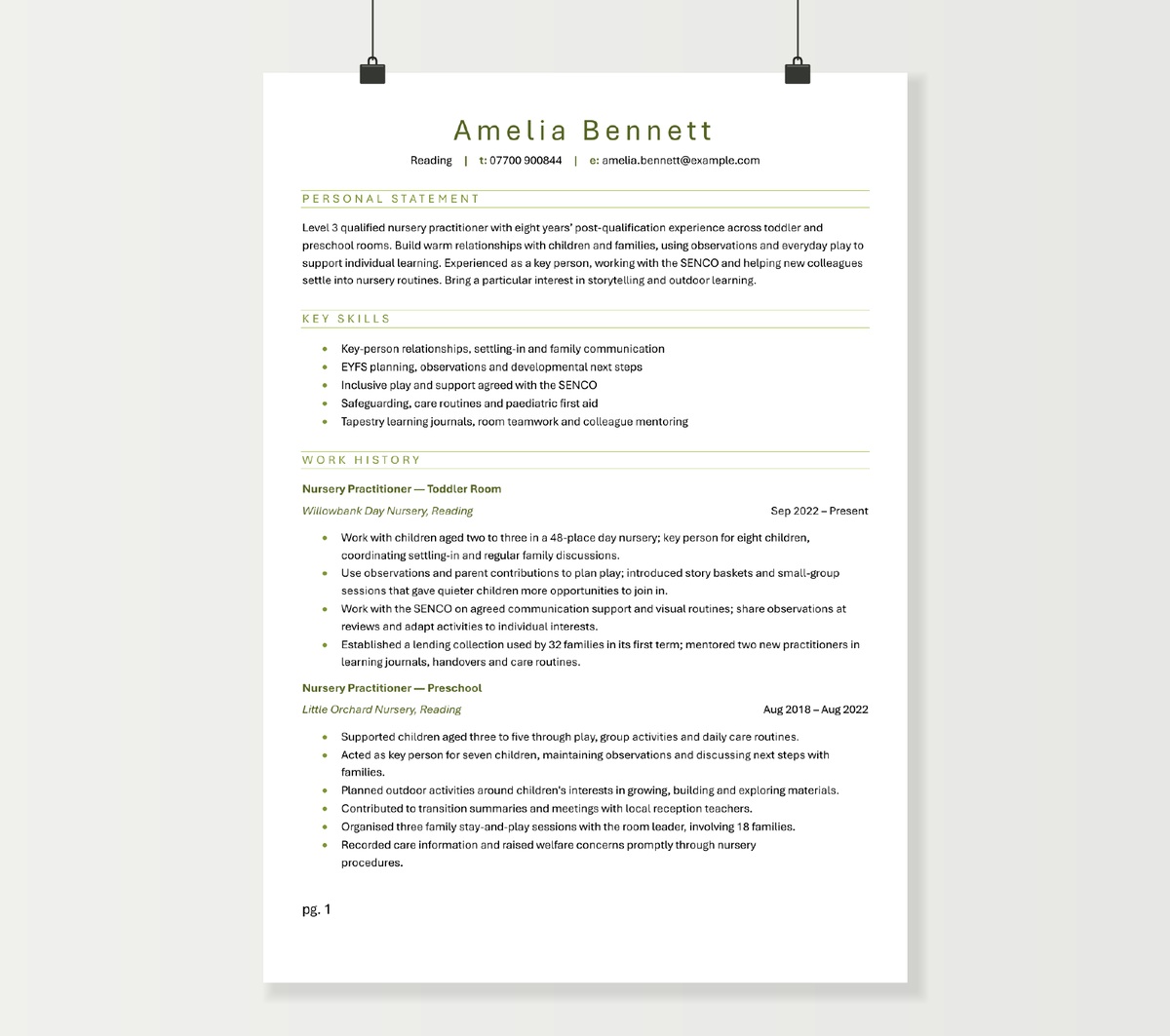
This nursery practitioner CV template follows an early years educator from apprenticeship into an experienced key-person role. The Word example brings together toddler and preschool experience, learning through play, family communication and contributions to the nursery team. The guide explains how to present practical childcare experience and qualifications for nursery applications.
Filename: FreeCVDownload_Nursery_Practitioner.docx
Content of this CV template
Amelia Bennett
Reading | t: 07700 900844 | e: [email protected]
Personal statement
Level 3 qualified nursery practitioner with eight years’ post-qualification experience across toddler and preschool rooms. Build warm relationships with children and families, using observations and everyday play to support individual learning. Experienced as a key person, working with the SENCO and helping new colleagues settle into nursery routines. Bring a particular interest in storytelling and outdoor learning.
Key skills
- Key-person relationships, settling-in and family communication
- EYFS planning, observations and developmental next steps
- Inclusive play and support agreed with the SENCO
- Safeguarding, care routines and paediatric first aid
- Tapestry learning journals, room teamwork and colleague mentoring
Work history
Nursery Practitioner — Toddler Room
Willowbank Day Nursery, Reading
Sep 2022 – Present
- Work with children aged two to three in a 48-place day nursery; key person for eight children, coordinating settling-in and regular family discussions.
- Use observations and parent contributions to plan play; introduced story baskets and small-group sessions that gave quieter children more opportunities to join in.
- Work with the SENCO on agreed communication support and visual routines; share observations at reviews and adapt activities to individual interests.
- Established a lending collection used by 32 families in its first term; mentored two new practitioners in learning journals, handovers and care routines.
Nursery Practitioner — Preschool
Little Orchard Nursery, Reading
Aug 2018 – Aug 2022
- Supported children aged three to five through play, group activities and daily care routines.
- Acted as key person for seven children, maintaining observations and discussing next steps with families.
- Planned outdoor activities around children's interests in growing, building and exploring materials.
- Contributed to transition summaries and meetings with local reception teachers.
- Organised three family stay-and-play sessions with the room leader, involving 18 families.
- Recorded care information and raised welfare concerns promptly through nursery procedures.
Apprentice Nursery Practitioner
Little Orchard Nursery, Reading
Sep 2016 – Jul 2018
- Rotated through toddler and preschool rooms while completing Level 3 training.
- Prepared play resources and supported mealtimes, personal care and tidy-up routines.
- Completed observations with a mentor and learned to contribute to activity planning.
- Built relationships with families through supervised daily handovers.
Qualifications
Level 3 Diploma for the Early Years Workforce
NCFE CACHE
2016 – 2018
- Early Years Educator pathway; course started September 2016, awarded July 2018.
- Eight GCSEs including English Language and Mathematics, 2016.
- Paediatric First Aid, 12-hour course, renewed March 2026.
Recent development
Nursery and local early years training
2025 – 2026
- Safeguarding refresher (2026); supporting speech and language (2025); food hygiene and allergy awareness (2025).
Hobbies and interests
- Reading: Contemporary fiction and a monthly book group.
- Outdoors: Walking and growing vegetables on an allotment.
- Creative: Pottery classes and sketching.
Additional information
Experienced in year-round nursery provision and rotating opening and closing shifts.
How to write a nursery practitioner CV
A nursery practitioner CV should show how you help children feel secure, take part in play and develop through everyday experiences. Qualifications establish an important part of your suitability, but your examples should also reveal the practitioner you are: how you get to know a child, work with their family and contribute to a room team.
Age-group experience makes a substantial difference. A baby-room vacancy may place particular weight on care routines and settling-in, while a preschool role may need stronger evidence of communication, independence and transitions to school. Build the opening profile around the age range and responsibilities most relevant to the position.
Make your qualification easy to understand
Give the qualification’s full title, level, awarding organisation and completion date. Include the course start date where it helps establish the qualification’s status. “Level 3 childcare” can be too broad for an employer assessing a practitioner’s suitability for a qualified post.
In England, the Department for Education’s early years qualification checker helps practitioners and managers check whether a UK qualification is full and relevant for staff:child ratios and whether additional requirements apply. Have the exact award details ready so the CV and application form use consistent wording.
Put an essential early years award in the profile as well as the qualification section. A newly qualified applicant can place qualifications and placements near the top; an established practitioner can give more space to recent employment. Include English and mathematics qualifications where requested, and distinguish completed awards from current study with an expected completion date.
EYFS references in this example concern England. For applications elsewhere in the UK, use the framework, qualification terminology and registration information relevant to that setting. The practical evidence of relationships, care and children’s learning remains valuable, but the professional context should match the vacancy.
Describe your room and key-person responsibility
Introduce each nursery job with the type of provision and ages you worked with. A setting’s overall size can establish context, but your own room and responsibilities are usually more useful than the nursery’s full marketing description.
Explain key-person work through the relationship it involves: settling-in conversations, learning about home routines, observations, regular family discussions and transitions between rooms. You can state the number of key children as part of your workload. Keep that separate from how many children you cared for at a particular time so the reader can understand the arrangement clearly.
For baby-room work, relevant evidence might include responsive care, communication around feeding and sleep, and helping families through the start of nursery. For toddlers, examples could show support with communication, personal care and growing independence. Preschool experience can highlight sustained play, cooperation, early language and preparation for a new setting.
Connect observations with what you did next
“Completed observations” records a task. A stronger CV explains how you used what you noticed. Describe a child’s interests or a group’s needs in general terms, the change you made to activities or resources, and what you observed afterwards.
For example, a practitioner might introduce story props after noticing that some children joined in more readily when they could handle objects. Another might adapt outdoor resources to extend children’s interest in building and balancing. The CV needs enough detail to show thoughtful planning, rather than a full activity plan.
Explain how parent contributions and colleague discussions informed your choices. If you use Tapestry, Famly or another system, connect it to observations, family communication or records. The software name supports the evidence; the important point is how the information helped you understand and support children.
Show care, learning and inclusion together
Nursery work combines education and care throughout the day. Give space to mealtimes, personal care, rest, emotional reassurance and transitions as well as planned activities. These responsibilities help an employer judge your readiness for the room’s daily routine.
For inclusion, describe the adjustments you contributed to and the colleagues or professionals you worked with. Useful evidence includes following an agreed support plan, introducing visual routines, adapting resources, supporting communication or sharing observations with the SENCO. Clarify whether you were the practitioner implementing support or held a designated SENCO role.
Working with children who use more than one language can also provide strong examples. Explain how you involved families, used home-language information or made resources more accessible. If you speak another language, state how you use it in practice and the level at which you can communicate.
The most helpful examples focus on your professional contribution while keeping children’s circumstances general. A brief description of the need, your response and the outcome gives the reader enough to assess your experience.
Give parent partnership a practical example
“Good communication with parents” could describe almost anyone. Show the setting in which you used that skill: daily handovers, settling-in meetings, progress conversations, home-learning resources or conversations about a change in a child’s routine.
You might explain how a shared approach between home and nursery supported a transition, or how you made a family session more accessible to parents who could not attend at the usual time. These examples demonstrate listening and follow-through as well as confidence in speaking.
Amelia’s lending collection is a useful achievement because it gives a concrete contribution and a measure of use. The number of families involved helps the reader understand its reach; the CV does not need to attach a speculative learning score to it.
Present safeguarding and recent training clearly
A short, current training section makes essential preparation easy to find. Include paediatric first aid with the course type and date, safeguarding training, and any relevant updates in areas such as allergies, communication or supporting additional needs.
In employment bullets, show safeguarding as part of your practice: accurate records, recognising and reporting concerns through the setting’s procedures, careful handovers and following agreed care arrangements. A designated safeguarding responsibility deserves its own explanation; routine practitioner responsibilities can be shown in a concise example.
Group routine refresher courses where this improves readability, but retain dates for time-sensitive training. A recent course becomes more persuasive when another part of the CV shows its application, such as changing how you support a child’s communication after speech-and-language training.
Choose achievements that make sense in early years
Results do not have to be percentages. An improvement to settling-in, a successful room transition, an inclusive resource collection or a stronger family partnership can all show valuable work. Explain what you changed and what the team or families could then do more easily.
Numbers are useful for scale: sessions organised, families participating, colleagues mentored or resources made available. Where you describe children’s progress, use a specific observation or agreed review outcome and explain your contribution alongside the wider support around the child.
Team achievements can appear too. If you contributed to inspection preparation, name the work you did, such as reviewing learning records or organising room resources. If you supported a new colleague, explain the routines or responsibilities you helped them learn. This shows emerging leadership without requiring a management job title.
Shape the CV around your stage of experience
For an apprenticeship or first nursery role, placements, volunteering and supervised work can supply the strongest evidence. Give the setting, dates and age range, then describe the activities, care routines and teamwork you took part in. Keep qualifications in progress visible and make the practical experience gained during training easy to distinguish.
An experienced practitioner should prioritise recent key-person work, age-group knowledge and a few well-developed examples. Earlier roles can show progression across rooms or from apprentice to qualified practitioner. Someone seeking a room-leader post can add evidence of mentoring, coordinating room tasks, supporting consistency and contributing to planning meetings.
If your experience is mainly with families in their homes, the nanny CV example can help you identify relevant care and family-communication evidence. For a move into a nursery, also make group work, colleague collaboration and relevant early years training visible.
Nursery applications sometimes use an employer form and supporting statement. Your CV provides a useful organised record, while the statement gives room to address the particular person specification. Match the requested application format and carry your strongest practical examples across to it.
Nursery Practitioner CV FAQs
Employers may use nursery nurse, nursery practitioner and early years educator for similar roles. Check the age range, qualification requirement and responsibilities in the vacancy. Use an appropriate heading for the application and retain the titles you held in your employment history, with room or age-group details to clarify the work.
Give the original qualification title, awarding institution, country and dates, followed by any formal recognition outcome relevant to the role. For a post in England, qualification recognition for early years staffing is a separate question from a general academic comparison. The employer will need enough detail to establish the applicable status; any recognition process in progress can be identified briefly.
A short line stating the relevant check status and Update Service membership, where applicable, is usually enough at CV stage. The employer carries out its own recruitment checks and can request the necessary evidence through that process. Certificate numbers and identity documents do not help explain your nursery experience.
You can record a career break for family responsibilities to make your employment timeline clear. Recent early years training, volunteering or supervised nursery experience can then show how you are preparing for a professional setting. Keep the main evidence focused on the responsibilities in the vacancy, including group care, records and working within a nursery team.
List the agency or nursery group, dates and the range of settings or rooms covered. Give more detail for substantial placements and summarise short cover assignments. Examples of learning routines quickly, providing clear handovers and being invited back can demonstrate the value of that experience.
A small selection of your own planning or resource ideas can support an interview discussion if the employer welcomes it. Choose items that help you explain the children’s interests, your decisions and what you learned. On the CV, a concise description of the project is usually enough; the interview offers space to discuss it in depth using material suitable for sharing.