This nanny CV template follows an experienced nanny whose career began in a nursery. The Word example shows how to present long-term family placements, children's changing needs and practical childcare credentials. Use the guide to shape your own application for baby care, school-age children, a nanny share or your first private-household role.
Filename: FreeCVDownload_Nanny.docx
Content of this CV template
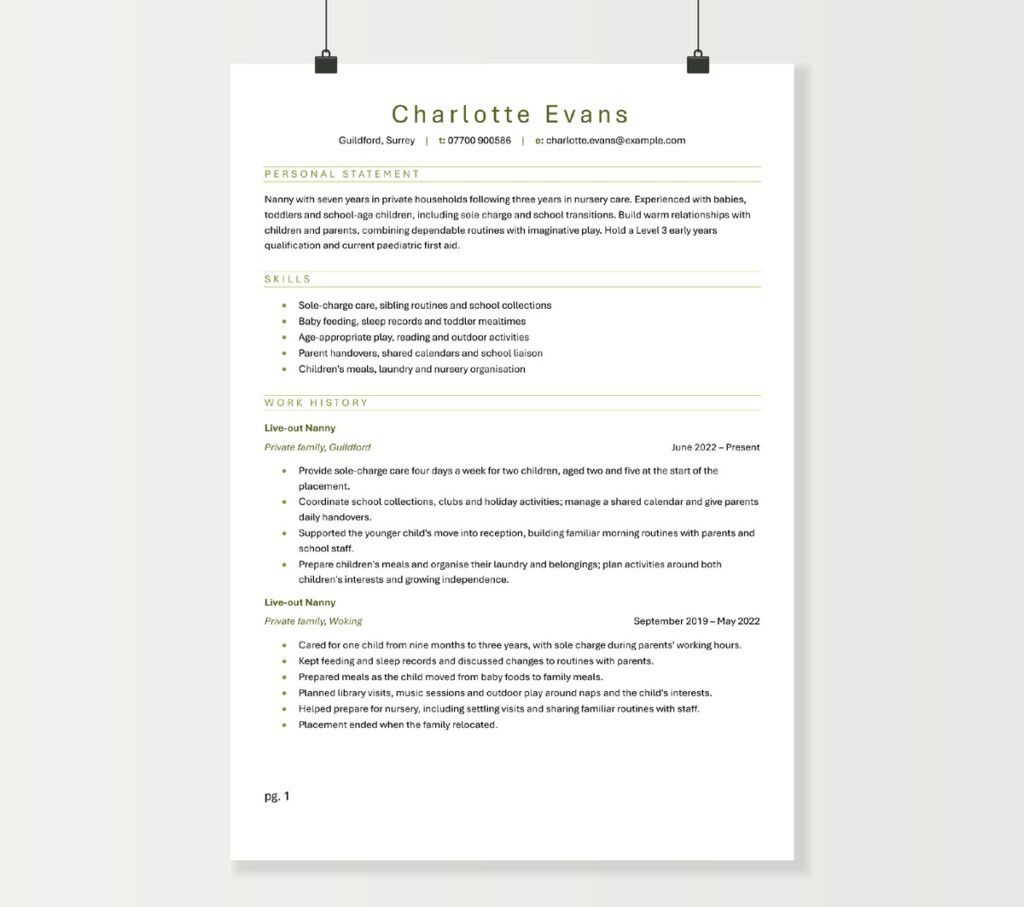
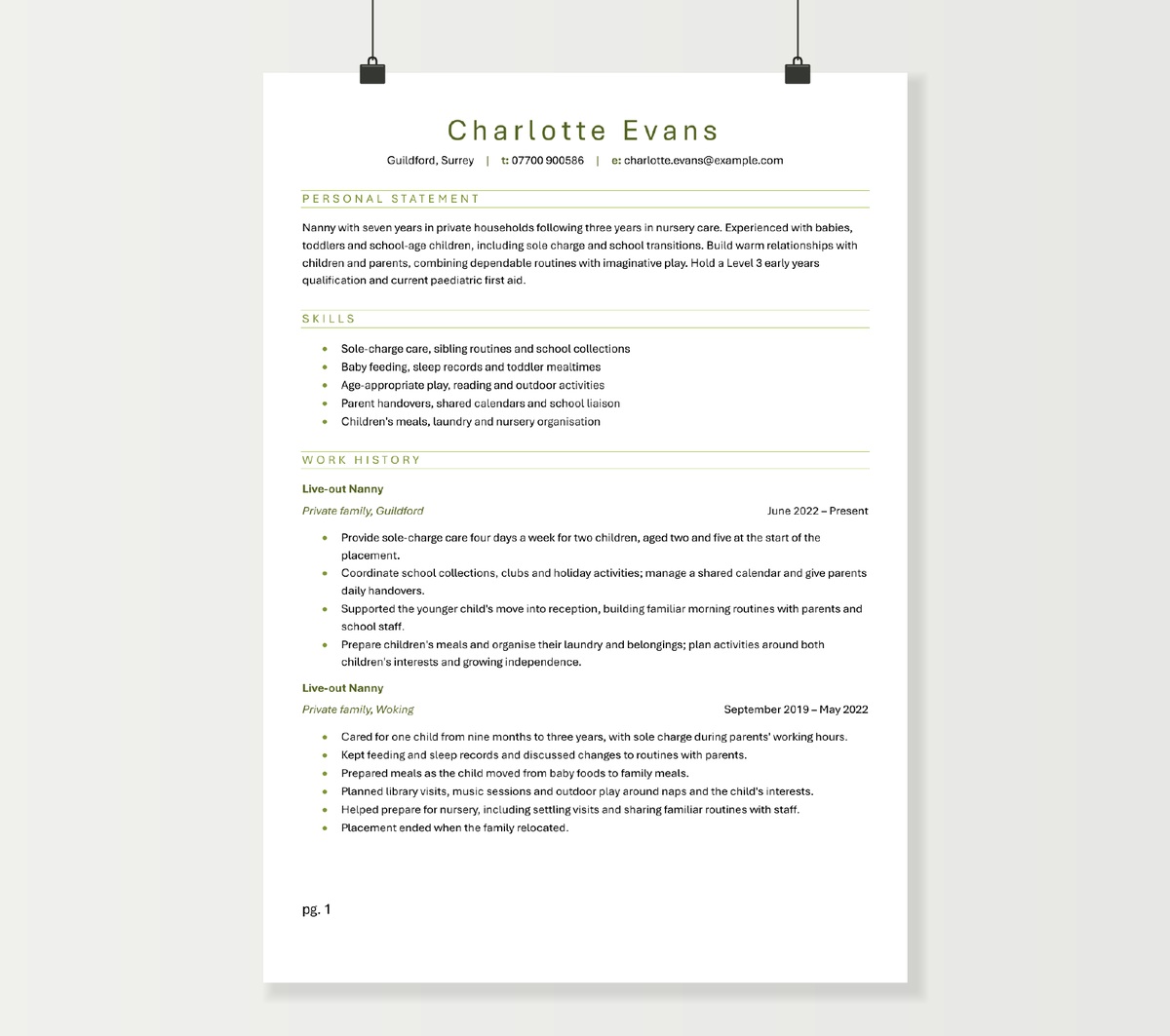
Charlotte Evans
Guildford, Surrey | t: 07700 900586 | e: [email protected]
Personal statement
Nanny with seven years in private households following three years in nursery care. Experienced with babies, toddlers and school-age children, including sole charge and school transitions. Build warm relationships with children and parents, combining dependable routines with imaginative play. Hold a Level 3 early years qualification and current paediatric first aid.
Skills
- Sole-charge care, sibling routines and school collections
- Baby feeding, sleep records and toddler mealtimes
- Age-appropriate play, reading and outdoor activities
- Parent handovers, shared calendars and school liaison
- Children's meals, laundry and nursery organisation
Work history
Live-out Nanny
Private family, Guildford
June 2022 – Present
- Provide sole-charge care four days a week for two children, aged two and five at the start of the placement.
- Coordinate school collections, clubs and holiday activities; manage a shared calendar and give parents daily handovers.
- Supported the younger child's move into reception, building familiar morning routines with parents and school staff.
- Prepare children's meals and organise their laundry and belongings; plan activities around both children's interests and growing independence.
Live-out Nanny
Private family, Woking
September 2019 – May 2022
- Cared for one child from nine months to three years, with sole charge during parents' working hours.
- Kept feeding and sleep records and discussed changes to routines with parents.
- Prepared meals as the child moved from baby foods to family meals.
- Planned library visits, music sessions and outdoor play around naps and the child's interests.
- Helped prepare for nursery, including settling visits and sharing familiar routines with staff.
- Placement ended when the family relocated.
Nursery Practitioner
Willow Tree Nursery, Guildford
September 2016 – August 2019
- Worked in toddler and preschool rooms, supporting play, meals and personal-care routines.
- Acted as key person for six children, keeping observations and discussing progress with parents.
- Prepared creative activities and adapted resources for different interests and abilities.
- Worked with colleagues on room safety checks and safeguarding procedures.
Qualifications
Childcare training and checks
Professional development
2025 – 2026
- 12-hour Paediatric First Aid — May 2025; safeguarding update — 2026.
- Enhanced DBS — 2025; registered with the DBS Update Service.
- Ofsted voluntary Childcare Register: registered home childcarer.
CACHE Level 3 Diploma
Guildford College
2016
- Early Years Workforce (Early Years Educator). Eight GCSEs A–C including English and Maths (2014).
Hobbies and interests
- Baking: Trying new recipes at weekends.
- Walking: Exploring local woodland trails.
- Crafts: Sewing and making greetings cards.
Additional information
Full UK driving licence; references available from both nanny placements.
How to write a nanny CV that helps a family picture you in the role
A family reading a nanny CV needs to understand the care you have provided, the ages you know well and how you work with parents. “Experienced with children” leaves most of that unanswered. A clear account of a baby placement, a busy school run or several years with the same siblings gives them much more to work with.
Build the application around the arrangement being advertised. A full-time baby role, an after-school position and a nanny share can all carry the same job title, but the evidence that makes you a strong candidate will differ. Your employment history can stay complete while the profile and order of your responsibilities bring the most relevant experience forward.
Make the childcare arrangement clear in every job entry
Start each placement with its dates, location, number of children and their ages when you joined. Add whether the role was live-in or live-out and sole charge or shared care. A family can then understand the experience before reading the detail. For a long placement, stating the starting ages is particularly useful: it shows the stages you supported without making the children appear to remain toddlers for several years.
A heading such as “Live-out nanny, private family, Guildford | June 2022–present” can be followed by “Sole-charge care four days a week for two children, aged two and five when the placement began.” The bullets beneath it should explain what that arrangement involved and how your responsibilities developed as the children grew.
Shared care also deserves a precise description. You might have worked alongside a parent during maternity leave, covered independent afternoons or coordinated with another nanny. State the pattern and your own responsibilities. Similarly, a parent working from home does not automatically make the job shared care; explain who managed the children’s day.
For a nanny share, identify the number of families and children and show how you coordinated routines, handovers and different parental preferences. For temporary cover, put the reason or contract type next to the dates. Several short bookings then read as an intentional working pattern.
Choose evidence that fits the children’s ages
Babies and younger toddlers
Give the youngest age you have cared for and the setting in which you gained that experience. Newborn care, looking after a nine-month-old and helping in a nursery baby room offer different evidence. Families may want to see feeding records, sleep routines, introducing age-appropriate foods, nursery organisation and communication during changes in the child’s day.
Describe your contribution in a compact employment bullet: “Kept daily feeding and sleep records for a six-month-old and agreed routine changes with parents during their return to work.” That tells the reader about both practical care and working relationships. If you supported twins, overnight care or a child with particular feeding needs, place that experience prominently when it matches the vacancy.
Activities should help explain your approach to the child. A short account of adapting floor play, books or outings as the baby grew is more informative than a long list of classes attended. Some families want regular groups; others value a quieter home-based day. Show the judgement and responsiveness behind your choices.
Preschool and school-age children
For older children, give more space to the day you organised: school and nursery collections, clubs, meals, homework, friendships and holiday plans. Include how you balanced siblings’ different needs. A shared calendar, communication with school and preparation for the next day can demonstrate organisation more convincingly than simply describing yourself as organised.
School transitions are useful evidence. Explain whether you supported settling visits, coordinated familiar routines with staff or helped a child become more independent with belongings and morning preparation. For homework, indicate the age group and your role, such as supporting reading practice and keeping parents informed about school messages.
A governess or education-focused vacancy may merit a separate section for teaching qualifications, languages and curriculum experience. In a general nanny application, keep educational support alongside the broader care you provided so that the family can see the whole role.
Show how you work with parents
Trust develops through dependable decisions and useful communication. Bring those qualities into the employment history through specific responsibilities: daily handovers, agreement on routines, updates about changes in appetite or mood, and coordination with another carer. Mention the system only where it helps explain the work, whether that was a diary, shared calendar or agreed messaging arrangement.
You can also show initiative through a change discussed and agreed with the family. “Introduced a shared weekly calendar for collections and clubs, giving both parents one place to check changes” describes a practical improvement. “Excellent communication skills” gives the reader less evidence.
Families often have established approaches to food, sleep, screen time or behaviour. Your CV can demonstrate adaptability by describing how you maintained consistent routines with parents or helped revise them as the children grew. Save the detailed discussion of a prospective family’s preferences for the interview.
Describe outcomes in the language of childcare
A strong nanny CV can contain very few percentages. The number and ages of children, days worked, length of placements and scope of responsibilities already give the experience substance. Long-term care through several developmental stages is an achievement worth explaining.
Useful outcomes include helping a child settle into nursery, establishing a workable handover between two households, supporting greater independence with school preparation, or being asked back for later holiday cover. Connect the outcome to what you did and, where relevant, the parents or professionals you worked with.
- “Supported a gradual nursery transition through settling visits and consistent handovers between parents and nursery staff.”
- “Returned for three school-holiday bookings after the original full-time placement ended.”
- “Planned activities for siblings with different school finish times, combining individual attention with shared time at home.”
These details allow the reader to recognise the value of patient, consistent care. Routine responsibilities still belong on the CV, especially when they match the next family’s needs; a carefully chosen outcome adds depth to them.
Give childcare credentials their own visible section
List the exact title and level of your childcare qualification, the awarding body or college and completion year. An established CACHE qualification, a Norland or Chiltern award and a teaching qualification each communicate a different background. Keeping the original award title makes your training easy to understand, even when newer courses use different names.
Put paediatric first aid beside its completion or expiry date and identify the course clearly. Relevant safeguarding refreshers and specialist training can follow. A short, current list is easier to use than a record of every repeated workplace session.
For an enhanced DBS check, include the issue year and Update Service membership where applicable. An agency or family can arrange the relevant checking process separately. Applicants working elsewhere in the UK can name the applicable disclosure scheme rather than using DBS as a blanket label.
If registered with Ofsted as a home childcarer, state that status in the same section. In England, nanny registration is voluntary and belongs to the voluntary Childcare Register; it is distinct from registration as a childminder. The government’s nanny registration guidance explains the arrangement. A clear status line is sufficient on the CV.
Separate childcare duties from wider household work
Children’s meals, laundry, bedrooms, toys and school belongings often sit naturally within a nanny role. Describe the actual scope. “Managed children’s laundry and kept nursery supplies organised” gives a family a clearer picture than “all household duties”.
For a nanny-housekeeper application, show the balance of childcare and broader domestic responsibilities. You could give childcare its own group of bullets, then cover family laundry, household cleaning or meal preparation with the same clarity. The housekeeper CV example can help with presenting that wider experience.
Travel, overnight stays and coordination with other household staff also deserve context. Indicate whether these were regular duties or occasional cover and describe the relevant organisation. A family seeking a live-out school-hours nanny may place much less weight on international travel than one recruiting for frequent trips.
Moving from a nursery or other childcare setting
A first nanny CV can draw strong evidence from nursery work, school support, regular babysitting or supervised placements. State the setting, age range and responsibility level. A nursery key-person role, for example, can demonstrate observations, relationships with parents and planning for individual children within a team.
Bring forward experience that transfers into a family home: preparing suitable activities, supporting meals and personal care, communicating with parents and managing a child’s transition. Then identify any independent childcare separately, with its frequency and duration. This helps the reader see both your professional foundation and your experience of organising a day without a room team around you.
A newer applicant may place qualifications and placements before employment history. An experienced nanny will usually gain more from leading with recent family roles and retaining older nursery work in a shorter entry. If your background is mainly classroom support, the teaching assistant example offers another way to present pupil support and school communication.
Make references and practical arrangements easy to assess
Month-and-year dates help agencies follow your placements and arrange references. Where useful, a short reason for a role ending can explain the sequence: family relocation, a child starting full-time school or completion of maternity cover. A reference line can say that references are available from your two most recent families or from a nursery manager and regular childcare employer.
Your location, realistic travel area and driving information can be important selection details. Distinguish holding a licence from having a car available for work, and mention manual or automatic driving where the family’s vehicle makes that relevant. Availability for school holidays, evening babysitting or travel can go in a brief additional-information section or the accompanying application.
Finish by reading the CV from the family’s perspective: can they identify the ages you know, the care you managed, the people you worked with and the arrangement you are seeking? Keep the most relevant evidence easy to find within the design. You can compare other layouts in the Word CV template library.
Nanny CV FAQs
A label such as ‘Private family, Guildford’ is enough for the employment heading. Add the children's ages at the start, placement dates and care arrangement so the experience remains clear. Family names and reference contact details can be shared separately with the agency or prospective employer at the appropriate stage.
Give each family its own entry, with overlapping dates and the usual days or weekly hours. This explains the timetable immediately. If it was a nanny share with children cared for together, use one entry and identify it as a share; the coordination involved is different from two separate jobs.
Yes. A short career-break entry can make the timeline clear, while earlier paid childcare remains in your employment history. Bring any recent first-aid training, regular childcare commitments or professional refreshers near the top. Your profile can connect your previous nanny experience with the age group and working pattern you now want.
The placement still provides useful experience and a potential reference. State where the work took place and keep the dates and responsibilities clear. In your accompanying application, explain that the family is overseas and can be contacted by email or at an agreed time. A former nursery manager or another recent family can provide an additional perspective.
Put it in the initial application or agency profile so the family can assess the proposed arrangement early. Briefly give your child's age and the days involved. Keep the CV focused on your professional childcare experience; the application can explain how the arrangement would fit the advertised role.
Use the same underlying dates, qualifications and employment history. An agency may also request a fuller registration form, availability details and reference information. For a direct application, tailor the opening profile and order of evidence to that family's children's ages and schedule. The CV and any agency profile should give a consistent account of your experience.