
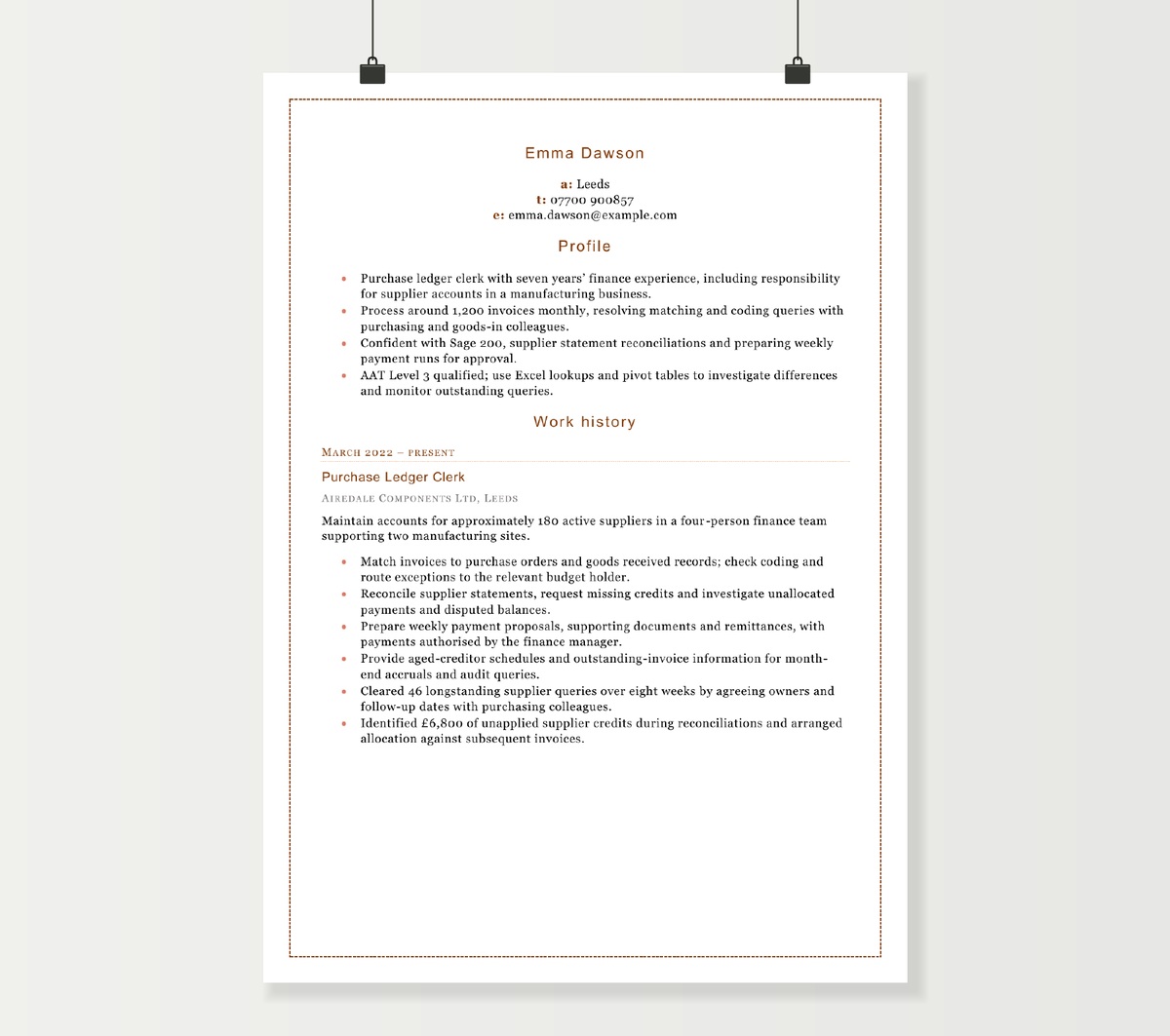
This purchase ledger clerk CV template follows an office administrator into accounts support and a dedicated purchase ledger role. The Word example shows invoice processing, supplier reconciliations and payment preparation alongside practical improvements. The guide helps experienced clerks and applicants entering finance present the detail behind accurate, timely accounts payable work.
Filename: FreeCVDownload_Purchase_Ledger_Clerk.docx
Content of this CV template
Emma Dawson
a: Leeds
t: 07700 900857
Profile
- Purchase ledger clerk with seven years’ finance experience, including responsibility for supplier accounts in a manufacturing business.
- Process around 1,200 invoices monthly, resolving matching and coding queries with purchasing and goods-in colleagues.
- Confident with Sage 200, supplier statement reconciliations and preparing weekly payment runs for approval.
- AAT Level 3 qualified; use Excel lookups and pivot tables to investigate differences and monitor outstanding queries.
Work history
March 2022 – present
Purchase Ledger Clerk
Airedale Components Ltd, Leeds
Maintain accounts for approximately 180 active suppliers in a four-person finance team supporting two manufacturing sites.
- Match invoices to purchase orders and goods received records; check coding and route exceptions to the relevant budget holder.
- Reconcile supplier statements, request missing credits and investigate unallocated payments and disputed balances.
- Prepare weekly payment proposals, supporting documents and remittances, with payments authorised by the finance manager.
- Provide aged-creditor schedules and outstanding-invoice information for month-end accruals and audit queries.
- Cleared 46 longstanding supplier queries over eight weeks by agreeing owners and follow-up dates with purchasing colleagues.
- Identified £6,800 of unapplied supplier credits during reconciliations and arranged allocation against subsequent invoices.
August 2019 – February 2022
Accounts Assistant
Calder Office Supplies, Leeds
Supported purchase and sales ledgers for an office-supplies distributor while studying AAT.
- Entered purchase invoices and credit notes into Sage 50 Accounts.
- Matched delivery paperwork and followed up missing approvals.
- Reconciled supplier statements and prepared query lists for review.
- Allocated customer receipts and maintained the daily cashbook.
- Created an invoice log that reduced duplicate chasing across the team.
- Helped reconcile 70 supplier accounts ahead of the year-end audit.
September 2017 – July 2019
Office Administrator
Calder Office Supplies, Leeds
Provided order and document support to the sales, warehouse and finance teams.
- Entered customer orders and checked product codes and quantities.
- Filed purchase orders, invoices and signed delivery notes.
- Answered supplier calls and passed queries to the accounts team.
- Maintained spreadsheet records of deliveries and returns.
- Matched missing delivery notes to invoices during busy periods.
- Reorganised scanned records by supplier and month for easier retrieval.
Qualifications and training
AAT Level 3 Advanced Diploma in Accounting, Leeds City College, 2021.
8 GCSEs including English and Mathematics, 2017.
Excel lookups and pivot tables, 2024; Sage 200 training, 2022.
Interests
Swimming, reading crime novels and helping at a local community garden.
How to write a purchase ledger clerk CV
A good purchase ledger CV shows how you keep supplier accounts moving from invoice receipt to an accurate, approved payment. Employers need to understand the volume you handle, the systems you use and the queries you can resolve. Those details turn a familiar list of finance duties into a clear picture of your experience.
Establish the scale and shape of your ledger
Use the opening line under each role to describe the business and your part of the finance function. Include the number of active supplier accounts, typical invoice volume or number of sites when it helps establish the workload. A clerk processing invoices for several entities in a shared-service team has a different remit from someone handling the whole purchase ledger in a small business.
Make personal and team volumes easy to distinguish. “Process around 1,200 invoices monthly” describes your workload; “part of a team processing 12,000 invoices monthly” describes the wider setting. Add the work surrounding those invoices, such as matching, exception handling and reconciliation. This gives the reader a fair basis for understanding the complexity as well as the number.
Your profile can then summarise the strongest fit for the vacancy: purchase-ledger experience, relevant sector, accounting system and one or two areas of responsibility. For an entry-level application, lead with finance study and relevant administration, numeracy or records experience.
Explain invoice processing beyond data entry
Describe the checks and decisions involved in your normal workflow. These may include matching invoices to purchase orders and goods received notes, checking cost-centre or nominal coding, dealing with non-PO invoices, routing approvals and recording credit notes. Select the parts that reflect your experience and the advertised role.
A useful bullet might read: “Matched purchase invoices to orders and receipt records, working with goods-in and purchasing to resolve quantity and price differences.” It identifies the process, the exception and the colleagues involved. Another could explain how you handled overhead invoices across multiple sites or allocated costs to departments.
If invoice capture or approval software formed part of the process, name it alongside the accounting system. Explain whether your work involved reviewing captured information, resolving exceptions, maintaining approval records or posting approved documents. Experience with an automated workflow can be valuable even when much of the initial data entry happens elsewhere.
Give supplier reconciliations and queries proper space
Supplier statement reconciliation often reveals more about your understanding than a processing-speed claim. State the accounts you reconciled, the frequency or scale, and the types of difference you investigated. Missing invoices, unallocated payments, credits and disputed charges all provide useful context.
Show what happened next. You may have obtained a missing credit note, traced a payment, agreed the status of a disputed invoice or worked with a buyer to resolve a price difference. “Reconciled 70 supplier accounts before year end and documented unresolved items for the finance manager” gives a clear deliverable.
Communication matters because many queries depend on people outside finance. Include how you coordinated with purchasing, goods-in, budget holders and suppliers. A shared query log, agreed follow-up dates or a clearer handover can be a worthwhile improvement when it helped issues reach a conclusion.
Be precise about payment runs and month-end work
Set out your part in the payment cycle. Preparing a payment proposal, checking supporting approvals, loading a payment file, obtaining authorisation and issuing remittances are distinct responsibilities. A sentence such as “Prepared weekly supplier payment runs for finance-manager approval and issued remittances after processing” makes the scope easy to assess.
Include payment frequency, multiple currencies or several business entities where relevant. If you managed urgent supplier queries or helped protect continuity of supply, explain the action and operational result. The strongest account connects payment administration with accurate supplier information and agreed deadlines.
For month end, name the contribution: aged-creditor reports, ledger reconciliations, schedules of invoices awaiting approval, information for accruals, debit-balance reviews or audit evidence. “Supported month end” gives little indication of your capability. “Prepared outstanding-invoice schedules for the accountant’s accrual review” gives a specific responsibility without needing an accounting tutorial.
Describe Excel and finance systems through their use
Put the systems most relevant to the vacancy near the top of your skills or experience. Be specific about the product where possible: Sage 50 Accounts and Sage 200 convey more than “Sage”. For a larger ERP, identify the accounts payable or purchase-to-pay work you carried out within it.
Excel evidence should connect a function with a task. Useful examples include:
- Lookups to compare supplier statements with ledger exports and flag missing references.
- Pivot tables to summarise outstanding invoices by supplier, age or query owner.
- SUMIF or COUNTIF to total categories or identify repeated references.
- Filters and structured lists to monitor approvals and prepare reconciliation schedules.
Choose the functions that feature in your actual work and give one strong application in your employment history. That is more informative than a proficiency bar or “advanced Excel”. If you helped introduce a new finance system, describe your contribution to testing, supplier-record checks, migration reconciliation or colleague training.
Find achievements in the day-to-day ledger work
Purchase ledger achievements do not have to be dramatic. Employers value a backlog brought under control, a longstanding supplier difference resolved, a more useful report or a dependable handover. Look for a change you helped make and the evidence that shows why it mattered.
A before-and-after count works well for queries or unprocessed items, particularly with a timeframe. For example, “Reduced invoices awaiting coding from 85 to 32 over six weeks by agreeing a weekly review with department managers.” Credit recovery can also be useful: state whether the result was a refund, a credit allocated against invoices or a duplicate payment recovered. These are different outcomes and each is understandable on its own terms.
Accuracy is best shown through the work that supports it: reconciliations completed, discrepancies investigated, records maintained for review and recurring issues resolved. If your employer measured processing quality, use the defined measure and period. Otherwise, concrete examples of checks and resolved exceptions are stronger than an unexplained percentage.
Volume can demonstrate capacity, but it works best beside evidence of quality and complexity. An invoice total, a reconciliation example and a query-resolution achievement together provide a rounded account of the role.
Adapt the CV to the type of purchase ledger vacancy
For a standalone role, show the breadth of your responsibility from invoices through statements, payments and month-end support. For a larger accounts payable team, make the allocated area clear: supplier portfolio, business entity, invoice stream or specialist exceptions. Experience of service deadlines, shared inboxes and handovers may be especially useful.
A manufacturing or distribution business may place weight on PO and receipt matching and work with warehouse or purchasing teams. An overheads role may involve recurring service invoices, utilities, cost allocation and multiple locations. Intercompany work, foreign-currency suppliers, expenses or sector-specific processes should appear when they are relevant to the vacancy and form part of your experience.
For temporary cover, help the employer see how quickly you can contribute. State the systems used recently, the processes you can take over and your availability where useful. Label fixed-term and agency assignments clearly, and give each a purpose or result such as leave cover, a backlog project or year-end support.
Present study and a move into finance
List the exact accounting qualification, level, provider and completion date. For ongoing study, identify the course and current stage, with an expected completion date if established. Relevant Excel or accounting-system training can sit below it. Qualifications are easiest to assess when completed awards and current study are separate.
Applicants entering purchase ledger can draw on experience with orders, delivery records, till reconciliations, spreadsheets, document checks and customer or supplier queries. Explain the task and the responsibility you held. Matching delivery paperwork to invoices in an administration role is directly useful evidence; a broad claim of being “good with numbers” is less informative.
A course assignment can support a first application when it demonstrates relevant bookkeeping or spreadsheet work. Identify it as part of your studies and describe the task briefly. As work experience grows, give employment evidence more space. The accounts assistant CV example is useful if your target role combines purchase ledger with sales ledger, cashbook or wider finance support.
Keep the most useful evidence easy to find
Use recent employment to carry the detail. Earlier administration or customer-service roles can be shorter, keeping the parts that explain your progression into finance. Avoid repeating the same invoice-processing bullet under every employer; use each entry to show a change in scale, systems, responsibility or complexity.
Before sending the CV, check whether the first half-page makes your fit clear: ledger experience, accounting system, workload and key strengths. Then check that the employment section provides evidence for those strengths. A recruiter should be able to see both what you can take responsibility for and how you help the finance team keep supplier accounts accurate and up to date.
Purchase Ledger Clerk CV FAQs
Use the wording of the vacancy in your profile or skills section, with the alternative term where it helps recognition. Keep your actual employment title. For many roles the terms overlap, but the scope statement should explain whether you processed invoices, maintained supplier accounts or handled a wider payment and month-end remit.
Use another meaningful measure, such as the supplier accounts you maintained, sites supported, frequency of payment runs or reconciliation schedule. You can also describe the mix of work and deadlines. A clear account of your responsibilities is useful without an invoice count.
Make your existing system experience easy to assess and describe the transferable processes: invoice matching, coding, reconciliation, approvals and reporting. If you have previously learned a new system or helped with a migration, include that example. An employer can then judge both your ledger knowledge and your experience adapting to software.
Yes, when they formed part of your role and are relevant to the vacancy. A brief reference to maintaining supplier records and following the company's verification and approval process is usually enough. The CV should establish your responsibility without setting out sensitive operational details.
Group placements under the agency if that makes the employment history clearer, then name the assignments or sectors, dates and main remit. Highlight a different contribution for each, such as clearing queries, covering payment preparation or supporting year end. Marking them as temporary assignments explains the pattern naturally.
Include it when the role is mixed or it shows useful cover across a small finance team. Keep purchase-ledger evidence prominent for a dedicated vacancy, then add a concise line on customer receipts, sales invoices or credit-control support. A broader accounts assistant application can give those responsibilities more space.




