
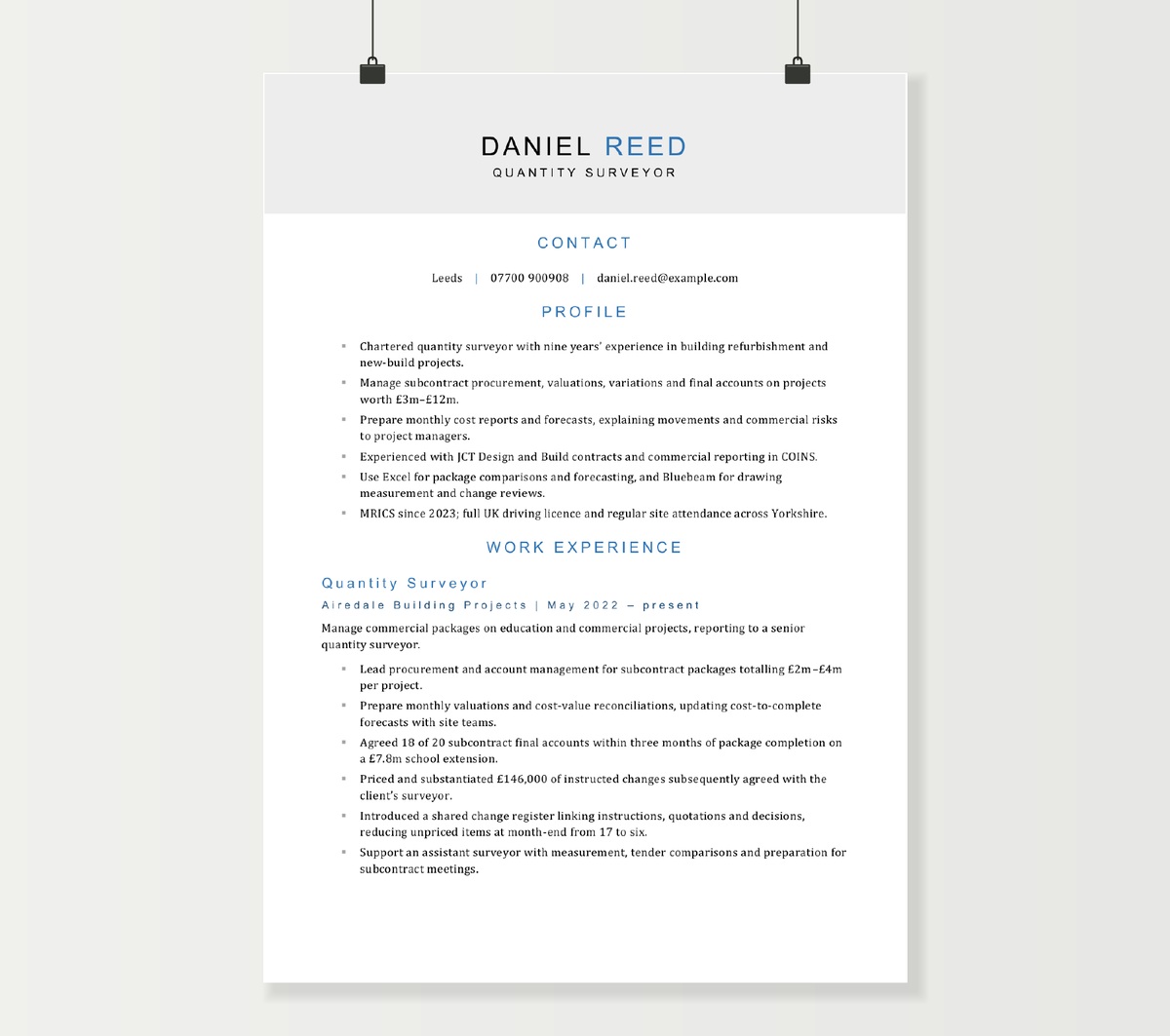
This quantity surveyor CV template follows a graduate into a contractor-side role managing procurement, valuations and project cost reporting. The Word example combines project scale with clear personal responsibilities and commercial results. The guide covers how to present main contractor, subcontractor and consultancy experience, from graduate applications to more senior appointments.
Filename: FreeCVDownload_Quantity_Surveyor.docx
Content of this CV template
Daniel Reed
Quantity Surveyor
Contact
Leeds | 07700 900908 | [email protected]
Profile
- Chartered quantity surveyor with nine years’ experience in building refurbishment and new-build projects.
- Manage subcontract procurement, valuations, variations and final accounts on projects worth £3m–£12m.
- Prepare monthly cost reports and forecasts, explaining movements and commercial risks to project managers.
- Experienced with JCT Design and Build contracts and commercial reporting in COINS.
- Use Excel for package comparisons and forecasting, and Bluebeam for drawing measurement and change reviews.
- MRICS since 2023; full UK driving licence and regular site attendance across Yorkshire.
Work experience
Quantity Surveyor
Airedale Building Projects | May 2022 – present
Manage commercial packages on education and commercial projects, reporting to a senior quantity surveyor.
- Lead procurement and account management for subcontract packages totalling £2m–£4m per project.
- Prepare monthly valuations and cost-value reconciliations, updating cost-to-complete forecasts with site teams.
- Agreed 18 of 20 subcontract final accounts within three months of package completion on a £7.8m school extension.
- Priced and substantiated £146,000 of instructed changes subsequently agreed with the client’s surveyor.
- Introduced a shared change register linking instructions, quotations and decisions, reducing unpriced items at month-end from 17 to six.
- Support an assistant surveyor with measurement, tender comparisons and preparation for subcontract meetings.
Assistant Quantity Surveyor
Pennine Construction Services | Sep 2019 – Apr 2022
Supported the commercial lead on office refurbishments and small industrial developments.
- Measured works, compared subcontract tenders and prepared recommendations for package awards.
- Assessed subcontract applications and maintained payment and variation records.
- Prepared supporting records for monthly client valuations and project cost reviews.
- Reconciled outstanding accounts on three completed projects, helping agree 12 final settlements.
Graduate Quantity Surveyor
Pennine Construction Services | Sep 2017 – Aug 2019
Rotated between estimating, site commercial support and procurement.
- Prepared quantity take-offs and obtained supplier quotations for tender submissions.
- Maintained drawing registers and checked delivery records against subcontract claims.
Qualifications
BSc (Hons) Quantity Surveying — 2:1
Leeds Beckett University | 2017
MRICS | Admitted 2023
Recent CPD: JCT contract updates (2025); commercial forecasting and change management (2026).
Interests
Cycling, live music and weekend walks in the Yorkshire Dales.
How to write a quantity surveyor CV
A quantity surveyor CV needs to show the commercial work you can take responsibility for. A project name and a large contract value provide context, but the stronger evidence is what you procured, assessed, forecast, negotiated or advised on. Make it easy to see your sector, the side of the contract you worked on and the stages of a project you have covered.
The example above follows a building contractor route. A consultancy surveyor may put feasibility estimates and client cost advice first; an infrastructure surveyor may lead with a framework, contract option and change-management responsibilities. Give the experience closest to the vacancy the most space, while preserving a clear career history.
Identify your commercial setting in the opening profile
Start with your level and specialism: graduate quantity surveyor, contractor-side QS, chartered project surveyor or senior commercial lead. Add the project types and scale that help an employer place your experience. A surveyor managing several refurbishment contracts has a different workload from one responsible for a major civils package, even when both job titles are simply “Quantity Surveyor”.
Follow that context with two or three areas of responsibility. For a main contractor, these might be subcontract procurement, monthly cost-value reconciliations and final accounts. For a consultancy, they could be cost planning, tender analysis and post-contract cost advice. Include chartered status where relevant, but keep the profile focused on the work you offer rather than a long string of memberships and software names.
“Quantity surveyor with six years’ experience in residential and education projects, managing subcontract packages from tender enquiry to final account. Prepare monthly forecasts and client valuations on JCT design-and-build contracts, working closely with site teams and the commercial manager.”
Give project values a clear meaning
Employers need to understand both the size of the development and your share of its commercial management. State the overall project value, then identify your packages or remit. “£65m development; responsible for £8m of façade and internal finishes packages” is more informative than “managed a £65m project”. Include whether you worked independently, reported to a senior QS or led other surveyors.
For each substantial role, introduce the employer, project mix and reporting line in a short sentence. Use selected project details where they explain relevant experience:
- Project type, sector and approximate contract value.
- Main contractor, specialist subcontractor, consultancy or client-side position.
- Relevant contract form and the project stages you covered.
- Your package responsibilities, decision-making scope and team relationships.
- A commercial result or completed milestone that demonstrates your contribution.
Two or three well-chosen projects are usually more useful than a catalogue of every site. If your employment covers many short assignments, keep the employer history readable and use a compact “Selected projects” section. Give each project enough context to be understood without an accompanying portfolio.
Show the difference between pre-contract and post-contract work
A consultancy application benefits from a clear account of how early-stage advice developed into a tender or live project. Describe your contribution to feasibility estimates, elemental cost plans, benchmarking, procurement advice and tender analysis. Include the design stage and who received your recommendations. “Prepared cost plans” becomes stronger when the reader understands the type of scheme and the decisions those plans supported.
On contractor applications, explain involvement in tender allowances, package scoping, enquiries, bid comparisons and subcontract placement. If you joined at the second-stage tender, show how you helped turn developing design information into workable package budgets. Experience with estimating is valuable, but distinguish preparing a tender from managing its commercial delivery after award.
For post-contract work, cover the responsibilities you actually held: assessing applications, preparing client valuations, maintaining cost reports, pricing change, advising on risks and agreeing accounts. A concise account of the project lifecycle demonstrates breadth more effectively than repeating “pre- and post-contract experience” in several sections.
Describe contract experience through the work it involved
Put relevant contract forms into the role or project where you used them. For JCT experience, that might include administering subcontract accounts, valuing instructed changes or preparing supporting information for the commercial lead. For NEC work, it may involve early-warning records, compensation-event quotations, forecasting or maintaining a project system such as CEMAR.
Where the vacancy specifies an NEC option or a particular JCT form, make matching experience easy to find. State which contract applied to your work and whether you prepared information, managed the process or held delegated authority. This is particularly useful where a project used one form at main-contract level and different arrangements for its subcontracts.
Give enough detail to demonstrate practical familiarity; a CV does not need an explanation of contractual procedures. Use the space for a specific example of change assessment, substantiation or agreement and your relationship with the project team, client or subcontractor.
Make valuations, forecasting and final accounts tangible
These responsibilities appear on many QS CVs, so add the detail that distinguishes yours. With valuations, explain the packages or projects involved, whether you prepared or assessed applications, and the records or site information you brought together. With forecasts, show how you updated cost to complete and explained movements to the people managing delivery.
For cost-value reconciliation, identify the reporting responsibility: compiling package information, preparing the project CVR, presenting it to a commercial manager or overseeing reports from a team. A useful bullet might describe a review of outstanding commitments and variations that improved the forecast available at the monthly project meeting.
Final-account work is especially useful evidence of seeing a project through. Give the number or value of accounts, the stage reached and your contribution to agreement. The example CV’s “18 of 20 subcontract final accounts within three months” provides a defined outcome and timeframe. For an assistant, preparing records and reconciling outstanding items can be a substantial contribution even where a senior colleague conducted the final negotiation.
Choose commercial achievements with a clear basis
Useful results include agreed variations, completed accounts, shorter reporting delays, resolved outstanding items, improved tender coverage and procurement savings against an identified allowance. Explain what the measure represents. An agreed change value demonstrates substantiation and negotiation; a reduction against a like-for-like tender allowance demonstrates a different type of result.
Link the figure to an action and a stage. For example, “Compared three compliant subcontract bids and negotiated a £24,000 reduction against the package allowance, retaining the specified scope” tells the reader how the result arose. If the outcome was achieved by a commercial team, identify your part, such as preparing the comparison, developing the supporting records or managing particular accounts.
Not every strong bullet needs a monetary figure. Securing agreement on a difficult account, bringing change records up to date before a forecast review or producing a client report in time for a funding decision can show good judgement. Explain the practical effect on the project rather than ending every bullet with a general claim about efficiency.
Connect software and measurement skills to outputs
A short technical section can help recruiters locate Excel, cost-management systems and measurement tools. Add a few words on their use: Excel for tender comparisons and forecasts; CostX or Bluebeam for measurement and drawing revisions; COINS for commercial reporting; CEMAR for contract records. The employment section should then provide at least one example of the work behind those labels.
If measurement is central to the role, identify the types of work you measured and the relevant measurement standards or schedules you used. For a specialist subcontractor, detailed trade knowledge may be more valuable than a broad list of software. For a consultancy, cost planning and tender documentation may deserve greater emphasis. Include BIM-related experience where you used model information for quantities or cost advice, with the task made clear.
Present qualifications and RICS progression clearly
List your relevant degree, HNC, HND or apprenticeship with institution and completion date. An experienced applicant can keep older education brief. Graduates can add a dissertation, placement or assessed project when it demonstrates relevant measurement, procurement or cost-planning work.
Put MRICS prominently if you hold it. For applicants progressing towards chartership, describe the current stage in plain terms, such as working towards the APC with a stated pathway and assessment timetable where established. If you hold another membership grade, use its correct designation so the reader can understand your position immediately.
Select recent development relevant to the application: contract updates, sector-specific commercial work, measurement, cost planning or leadership. A short selection is more useful than a long attendance list. Explain practical application within your experience where a course led to a new responsibility.
Adjust the evidence for graduate and senior applications
For a graduate or assistant role, placements and supervised work can demonstrate a sound start. Describe the quantities you measured, comparisons you prepared, site records you checked and reports you helped assemble. An academic project earns space when you can identify its output, such as a cost plan or procurement recommendation, and explain the decisions you made.
A senior applicant needs a wider view of commercial responsibility. Show the number of projects or surveyors overseen, reporting to directors or clients, procurement decisions, forecast review, negotiation and staff development. Keep enough project detail to establish technical credibility, then make leadership and commercial judgement visible. Progression should appear in the change from preparing information to owning accounts, advising others and reviewing their work.
If you are comparing responsibilities across the wider construction team, the project manager CV example offers a useful reference for presenting programme and delivery leadership. Keep your own quantity surveyor application centred on commercial responsibilities. You can also browse the Word CV template library for other layouts.
Quantity Surveyor CV FAQs
Use the contracting business or a clear freelance heading with dates, then list selected assignments beneath it. Give the client or contractor, sector, contract period and your commercial remit for each. This preserves a readable chronology while showing that short tenures reflect project assignments. Where an engagement continued through several phases, present those phases together rather than as separate jobs.
Use an agreed value band or non-sensitive measures such as project type, number of packages, number of sites and the stages covered. You can still explain your responsibility for procurement, reporting and account agreement. A description such as “commercial lead for three occupied-building refurbishments” can give useful context without naming a client or publishing a restricted budget.
Show the breadth within your specialist work: procurement, applications, change, forecasting, site coordination and final accounts. Describe how you worked with the main contractor’s commercial team and how your package interacted with other trades. Give relevant multi-project or supervisory experience space, alongside your trade knowledge, so the employer can assess the step into wider package responsibility.
State the country, project sector, contract forms and commercial responsibilities clearly. Explain unfamiliar job titles through the work rather than assuming a UK reader knows the local hierarchy. Relevant UK study, contracts training or recent UK project experience can help bridge the context. Give professional memberships their exact names and set out any current UK chartership progression separately.
A short project sheet can help when a recruiter requests detailed sector experience or when several significant assignments would crowd the CV. Use consistent fields for project type, value band, contract, stage and personal remit. Keep the strongest evidence in the CV itself so the application remains understandable if the attachment is not opened.
Yes, where the vacancy accepts your qualifications and experience. Many contractor and assistant roles focus on practical commercial responsibilities, while some consultancy or senior appointments specify chartered status. Read the requirement for that particular position and make your education, experience and current professional progression easy to identify. The job title alone does not establish a universal chartership requirement.




