
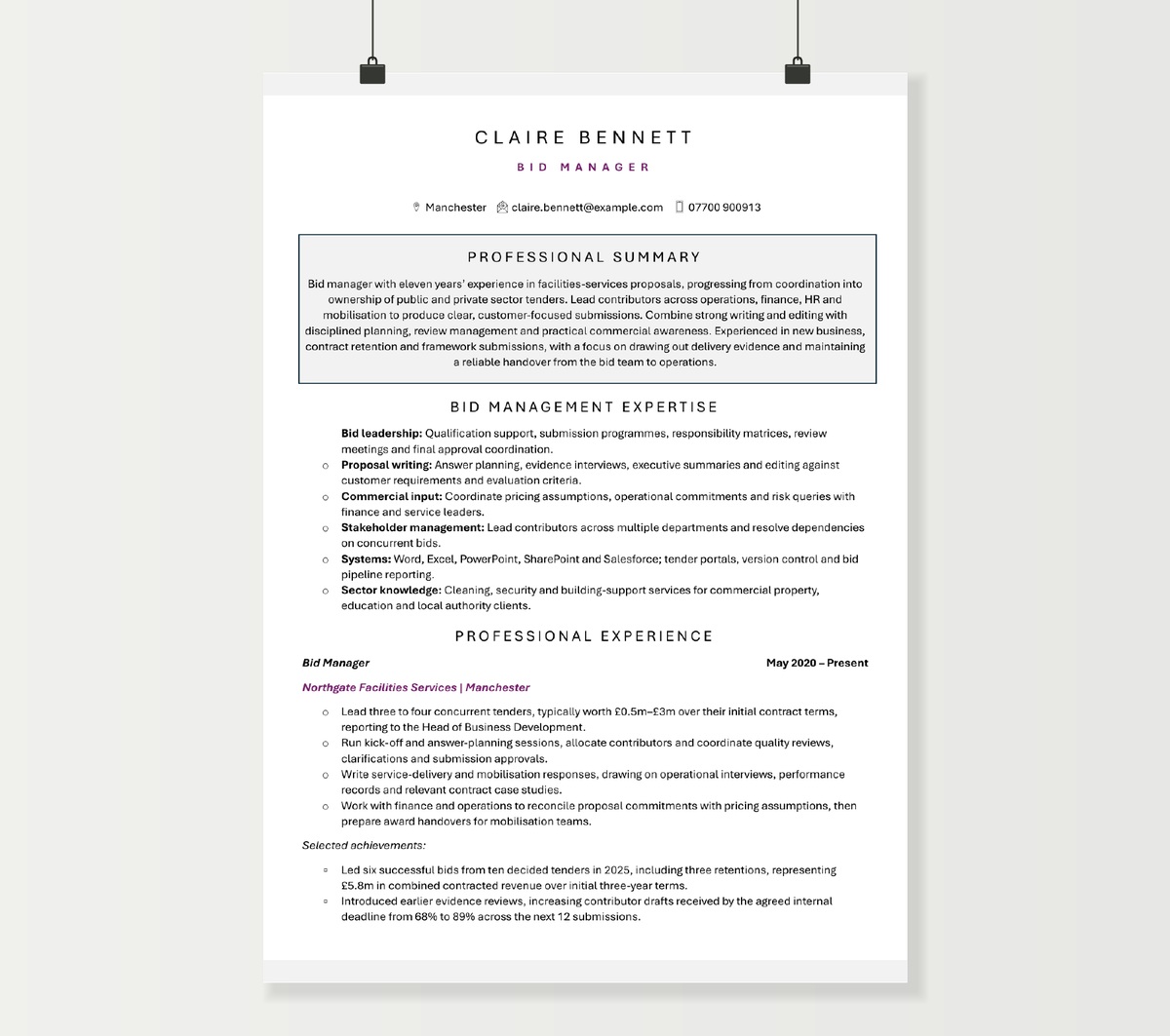
This bid manager CV template shows progression from bid coordination into managing facilities-services tenders. The Word example brings together submission planning, proposal writing, contributor management and defined contract results. The guide explains how to present bid ownership, sector knowledge, commercial judgement and achievements for both experienced applicants and those moving into their first bid manager role.
Filename: FreeCVDownload_Bid_Manager.docx
Content of this CV template
Claire Bennett
BID MANAGER
Manchester | [email protected] | 07700 900913
Professional summary
Bid manager with eleven years’ experience in facilities-services proposals, progressing from coordination into ownership of public and private sector tenders. Lead contributors across operations, finance, HR and mobilisation to produce clear, customer-focused submissions. Combine strong writing and editing with disciplined planning, review management and practical commercial awareness. Experienced in new business, contract retention and framework submissions, with a focus on drawing out delivery evidence and maintaining a reliable handover from the bid team to operations.
Bid management expertise
- Bid leadership: Qualification support, submission programmes, responsibility matrices, review meetings and final approval coordination.
- Proposal writing: Answer planning, evidence interviews, executive summaries and editing against customer requirements and evaluation criteria.
- Commercial input: Coordinate pricing assumptions, operational commitments and risk queries with finance and service leaders.
- Stakeholder management: Lead contributors across multiple departments and resolve dependencies on concurrent bids.
- Systems: Word, Excel, PowerPoint, SharePoint and Salesforce; tender portals, version control and bid pipeline reporting.
- Sector knowledge: Cleaning, security and building-support services for commercial property, education and local authority clients.
Professional experience
Bid Manager | May 2020 – Present
Northgate Facilities Services | Manchester
- Lead three to four concurrent tenders, typically worth £0.5m–£3m over their initial contract terms, reporting to the Head of Business Development.
- Run kick-off and answer-planning sessions, allocate contributors and coordinate quality reviews, clarifications and submission approvals.
- Write service-delivery and mobilisation responses, drawing on operational interviews, performance records and relevant contract case studies.
- Work with finance and operations to reconcile proposal commitments with pricing assumptions, then prepare award handovers for mobilisation teams.
Selected achievements:
- Led six successful bids from ten decided tenders in 2025, including three retentions, representing £5.8m in combined contracted revenue over initial three-year terms.
- Introduced earlier evidence reviews, increasing contributor drafts received by the agreed internal deadline from 68% to 89% across the next 12 submissions.
Bid Coordinator | September 2015 – April 2020
Mersey Support Services | Liverpool
- Coordinated tender schedules, document control and portal submissions for a five-person business development team.
- Prepared selection-questionnaire responses and gathered insurance, policy, financial and contract-reference information from internal owners.
- Drafted case studies and service descriptions, checked response limits and assembled presentation materials for senior colleagues.
- Maintained the bid tracker and recorded customer feedback, keeping evidence owners and review dates visible in SharePoint.
Selected achievements:
- Reorganised 85 approved evidence items by service and customer requirement, reducing time spent assembling standard response packs from three hours to 90 minutes.
- Coordinated 22 submissions in the final year of the role, meeting every external deadline and keeping complete approval and submission records.
Qualifications & development
APMP Practitioner Certification (CP APMP) – Awarded 2024; current CPD maintained
BA (Hons) English, 2:1 – Manchester Metropolitan University, 2015
Commercial proposal writing – Professional development course, 2022
Public procurement developments – Employer training programme, 2026
Additional information
- Professional activity: APMP member; regular development in bid leadership, evaluation and proposal quality.
- Mobility: Full UK driving licence; available for client workshops and regional office visits.
- Interests: Hiking, theatre and trying new recipes.
How to write a bid manager CV
A bid manager CV should show how you bring people, evidence and decisions together to produce a strong submission. Writing is important, but so are planning, commercial understanding and the ability to move a bid forward when several teams have competing priorities. Employers need to understand the opportunities you have managed and the responsibility you held within them.
Choose examples that make that responsibility tangible. A well-described tender, a useful improvement to the bid process and a clearly defined result will usually tell the reader more than a long list of proposal-management terminology.
Put the scale and setting of your bids near the top
Use the profile to establish your sectors, customer types and level of ownership. Facilities services, software, construction and engineering bids require different delivery knowledge. Public tenders, negotiated opportunities, framework submissions and contract renewals also create different demands on the bid team.
A concise opening might identify experience managing public and private sector facilities-services tenders from qualification through submission and mobilisation handover. An infrastructure applicant could instead lead with major frameworks, two-stage tenders and coordination with estimating and design teams.
Give each employment entry a short scope statement. Include a useful contract-value range, the typical number of concurrent bids and the people involved. State whether the value refers to annual revenue, the initial contract term or another basis. This makes the size of your work understandable before the reader reaches the achievements.
Make your ownership of the bid process visible
“Managed bids from start to finish” needs supporting detail. Show the stages you owned: qualification, planning, solution development, writing, review, approvals, submission, clarification or handover. Different employers divide these responsibilities differently, so the CV benefits from a clear account of your role.
Choose two or three examples of how you controlled delivery. You might have built the submission programme, agreed responsibilities with department heads, resolved a missing technical input or brought an approval decision forward before it affected the deadline. Explain the effect on the bid.
Concurrent work is particularly useful evidence. Give the number and type of live opportunities you handled together, then show how you maintained progress or quality. A mix of a major renewal, a new-business tender and several smaller proposals conveys more than a general claim to work well under pressure.
For senior roles, include decisions about where to invest bid effort. Contribution to bid/no-bid reviews, resource planning and prioritisation can demonstrate judgement, especially when you explain the factors considered and the decision supported.
Show the thinking behind your proposal writing
Writing evidence should reveal how you made a response more useful to its evaluator. Describe how you interpreted the question, drew out relevant delivery evidence and shaped a clear answer. Interviewing a service manager, extracting a case study from performance records and turning a technical explanation into a customer-focused response are all meaningful contributions.
Include the kinds of content you produced where relevant: executive summaries, service-delivery methods, mobilisation plans, technical responses, social value commitments or presentation material. Give more space to the content that matters in the target sector.
Review work deserves evidence too. You may have checked response coverage, challenged unsupported assumptions with their owners, improved structure or reconciled inconsistent commitments across sections. Explain what the review achieved, such as a clearer solution, stronger evidence or fewer issues at final approval.
Customer feedback can be a useful result when it is specific. A quality score for a particular submission or positive feedback on an approach gives the reader context. Comparisons work best when they refer to a consistent scoring basis and explain the change you helped make.
Demonstrate influence across the bid team
Bid managers often lead people who report to someone else. Show how you secured contributions from operations, finance, legal, HR, technical teams or external partners. “Stakeholder management” becomes convincing when the CV describes a decision you helped reach or a dependency you resolved.
For example, you might have brought operational and commercial colleagues together to settle a mobilisation assumption before the final review. Or you may have interviewed subject specialists and returned a structured draft for their approval, reducing the time they needed to contribute.
Distinguish direct line management from leadership of a bid team. Both matter. If you managed writers or coordinators, include team size and an example of their development. If you led temporary contributors, explain the work you organised and how you maintained accountability.
Connect commercial understanding with a deliverable offer
A strong bid CV shows awareness of what the organisation can deliver and the assumptions behind its offer. Describe your involvement in pricing reviews, scope clarification, risk registers, contractual queries or approval gates. Make the relationship with the commercial decision-makers clear.
In service contracts, relevant evidence could involve staffing assumptions, service levels and mobilisation commitments. In construction, it may concern design, programme, estimating and supply-chain input. In technology, it may involve implementation scope, support arrangements and dependencies.
Give handover work space when you were involved. A structured transfer of commitments, assumptions and outstanding actions to the delivery team demonstrates continuity beyond submission. The example CV uses this to connect Claire’s proposal work with the people who mobilise the awarded contract.
Present wins and performance measures with a clear basis
Bid results become much more useful when the reader can interpret them. Include the period, your contribution and the basis of the measure. In this example, six wins from ten decided tenders in 2025 is a defined result, with new business and retention distinguished and the contract-value period stated.
Choose the measures that best represent your work:
- Contract awards or renewals, with values and contract periods.
- Win rate across a stated group of decided tenders.
- Quality scores or relevant customer feedback.
- Submissions delivered against external and internal milestones.
- Time saved in evidence gathering or document preparation.
- Improved review readiness, contributor response or handover completeness.
Framework work needs its own description. Appointment to a framework establishes access to future opportunities; call-off awards show work subsequently secured. Present each outcome in its own terms. A framework’s overall estimated value and your employer’s awarded revenue answer different questions.
Team results are useful evidence when your role is visible. “Led the bid process for…” or “Coordinated the quality submission for…” can connect a shared award with your contribution. Include process improvements alongside wins so the reader can see how you make the function more effective over time.
Make sector and procurement knowledge practical
Describe the procurement settings you have worked in and the tasks they required. Selection questionnaires, invitations to tender, framework competitions, private proposals and negotiated bids can all be relevant. Use the terminology appropriate to the opportunity and your experience.
For public-sector roles, examples of interpreting evaluation criteria, managing clarifications and assembling required evidence can show practical understanding. Recent development in procurement changes can sit in the qualifications section, supported by experience applying the relevant process.
Sector knowledge is strongest when connected with the solution. A facilities-services applicant can show how operational evidence informed service commitments; an engineering applicant can explain coordination with technical and estimating colleagues. When moving sectors, identify the delivery knowledge you bring and the bid-management capabilities that transfer.
Explain how systems supported the work
List the tools you used for a recognisable purpose. Word might support complex response documents and controlled formatting; Excel might hold the compliance matrix or submission plan; PowerPoint might be used for client presentations. SharePoint or a bid platform may support approved content, review dates and version control.
A CRM entry is stronger when you explain the reporting it supported, such as opportunity status, deadlines, outcomes or the tender pipeline. Tender-portal experience can be described through the submissions and clarifications you managed, with particular systems named where the vacancy makes them relevant.
Content-library improvements are worth including when they changed the quality or speed of preparation. Show how you organised evidence, assigned owners or kept information current, then add a practical result. Claire’s earlier-role example connects a reorganised evidence bank with a shorter preparation task.
Show readiness for your next level
A coordinator moving into bid management should bring forward ownership already taken: running a smaller submission, leading a review meeting, managing contributors or resolving a delivery problem. Keep earlier administrative work concise enough for that progression to stand out.
An experienced bid manager applying for a senior role can emphasise more complex opportunities, judgement about resources, commercial influence, coaching and improvements adopted across the team. A title alone may not reveal that growth, so explain how the scope developed.
Applicants moving from sales or account management can draw on proposal ownership, customer understanding and commercial coordination. The business development manager CV example can help with that background; the bid application should foreground the submission process and the work you personally led.
Keep qualifications concise and specific
Give the full APMP certification level where held, with the award date and relevant current status. Membership and certification communicate different things and can be listed clearly in their appropriate places. Recent development in proposal quality, commercial writing or procurement can support the practical evidence in your employment history.
Degrees and sector qualifications matter according to the vacancy. Technical bids may benefit from engineering or construction knowledge, while other positions draw on writing, service delivery or commercial experience. Let the relevant work lead and use qualifications to explain the foundation behind it.
Choose a CV layout that leaves room for readable bid examples. A hiring manager should be able to find your scope, your contribution and your results without working through a miniature tender document.
Bid Manager CV FAQs
Use an appropriate customer or sector description, the type of opportunity and your responsibility. A value band, contract duration or general delivery scope can establish scale where exact details are restricted. The strongest evidence may be how you coordinated the solution, improved the submission or supported a decision, rather than the customer’s name.
Yes, if it demonstrates substantial relevant work. State its current stage, such as submitted, shortlisted or awaiting a decision, and describe the contribution already completed. An ongoing major bid can show leadership and complexity while your completed tenders provide separate outcome evidence.
They can be when the work demonstrates something important: leadership of a complex submission, a strong quality assessment, a useful debrief or an improvement adopted for later bids. Explain the result and what followed. A carefully chosen example can show judgement and learning alongside your awarded contracts.
A short selected-bids section can help when a few substantial projects best demonstrate your range. Include the sector, procurement type, value basis, role and outcome for each. For a long career or a specialist application, a separate project sheet may support the CV if requested, while the main document retains the strongest examples.
Identify the contract basis and dates, then give each assignment a concise brief and result. Differentiate the work: rescuing a delayed submission, covering a peak workload, developing a new evidence library or leading a strategic tender. Group very short related assignments where that creates a clearer account of your experience.
Keep your employer’s title in the employment history and explain the scope beneath it. If the work covers the advertised bid responsibilities, your profile can describe that experience directly. Titles such as Proposal Manager, Tender Manager and Work Winning Manager overlap in some organisations, but the responsibilities provide the useful comparison.




