
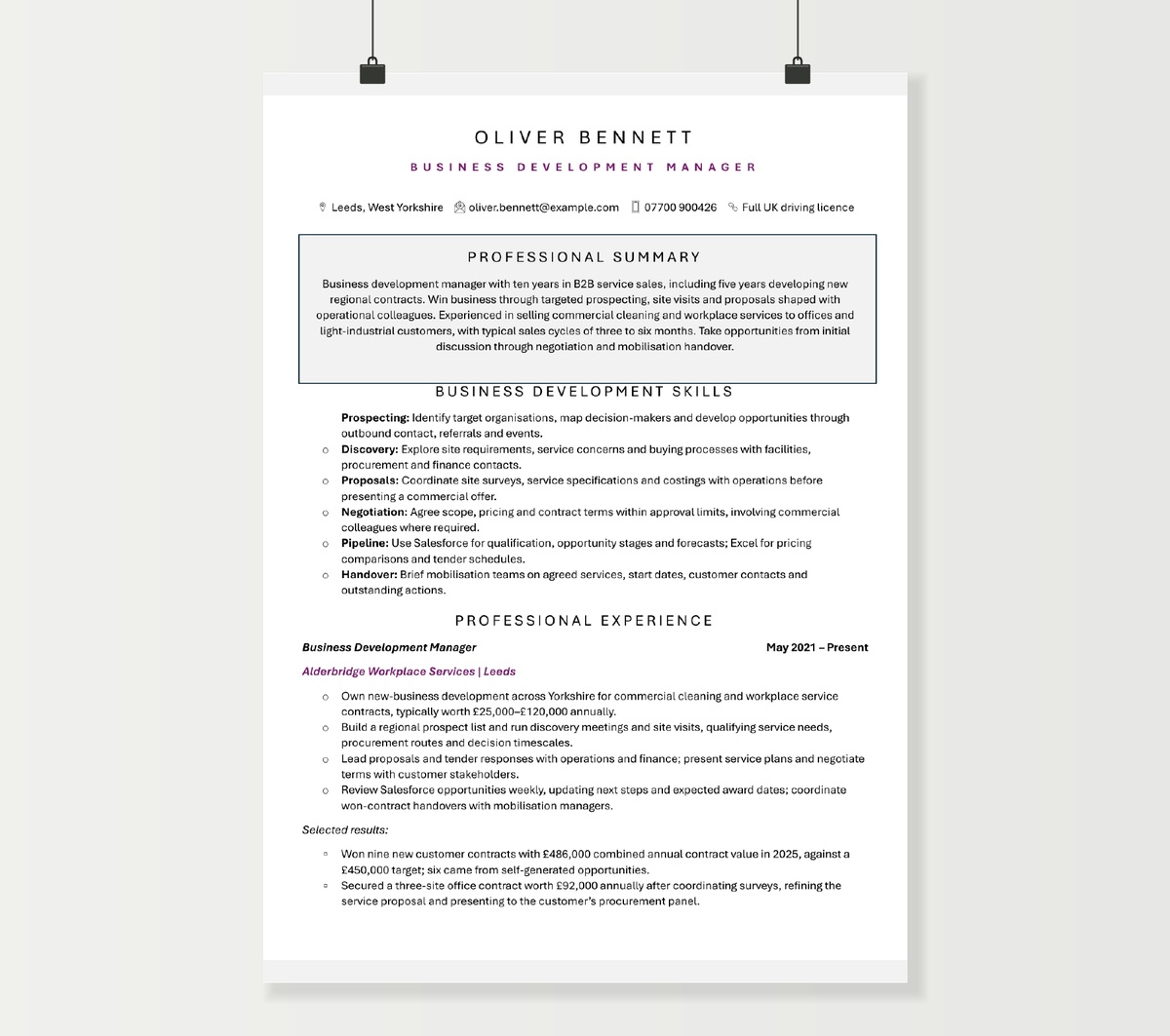
This business development manager CV template follows a B2B sales professional who progressed from a sales executive role to winning regional service contracts. The Word example shows prospecting, commercial proposals, negotiations and measurable new-business results. The guide covers how to explain your sales remit and present evidence for roles ranging from lead generation to complex contract development.
Filename: FreeCVDownload_Business_Development_Manager.docx
Content of this CV template
Oliver Bennett
BUSINESS DEVELOPMENT MANAGER
Leeds, West Yorkshire | [email protected] | 07700 900426 | Full UK driving licence
Professional summary
Business development manager with ten years in B2B service sales, including five years developing new regional contracts. Win business through targeted prospecting, site visits and proposals shaped with operational colleagues. Experienced in selling commercial cleaning and workplace services to offices and light-industrial customers, with typical sales cycles of three to six months. Take opportunities from initial discussion through negotiation and mobilisation handover.
Business development skills
- Prospecting: Identify target organisations, map decision-makers and develop opportunities through outbound contact, referrals and events.
- Discovery: Explore site requirements, service concerns and buying processes with facilities, procurement and finance contacts.
- Proposals: Coordinate site surveys, service specifications and costings with operations before presenting a commercial offer.
- Negotiation: Agree scope, pricing and contract terms within approval limits, involving commercial colleagues where required.
- Pipeline: Use Salesforce for qualification, opportunity stages and forecasts; Excel for pricing comparisons and tender schedules.
- Handover: Brief mobilisation teams on agreed services, start dates, customer contacts and outstanding actions.
Professional experience
Business Development Manager | May 2021 – Present
Alderbridge Workplace Services | Leeds
- Own new-business development across Yorkshire for commercial cleaning and workplace service contracts, typically worth £25,000–£120,000 annually.
- Build a regional prospect list and run discovery meetings and site visits, qualifying service needs, procurement routes and decision timescales.
- Lead proposals and tender responses with operations and finance; present service plans and negotiate terms with customer stakeholders.
- Review Salesforce opportunities weekly, updating next steps and expected award dates; coordinate won-contract handovers with mobilisation managers.
Selected results:
- Won nine new customer contracts with £486,000 combined annual contract value in 2025, against a £450,000 target; six came from self-generated opportunities.
- Secured a three-site office contract worth £92,000 annually after coordinating surveys, refining the service proposal and presenting to the customer’s procurement panel.
Sales Executive | Sep 2016 – Apr 2021
Westmere Business Services | Leeds
- Sold washroom and workplace-supply services to SMEs, progressing from appointment generation to responsibility for smaller new-business contracts.
- Contacted prospective customers, arranged site meetings and prepared quotations with the field sales team.
- Developed needs assessments and followed up proposals, recording customer requirements and buying timescales in the CRM.
- Coordinated installation and service-start details with operations and kept customers informed during onboarding.
Selected contributions:
- Achieved £164,000 in new annual contract value against a £150,000 target in 2020, across 23 smaller business customers.
- Created a prospect handover checklist adopted by four colleagues, making decision-maker details and agreed follow-up actions easier to track.
Education & development
BA (Hons) Business Management, 2:1 – Sheffield Hallam University, 2016
Negotiation and commercial proposals – employer training, 2025
Tender writing workshop – 2024
Salesforce pipeline and forecasting training – 2023
Additional information
- Territory: Regular travel across Yorkshire for prospect meetings, site surveys and presentations.
- Colleague support: Helped two new sales executives prepare discovery calls and organise their first prospect lists.
- Interests: Five-a-side football, cooking and walking in the Yorkshire Dales.
How to write a business development manager CV
A business development manager CV should make two things easy to understand: the business you were responsible for developing and what your work produced. The job title alone leaves a lot open. You might generate qualified opportunities for account executives, take new clients through a complete sales cycle, develop channel partnerships or grow business through tenders and long-term project relationships.
Give the reader that context before presenting your strongest results. A contract win means more when they know what you sold, who bought it, how long the decision took and which part of the opportunity you owned.
Make your commercial remit clear
Use the profile and the opening line of each role to establish the essentials: product or service, customer type, territory and responsibility. “B2B service sales across Yorkshire, owning new contracts from first meeting to handover” tells a reader how to assess the experience that follows. For a national specification-sales role, the important context might instead be relationships with consultants, contractors and end clients over a lengthy project cycle.
Include typical deal size or sales-cycle length where it helps distinguish the role. Selling a £5,000 annual service to an owner-managed business involves a different process from coordinating a seven-figure tender. Both can be strong experience; the CV needs to show the scale and buying environment relevant to the next position.
If your role combines new business and existing accounts, explain the split in practical terms. You might source new customers, then retain them for the first year, or manage an established territory while developing a new sector. For a role centred on renewals and account expansion, the account manager CV example provides a useful comparison.
Present targets and results with a clear basis
Strong commercial figures answer a few simple questions: what was measured, over which period, against what target, and for whose work? A short, well-defined result can answer all four. The example CV pairs £486,000 in new annual contract value with the £450,000 target and the year achieved, then gives the number of new customers.
Choose measures that reflect your sales model:
- New annual contract value: useful for recurring service contracts, with the period in which those contracts were won.
- Total contract value: useful for a multi-year award, accompanied by its term so the reader understands the scale.
- Orders or booked revenue: useful where this is the agreed sales measure; explain whether it concerns signed orders or revenue already recognised.
- Gross profit or margin: useful where you have commercial accountability and the figure shows the quality of the business won.
- Qualified opportunities or accepted meetings: useful when your role hands prospects to another team, especially alongside later progression or conversion.
For software sales, spell out annual recurring revenue (ARR) on first use if it is one of your central measures. For a tender-led business, contract awards or orders may be more informative. Use the language of the commercial model rather than importing a fashionable metric that does not fit the work.
A percentage can be effective, but give it a base. “Delivered 108% of a £450,000 new-business target” is more useful than “exceeded target”. If space permits, a short sequence across two or three years can demonstrate consistency. Select the results that explain your performance, rather than turning the CV into a full sales report.
Show how you created opportunities
Winning new customers usually starts well before a proposal. Your CV should give some evidence of where opportunities came from: targeted outbound work, referrals, events, partner introductions, inbound enquiries or an existing project network. This helps the reader understand how you would contribute in their business.
Choose a prospecting example with a clear link to progress. You might have opened a new regional segment, reached a previously inaccessible buying group or converted a partner introduction into a qualified project. Explain what made the activity productive. A count of calls or emails is most useful when it is connected to accepted meetings, opportunities or customer wins.
For roles with a strong self-generation requirement, show the source of a meaningful result. In the example, six of nine new customer contracts came from self-generated opportunities. That gives a hiring manager useful evidence about the candidate’s ability to create business, alongside their ability to close it.
Explain the selling work behind a contract win
Use one or two substantial wins to demonstrate how you sell. Start with the customer’s need and the commercial challenge, then identify your role in advancing the opportunity. The useful detail might be a discovery meeting, a site survey, a business case, a revised service specification or a presentation to procurement.
Where several people influenced the purchase, identify the functions you worked with. A facilities manager may define the service requirement, finance may assess cost and procurement may run the competition. Technical sales may also involve engineering or operational approval. This is more informative than saying you built relationships with “senior stakeholders”.
Describe internal collaboration as part of the sales result. Working with pre-sales specialists, estimators, operations or legal colleagues shows how you developed a proposal the business could deliver. Your personal contribution might be leading the customer relationship, coordinating the response, shaping the value proposition or negotiating the final scope. Those details make a shared win understandable.
For tender work, show the part of the process you handled: qualification, bid planning, coordinating inputs, presentations, clarifications or negotiation. A completed submission is one stage; a shortlist, award and mobilisation are further stages. State the outcome reached during your involvement.
Use pipeline and CRM experience to show judgement
A CRM name belongs in the skills section, but the stronger evidence is how you use it. Explain responsibility for opportunity qualification, stage changes, next actions, forecast reviews or keeping decision dates current. Salesforce, HubSpot or Microsoft Dynamics experience becomes more meaningful when attached to a commercial task.
Pipeline value needs context because it describes potential business. If you include it, identify the stage, period and basis that make it useful: qualified opportunities for the next two quarters, for instance, or a specified group of projects approaching tender. This lets the reader distinguish a prospect list from opportunities with a defined need and buying process.
Improvements to pipeline quality can also be strong achievements. Examples include introducing consistent qualification criteria, helping colleagues resolve stalled opportunities or improving the information available for a forecast review. Describe the resulting decision or measured change, such as a clearer award timetable or fewer opportunities carried forward without an agreed next step.
Include the commercial decisions that protected the deal
Business development involves balancing an attractive offer with delivery capacity and commercial return. Give evidence of that balance where it is part of your role: agreeing a workable service scope, comparing pricing options, securing approval for a non-standard term or involving operations before committing to a start date.
Negotiation is particularly useful when you explain what was negotiated. Price may be only one element. Contract term, service level, implementation timing, product mix and responsibilities can all influence the final agreement. A concise example gives the reader a better view of your judgement than “excellent negotiation skills”.
Handover deserves space when you remain involved after signature. Explain how you transferred agreed commitments to account management, implementation or service delivery. This can demonstrate that the business you won progressed into an organised customer relationship, especially where the sale included complex delivery assumptions.
Adapt the evidence when changing sector or moving up
For a sector change, emphasise similarities in the buying process before listing differences in product knowledge. Relevant experience could include a comparable contract size, a technical decision, a multi-site customer, a regulated procurement route or a long sales cycle. An engineer selling industrial components and a service salesperson may both coordinate specialists, but the CV should explain the specific overlap that makes the move credible.
When moving from sales executive or business development representative to BDM, show the responsibility you have already added. This might be running discovery meetings, qualifying opportunities independently, preparing proposals or closing a defined category of smaller deals. The example CV shows that progression within the earlier role, so the later BDM appointment feels like a clear next step.
For a more senior application, bring forward market choices, territory development, partner strategy or responsibility for complex pursuits. If you manage people, state the team size, remit and your role in coaching and performance. If your next position is primarily about leading a sales team, the sales manager CV guide gives more detailed treatment of that evidence.
Give qualifications and sales methods the right weight
For an experienced BDM, commercial experience will usually carry the main argument. List relevant education, industry qualifications and development concisely. A technical qualification may help explain credibility in an engineering market; a business degree may support an early-career application; recent negotiation or tender training may reinforce a current responsibility.
A sales methodology is most useful when linked to how you work. If you use a structured qualification or discovery approach, mention the relevant application alongside the method. Distinguish a completed course from day-to-day use by giving each its own context. A long list of methodology acronyms adds less than a clear example of identifying the decision process or developing a convincing customer case.
Field-based roles may also benefit from a short line on territory coverage, travel experience and a driving licence where relevant. Keep this practical information separate from the achievements so the reader can find both quickly.
Business Development Manager CV FAQs
Yes, if that is your job title. Many BDM roles are individual sales positions. Make your remit clear by describing the territory, opportunities or commercial relationships you own. Where you do supervise colleagues, identify that separately so the reader can distinguish sales responsibility from people management.
Use an appropriate alternative, such as target attainment, a value band, the number of customers won or a percentage change with a clear period. You can also explain the customer type, buying process and complexity of the win. An anonymised description such as a multi-site professional-services customer can provide context without naming the organisation.
Describe the milestones achieved so far: agreed discovery, technical approval, a tender invitation, shortlist or negotiation stage. Add the scale and expected decision period where useful, and separate this active pipeline from completed wins in previous roles. The CV can demonstrate credible progress through a long buying cycle before a contract has been awarded.
Explain the type of partner, the commercial arrangement and what changed after the relationship was established. Useful evidence might include activated referral partners, joint opportunities, partner-sourced orders or a new route to market. State whether you recruited partners, negotiated the agreement, supported their sales activity or managed the relationship after launch.
Sales results usually provide stronger CV evidence than personal remuneration. Target attainment, contract wins and commercial scope help an employer assess performance directly. Keep salary and commission expectations for the recruitment discussion or the part of an application that requests them.
Yes, where access to a particular market matters. Describe the relevant customer groups, geography and professional relationships rather than listing personal contacts. For example, experience building relationships with regional contractors or facilities directors explains the reach of your network; a project or opportunity developed through it shows its commercial relevance.




