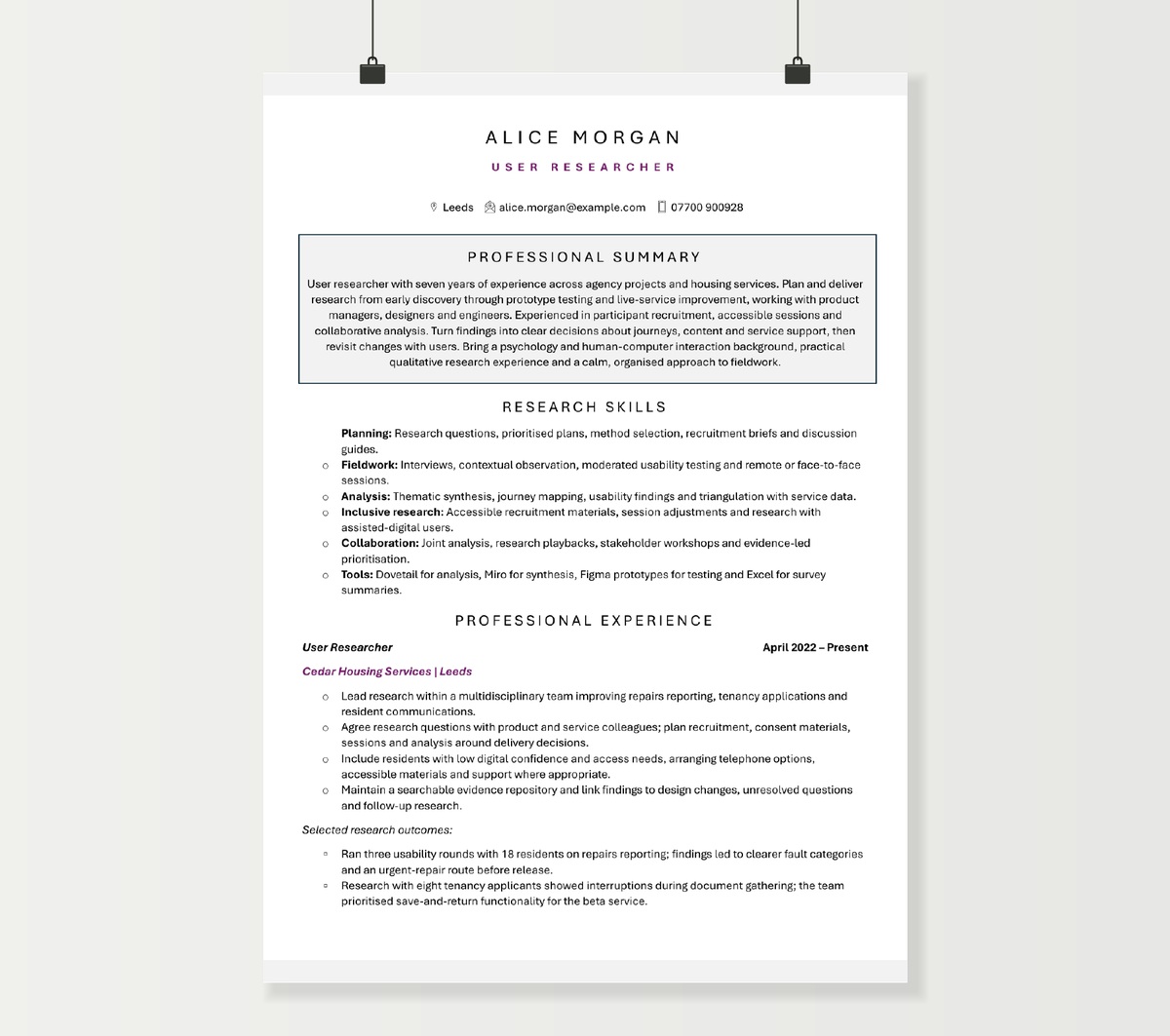
This user researcher CV template follows a researcher from a digital agency into a housing-services product team. The Word example connects research planning and fieldwork with design decisions and follow-up testing. The guide explains how to show your judgement, the quality of your evidence and the difference your research made.
Filename: FreeCVDownload_User_Researcher.docx
Content of this CV template
Alice Morgan
USER RESEARCHER
Leeds | [email protected] | 07700 900928
Professional summary
User researcher with seven years of experience across agency projects and housing services. Plan and deliver research from early discovery through prototype testing and live-service improvement, working with product managers, designers and engineers. Experienced in participant recruitment, accessible sessions and collaborative analysis. Turn findings into clear decisions about journeys, content and service support, then revisit changes with users. Bring a psychology and human-computer interaction background, practical qualitative research experience and a calm, organised approach to fieldwork.
Research skills
- Planning: Research questions, prioritised plans, method selection, recruitment briefs and discussion guides.
- Fieldwork: Interviews, contextual observation, moderated usability testing and remote or face-to-face sessions.
- Analysis: Thematic synthesis, journey mapping, usability findings and triangulation with service data.
- Inclusive research: Accessible recruitment materials, session adjustments and research with assisted-digital users.
- Collaboration: Joint analysis, research playbacks, stakeholder workshops and evidence-led prioritisation.
- Tools: Dovetail for analysis, Miro for synthesis, Figma prototypes for testing and Excel for survey summaries.
Professional experience
User Researcher | April 2022 – Present
Cedar Housing Services | Leeds
- Lead research within a multidisciplinary team improving repairs reporting, tenancy applications and resident communications.
- Agree research questions with product and service colleagues; plan recruitment, consent materials, sessions and analysis around delivery decisions.
- Include residents with low digital confidence and access needs, arranging telephone options, accessible materials and support where appropriate.
- Maintain a searchable evidence repository and link findings to design changes, unresolved questions and follow-up research.
Selected research outcomes:
- Ran three usability rounds with 18 residents on repairs reporting; findings led to clearer fault categories and an urgent-repair route before release.
- Research with eight tenancy applicants showed interruptions during document gathering; the team prioritised save-and-return functionality for the beta service.
Junior User Researcher | September 2019 – March 2022
Northlight Digital | Leeds
- Supported discovery and usability studies for charity, education and consumer-service clients, progressing to independently moderated sessions.
- Prepared recruitment screeners and discussion guides, coordinated participants and managed consent and session records.
- Analysed interview notes with senior researchers, distinguishing observed behaviour from interpretation and producing concise findings.
- Worked with designers on prototypes and presented research to client teams, explaining implications and questions for the next iteration.
Selected contributions:
- Tested a charity booking journey across two rounds: task completion was 4/8 in the first group and 7/8 in the second after design changes.
- Created a shared recruitment tracker used on 12 projects, giving the team one view of invitations, adjustments and session status.
Education & development
MSc Human-Centred Interactive Technologies – University of York, 2019
BSc Psychology — 2:1 – University of Leeds, 2018
Accessible research practice – Internal development programme, 2025
Survey design and analysis – Employer-led training, 2024
Additional information
- Community: Contribute to monthly research critiques and support new colleagues with session observation and note-taking.
- Projects: Selected research case studies available for interview, covering planning, synthesis and product decisions.
- Interests: Cycling, baking and visiting independent cinemas.
How to write a user researcher CV
A user researcher CV should make the connection between a question, the evidence you gathered and the decision that followed. Employers need to see how you choose and conduct research, make sense of findings and help a team act on them.
The strongest project descriptions reveal your judgement. They explain why the work mattered, what you personally handled and how the research changed the team’s understanding. Methods and tools support that account.
Introduce the kind of research you do
Use your opening profile to establish your experience, working context and level of responsibility. You might research consumer products, public services, internal staff systems or specialist business software. Say whether you work within a product team, across consultancy engagements or as a researcher supporting several services.
Include the phases you know. Discovery, concept evaluation, prototype testing and research on a live service involve different questions and decisions. An employer should be able to tell where you have worked independently and where you have contributed alongside a more experienced researcher.
Alice’s example combines agency work with a continuing role in housing services. That progression explains both her range of client experience and her opportunity to follow research through into later product changes.
Give selected studies a clear evidence-to-decision story
Choose studies that show relevant judgement or a useful contrast. One could demonstrate discovery in an unfamiliar problem area; another might show iterative testing, inclusive recruitment or influencing a difficult decision.
For each study, make these elements easy to find:
- The product, service or journey and the question the team needed to answer.
- Your role, the research approach and the participants involved.
- The finding that mattered and how you reached it.
- The recommendation, decision or change that followed.
- Any follow-up evidence or remaining question.
These can fit into a few employment bullets. A separate selected-projects section is useful when your job titles give little indication of the work, or when a small number of studies deserve more explanation.
In the example, research with tenancy applicants exposed interruptions while gathering documents. The CV connects that finding to prioritising save-and-return functionality. The reader learns more from this short account than from “delivered actionable insights”.
Show why a method was useful
A methods list helps recruiters locate relevant experience, but project evidence shows how you use it. Connect interviews, contextual observation, diary studies, usability testing, surveys or information-architecture studies to the question they addressed.
Where space allows, include the reason for the choice: understanding a process in its real setting, exploring an uncertain need, comparing how people interpret a proposition or finding barriers in a prototype. This communicates research judgement without turning the CV into a methods textbook.
Separate qualitative and quantitative contributions where that helps. Designing and analysing a survey, interpreting an analytics report with a specialist and leading an experiment are different experiences. A short description of your contribution is more useful than an undifferentiated “mixed methods” label.
For broader studies, explain how evidence sources came together. Interview findings may have helped explain a pattern in support contacts or product analytics. State the synthesis you performed and the conclusion it enabled the team to explore.
Make recruitment and inclusive practice visible
Recruitment is part of research quality. Your CV can show how you defined participant criteria, worked with a recruitment supplier or reached people whose experience was missing from the team’s understanding.
Describe relevant participant groups through their relationship to the service: occasional users, staff completing a complex task, people using assisted support or customers with access needs. Explain the adjustments or alternative channels you arranged where these demonstrate your capability.
Accessibility experience is strongest when attached to a study. An entry might describe researching a booking journey with screen-reader users, adapting materials for people with low literacy or arranging sessions around participants’ support needs. Clarify the research contribution and the design or service changes it informed.
Consent, participant welfare and careful handling of research material can appear through concrete responsibilities, such as preparing understandable information sheets, agreeing recording arrangements or managing access to session records. A concise account is usually enough; the CV does not need a policy manual.
Explain what happens between fieldwork and the playback
Analysis can disappear from a CV that jumps directly from “conducted interviews” to “presented findings”. Give it space. Describe how you organised observations, identified patterns, compared evidence and developed findings with the team.
Collaborative analysis is useful evidence when your role is clear. You may have facilitated sessions, helped colleagues separate observations from interpretations, explored contradictory findings or maintained a traceable link from an insight to its source.
Name outputs selectively. Journey maps, needs statements, opportunity areas and usability reports matter because of what they enabled. Explain whether a map exposed a gap between online and offline support, or whether a report helped the team choose the next prototype change.
A repository is worth mentioning when you helped people use evidence again. Describe the scope, organisation and use of the material, rather than treating the software itself as the achievement.
Demonstrate influence without claiming the whole team’s result
Show how research entered decisions. You might have brought a product manager into sessions, facilitated a prioritisation discussion, worked through conflicting stakeholder assumptions or helped a team revise its scope.
Use precise verbs: informed, prompted, supported, prioritised or tested can describe the contribution well. Explain which recommendation the team adopted and what happened next. If several disciplines delivered the change, naming your part makes the achievement easier to understand.
Some valuable research leads a team to stop, delay or narrow an idea. A CV can describe an assumption that was overturned, an investment decision that changed or a service route that was retained after research. These are meaningful outcomes even when there is no launch to showcase.
For public-service applications, include relevant service phases, multidisciplinary working and assessment contributions. Describe the evidence or presentation you prepared and the decisions it supported. Commercial applications may benefit more from customer journeys, proposition work and collaboration with product, brand or analytics colleagues.
Use numbers to explain scale and outcomes
Participant numbers, research rounds, services covered and the frequency of studies give useful context. Keep them connected to the work: three testing rounds that changed a repairs journey say more than a large total of sessions without a purpose.
For usability results, include the task and the basis of comparison. Alice’s booking example gives counts for two groups of eight participants. That makes the observation understandable as evidence from those sessions, rather than presenting it as a population-wide conversion rate.
If you have access to a live-service measure, identify the period and the team change it relates to. You can explain that research informed a redesigned journey and that the team subsequently observed fewer support contacts. This keeps the research contribution and the service result connected.
Where no reliable outcome measure exists, describe the adopted decision, resolved uncertainty or improvement in the team’s evidence. A clear qualitative result is valuable on a researcher CV.
Keep tools and qualifications in proportion
Group tools by the work you do with them: fieldwork, synthesis, research repositories, survey analysis or testing prototypes. Explain enough to distinguish using a Figma prototype in a study from designing the prototype, or analysing findings in Dovetail from administering a research repository.
Recruitment and project evidence should carry more weight than a long software inventory. Employers can assess transferable research capability even when their team uses a different platform.
List relevant degrees and focused development, including the institution or provider and date. Psychology, social research, anthropology, human-computer interaction and other backgrounds can contribute different strengths. The useful question for the CV is what your education equipped you to do and where you have applied it.
Adapt the evidence to your career stage
Junior applicants can use a placement, dissertation, substantial course project or research completed in another role. Explain the question, participant access, your method, analysis and conclusion. In group work, identify your contribution and any supervision.
Career changers can translate relevant experience from academic, market, social or service research. Bring forward interviewing, recruitment, analysis, ethics and stakeholder communication, then show any experience of iterative product or service development.
Senior applicants need evidence of setting research direction as well as conducting studies. Describe how you prioritised questions across teams, handled uncertainty, improved research practice, developed colleagues or influenced leaders. Distinguish line management, mentoring and professional leadership so the reader can see the scope of each.
A portfolio or case-study document can carry the detail behind this evidence. Link or reference a small set of readable studies and use the CV to explain why they are relevant. A research case study benefits from decisions and reasoning, even when the visual outputs are modest.
Browse other editable designs in the template library.
User Researcher CV FAQs
Use the title that reflects the vacancy in your profile, while retaining your actual job titles in employment history. The labels overlap, but the work may differ: some roles focus on digital product usability, while others include broader service journeys and offline interactions. Your project descriptions should make the relevant scope clear.
Yes. Where case studies are requested, a concise document or a private presentation may be suitable. State how the material can be shared and follow the employer’s application instructions. The CV should contain enough project evidence for an initial assessment without requiring the recruiter to visit a website.
Use an approved anonymised account of the question, your approach and the decision, with sensitive details removed. A simple process diagram or a description of the reasoning can explain your contribution without participant recordings or identifiable quotes. Check the permissions attached to any employer or client material before including it in a portfolio.
Explain the finding, your recommendation and the decision that followed. If implementation was deferred because of cost, policy or technical constraints, that context can be useful. Evidence of a well-supported decision, a revised research question or a documented risk can still demonstrate strong research work.
It can provide relevant evidence. Describe the purpose, recruitment, questions, analysis and use of the findings, keeping the original role title. A researcher application becomes stronger when it shows a considered approach and a connection to product or service decisions, rather than simply the number of customer conversations.
Follow the vacancy’s requested documents and assessment criteria. A supporting statement or behaviour example has a different purpose from the CV: it can develop the evidence against specific requirements in more detail. Keep dates, responsibilities and project facts consistent across the application, and use the available space to explain your decisions.
Show the contracting employer or consultancy, the assignment dates and the client or service context where it can be named. A brief project account should identify the phase, your responsibility and the handover or decision reached. Grouping related assignments can keep the chronology readable while showing the range of your work.