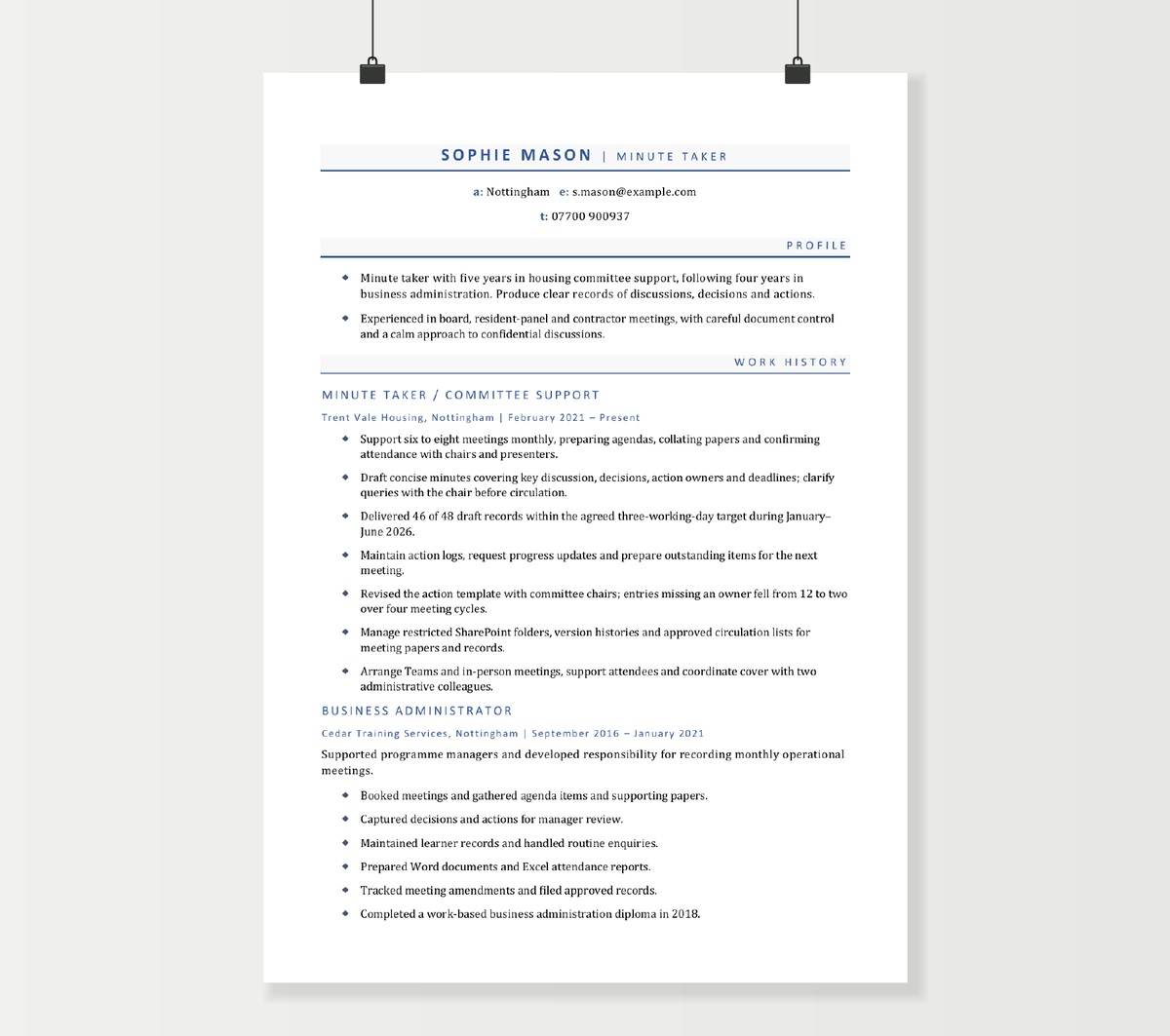
This minute taker CV template shows an administrator progressing into dedicated meeting and committee support for a housing organisation. The Word example combines accurate written records, reliable turnaround and practical support for chairs and attendees. The guide explains how to present minute-taking experience for governance, business support and specialist meeting roles.
Filename: FreeCVDownload_Minute_Taker.docx
Content of this CV template
Sophie Mason | Minute Taker
a: Nottingham e: [email protected]
t: 07700 900937
Profile
- Minute taker with five years in housing committee support, following four years in business administration. Produce clear records of discussions, decisions and actions.
- Experienced in board, resident-panel and contractor meetings, with careful document control and a calm approach to confidential discussions.
Work history
Minute Taker / Committee Support
Trent Vale Housing, Nottingham | February 2021 – Present
- Support six to eight meetings monthly, preparing agendas, collating papers and confirming attendance with chairs and presenters.
- Draft concise minutes covering key discussion, decisions, action owners and deadlines; clarify queries with the chair before circulation.
- Delivered 46 of 48 draft records within the agreed three-working-day target during January–June 2026.
- Maintain action logs, request progress updates and prepare outstanding items for the next meeting.
- Revised the action template with committee chairs; entries missing an owner fell from 12 to two over four meeting cycles.
- Manage restricted SharePoint folders, version histories and approved circulation lists for meeting papers and records.
- Arrange Teams and in-person meetings, support attendees and coordinate cover with two administrative colleagues.
Business Administrator
Cedar Training Services, Nottingham | September 2016 – January 2021
Supported programme managers and developed responsibility for recording monthly operational meetings.
- Booked meetings and gathered agenda items and supporting papers.
- Captured decisions and actions for manager review.
- Maintained learner records and handled routine enquiries.
- Prepared Word documents and Excel attendance reports.
- Tracked meeting amendments and filed approved records.
- Completed a work-based business administration diploma in 2018.
Qualifications
Level 3 Diploma in Business Administration
City & Guilds | 2018
Eight GCSEs at A*–C, including English and Maths
Nottingham | 2016
Skills
- Accurate summaries of complex discussions and agreed outcomes.
- Word: styles, document templates, Track Changes and proofreading.
- Outlook and Teams: meeting schedules, invitations and access arrangements.
- SharePoint: controlled document storage and version management.
- Excel: action logs, deadline tracking and simple workload reporting.
- Typing: 70 wpm at 98% accuracy, employer assessment, March 2026.
- Professional communication with chairs, residents and contractors.
- Confidential records and information governance; internal refresher, 2025.
- Minute-taking development workshop; internal training, 2022.
Hobbies and interests
Enjoy swimming, reading crime fiction and visiting the theatre.
How to write a minute taker CV
A minute taker CV should show that you can follow a discussion, recognise what needs to be recorded and turn it into a clear, dependable document. Typing speed helps, but the central evidence is your ability to capture meaning, decisions and actions while keeping up with a meeting.
The setting matters. Board committees, child protection conferences, contractor reviews and employee-relations meetings have different participants, records and approval routes. Name the meetings you have supported so the employer can understand the relevance of your experience.
Make minute taking visible within your job history
Many applicants have taken minutes as part of an administrator, secretary, personal assistant or business support role. Keep your actual job title and use the opening sentence or first bullet to establish the meeting work. This brings the relevant evidence forward without losing the broader context.
Give a useful sense of volume and complexity. Six monthly committees with several papers each, a weekly programme of case conferences or occasional lengthy hearings describe different workloads. Include frequency, typical duration or the range of participants when these help explain the work.
State whether you attended in person, remotely or in a hybrid setting. Experience following several speakers, managing changes to the agenda and keeping an accurate record through a long meeting can be valuable, especially when supported by a concrete example.
Sophie’s CV places minute taking at the centre of her current role and shows how it developed from an earlier administrative job. Her housing-sector meetings also give the reader a clear picture of the chairs, residents and contractors she supports.
Show the quality of the record you produce
Describe the outputs, not just attendance at meetings. These may include a draft record for the chair, a final approved set of minutes, a decision log, a schedule of actions or updates to a case-management system.
Explain what your minutes capture: key points of discussion, the basis of a decision where required, agreed outcomes, responsibilities and deadlines. The detail should fit the meeting. A short operational action record and a formal account of a sensitive case conference serve different purposes.
Choose one example showing how you handled complexity. You might have clarified an ambiguous action with the chair, distinguished a proposal from an agreed decision, resolved a reference to an earlier paper or incorporated approved corrections while keeping the document history clear.
Written English, spelling and proofreading deserve evidence because they are part of the product. Mention the checking or review responsibility you held, the documents you produced and any relevant feedback or quality measure. A claim to excellent attention to detail becomes more useful when attached to a record the employer can picture.
Where terminology is specialised, identify the field and the experience behind your familiarity. Housing maintenance, clinical governance, safeguarding and formal HR processes each involve different language. Your CV can show that you learned the terminology and produced accurate records in that environment.
Explain your relationship with the chair and participants
A good meeting record depends on professional communication as well as listening. Show how you worked with the chair before and after meetings: checking the agenda, identifying papers, raising queries, incorporating amendments and preparing the record for approval.
Distinguish your record-making responsibility from the decisions taken by the meeting. For example, “recorded agreed recommendations and updated the action schedule” tells the reader exactly what you contributed. In a specialist service, that clarity also helps show how you worked alongside practitioners or managers.
If you regularly liaise with senior leaders, elected members, families, residents or external agencies, name the groups relevant to the job. Explain the purpose of the contact, such as confirming attendance, arranging access or obtaining an update for an action log.
For sensitive meetings, a brief example of calm, tactful communication is valuable. Describe your professional contribution at the level of the meeting process: welcoming participants, responding to a practical concern or maintaining focus while recording a difficult discussion.
Present confidentiality as part of the workflow
“Handled confidential information” is a useful starting point, but it leaves the employer to infer the work. Add the type of record and the controls you used, such as restricted folders, approved circulation lists, secure case systems and document version management.
For child protection or other statutory-service roles, identify the meeting types and your administrative responsibilities clearly. Preparing records for review, updating outcomes and distributing approved documents can all demonstrate relevant experience. The CV can convey the complexity of the work through its setting and your actions, without recounting an individual case.
Information governance and safeguarding training may support the application. Give the course or internal training title and date, then connect it to the responsibilities in your employment history. Use the vacancy to decide which service-specific knowledge deserves space.
Demonstrate reliable turnaround and action tracking
Drafting time, review time and final circulation time are different measures. State which deadline you worked to and what stage you controlled. Sophie’s example measures delivery of draft records within an agreed three-working-day target; it does not leave the reader to guess whether final approval is included.
Workload evidence is stronger when it includes a period or denominator. “Delivered 46 of 48 draft records within target over six months” describes a clear service standard. You can also explain how you handled overlapping meetings, urgent changes or cover for an absent colleague.
Action tracking is worth showing separately where it forms part of the role. Describe maintaining owners and dates, requesting updates, identifying overdue items and preparing a progress report for the chair. That demonstrates follow-through beyond producing the minutes.
An improvement can concern the quality of the record itself. A clearer action template, consistent naming convention or better review tracker may reduce queries and make information easier to retrieve. Explain the problem, your contribution and what changed, using a measure if one was available.
Connect software and typing skills to the output
Microsoft Word is often central to the job. Relevant capabilities include using an agreed template, applying styles, managing tracked amendments and producing a clean final document. Describe the features you use regularly rather than rating yourself with an unexplained proficiency score.
Outlook and Teams can support scheduling, invitations, remote attendance and meeting administration. SharePoint or a case-management system may be more important for storing and distributing the finished record. Excel can help with action logs and deadline tracking. Place each tool beside the work it supports.
A tested typing speed can be helpful where the advert requests one. Include the speed, accuracy and test date or context, as Sophie does. This gives the employer something more informative than a speed alone. Your meeting examples should still demonstrate listening, summarising and written judgement.
If transcription or approved recording tools are part of your role, explain their place in the workflow and the review you perform. Following a live discussion, checking a transcript and preparing an approved record are distinct skills; an employer should be able to see which you have used.
Tailor the emphasis to the type of meeting
For committee and governance roles, bring forward agendas, paper deadlines, approval routes, decision records and work with chairs. Experience supporting a recurring calendar of meetings can show that you understand the cycle from preparation to follow-up.
For children’s services or other case-based settings, emphasise accurate handling of complex discussions, clear records of outcomes, sensitive information and coordination with practitioners and partner agencies. Name the relevant meetings and systems where you have used them.
For contractor or operational meetings, focus on actions, owners, deadlines, supporting documentation and communication across teams. For HR meetings, useful evidence may centre on neutral records, careful amendments and discreet coordination with participants.
Wider administration should support the application rather than obscure the meeting evidence. If the post combines reception, records and diary support, retain those responsibilities in proportion to the vacancy. The administrator CV example can help you present that broader part of the role.
Build evidence when minute taking is a newer skill
Start with meetings you have actually supported: a team meeting, project group, voluntary committee or staff forum can provide useful evidence. Explain the type of record, who reviewed it and how it was used afterwards.
Relevant administration experience can show preparation, document production and deadline management. A business administration qualification, written-communication training or minute-taking workshop can add context, especially when linked to practical use.
For an experienced applicant, qualifications can sit below the work history. For a first dedicated minute-taking role, a short section bringing together training and meeting experience may deserve a more prominent position. The template library includes alternative layouts for different amounts of experience.
Minute Taker CV FAQs
It depends on the vacancy and how the organisation records meetings. Many roles focus on accurate typed notes and clear written minutes. If shorthand is requested, give the system and your current working or tested speed. If it is not requested, lead with your meeting-record experience and the method you use effectively.
They overlap in listening and accurate writing, but employers may want different outputs. Transcription usually follows speech closely; minutes record the discussion and outcomes at the level required by the meeting. Transcription experience is useful on the CV, particularly when you also explain how you select, structure and summarise information for a meeting record.
Ask what format or meeting type would be most useful. An employer-set exercise is often the clearest option. An authorised public record or a sample prepared from a practice meeting can also show structure, writing and action capture. Briefly identify your role in producing the document and the review stage it represents.
Make the evidence behind the assessed skills easy to find: listening to complex discussion, accurate typing, clear summaries, decisions and actions, and delivery to a deadline. If you have a recent typing assessment, include its accuracy as well as speed. The employer’s instructions will indicate whether the exercise involves a live meeting, recording or written notes.
Yes. Put it under a clearly labelled voluntary role and describe the meetings, frequency, records and follow-up you handled. Regular responsibility for agendas, minutes and action tracking can be directly relevant, particularly when you are applying for your first paid meeting-support post.
Use a freelance minute taker entry with the overall dates, then summarise your main meeting types and selected assignments. Give the scale and output of the work, such as monthly board meetings or a series of consultation sessions. Where a client can be named, that can add context; sector and meeting type can also explain the experience.
Yes, when these are part of the vacancy. A short line stating your relevant evening availability, travel area or ability to attend meetings across several sites can answer a practical recruitment question. Keep detailed rota arrangements for the application discussion so the CV stays focused on your experience.