
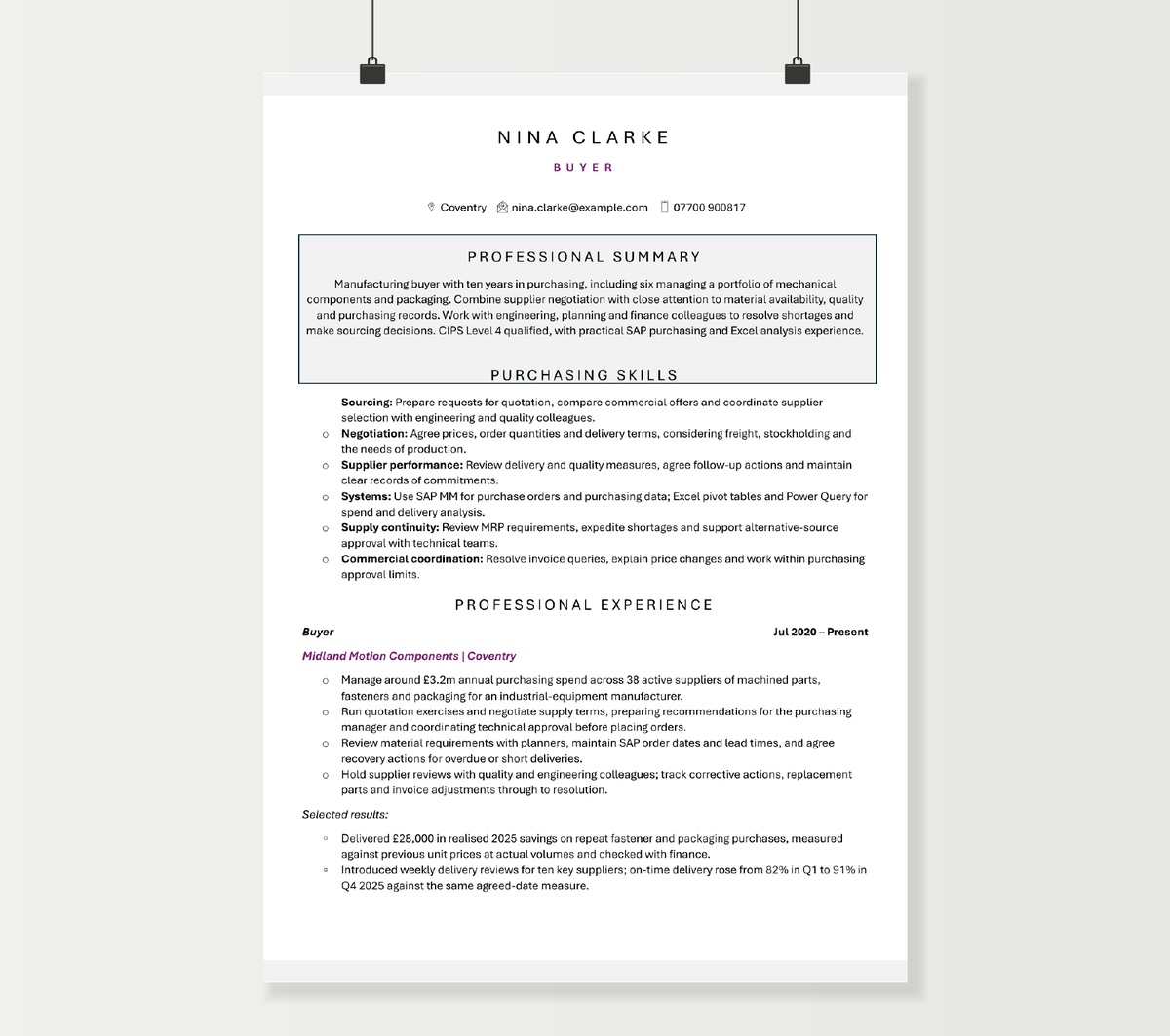
This buyer CV template follows a manufacturing buyer who progressed from purchasing support to responsibility for a supplier portfolio. The Word example covers sourcing, negotiations, material availability, purchasing systems and measurable improvements. The guide explains how to present procurement experience and how the emphasis changes for retail, operational and junior buying roles.
Filename: FreeCVDownload_Buyer.docx
Content of this CV template
Nina Clarke
BUYER
Coventry | [email protected] | 07700 900817
Professional summary
Manufacturing buyer with ten years in purchasing, including six managing a portfolio of mechanical components and packaging. Combine supplier negotiation with close attention to material availability, quality and purchasing records. Work with engineering, planning and finance colleagues to resolve shortages and make sourcing decisions. CIPS Level 4 qualified, with practical SAP purchasing and Excel analysis experience.
Purchasing skills
- Sourcing: Prepare requests for quotation, compare commercial offers and coordinate supplier selection with engineering and quality colleagues.
- Negotiation: Agree prices, order quantities and delivery terms, considering freight, stockholding and the needs of production.
- Supplier performance: Review delivery and quality measures, agree follow-up actions and maintain clear records of commitments.
- Systems: Use SAP MM for purchase orders and purchasing data; Excel pivot tables and Power Query for spend and delivery analysis.
- Supply continuity: Review MRP requirements, expedite shortages and support alternative-source approval with technical teams.
- Commercial coordination: Resolve invoice queries, explain price changes and work within purchasing approval limits.
Professional experience
Buyer | Jul 2020 – Present
Midland Motion Components | Coventry
- Manage around £3.2m annual purchasing spend across 38 active suppliers of machined parts, fasteners and packaging for an industrial-equipment manufacturer.
- Run quotation exercises and negotiate supply terms, preparing recommendations for the purchasing manager and coordinating technical approval before placing orders.
- Review material requirements with planners, maintain SAP order dates and lead times, and agree recovery actions for overdue or short deliveries.
- Hold supplier reviews with quality and engineering colleagues; track corrective actions, replacement parts and invoice adjustments through to resolution.
Selected results:
- Delivered £28,000 in realised 2025 savings on repeat fastener and packaging purchases, measured against previous unit prices at actual volumes and checked with finance.
- Introduced weekly delivery reviews for ten key suppliers; on-time delivery rose from 82% in Q1 to 91% in Q4 2025 against the same agreed-date measure.
Purchasing Assistant | Sep 2016 – Jun 2020
Avon Industrial Supplies | Coventry
- Supported two buyers with orders, supplier confirmations and delivery queries for a regional engineering distributor.
- Raised purchase orders, checked acknowledgements and updated promised dates, escalating shortages affecting customer orders.
- Compared supplier quotations, prepared simple spend summaries and kept price lists and supplier contact records up to date.
- Worked with goods-in and accounts colleagues to resolve quantity differences, returns and invoices awaiting purchase-order information.
Selected contributions:
- Created a shared acknowledgement tracker; reduced orders awaiting confirmation for more than five working days from 36 to 14 over three months.
- Supported the annual fastener review by comparing prices and order frequency across 120 regularly purchased lines, helping the buyer prepare supplier negotiations.
Education & development
CIPS Level 4 Diploma in Procurement and Supply – completed 2021
BA (Hons) Business Management — 2:1 – Coventry University, 2016
Excel data analysis and Power Query – employer development programme, 2024
Supplier quality and commercial negotiation workshops – employer training, 2025
Additional information
- Supplier development: Coordinated samples and records for a second-source trial on 12 machined components, working with engineering and quality teams.
- Working arrangements: Full UK driving licence; experienced in supplier visits and working with UK and European suppliers.
- Interests: Cycling, baking and visiting museums.
How to write a buyer CV
A buyer CV should make the commercial work visible: what you buy, the decisions you make and the results for the business. Purchase orders are part of the story, but an employer also wants to understand how you evaluate suppliers, negotiate terms, maintain supply and work with colleagues whose needs shape the purchase. The right emphasis depends on the buying role you want.
Establish your buying specialism straight away
Use your profile and the first line of each role to identify your categories and setting. A buyer of machined components, a construction materials buyer and a retail fashion buyer bring different market knowledge. Specific categories help the reader recognise the relevance of your experience before reaching the detail.
Give useful scale: annual spend, active suppliers, product lines, sites or projects supported. Choose the measures that describe your remit. For a manufacturing buyer, “£3.2m annual spend across machined parts, fasteners and packaging” is meaningful. For a retail buyer, category sales, range size and channels may provide a better starting point.
Explain your decision-making responsibility too. Preparing quotation comparisons, leading supplier negotiations and approving an award are distinct contributions. A concise description of your part helps the recruiter assess your level without relying on the job title alone.
Show the sourcing work behind an order
Choose one or two examples that follow a buying decision from requirement to outcome. The useful detail is the category, the commercial or operational need, your evaluation or negotiation, and what the business gained. This can demonstrate judgement more effectively than a general list of procurement processes.
A manufacturing example might explain how you compared alternative suppliers with engineering and quality colleagues before recommending a source. A project buyer might describe a quotation exercise for a materials package, including delivery requirements and coordination with the site team. An indirect buyer may have evaluated service levels and contract terms alongside price.
Give negotiation some substance. You may have improved unit prices, payment terms, minimum order quantities, lead times, call-off arrangements or warranty support. State the useful change and its significance to the operation. This shows what “strong negotiation skills” means in your work.
Present savings with enough context to be meaningful
A saving is easier to assess when its basis is clear. Give the category, period, comparison and your contribution. “Delivered £28,000 in realised annual savings on repeat purchases, measured against previous unit prices at actual volumes” tells the reader much more than a percentage without a baseline.
Use the measure that your organisation actually reports. Realised savings, annualised projections, cost avoidance and reductions in purchase-price variance describe different things. A few words identifying the measure make the achievement more credible and easier to discuss at interview.
Include the wider outcome where it mattered. A price reduction may have been valuable because delivery performance and quality were maintained; a revised order quantity may have reduced stockholding; a new supply arrangement may have removed recurring premium freight. Select the outcome that best explains the business benefit rather than squeezing every measure into one bullet.
Give supply continuity equal weight
Operational buyers often spend substantial time keeping materials available. Show how you manage that responsibility: reviewing demand with planners, obtaining supplier commitments, resolving shortages and keeping order dates accurate. These duties become stronger CV evidence when linked to the production, project or customer requirement they support.
If you improved supplier delivery, state the supplier group and reporting period. The example CV refers to ten key suppliers and compares the same on-time-delivery measure between two quarters. That makes the result understandable without requiring a long explanation of the underlying report.
Supplier development can also provide a useful achievement. Describe work on recurring quality issues, alternative sourcing, capacity constraints or excessive lead times. Identify the colleagues involved and your commercial contribution. Coordinating samples, chasing agreed corrective actions and completing supplier records can all be important parts of a wider improvement.
Explain how you use purchasing systems and data
Name the ERP or purchasing system and connect it to your work. Relevant detail may include MRP-driven orders, supplier acknowledgements, source lists, price records, lead times, purchase-order amendments or invoice queries. “SAP MM purchasing data and order management” is more useful than a software name without context.
For Excel, describe the analysis you carry out. Spend summaries, quotation comparisons, delivery scorecards and price-change analysis all provide clear evidence. Mention pivot tables, Power Query or other features where they support that work. The purpose of the analysis should remain more prominent than the tool.
Make the link between information and a decision. You might have grouped repeated orders to prepare a supplier review, identified a pattern in overdue lines or compared freight-inclusive costs. That shows how your analysis improves buying decisions rather than simply producing reports.
Show how you work with the people who need the purchase
A buyer rarely makes decisions in isolation. Choose examples involving the teams that matter in your sector: engineering and quality, production and planning, project managers, finance, retail merchandising or product development. Explain what you resolved or agreed with them.
Useful evidence includes clarifying a specification, balancing an urgent requirement against supply options, resolving a goods-received discrepancy or explaining a price change. These examples show communication and commercial judgement through work that a hiring manager will recognise.
Where governance is central to the role, identify your experience of approvals, tender records, supplier onboarding or delegated authority. Keep it linked to the transactions or sourcing projects you supported. A list of policies is less useful than a clear account of how you helped a purchase progress through the organisation.
Adjust the evidence for retail buying
A retail buyer CV needs a clear account of category performance and customer demand. Bring forward your product area, range responsibilities, routes to market and work with merchandising or planning colleagues. Explain how you used sales, margin, stock and customer information to make range or trading decisions.
Choose achievements involving product selection, launches, supplier negotiations, availability, markdown exposure or profitable growth, according to your remit. State the category and period so the result has context. If you worked across stores and online, show how that influenced your decisions or coordination.
For an assistant buyer, valuable evidence may include sample coordination, product information, critical-path tracking, supplier communication and analysis that supported a range review. For a buyer with full category responsibility, give more space to commercial decisions, supplier relationships and cross-functional influence.
When moving between retail and procurement buying, keep the common strengths visible but describe the new sector’s priorities explicitly. Supplier negotiation and analysis transfer well; the reader still needs to understand your familiarity with the products, demand patterns and measures relevant to the vacancy.
Make qualifications and development precise
Give the full CIPS qualification title, level and completion date. If you are studying, state the qualification in progress and expected completion where known. Present a professional membership designation separately from a qualification so your current position is immediately clear.
Include a relevant degree, apprenticeship or technical qualification where it supports the categories you buy. Engineering knowledge may be valuable in a component-buying role; product or commercial experience may matter more in retail. Recent training in negotiation, supplier management or relevant systems can add useful evidence alongside practical experience.
Qualifications should support the employment story. A short line explaining how you used a course in a supplier review or a purchasing improvement may be more useful than listing every module. For graduate applications, a relevant project can show analysis, comparison of options and a reasoned recommendation.
Show readiness for your next level
If you are moving from purchasing assistant to buyer, bring forward the work in which you took greater responsibility: obtaining quotations, maintaining supplier contact, resolving order problems or preparing a recommendation. Make your contribution to a senior buyer’s decision clear and give at least one example of following an issue through to completion.
For an experienced buyer, select evidence of a wider portfolio, more complex negotiations, supplier development or improved commercial outcomes. Progression can be visible through responsibility even when the job title has stayed the same.
If the next role involves leading a team or a broader procurement function, the procurement manager CV example shows how to give more prominence to strategy, governance and leadership. For a buyer application, keep the strongest evidence close to your own sourcing and supplier work.
Buyer CV FAQs
You can use an approved percentage, a rounded figure or a description of the result at category level. Explain the comparison and your contribution without revealing sensitive supplier prices or contract terms. For example, an improvement in delivery performance or a change to order quantities may demonstrate value even when the financial result cannot be shared.
Level 4 is a qualification in its own right and should be listed by its full title. MCIPS is a separate professional designation. Show the qualification you have completed and your current membership grade separately; if you are progressing through further study, add that as an in-progress entry.
Identify the relevant buying conditions in your previous work: long lead times, technical specifications, international suppliers, seasonal demand or service contracts, for example. Then show how you learned a previous category or worked with specialists to make decisions. This gives the employer evidence of adaptability alongside your existing commercial skills.
It can be a useful achievement when clearly labelled. State the proposed increase or cost exposure, the action you took and the resulting position over a defined period. Keep it separate from realised savings so the reader can understand the type of value you delivered.
It can help when the vacancy involves range development, product selection or a strong creative element. A short, permitted case study can show the customer need, range decision, your contribution and commercial outcome. Many buyer roles are assessed effectively through a CV and interview, so use a portfolio when it adds evidence rather than as a routine requirement.
Give greater prominence to the procurement procedures, approval records, tender support and supplier evaluation you have actually worked with. Name the relevant regime and organisation where helpful, because arrangements differ across jurisdictions and contracts. Evidence of value for money, transparent decisions and collaboration with service users is particularly useful alongside your category knowledge.




