
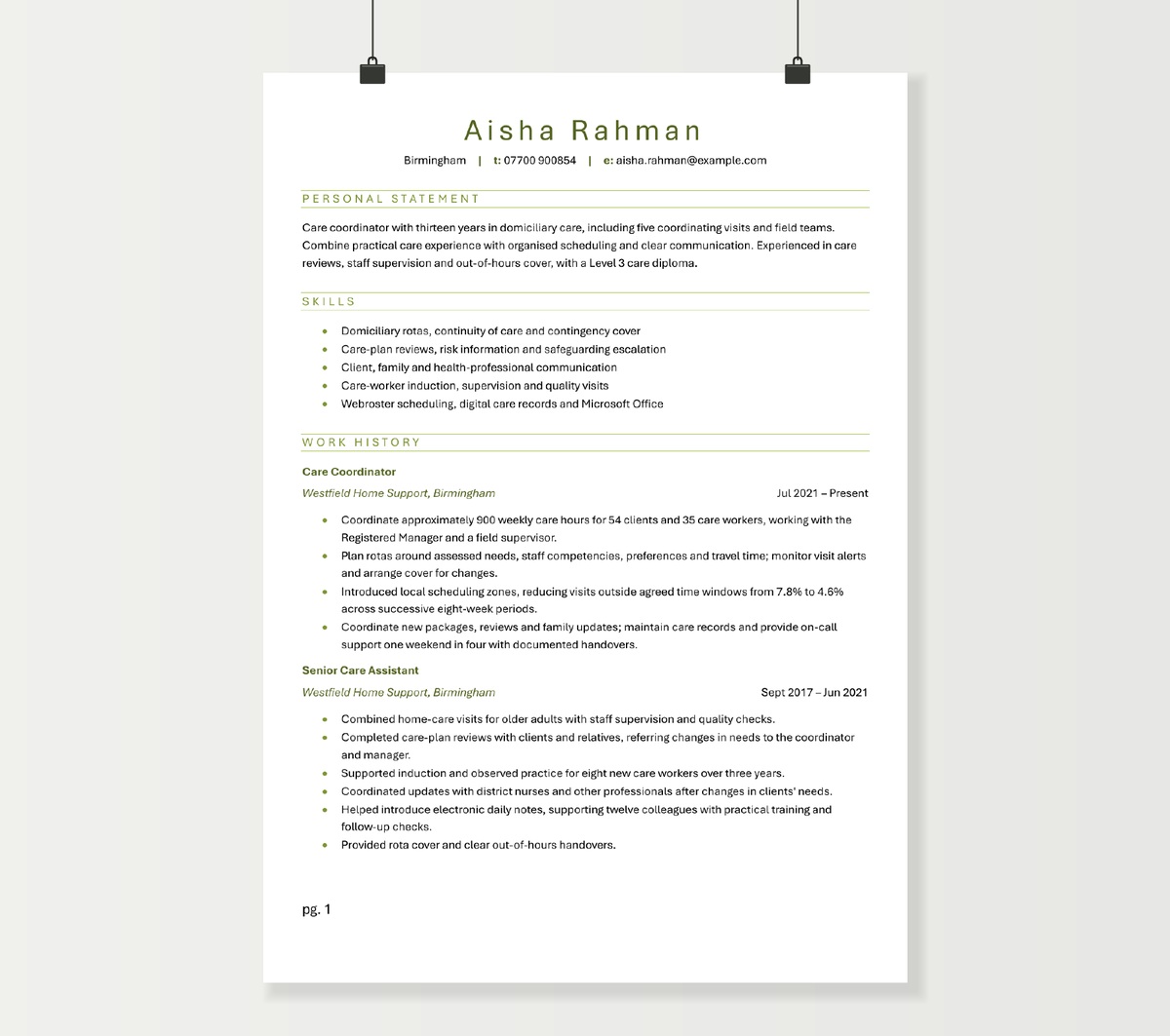
This care coordinator CV template follows an experienced home-care worker into senior care and domiciliary coordination. The Word example combines scheduling, care reviews, staff support and communication with people receiving care. The guide explains how to present this experience and how the emphasis changes for referral-centre, primary-care and clinical coordination roles.
Filename: FreeCVDownload_Care_Coordinator.docx
Content of this CV template
Aisha Rahman
Birmingham | t: 07700 900854 | e: [email protected]
Personal statement
Care coordinator with thirteen years in domiciliary care, including five coordinating visits and field teams. Combine practical care experience with organised scheduling and clear communication. Experienced in care reviews, staff supervision and out-of-hours cover, with a Level 3 care diploma.
Skills
- Domiciliary rotas, continuity of care and contingency cover
- Care-plan reviews, risk information and safeguarding escalation
- Client, family and health-professional communication
- Care-worker induction, supervision and quality visits
- Webroster scheduling, digital care records and Microsoft Office
Work history
Care Coordinator
Westfield Home Support, Birmingham
Jul 2021 – Present
- Coordinate approximately 900 weekly care hours for 54 clients and 35 care workers, working with the Registered Manager and a field supervisor.
- Plan rotas around assessed needs, staff competencies, preferences and travel time; monitor visit alerts and arrange cover for changes.
- Introduced local scheduling zones, reducing visits outside agreed time windows from 7.8% to 4.6% across successive eight-week periods.
- Coordinate new packages, reviews and family updates; maintain care records and provide on-call support one weekend in four with documented handovers.
Senior Care Assistant
Westfield Home Support, Birmingham
Sept 2017 – Jun 2021
- Combined home-care visits for older adults with staff supervision and quality checks.
- Completed care-plan reviews with clients and relatives, referring changes in needs to the coordinator and manager.
- Supported induction and observed practice for eight new care workers over three years.
- Coordinated updates with district nurses and other professionals after changes in clients' needs.
- Helped introduce electronic daily notes, supporting twelve colleagues with practical training and follow-up checks.
- Provided rota cover and clear out-of-hours handovers.
Care Assistant
Rosemead Home Care, Birmingham
Sept 2013 – Aug 2017
- Delivered personal care, meal support and companionship in clients' homes.
- Supported medication in line with care plans, training and assessed competence.
- Recorded visits and changes in wellbeing, raising concerns with the senior team.
- Built consistent relationships with clients and respected their routines and choices.
Qualifications
Level 3 Diploma in Health and Social Care (Adults) for England
City & Guilds
2016
- Work-based qualification completed alongside domiciliary care duties.
- Care Certificate completed through employer assessment, 2016.
- 8 GCSEs, including English and Maths at grade C or above, 2013.
Continuing development
Employer and local safeguarding partnership
2025 – 2026
- Safeguarding adults, dementia care, mental capacity, moving and handling, medication support and care-plan review.
Hobbies and interests
- Cooking: Trying recipes with family and friends.
- Walking: Exploring local parks and canals.
- Reading: Contemporary fiction.
Additional information
Full UK driving licence and own car. Enhanced DBS on the Update Service.
How to write a care coordinator CV
A care coordinator CV should show how your organisation and communication help people receive consistent, appropriate support. The strongest evidence connects the practical work—rotas, referrals, records, reviews and follow-up—with the experience of people receiving care and the colleagues delivering it.
Start by identifying the setting. Domiciliary care coordinators often organise care packages and field teams. Referral-centre roles may focus on information, appointments and access to services. Some mental-health and other clinical coordinator posts require a registered professional. The same title can therefore call for quite different evidence.
Make your care setting and responsibilities clear
Your profile should establish the type of service, your relevant experience and the contribution you bring. A home-care applicant might lead with coordination of visits, earlier frontline care experience and work with clients and families. A primary-care applicant could emphasise patient contact, referral follow-up and communication across services. For a clinical vacancy, professional registration, clinical experience and the relevant patient group belong near the top.
Give each recent job a short description of its scope. In domiciliary care, client numbers, weekly care hours, the number of care workers and geographical coverage can explain the service. For a referral centre, the types of referral, services supported and operating hours may be more useful. For a caseload role, describe the population and complexity alongside the size of the caseload.
Clarify how you worked with the registered manager, field supervisors, clinical colleagues or other coordinators. This helps an employer understand which decisions you made, what you reviewed and how you escalated concerns. A coordinator who owns a local rota and supports reviews has different responsibilities from a registered practitioner assessing and treating patients.
Show the judgement behind care scheduling
For home-care applications, “managed rotas” needs some explanation. Useful detail includes matching staff competence and availability to assessed needs, maintaining familiar care teams, allowing travel time and responding to changes in visits. Describe the factors you balanced and the outcome, rather than listing scheduling tasks in isolation.
Continuity can be particularly important for people living with dementia, people who need communication support or clients whose routines depend on agreed visit times. If you improved regular-team allocation, reduced last-minute changes or reorganised geographical runs, explain how that affected the service. The operational improvement is strongest when the benefit to clients and care workers is visible.
For example: “Reorganised two local runs around agreed visit windows and travel time, reducing late arrivals over the following eight weeks.” A measured before-and-after result can add precision. Keep the measure tied to the service definition, such as arrival outside an agreed time window, so the reader understands what improved.
Capacity planning also matters. Show how you worked with managers when considering new packages, staff leave or a change in care needs. Coordinating introductions, checking availability and preparing a clear start arrangement can demonstrate good judgement without requiring a large project or management title.
Present care reviews and changing needs through your contribution
Care-plan experience should describe what you did with the person receiving support and the people involved in their care. You may have gathered preferences, recorded a change, arranged a review, updated agreed information or checked that the field team received it. Choose wording that makes your part in the process clear.
For a new care package, explain how you helped turn an assessment and agreed plan into a workable service. This might include arranging staff introductions, confirming visit arrangements, coordinating information with a family or professional and checking that the first visits took place as planned. For complex care, show how you worked with clinical colleagues on staffing readiness and the delivery requirements they established.
A useful work-history example can follow one change from identification to follow-up: a care worker raised a concern, you arranged the appropriate review, the agreed plan changed and the team received an updated handover. The CV needs only the key contribution and result, expressed without personal case details.
For registered clinical roles, the emphasis will be different. Give space to assessment, clinical planning, risk management, multidisciplinary work and the interventions within your professional practice. A domiciliary scheduling example can inform the layout, but the evidence needs to match the clinical person specification.
Make communication more specific than “good people skills”
Care coordinators often handle conversations when someone is worried, frustrated or unsure what happens next. Show how you made those conversations useful: explaining a change in visits, gathering information for a review, following up a referral or keeping a family informed while a manager considered a concern.
Identify the people you regularly worked with where it helps establish your experience. These may include clients, relatives, care workers, GPs, district nurses, social workers, commissioners and hospital discharge teams. Follow the list with an example of coordination, rather than expecting the names alone to demonstrate effective relationships.
Communication preferences are also relevant. Experience arranging an interpreter, adapting written information or recording how someone prefers to be contacted can show a thoughtful approach to access. Where a person relied on an advocate or representative, describe how you supported joined-up communication within the agreed arrangements.
In referral or primary-care coordination, highlight follow-through. A referral sent, an appointment arranged and a query resolved are different stages. Explain which stages you tracked and how you helped people understand their next step. That gives administrative experience a clear connection to the service provided.
Show reliable records, systems and handovers
Name scheduling and care-record systems alongside the work you performed in them. Webroster or another rota platform can be connected to allocation, visit monitoring and changes. Digital care records can be linked to review updates, communication notes, audit actions or quality checks. In primary care or referral services, use the relevant patient-record and referral systems from your own experience.
Useful evidence goes beyond data entry. Describe checking missing information, reconciling a schedule with an agreed package, following up a visit alert or keeping a review tracker current. If you helped colleagues adopt a new system, state the number trained, the part of the process covered and any support you provided after launch.
On-call and shift handovers deserve attention where they are part of the role. Show how you recorded outstanding issues, arranged suitable cover and passed information to the next colleague or manager. A concise example of dependable continuity is more persuasive than a general claim to work well under pressure.
For quality or inspection support, identify the evidence you maintained and the actions you followed up. Care-record audits, review dates and supervision records may be relevant. This helps an employer understand your contribution to the service’s quality systems without blurring it with the registered manager’s overall accountability.
Describe safeguarding and escalation as practical experience
Safeguarding knowledge is important, and the CV can demonstrate it through appropriate action. An experienced applicant might describe recognising concerns in records or conversations, documenting the relevant information, raising it through the agreed route and following up actions with the manager or safeguarding lead.
Keep examples focused on your contribution and the process, using a level of detail suitable for a CV. A brief statement about coordinating information and maintaining accurate follow-up can show sound judgement. Recent training can support this evidence in the qualifications section.
The same approach works for incidents, complaints and urgent service disruption. Explain how you prioritised the issue, involved the appropriate colleague and maintained communication. For an on-call role, it can be useful to state the rota frequency and the type of operational support you provided.
Show how you supported care workers
Coordination depends on relationships with the field team as well as a workable schedule. If you helped with induction, supervision, spot checks or training, explain the scope. Supporting eight new colleagues over three years, reviewing daily notes or coaching staff through a new recording system are concrete examples.
Distinguish formal line management from day-to-day support. Both can be relevant. A coordinator may allocate visits and resolve queries while the registered manager handles appraisals and employment decisions. Clear wording lets an employer assess your experience for either a coordination role or a step towards supervision.
Applicants progressing from frontline care should make these developing responsibilities easy to find. Shift leadership, rota cover, new-starter support and contributions to reviews can provide the bridge. The care assistant example can help with the earlier care-history section, while the recent bullets should show the move into coordination.
Choose results that explain service quality
Useful care-coordination results include improved visit timeliness, more consistent care teams, completed reviews, fewer unresolved scheduling queries or better handover information. Give the period and scope when using figures. A percentage is more meaningful when the reader knows whether it refers to visits, clients, referrals or records.
Some improvements are best described without a percentage. Establishing an induction process, coordinating the start of a complex package or introducing a shared review tracker can be substantial achievements. Explain what changed and who benefited.
For a care or health outcome achieved by several professionals, make your contribution visible. Arranging appointments, maintaining contact or coordinating agreed support may have helped the wider result. That precise account is useful evidence of teamwork and gives you a clear example to discuss at interview.
Qualifications and applications from another background
List relevant care qualifications with their full titles, awarding bodies and completion dates. Add selected current training where it supports the vacancy, such as safeguarding, dementia care, mental capacity or record keeping. A Care Certificate and a diploma can be listed separately because they describe different learning and assessment.
Requirements depend on the role and the part of the UK. A domiciliary coordinator vacancy may value a care qualification and frontline experience; a referral-centre role may prioritise administration and customer service. A registered clinical post will specify its professional requirements. Use the person specification to decide which qualifications and experience need greatest prominence.
Applicants coming from scheduling, reception or customer service can demonstrate transferable evidence through managing changing appointments, keeping accurate records, handling sensitive conversations and following up requests. Connect each example to the coordination work sought. Relevant care exposure, volunteering or completed training can then show your understanding of the setting.
Driving, access to a vehicle and availability for the required working pattern are useful practical details when the role involves home visits or on-call cover. Keep them in a short additional-information entry. For a primarily administrative application, the CV template library also offers formats with more space for office and service experience.
Care Coordinator CV FAQs
Use the agency as the employer and give the dates, with a concise description of the settings or assignments. Highlight responsibilities that support coordination, such as adapting to different care plans, clear handovers, maintaining records and helping new colleagues. A few substantial assignments can be named or grouped where that makes the experience easier to understand.
It can provide relevant context, especially for someone changing careers. A short, clearly labelled entry can describe organising appointments, communicating with services or coordinating practical support. Paid employment, qualifications and any formal coordination responsibilities can then show the other evidence you bring to the role.
Yes, where it demonstrates the combined nature of the job. Explain the normal balance and the circumstances in which you provided frontline cover. This shows practical understanding of the service while keeping your main coordination responsibilities visible. It is particularly relevant to vacancies that combine office work, field visits and on-call support.
Give one concise example of the mobilisation work: confirming staffing, arranging introductions, coordinating records and agreed visit times, and checking the initial service with the client or family. State the number or type of packages if it helps explain scale, and identify how you worked with the manager or clinical team.
Use the CV as a clear record of your employment, qualifications and strongest examples, then organise the supporting information around the person specification. Expand the examples that demonstrate its essential criteria, particularly communication, prioritisation, records and the relevant care setting. Include professional registration and clinical evidence where the particular role requires them.




