This educational psychologist CV template presents qualified practice alongside doctoral placements, earlier assistant experience and applied research. The Word example focuses on an England-based service, including consultation and psychological advice for EHC needs assessments. The guide covers how to evidence your contribution at child, school and service level.
Filename: FreeCVDownload_Educational_Psychologist.docx
Content of this CV template
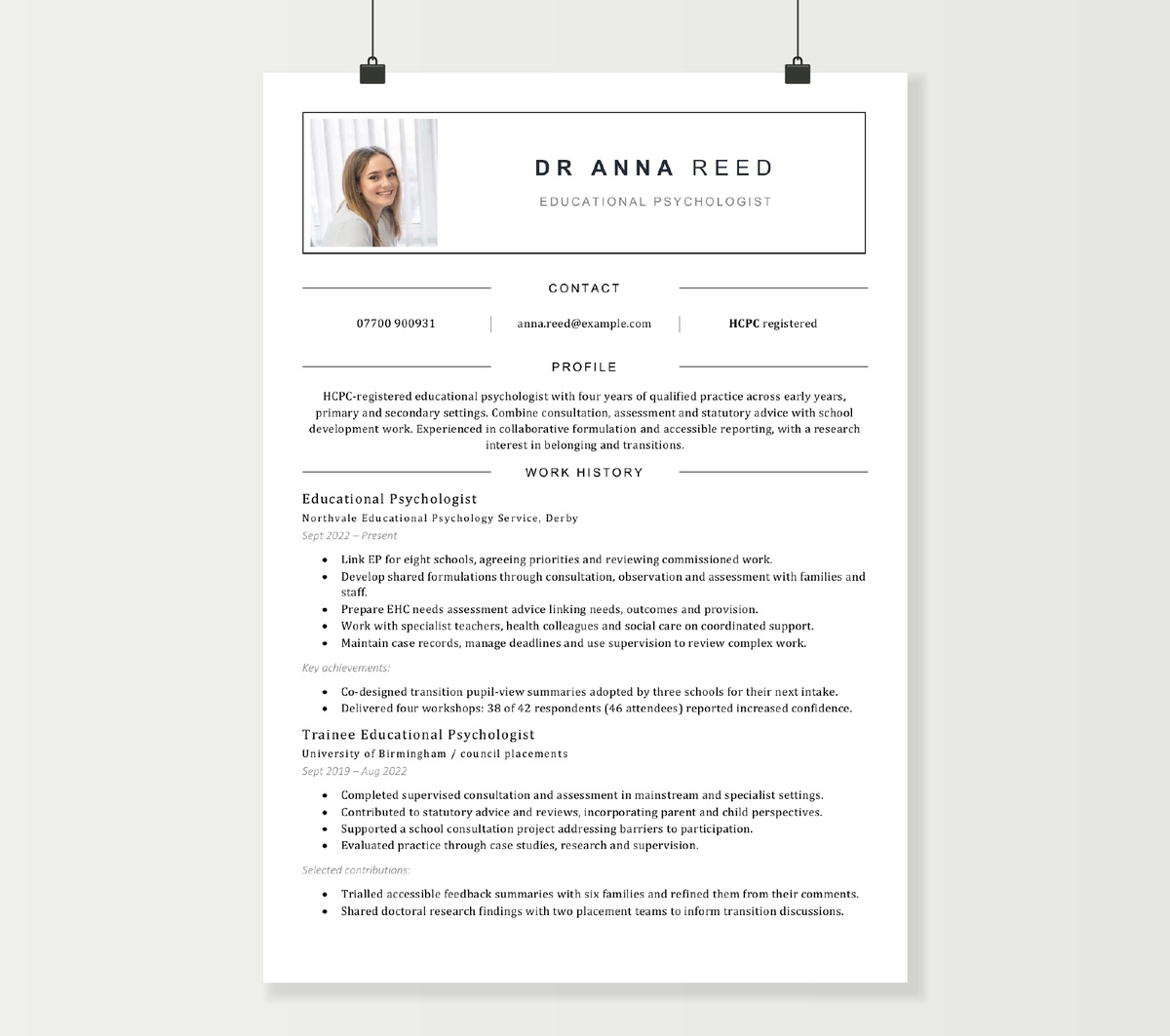
DR ANNA REED
EDUCATIONAL PSYCHOLOGIST
CONTACT
07700 900931
HCPC registered
PROFILE
HCPC-registered educational psychologist with four years of qualified practice across early years, primary and secondary settings. Combine consultation, assessment and statutory advice with school development work. Experienced in collaborative formulation and accessible reporting, with a research interest in belonging and transitions.
WORK HISTORY
Educational Psychologist
Northvale Educational Psychology Service, Derby
Sept 2022 – Present
- Link EP for eight schools, agreeing priorities and reviewing commissioned work.
- Develop shared formulations through consultation, observation and assessment with families and staff.
- Prepare EHC needs assessment advice linking needs, outcomes and provision.
- Work with specialist teachers, health colleagues and social care on coordinated support.
- Maintain case records, manage deadlines and use supervision to review complex work.
Key achievements:
- Co-designed transition pupil-view summaries adopted by three schools for their next intake.
- Delivered four workshops: 38 of 42 respondents (46 attendees) reported increased confidence.
Trainee Educational Psychologist
University of Birmingham / council placements
Sept 2019 – Aug 2022
- Completed supervised consultation and assessment in mainstream and specialist settings.
- Contributed to statutory advice and reviews, incorporating parent and child perspectives.
- Supported a school consultation project addressing barriers to participation.
- Evaluated practice through case studies, research and supervision.
Selected contributions:
- Trialled accessible feedback summaries with six families and refined them from their comments.
- Shared doctoral research findings with two placement teams to inform transition discussions.
EARLIER EXPERIENCE
Assistant Educational Psychologist | Sept 2017 – Aug 2019
Sherwood EPS, Nottingham. Supported supervised group work, observations and evaluation.
Collated school feedback and prepared resources for consultation and training.
Doctoral research | 2019 – 2022
Explored pupils’ experiences of belonging during transition to secondary school.
Thematically analysed ten pupil interviews and developed implications for consultation.
Presented findings to placement colleagues and contributed a practice briefing.
QUALIFICATIONS
Applied Educational & Child Psychology Doctorate
University of Birmingham | 2022
BSc (Hons) Psychology — 2:1
University of Nottingham | 2017
Registration & development
HCPC — Educational Psychologist
Registered since 2022
Recent CPD: dynamic assessment and relational practice
Service development programme | 2025–2026
SKILLS
Consultation
Shared formulation with families and school staff.
Assessment
Integrating observations and assessment findings.
Training & evaluation
Workshops and feedback analysis.
Reporting
Accessible psychological advice and feedback.
Derby, East Midlands
How to write an educational psychologist CV
An educational psychologist CV needs to show how you apply psychology to understand a situation and help people decide what to do next. A list of assessments, interventions and school visits gives limited insight into that contribution. Stronger evidence connects consultation, formulation and assessment with agreed actions, review and learning.
Make your professional stage and service context clear, then select examples that show the level at which you work: with an individual child or young person, a family, a group, a school or a wider service.
Establish registration, qualification and practice context
Place your current HCPC registration and educational psychology qualification where they can be found quickly. List the exact award, university and completion date. Professional membership or chartered status can appear alongside this as separate information.
For a trainee application, state your programme, year of training and expected qualification date. Describe placements as supervised practice and make the anticipated transition into qualified employment clear. This allows a service to assess your experience in the context of its recruitment timetable.
Use the profile to identify your setting and principal contribution. Relevant context might include local-authority work, a traded school service, an independent practice, early years, post-16 work or a specialist population. Anna’s example establishes four years of qualified practice, school consultation and statutory advice, with a developing interest in belonging and transitions.
Keep the jurisdiction visible. The example uses the language of England’s SEND and EHC processes. Applications elsewhere in the UK should describe the frameworks and systems used in that setting, while retaining the psychological contribution that transfers between services.
Show the reasoning behind consultation and assessment
Select casework examples that reveal your contribution without needing a long case history. A concise entry can describe the referral question or barrier to participation, the people involved, the information you brought together and the next step agreed.
Consultation can demonstrate skilled work with different perspectives. Explain how you helped a family and school develop a shared understanding, supported staff to identify priorities or contributed to a review when existing support was not working as intended.
For assessment, name an approach or tool when it adds useful information, then connect it to the purpose and formulation. Observation, dynamic assessment, structured assessment and discussion with the child can each contribute different evidence. The employer needs to understand how you integrated that evidence and communicated its implications.
A technical-skills list can identify selected assessment experience, but the employment section should show its use. Choose examples that reflect the service’s work rather than trying to include every measure encountered during training.
Present statutory work as psychological advice with a clear contribution
For an England-based application, describe your experience of providing psychological advice for Education, Health and Care needs assessments and contributing to reviews. Explain how your work links the assessment of needs with outcomes and provision, and how you incorporate the views of children, young people and families.
Give the scope and level of responsibility. Preparing advice during a supervised placement, managing an allocated statutory workload and supporting quality assurance across a team provide different evidence. Make that distinction through the description of your work.
Reporting skills are especially useful when made concrete: integrating information from several sources, explaining a formulation accessibly, producing recommendations that others can use or responding to questions in a multi-agency meeting. If you have relevant tribunal experience, identify your contribution and professional role rather than relying on the word “tribunal” alone.
Workload figures can establish scale, but balance them with evidence of quality and communication. A service needs to understand how you organise timely work as well as how many pieces of advice you complete.
Make inclusion and participation visible in your examples
Show how children’s and young people’s perspectives influenced your work. An adapted consultation method, accessible feedback format or change to a transition plan can demonstrate this more effectively than a general statement about valuing pupil voice.
Describe the setting and what changed as a result of the participation. Anna’s transition example connects work with three schools to their adoption of a pupil-view summary for the next intake. It presents a specific practice change rather than claiming a broad improvement in wellbeing.
Experience with culturally responsive practice, interpreters, communication differences or groups whose perspectives are less often heard can be valuable. Explain the adaptation and its relevance to the consultation or assessment. The emphasis should be on how you made your work more accessible and useful.
For specialist interests such as emotionally based school avoidance, neurodivergence, care-experienced children or early years, show depth through relevant work, development and evaluation. A focused example helps the employer distinguish an emerging interest from an established specialist remit.
Include work with adults, schools and wider systems
Many services want to build capacity around children as well as provide individual casework. Include consultation with school leaders, staff development, parent work, group interventions or contributions to an inclusion project where these form part of your experience.
For training, explain the audience, purpose, your role and follow-up. Developing and delivering a programme, contributing one session and supporting an existing offer involve different responsibilities. Add evidence of how participants used the work if this was evaluated.
School or service projects can demonstrate planning and collaboration. Describe how priorities were agreed, who was involved, what you produced and what was adopted or reviewed. A project may have value through a better consultation process, an accessible resource or stronger coordination, even before longer-term outcomes are known.
Multi-agency work becomes clearer when you name the professional groups and shared task. For example, explain your psychological contribution to a transition review with education, health and social-care colleagues, or to a school project alongside specialist teachers and therapists.
Choose outcomes that suit psychological work
Use evidence that matches what your work was intended to achieve. This might include progress against jointly agreed goals, participation in a reviewed activity, changes in staff practice, family feedback, adoption of a resource or a service improvement.
Give the basis of any figure. Anna’s workshop entry distinguishes the 46 attendees from the 42 feedback respondents and reports the number who described increased confidence. That is useful information about participant feedback, rather than a measure of children’s longer-term outcomes.
Qualitative evidence can be equally helpful. A short account of a revised formulation, a jointly agreed plan or a change adopted after consultation may explain your impact more accurately than a percentage. Include the review period or source of feedback where it helps the reader interpret the result.
For shared work, connect your contribution with the team’s outcome. This preserves the collaborative nature of educational psychology while showing the skill and judgement you brought to it.
Use research and evaluation as applied evidence
A doctorate gives newly qualified applicants substantial research experience, but the full thesis title may say little to a recruiting service. Summarise the question, population or setting, method and practical implications in a few lines.
Anna’s research entry identifies transition and belonging, ten pupil interviews, thematic analysis and dissemination to placement teams. It shows both the research process and the connection to practice.
Experienced applicants can bring forward service evaluations, action research, participation projects and contributions to professional learning. Explain what decision the work informed or how findings were shared. Publications and conference contributions can be listed selectively, with a fuller academic record supplied separately if the role calls for one.
Software is useful supporting information where it reflects the work: qualitative analysis, survey analysis, case recording or presentation. Keep it proportionate to the role. The research question and interpretation generally deserve more emphasis than the name of the analysis package.
Show how your responsibility has developed
A newly qualified CV can give substantial space to placements, supervised casework, research and earlier work with children or young people. Identify the settings and your contribution, then use the profile to explain the professional stage you have reached.
For an established practitioner, recent qualified work should lead. Earlier assistant, teaching or support roles can remain in a shorter section where they explain your progression or add relevant experience.
Senior applications need evidence beyond a larger caseload. Include professional supervision, mentoring, quality assurance, service development, commissioning or strategic partnership work according to the vacancy. Distinguish supervision from line management and describe the people or functions within your remit.
A specialist leadership role may involve influencing practice across a service without managing staff. In that case, show the project, specialist contribution, partnerships and changes adopted. This gives the reader a clear account of leadership through expertise.
Connect professional development with practice
Choose recent CPD that supports your current responsibilities or intended move. An entry becomes more informative when the CV also shows where that development influenced assessment, consultation, training or service work.
Supervision and reflective practice can appear through an example of developing your approach, contributing to a learning group or supporting another practitioner. Safeguarding experience is strongest when its scope is clear, such as participation in multi-agency work or relevant training, without including sensitive case details.
Many educational psychology employers use an application form and supporting statement. Treat the CV as a clear career record; use the statement to develop examples against the person specification. Keep dates, qualifications and descriptions consistent across both. Other editable layouts are available in the CV template library.
Educational Psychologist CV FAQs
No. HCPC registration is the professional registration relevant to practising under the protected title Educational Psychologist. BPS membership and chartered status are separate professional credentials. Give each its own clear entry so that a recruiter can identify your current registration and any additional membership or designation.
Some services recruit trainees ahead of qualification. Where the vacancy welcomes this, state your training year, expected completion date and current registration position, and give the proposed availability requested in the application. Use placement evidence to show the scope of your supervised experience.
Not necessarily. A single trainee-role entry can name the programme and placement settings, with selected examples showing range and increasing responsibility. Separate entries are useful when placements were substantially different or one provides especially relevant experience for the vacancy.
Use a concise, anonymised account of the context, your contribution and the agreed outcome or review. Broad age phase and setting are often enough. A CV rarely needs the combination of personal, family and school details contained in a professional report; the useful evidence is your reasoning, collaboration and contribution.
Group work under your practice or contracting role, with dates, service settings and the types of commissions you undertake. Describe your own scope, such as consultation, assessment, statutory advice or training, and explain arrangements for ongoing professional development and supervision where relevant. Selected assignments can show range without a long list of similar commissions.
The career record can be retained, but adapt the terminology and emphasis to the service and jurisdiction. Explain the statutory framework in which your experience was gained and bring transferable consultation, assessment, intervention and research evidence forward. The qualification entry should use your exact award and current registration, rather than assuming all applicants followed the same training route.
A clear registration entry is useful on the CV. Include the registration number where the employer asks for it, often in a dedicated application field. A short selection of relevant recent CPD is usually more helpful in the CV than the complete professional record, which can be supplied separately if requested.
It can be useful where it adds knowledge of school systems, curriculum, inclusion or staff development. Give it space in proportion to its relevance and recency. Qualified educational psychology work should usually carry the strongest examples, with earlier teaching experience retained as a concise part of the progression story.