
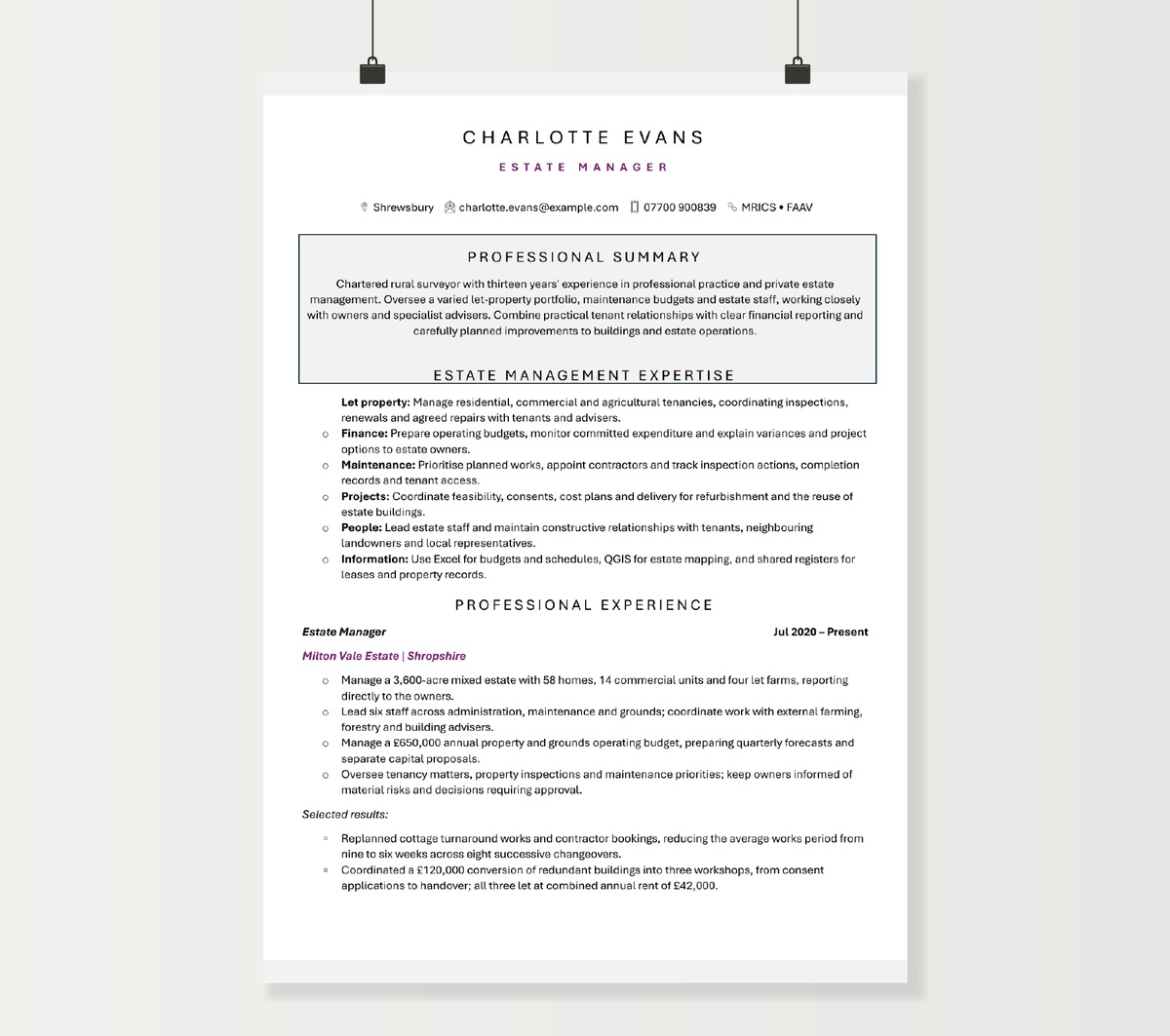
This estate manager CV template follows a chartered rural surveyor moving from professional practice into the management of a mixed private estate. The Word example brings together let property, maintenance, staff leadership and development projects. The guide explains how to present the scale and character of your estate, your responsibilities and the results of your decisions.
Filename: FreeCVDownload_Estate_Manager.docx
Content of this CV template
Charlotte Evans
ESTATE MANAGER
Shrewsbury | [email protected] | 07700 900839 | MRICS • FAAV
Professional summary
Chartered rural surveyor with thirteen years' experience in professional practice and private estate management. Oversee a varied let-property portfolio, maintenance budgets and estate staff, working closely with owners and specialist advisers. Combine practical tenant relationships with clear financial reporting and carefully planned improvements to buildings and estate operations.
Estate management expertise
- Let property: Manage residential, commercial and agricultural tenancies, coordinating inspections, renewals and agreed repairs with tenants and advisers.
- Finance: Prepare operating budgets, monitor committed expenditure and explain variances and project options to estate owners.
- Maintenance: Prioritise planned works, appoint contractors and track inspection actions, completion records and tenant access.
- Projects: Coordinate feasibility, consents, cost plans and delivery for refurbishment and the reuse of estate buildings.
- People: Lead estate staff and maintain constructive relationships with tenants, neighbouring landowners and local representatives.
- Information: Use Excel for budgets and schedules, QGIS for estate mapping, and shared registers for leases and property records.
Professional experience
Estate Manager | Jul 2020 – Present
Milton Vale Estate | Shropshire
- Manage a 3,600-acre mixed estate with 58 homes, 14 commercial units and four let farms, reporting directly to the owners.
- Lead six staff across administration, maintenance and grounds; coordinate work with external farming, forestry and building advisers.
- Manage a £650,000 annual property and grounds operating budget, preparing quarterly forecasts and separate capital proposals.
- Oversee tenancy matters, property inspections and maintenance priorities; keep owners informed of material risks and decisions requiring approval.
Selected results:
- Replanned cottage turnaround works and contractor bookings, reducing the average works period from nine to six weeks across eight successive changeovers.
- Coordinated a £120,000 conversion of redundant buildings into three workshops, from consent applications to handover; all three let at combined annual rent of £42,000.
Rural Surveyor | Sep 2013 – Jun 2020
Hatherley Land & Property | Shrewsbury
- Joined as a graduate surveyor in 2013 and progressed to rural surveyor after qualifying in 2016, working with private estate and farm clients.
- Managed day-to-day instructions for residential and agricultural lettings, preparing inspection notes, tenancy schedules and client updates.
- Supported rent reviews and lease renewals with comparable evidence, working with the supervising partner and clients' solicitors.
- Prepared repair budgets and coordinated contractors, keeping clients informed about costs, access arrangements and completion dates.
Selected results:
- Reconciled tenancy and inspection records for a 42-property estate, creating a shared schedule of renewal dates and outstanding actions.
- Coordinated a phased refurbishment programme for six cottages, arranging tenant communications and work packages within the client's £95,000 budget.
Qualifications & development
MRICS, Rural pathway – qualified 2016
Fellow, Central Association of Agricultural Valuers (FAAV) – 2017
BSc (Hons) Rural Enterprise and Land Management, 2:1 – Harper Adams University, 2013
IOSH Managing Safely – 2022
Additional information
- Professional development: Recent CPD in rural tenancies, building conservation and natural capital; maintain RICS and CAAV learning records.
- Travel: Full UK driving licence; accustomed to regular site visits and working with geographically dispersed tenants and contractors.
- Interests: Swimming, baking and local history.
How to write an estate manager CV
An estate manager’s CV needs to give the reader a clear picture of what was entrusted to you. Acreage alone says little about the demands of an estate with tenant farms, cottages, workshops, woodland and public access. A smaller residential development may involve substantial service-charge expenditure, resident relationships and building-maintenance responsibilities. Start with the character of the estate, then show how you managed its people, property and resources.
The example above concentrates on a mixed rural estate. Your own emphasis should follow the position you are seeking: land and tenancies for a rural appointment, resident services and common areas for a residential estate, or buildings and site operations for an institutional portfolio.
Make the estate and your authority understandable
Use your profile and the opening line of each employment entry to establish the setting. Useful details include acreage or site area, the number and type of properties, the geographical spread and the business activities you supported. A description such as “58 homes, 14 commercial units and four let farms” gives more substance to a management claim than “a diverse property portfolio”.
Explain the reporting relationship as well. Reporting to a private owner, an estate director, a board of trustees or a managing-agent client creates different expectations. Include your team size and the budgets or decisions you controlled. Where farming, forestry or surveying specialists had their own responsibilities, show how you worked together. This makes the breadth of your role easier to assess.
A rural profile might combine chartered status, the range of tenancies and experience of bringing estate buildings back into use. An institutional profile could lead with occupied-site maintenance, contractor management and a planned works programme. Someone managing residential grounds and shared facilities might focus on inspections, resident communication, service contracts and expenditure. Each approach gives the employer relevant context without turning the profile into a catalogue of every task you have performed.
Show what you managed within the property portfolio
Let-property work is more persuasive when it identifies both the assets and the responsibility. Describe the tenancy matters you handled, such as inspections, rent-review preparation, lease renewals, arrears follow-up, repair agreements or handovers. Include the parties involved where they help explain the work: tenants, owners, solicitors, agents or specialist surveyors.
For rural appointments, distinguish agricultural, commercial and residential experience. A reader assessing farm-tenancy knowledge will want more than a general statement about customer service. You might describe maintaining tenancy schedules for let farms, assembling evidence for a review, or coordinating discussions between a tenant, the owner and their adviser. The useful detail is the work you personally carried forward and the point at which decisions were agreed.
For residential estates, the comparable evidence may concern service-charge budgets, communal repairs, grounds contracts and meetings with residents or a management company. Show how you connected the financial records with the service residents received. If your background is primarily residential lettings, the property manager example provides a closer comparison for presenting that experience.
Property records deserve space when they improved decisions. A reconciled lease register, reliable inspection schedule or mapped record of access rights can be a worthwhile achievement. Explain what became easier to manage: renewal dates were visible, repair actions had owners, or information needed for a project could be retrieved promptly. Naming a spreadsheet by itself leaves that value unexplained.
Present maintenance as a programme you controlled
Estate maintenance can occupy much of the working week, yet “oversaw repairs and contractors” gives little indication of judgement. Describe how you converted inspections and reports into priorities, agreed work packages, arranged access and followed up completion. Include the scale of the annual programme or the types of buildings and infrastructure involved.
There is a useful distinction between administering jobs and managing the programme. If you set priorities against a budget, assessed quotations, coordinated specialist advice or recommended deferring one project to address a more urgent defect, make that decision-making visible. An assistant’s CV can be equally clear about preparing the information, arranging site visits and tracking actions for the manager.
Compliance experience is strongest when attached to an actual responsibility. Examples include maintaining inspection records across a let portfolio, commissioning specialist assessments, scheduling remedial works or reporting overdue actions. For a school estate, the relevant evidence might be planned preventative maintenance, safe contractor access and arranging disruptive works around the school calendar. For a private rural estate, it may involve older buildings, dispersed properties and coordination with tenants.
Use a completed improvement to bring this work together. In Charlotte’s example, the cottage-turnaround result combines contractor bookings, the works period and the number of changeovers. The measurement concerns the refurbishment stage; it does not leave the reader to guess whether marketing, legal work and the whole vacancy period were included.
Choose projects that reveal your judgement
One or two well-explained projects can show more than a long list of development interests. Choose work that resembles the prospective estate’s priorities: converting redundant buildings, refurbishing let homes, improving access, renewing infrastructure, supporting a woodland plan or assessing a new commercial use.
Build each project description around the decision and your contribution. Establish the problem or opportunity, the scale, the work you coordinated and the stage reached. For example, a workshop conversion may involve comparing uses, gathering cost information, arranging professional advice, coordinating consent applications, monitoring expenditure and managing the handover. Select the elements that demonstrate your responsibility.
Completed, consented, funded and under consideration are different project stages, and each can provide valuable CV evidence. A recommendation that helped owners select a viable scheme is useful even before construction begins. Equally, a delivery role should show the move from approval through works to occupation or operational use.
For conservation or natural-capital work, connect the subject to a tangible contribution. This might be coordinating baseline information, commissioning an adviser, discussing management options with tenants or building an agreed programme into the estate plan. The employer needs to see how your work helped the estate make a decision or deliver an agreed objective. A string of terms such as biodiversity, carbon and sustainability provides much less insight.
Give financial results the right context
Financial evidence can include income, operating expenditure, capital delivery or the cost of vacant space. State which measure you mean. A £650,000 property and grounds budget explains a particular area of responsibility; total estate turnover could include activities managed by other people. Similarly, annual contracted rent, rent collected and net operating income tell different stories.
Useful ways to present results include:
- The number of previously unused units brought into occupation, with the completed project cost and agreed annual rent where appropriate.
- A shorter works or vacancy period across a stated number of property changeovers.
- A maintenance programme completed within its approved budget, with its buildings, scope and period identified.
- A reduction in a defined overdue balance, supported by the period and your approach to tenant follow-up.
- A phased investment plan accepted by owners or trustees, explaining what it enabled them to prioritise.
Choose a few results that reflect the purpose of the role. An estate with heritage or public-access objectives may value improved condition, continuity of use and delivery of agreed conservation work alongside income. A commercially focused appointment may place greater weight on occupancy, cost control and development. Give the reader enough context to understand why the outcome mattered.
Make relationships and staff leadership concrete
Estate management depends on relationships that continue long after an individual transaction. Show how you handled that continuity: regular tenant meetings, clear repair updates, practical arrangements with neighbours, or concise recommendations to owners. Describe the issue and the useful outcome rather than relying on “excellent stakeholder management”.
For team leadership, identify the people you managed and how the work was organised. An administrator, a maintenance team and grounds staff have different priorities and development needs. Evidence might cover allocating work, agreeing seasonal plans, improving handovers, recruiting a supervisor or helping staff take on more responsibility.
Contractor oversight is also worth explaining separately from direct line management. State the works or services you commissioned, how you agreed scope and how you followed up performance. Where an estate has several operational businesses, a short example of coordinating competing demands can demonstrate the practical judgement needed to keep the wider estate working.
Present qualifications and systems in relation to the role
For rural surveying appointments, place relevant professional designations such as MRICS or FAAV where they are easy to find, then give the qualification or membership details and year in the education section. A relevant degree and professional qualification represent different stages of development. Applicants working towards their APC can state the pathway and current stage alongside their supervised experience.
Other estate-management routes may be better represented by building-services, facilities, property-management or health-and-safety qualifications. Select training that supports the target responsibilities. A short record of recent learning in building conservation or rural tenancies may be more useful than a long list of unrelated courses.
Software belongs alongside its use. Excel can support budget forecasts, tenancy schedules and works tracking; GIS can support estate mapping and land records; a property or maintenance system may hold leases, inspections and contractor jobs. Explain the information you maintained or the decisions it supported. This gives the employer a practical picture of your digital capability.
Show the progression towards estate-wide responsibility
A move from professional practice to an in-house estate role should show continuity: client instructions become responsibility for an ongoing portfolio, individual projects become an investment programme, and recommendations become decisions followed through over several years. In the example, Charlotte’s earlier surveyor role establishes the tenancy, repair and client-reporting experience behind her later management appointment.
For an assistant estate manager or an applicant progressing from site supervision, draw attention to the parts of the work you already own. These might include a group of properties, a maintenance budget, a contractor package or responsibility for supervising colleagues. A placement or apprenticeship can provide useful evidence when the entry explains the instruction, your contribution and the work produced.
Experienced applicants can give older technical duties less space and use the room for decisions, team development and sustained results. Keep enough practical evidence to show how your strategy reaches the estate itself: occupied buildings, completed works, dependable records and relationships that support the next stage of its development.
You can compare the presentation of other examples in the CV template library.
Estate Manager CV FAQs
They usually need different evidence. An estate agent CV centres on instructions, sales or lettings transactions, negotiation and client service. An estate manager CV normally concerns the continuing operation of land, property, facilities or an estate business. If you are moving from agency, explain the ongoing portfolio responsibilities you have already handled, such as maintenance, budgets, tenant relationships or managing staff.
A description such as ‘Private mixed rural estate, Shropshire’ can still give useful context. State the broad property mix, approximate scale, reporting relationship and your responsibilities. Project descriptions can focus on the type of work and outcome without identifying individual homes or the family's personal arrangements. A recruiter can discuss any further background needed during the selection process.
Include it when it forms part of the estate role you are applying for, with your responsibility clearly described. Coordinating a forestry contractor, managing a let-farm relationship and running an in-hand farming operation are different types of experience. Give the activity enough context to show its relevance to the estate's operations, finances or long-term plans; a personal interest can sit separately in the interests section.
A brief statement in additional information or the covering letter is usually sufficient. You can give your willingness to relocate and any practical notice period relevant to taking up the position. The CV's main space is better used for evidence of managing the estate; accommodation requirements can be discussed with the recruiter or employer.
The evidence can be adapted, but check the employer's application format. Some schools and public bodies use a structured form and supporting statement instead of accepting a CV. Use your CV as the source for dates, qualifications and relevant examples, then organise the statement around the person specification. For an institutional role, bring occupied-site maintenance, contractors, staff supervision and delivery around operational needs to the foreground.




