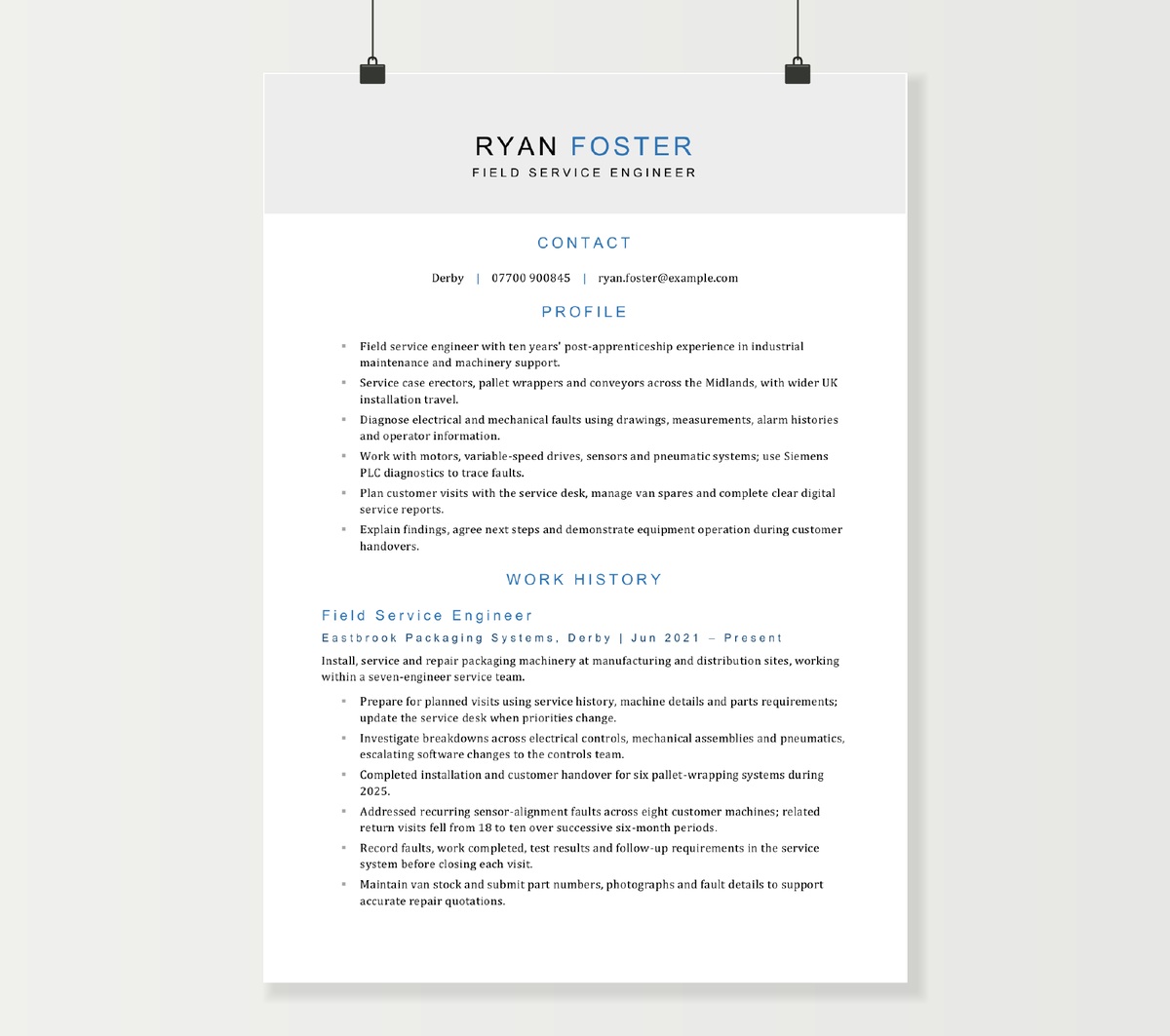
This field service engineer CV template shows an electrical maintenance technician progressing into customer-site service work on packaging machinery. The Word example covers breakdown diagnosis, planned servicing, installations and customer handovers. The guide explains how to make your equipment knowledge, independence and service results clear for employers in your chosen sector.
Filename: FreeCVDownload_Field_Service_Engineer.docx
Content of this CV template
Ryan Foster
Field Service Engineer
Contact
Derby | 07700 900845 | [email protected]
Profile
- Field service engineer with ten years' post-apprenticeship experience in industrial maintenance and machinery support.
- Service case erectors, pallet wrappers and conveyors across the Midlands, with wider UK installation travel.
- Diagnose electrical and mechanical faults using drawings, measurements, alarm histories and operator information.
- Work with motors, variable-speed drives, sensors and pneumatic systems; use Siemens PLC diagnostics to trace faults.
- Plan customer visits with the service desk, manage van spares and complete clear digital service reports.
- Explain findings, agree next steps and demonstrate equipment operation during customer handovers.
Work history
Field Service Engineer
Eastbrook Packaging Systems, Derby | Jun 2021 – Present
Install, service and repair packaging machinery at manufacturing and distribution sites, working within a seven-engineer service team.
- Prepare for planned visits using service history, machine details and parts requirements; update the service desk when priorities change.
- Investigate breakdowns across electrical controls, mechanical assemblies and pneumatics, escalating software changes to the controls team.
- Completed installation and customer handover for six pallet-wrapping systems during 2025.
- Addressed recurring sensor-alignment faults across eight customer machines; related return visits fell from 18 to ten over successive six-month periods.
- Record faults, work completed, test results and follow-up requirements in the service system before closing each visit.
- Maintain van stock and submit part numbers, photographs and fault details to support accurate repair quotations.
Electrical Maintenance Technician
Derwent Carton Manufacturing, Derby | Sep 2016 – May 2021
Maintained production machinery on rotating shifts, covering planned work and breakdowns.
- Traced conveyor faults using electrical drawings and PLC input/output status.
- Replaced and tested motors, sensors and drive components.
- Introduced a sensor-spares location list for two lines, adopted by all three shifts.
- Logged completed work and recurring defects for weekly engineering review.
Apprentice Maintenance Technician
Derwent Carton Manufacturing, Derby | Sep 2012 – Aug 2016
Completed an engineering maintenance apprenticeship in a factory engineering team.
- Assisted with inspections, component replacement and supervised electrical testing.
- Read drawings, recorded work and supported planned shutdowns.
Qualifications and development
EAL Level 3 NVQ Diploma in Engineering Maintenance
Electrical pathway, 2016; awarded during engineering maintenance apprenticeship.
Technical development
Manufacturer training in packaging machinery servicing, 2022. Siemens PLC diagnostic training, 2024. Employer safe-isolation refresher, 2025.
Interests and availability
I enjoy mountain biking, cooking and live music. Full UK driving licence; available for UK travel and overnight stays.
How to write a field service engineer CV
A service manager needs to understand what equipment you can support, how you approach an unfamiliar fault and what happens when you are the engineer representing the company at a customer’s site. A useful field service engineer CV answers those questions together. Technical ability matters, but so do preparation, communication and leaving a clear record for the next person involved.
Start with your equipment specialism rather than the broad title alone. An engineer maintaining laboratory analysers, one repairing mobile plant and one commissioning packaging machinery may share a job title while offering very different experience. Your opening lines should make the connection to the vacancy easy to see.
Put the equipment and service environment in your profile
Give the reader your engineering background, principal equipment and type of service work. Electrical or mechanical bias, relevant product families and experience of installation, preventive maintenance or breakdown response provide more information than a description such as “technically minded problem solver”. Add the customer setting where it changes the demands of the job: production lines, clinical laboratories, retail premises or outdoor plant, for example.
The example CV makes packaging equipment and an electrical maintenance background clear immediately. An engineer applying to another sector could instead lead with experience of hydraulic mobile machinery or network-connected diagnostic instruments. Keep the selection tied to the equipment in the target role; the profile does not need to accommodate every machine you have encountered.
Location and coverage can also help establish the fit. “Based in Derby, covering Midlands customer sites with UK installation travel” gives a practical picture of the role. Put a driving licence and availability for overnight stays in a short additional-information line when they are relevant.
Show the boundaries of your technical experience
Organise technical skills around the work they support. A compact set of categories might cover equipment, electrical and mechanical systems, diagnostics, and service records. Within those categories, use enough detail to show the depth of your involvement:
- Equipment: machine families, application and relevant capacity or operating range, rather than a long unexplained list of model numbers.
- Fault diagnosis: reading electrical or hydraulic drawings, interpreting alarms, taking measurements and checking components.
- Controls: the PLC, drive or controller families you use, followed by the task: tracing I/O, reading fault logs, adjusting approved parameters or developing software.
- Connected equipment: relevant Windows, network or remote-support work where it forms part of the service role.
- Service systems: the platform used for jobs, asset history, parts and reports, with a short explanation of what you record.
“Siemens PLC diagnostics to trace sensor and sequence faults” is more useful than “Siemens expert”. Similarly, commissioning a machine from an established procedure is different experience from designing its control system. Describing the action gives the recruiting engineer a clear basis for assessing your fit.
For field service applications, make the service outcome the focus: identifying the fault, restoring operation, documenting the change and supporting the customer. If a vacancy includes substantial software development, give that work its own project example so the reader can distinguish it from diagnostic access to a controller.
Build employment entries around the whole service visit
Under each role, first explain the employer’s products, your territory and the service arrangement. Were you the local engineer within a national team, part of a regional rota, or a workshop technician who also attended sites? Then choose responsibilities and results that show how you handled the work.
A strong recent entry can follow the practical sequence of a visit: reviewing the service history, identifying likely parts, attending the site, diagnosing and repairing the fault, testing the equipment, explaining the outcome and completing the record. You do not need a bullet for every step. Select the stages where you made a useful contribution or held particular responsibility.
Include how you worked with the service desk, parts team and technical specialists. Coordinating an urgent replacement component or giving a controls engineer enough evidence to resolve a software issue demonstrates effective field work. Escalation can be a strength when your CV explains the information you gathered and how it helped move the job forward.
Use a fault example to demonstrate diagnostic judgement
A concise fault example makes your technical ability tangible. Choose one with a clear symptom, a meaningful diagnostic contribution and an outcome. For instance: “Traced intermittent conveyor stops to a damaged sensor cable using drawings and I/O checks; replaced the cable and completed production trials with the customer.” That sentence shows more than a general claim to excellent troubleshooting skills.
A recurring problem can provide even stronger evidence when you show what changed. The example CV links sensor alignment to fewer return visits across a defined group of machines and two comparable periods. The useful detail is the connection between the intervention and the service pattern, not the size of the number.
Where several engineers contributed, describe your part: collecting fault data, reproducing the issue, trialling a modification or checking performance after installation. Customer sites can have several simultaneous causes of downtime, so choose an outcome that the service records can actually distinguish, such as recurrence of the particular fault.
Separate servicing, installation and commissioning
These activities may sit within one job, but they give an employer different evidence. Planned servicing shows product knowledge, consistent records and the ability to identify developing defects. Breakdown work shows diagnosis and decision-making under time pressure. Installation and commissioning show preparation, coordination, testing and handover.
If installations are a significant part of the vacancy, include an example with the equipment, scale and your responsibility. “Installed and handed over six pallet-wrapping systems during 2025” establishes a workload; a further detail about site coordination, acceptance checks or operator familiarisation can establish its complexity. Large projects may deserve a short selected-installations section, while a few well-chosen bullets are usually sufficient for a mixed service role.
For specialist instruments, describe calibration, verification or qualification work using the terminology of your own service environment. For mechanical plant, inspection and repair scope may matter more. Give the reader evidence of the work you performed and the records or acceptance process it supported.
Make customer communication visible
Field engineers often meet customers when equipment has failed and plans have been disrupted. Show how you translated a technical finding into a useful decision: explaining repair options, providing a realistic update through the service desk, identifying a further part requirement or demonstrating operation after a repair.
Training and handover deserve specific treatment. Name the audience and subject, such as production operators learning start-up and changeover routines, or laboratory users receiving an instrument handover. “Delivered customer training” becomes more informative when the reader can see what the customer was equipped to do afterwards.
Commercial awareness can also belong here. Accurate parts identification, photographs and service notes may support a quotation; identifying an ageing component may prompt a planned replacement. State your contribution to that process. If you directly sold service contracts or upgrades, give it a separate bullet with the relevant responsibility and result.
Choose results that reflect the work you controlled
Useful measures include repeat visits for a defined fault, completion of planned services, installations handed over, outstanding jobs resolved and time saved through better parts preparation. First-visit completion can be helpful where your employer records it consistently. Include the period and relevant job group so the figure has meaning.
For example, “Completed 42 of 48 eligible repair jobs on the first visit over the quarter” is easier to assess than a percentage without context. Explain an important condition briefly, such as jobs with the required parts available, if that is how the measure is defined. Service-contract targets can provide context, but distinguish the target from your achieved result.
Results need not all be numerical. A parts reference adopted by the service team, a repeatable diagnostic note or a successful customer handover can demonstrate lasting value. Use numbers where they illuminate the work and concrete outcomes where they do not.
Present independence through preparation and records
“Able to work alone” is a starting point. Stronger evidence describes how you organised a territory, prepared for visits, maintained van stock and kept the service team informed when an urgent job changed the diary. Mention an on-call rota or out-of-hours support where it formed a substantial part of the role.
Service reports deserve a place on the CV because they connect engineering work to future repairs, parts supply, warranties and customer communication. Explain the information you captured: symptoms, diagnosis, parts, test results and follow-up requirements. Experience improving report quality or reducing incomplete job records can be particularly useful for a senior service role.
Customer-site working also involves local procedures and coordination with the people responsible for the equipment. Describe relevant experience of permits, agreed isolation arrangements or controlled work areas within the employment entry. Keep this as evidence of your working environment and responsibility rather than a set of technical instructions.
Make qualifications and product training easy to assess
Give your main engineering qualification its full title, level, pathway where relevant and award year. An apprenticeship, NVQ, HNC, HND or degree can establish the foundation for your experience. Group shorter manufacturer courses and recent technical development separately so the reader can distinguish a formal qualification from product familiarisation.
Select training that helps explain your suitability for the equipment: a manufacturer’s service course, drive diagnostics, hydraulic systems, instrument calibration or networking. Include specific registrations or certificates where the vacancy or equipment requires them, with relevant scope and current status. Different field-service sectors need different evidence; a long list of unrelated certificates can obscure the qualifications that matter.
Experienced engineers can keep school qualifications brief. For an apprentice or newly qualified applicant, practical assessment, placement work and supervised service experience may deserve more space. Name the equipment and your contribution so the qualification is supported by evidence of application.
Moving from site maintenance into field service
A maintenance background can transfer well when the CV explains both equipment familiarity and readiness for customer-site work. Bring forward breakdown diagnosis, reading drawings, planned work, parts preparation and clear records. Then add experience of liaising with visiting contractors, explaining repairs to production teams or supporting an installation.
Your maintenance experience remains valuable; the emphasis shifts towards preparing independently, adapting to different sites and communicating with customers. For a first field role, these examples can be more persuasive than trying to make an existing job title sound like a service position.
Before sending the CV, check that its first half establishes the equipment match and its employment history supplies the evidence. Use the CV template library if a different layout would give your technical background or project history a clearer presentation.
Field Service Engineer CV FAQs
List the product families most relevant to the vacancy, then add a few recognisable models where they establish useful depth. If your experience covers many generations of one manufacturer's equipment, a grouped description is easier to scan. A separate equipment list can accompany an application that specifically asks for a detailed service history.
Name your employer or contracting business and explain the customer equipment and service arrangement underneath. For example, state that you provided regional warranty repairs on behalf of a manufacturer. This makes the relationship clear while preserving the value of your product experience. Group short assignments under the contracting role where that produces a clearer career history.
Make the transferable engineering match explicit: electrical diagnosis, hydraulics, precision mechanisms, instrumentation or connected equipment, depending on the role. Add an example of learning a new product range and the training that supported it. The employer can then assess both your technical foundation and the product training you would need.
State your location and preferred coverage briefly in the profile or additional-information section, then explain the fit with the advertised territory in your covering letter. Your CV can still show previous national or international work as evidence of experience. A clear distinction between past travel and current availability helps the employer assess the practical match.
Most applications can be supported by concise equipment and service examples in the CV. A short project sheet can help for substantial installations, specialist retrofits or a move into applications engineering. Describe the equipment, your role, acceptance or handover and result; photographs are optional and rarely add as much as a clear account of the engineering work.