
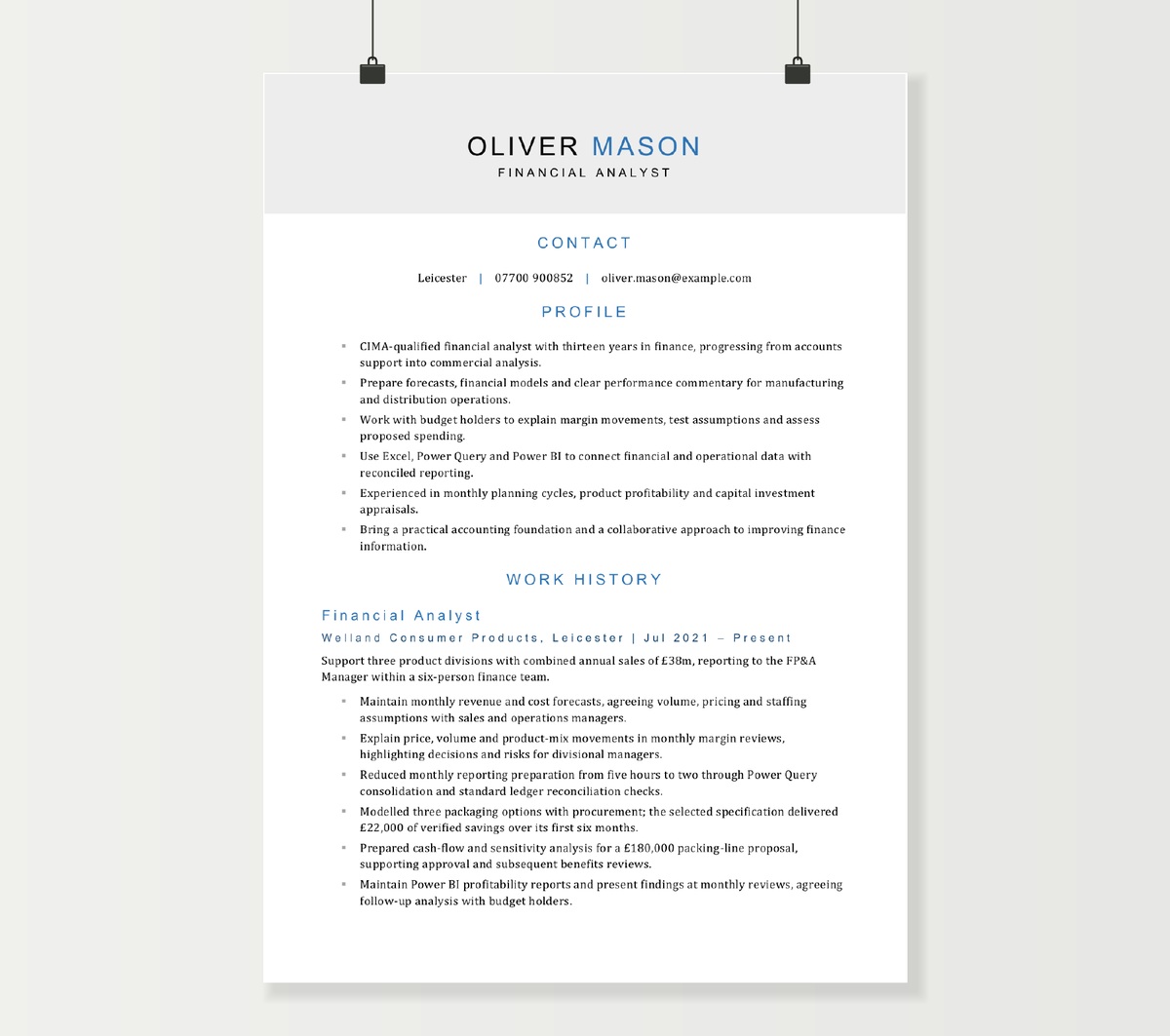
This financial analyst CV template follows a career from accounts support into commercial analysis in a manufacturing business. The Word example shows forecasting, financial modelling and reporting alongside the decisions they support. The guide explains how to present analytical work, finance systems, qualifications and results for financial analyst and FP&A vacancies.
Filename: FreeCVDownload_Financial_Analyst.docx
Content of this CV template
Oliver Mason
Financial Analyst
Contact
Leicester | 07700 900852 | [email protected]
Profile
- CIMA-qualified financial analyst with thirteen years in finance, progressing from accounts support into commercial analysis.
- Prepare forecasts, financial models and clear performance commentary for manufacturing and distribution operations.
- Work with budget holders to explain margin movements, test assumptions and assess proposed spending.
- Use Excel, Power Query and Power BI to connect financial and operational data with reconciled reporting.
- Experienced in monthly planning cycles, product profitability and capital investment appraisals.
- Bring a practical accounting foundation and a collaborative approach to improving finance information.
Work history
Financial Analyst
Welland Consumer Products, Leicester | Jul 2021 – Present
Support three product divisions with combined annual sales of £38m, reporting to the FP&A Manager within a six-person finance team.
- Maintain monthly revenue and cost forecasts, agreeing volume, pricing and staffing assumptions with sales and operations managers.
- Explain price, volume and product-mix movements in monthly margin reviews, highlighting decisions and risks for divisional managers.
- Reduced monthly reporting preparation from five hours to two through Power Query consolidation and standard ledger reconciliation checks.
- Modelled three packaging options with procurement; the selected specification delivered £22,000 of verified savings over its first six months.
- Prepared cash-flow and sensitivity analysis for a £180,000 packing-line proposal, supporting approval and subsequent benefits reviews.
- Maintain Power BI profitability reports and present findings at monthly reviews, agreeing follow-up analysis with budget holders.
Assistant Management Accountant
Welland Consumer Products, Leicester | Sep 2017 – Jun 2021
Supported month-end reporting and budgeting for the manufacturing site while studying towards CIMA qualification.
- Prepared accruals, prepayments and balance sheet reconciliations, resolving queries with purchasing and production colleagues.
- Produced labour and material-cost variance schedules with commentary for the management accountant.
- Built an Excel headcount schedule linking departmental staffing plans to salary and overtime forecasts.
- Standardised six departmental budget returns, simplifying consolidation and making changes easier to trace.
Accounts Assistant
Abbeygate Wholesale, Leicester | Aug 2013 – Aug 2017
Supported the finance team in a regional wholesale business.
- Maintained purchase-ledger records, reconciled supplier statements and resolved invoice discrepancies.
- Prepared bank reconciliations and sales summaries; supported stock counts and month-end schedules.
Qualifications and development
CIMA — ACMA, CGMA
Admitted to associate membership in 2022 following examinations and practical experience requirements.
Further education and training
Power BI reporting workshop, 2024; financial modelling course, 2023. Three A levels including Mathematics, 2013.
Hobbies and interests
I enjoy cycling, playing five-a-side football and cooking.
How to write a financial analyst CV
A strong financial analyst CV shows how you turn financial information into a better understanding of performance and a useful basis for decisions. Reports, forecasts and models are the outputs; the CV should also explain the questions they answered, the assumptions you examined and the people who used the results.
The title covers several kinds of work. A corporate FP&A analyst may focus on budgets, margins and future performance; another finance analyst may spend more time on reconciliations, controls and reporting. Investment analysis places greater emphasis on valuation, securities or transactions. Start with the responsibilities of the vacancy, then choose evidence from your career that fits that particular analytical role.
Establish your financial and commercial context
Your profile needs a clear professional identity: qualification or study position, relevant business environment and the analysis you are equipped to deliver. “CIMA-qualified analyst supporting product profitability and forecasting in manufacturing” gives the reader more to work with than a claim to be commercially aware. Add a useful technical strength or a concise result where it helps establish your level.
At the start of each recent job, describe the scope of the work. This might be three product divisions, a regional cost base, a subscription business, a portfolio of projects or a public-sector service. Turnover, expenditure, number of entities and reporting audience can all help the reader judge complexity. Choose the measures that explain your role, and identify whether you prepared the analysis, coordinated submissions or owned the final forecast.
Team context is useful too. Reporting to an FP&A Manager in a six-person finance team describes a different position from being the sole analyst supporting a finance director. Both can be strong experience. The distinction helps employers understand your independence, access to reviewers and exposure to decisions.
Show what went into your forecasts and models
“Financial modelling” is broad. Name the model’s purpose and the main drivers: customer volumes and prices, staffing and pay, production capacity, project milestones or working capital. Identify the planning horizon and cycle where relevant. A rolling twelve-month forecast updated monthly tells the reader something different from an annual budget consolidation or a one-off acquisition model.
Explain your contribution to assumptions. Did you gather input from budget holders, challenge a sales forecast against order intake, reconcile headcount to HR records or test alternative implementation dates? These details show judgement alongside spreadsheet ability. They also create useful interview material without turning your CV into a description of every worksheet.
For an investment appraisal, include the spending decision, the alternatives assessed and the evaluation you prepared. Cash-flow modelling, sensitivities, payback or net present value may be relevant, depending on the work. Finish with what happened: the proposal was approved, redesigned, deferred or taken into a benefits review. An analysis that changed the scope of an unattractive proposal can be as persuasive as one that supported investment.
For example: “Modelled staffing and utilisation scenarios for a proposed service expansion; the review supported a phased launch with a lower initial cash requirement.” The value lies in the connection between the model and the decision. A monetary outcome can strengthen it when you have a meaningful measure, but the decision itself is worthwhile evidence.
Make variance analysis explain a business issue
Most finance CVs mention actuals against budget. Improve that description by showing the level of analysis and the explanation you supplied. Price, volume, mix, material usage, labour rates, timing and foreign exchange may matter in different businesses. Select the drivers you actually analysed and connect them to the performance question.
A manufacturing applicant might describe separating production-volume effects from material usage variances. A subscription-business analyst could explain changes in recurring revenue through customer retention, new business and pricing. A charity analyst might connect restricted funding, programme delivery and expenditure timing. Sector vocabulary is useful when it reveals the economics behind the reporting.
Show how the conclusion was used. Did a margin review change a purchasing specification, prompt a pricing discussion or help an operations manager address overtime? A good bullet has room for the analysis and the resulting action. Routine monthly reporting can be summarised elsewhere, leaving the achievement bullets to demonstrate the more valuable work.
Present Excel, reporting systems and data work through outputs
A compact skills section can list Excel, Power Query, Power BI and the finance systems relevant to your applications. Work-history examples should then establish depth. Useful Excel evidence includes building a driver-based forecast, consolidating budget submissions, applying sensitivity analysis or maintaining a model that another colleague can review and update.
Power Query is particularly relevant where you bring together recurring ledger or operational extracts. Describe the sources combined, the repeatable output and how it improved the reporting cycle. For Power BI, distinguish building a report and its data model from using an existing dashboard. Measures, refresh processes, permissions and reconciliations can be worth mentioning when they formed a substantial part of your responsibility.
Finance employers also need confidence in the numbers behind the visualisation. A short reference to ledger reconciliation, consistent product mappings, exception checks or documented assumptions can explain that reliability. This is stronger evidence than describing a dashboard only as interactive or visually appealing.
SQL, Python and R can strengthen applications involving large datasets, automation or specialist analytics. Give them space in proportion to their use. A SQL query that combined billing and customer data for a margin review is relevant evidence; a lengthy list of programming libraries may distract from a role centred on financial planning. Similarly, name SAP, Oracle, NetSuite or another platform alongside the reporting, extraction or planning work you performed in it.
Quantify analytical impact with the right measure
Financial analysis can create value through better decisions, earlier visibility, reduced manual effort and more dependable planning. Choose the measure that matches the improvement. A shorter reporting task needs a before-and-after time; a working-capital project might need a cash or ageing measure; a procurement review might show the saving achieved after a specification change.
Keep the status of a result clear in the wording. “Identified a potential £60,000 annual saving”, “supported approval of a £180,000 investment” and “verified £22,000 of savings in six months” describe different achievements. Each is useful at the appropriate stage. Shared results read well when your analytical contribution is visible alongside the colleagues who implemented the change.
Forecast accuracy needs more context than a percentage on its own. Specify what was forecast, how far ahead and over what comparison period. A next-month revenue forecast is different from an annual profit forecast revised during the year. If a consistent error measure was used internally, identify it briefly; if the improvement was mainly clearer assumptions or earlier updates, describe that practical benefit instead.
Reporting improvements also deserve a boundary. Reducing preparation from five hours to two is credible and easy to understand. Explain the recurring task and the main change, rather than converting every saved minute into a speculative financial benefit. Evidence of fewer manual adjustments, clearer review or faster access to information may be the more useful result.
Show how you worked with people outside finance
Stakeholder communication is central to an analyst’s effectiveness. Describe the conversation you enabled: agreeing demand assumptions with sales, explaining a margin movement to a product manager or testing a staffing plan with operations. “Presented monthly findings to divisional managers and agreed follow-up analysis” is more informative than “excellent communication skills”.
For more experienced roles, include occasions when you shaped a recommendation or challenged an assumption constructively. Explain what evidence you brought and how the plan changed. Board or executive exposure can be relevant, but clarify whether you prepared the pack, presented a section or supported the finance lead’s review.
If business partnering and ownership of a broad stakeholder relationship dominate your next move, the finance business partner example offers another way to organise that experience. Keep this analyst CV centred on the analysis and decisions for which you can provide the strongest evidence.
Balance analytical work with accounting and controls
A foundation in month-end accounting can strengthen a financial analyst CV. Reconciliations, accruals, cost allocations and knowledge of how transactions reach the accounts help explain the quality of your analysis. For a controls-heavy vacancy, give these responsibilities substantial space, including investigation of aged items, root causes, audit support and improvements to the close process.
For a commercial FP&A role, summarise routine processing and make room for forecasts, models and recommendations. Your earlier accounting experience remains part of the progression, but it should support the direction of the application. The management accountant CV is useful when management reporting and ownership of the accounts are the main emphasis.
Public-sector, healthcare and charity applications may need a different balance again. Present the funding, service activity, costing, project or efficiency work relevant to the employer. A useful outcome might be a better-supported business case or a clearer view of service costs, rather than increased commercial profit.
Qualifications, progression and early-career evidence
State professional qualifications and membership clearly, with the relevant completion or admission date. For CIMA, ACCA or ACA study, give a precise stage and recent progress. A concise qualification entry is more useful than an unexplained “part-qualified” label. Relevant experience can be prominent for applicants qualified by experience, especially where the vacancy accepts that route.
A degree in accounting, finance, economics, mathematics or another analytical subject may support an early-career application. Choose modules or a dissertation only where they add evidence the work history cannot yet provide. Specialist valuation or investment credentials deserve greater prominence for investment-facing roles than for a corporate cost-analysis vacancy.
Applicants moving from accounts support can build a strong case through work already completed: an improved budget schedule, analysis of overdue balances, an investigation into material variances or a forecast developed with a supervisor. Explain the scope you handled and the review process. This makes the transition into analysis visible without needing a previous analyst job title.
For a graduate, one well-chosen analytical project can demonstrate modelling and interpretation. Describe the business question, data, assumptions, checks and conclusion in a few lines. A project based on published company accounts might compare cash generation or assess a proposed investment under different scenarios. The conclusion and limitations of the analysis matter more than the number of charts produced.
Experienced applicants usually gain more from a selective employment history than from adding several academic projects. Give the strongest recent models, decisions and improvements room to stand out, with earlier jobs showing how the accounting and commercial foundations developed.
Financial Analyst CV FAQs
Use your actual job title in the employment history. In the profile or headline, use the description that best matches your experience and target role. Financial planning and analysis can be written out with FP&A in brackets to make the specialism clear. If an internal title is vague, add a short explanation such as commercial forecasting and analysis alongside it.
Describe the decision, scale and method at a level you can share. Percentages, rounded ranges, numbers of divisions or the time saved in a reporting process may explain the work without disclosing sensitive pricing or forecasts. A bullet about changing an investment recommendation or improving a budget review can also be effective without a financial value.
It can help a graduate, career changer or applicant moving into a more modelling-intensive role. A short, accessible model with documented assumptions and a written recommendation is easier to assess than a folder of unexplained spreadsheets. Experienced corporate analysts can usually rely on employment evidence; a portfolio is an optional addition rather than an expected part of every application.
Label each assignment as a contract or fixed-term role and explain its purpose. A six-month engagement might cover a planning cycle, reporting redesign, acquisition integration or temporary vacancy. Give the completed deliverable, its users and the handover. This helps the reader understand why the role ended and what you achieved within the available time.
The layout is suitable, but the emphasis will need to follow the investment role. Give greater prominence to valuation, investment research, asset or sector knowledge, transaction work and the recommendations you produced. Corporate budgeting and management reporting can support that application, but they do not provide the same evidence as analysing an investment opportunity.




