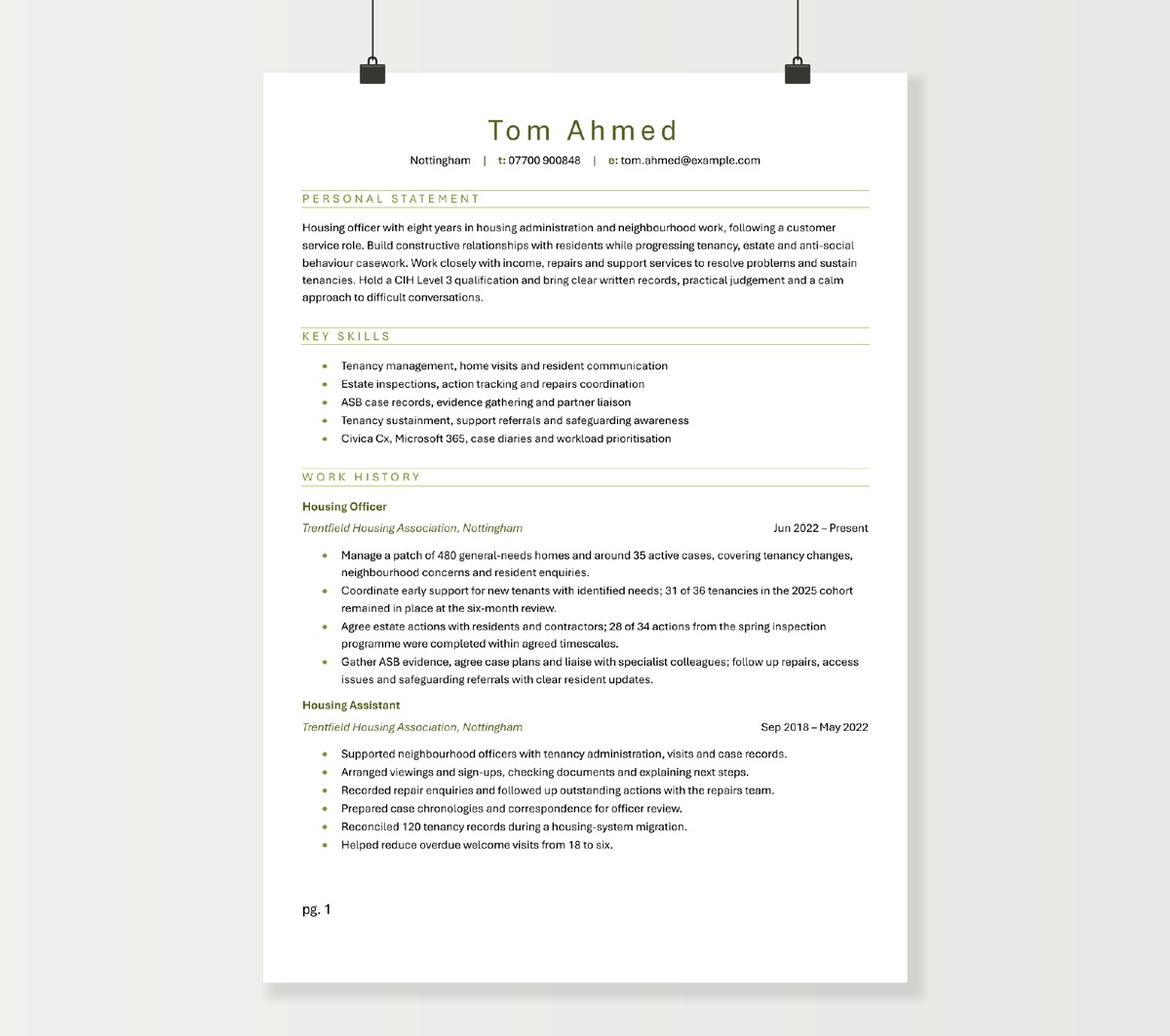
This housing officer CV template follows a customer service adviser into housing administration and neighbourhood management. The Word example shows a defined patch, practical tenancy work and measured improvements for residents. The guide helps you choose evidence for housing association, council, temporary accommodation and homelessness roles, with advice on casework, qualifications and supporting statements.
Filename: FreeCVDownload_Housing_Officer.docx
Content of this CV template
Tom Ahmed
Nottingham | t: 07700 900848 | e: [email protected]
Personal statement
Housing officer with eight years in housing administration and neighbourhood work, following a customer service role. Build constructive relationships with residents while progressing tenancy, estate and anti-social behaviour casework. Work closely with income, repairs and support services to resolve problems and sustain tenancies. Hold a CIH Level 3 qualification and bring clear written records, practical judgement and a calm approach to difficult conversations.
Key skills
- Tenancy management, home visits and resident communication
- Estate inspections, action tracking and repairs coordination
- ASB case records, evidence gathering and partner liaison
- Tenancy sustainment, support referrals and safeguarding awareness
- Civica Cx, Microsoft 365, case diaries and workload prioritisation
Work history
Housing Officer
Trentfield Housing Association, Nottingham
Jun 2022 – Present
- Manage a patch of 480 general-needs homes and around 35 active cases, covering tenancy changes, neighbourhood concerns and resident enquiries.
- Coordinate early support for new tenants with identified needs; 31 of 36 tenancies in the 2025 cohort remained in place at the six-month review.
- Agree estate actions with residents and contractors; 28 of 34 actions from the spring inspection programme were completed within agreed timescales.
- Gather ASB evidence, agree case plans and liaise with specialist colleagues; follow up repairs, access issues and safeguarding referrals with clear resident updates.
Housing Assistant
Trentfield Housing Association, Nottingham
Sep 2018 – May 2022
- Supported neighbourhood officers with tenancy administration, visits and case records.
- Arranged viewings and sign-ups, checking documents and explaining next steps.
- Recorded repair enquiries and followed up outstanding actions with the repairs team.
- Prepared case chronologies and correspondence for officer review.
- Reconciled 120 tenancy records during a housing-system migration.
- Helped reduce overdue welcome visits from 18 to six.
Customer Service Adviser
Northgate Community Homes, Nottingham
Sep 2015 – Aug 2018
- Handled resident enquiries for a local housing provider by telephone and at reception.
- Logged repair requests and directed urgent concerns to the appropriate team.
- Explained rent account information and arranged income-team callbacks.
- Maintained contact records and helped residents use online housing services.
Qualifications
CIH Level 3 Certificate in Housing Practice
Chartered Institute of Housing
2021
- Completed through workplace-supported study while working as a Housing Assistant.
- Level 3 Diploma in Business Administration, completed 2015.
- Eight GCSEs including English and Mathematics, 2013.
Recent development
Employer and sector training
2025 – 2026
- Safeguarding adults and domestic abuse awareness (2026); ASB case management, lone working and complaint handling (2025).
Hobbies and interests
- Football: Playing in a local five-a-side team.
- Cooking: Trying new recipes with friends.
- Cycling: Weekend rides around Nottinghamshire.
Additional information
Full UK driving licence; regular home visits, estate inspections and occasional evening resident meetings.
How to write a housing officer CV
A housing officer CV should show how you manage housing issues while maintaining constructive relationships with residents. Employers need to see the service you worked in, the decisions you handled and how you followed cases through. “Dealt with tenants and managed a caseload” gives little sense of the judgement involved.
Start by identifying the role’s main purpose. Neighbourhood housing management, homelessness prevention, temporary accommodation and sheltered housing require overlapping skills, but different evidence. A strong CV makes the relevant experience easy to recognise, rather than treating every housing job as the same.
Define your patch, service and responsibility
Give each housing role a short scope statement. Identify the landlord or service type, location, tenure or accommodation and the scale you managed. A patch of 480 general-needs homes, two sheltered schemes or a temporary-accommodation caseload tells the reader something useful about your working context.
Distinguish the number of properties from the number of active cases. They measure different things. Add the main areas you owned, such as tenancy changes, estate standards, low-level ASB or sign-ups, and explain where you worked alongside specialist income, legal, repairs or support teams.
Use your profile to bring this together: relevant housing experience, the service you know best and one or two strengths demonstrated later in the CV. Qualifications can support that introduction, but practical casework should remain prominent for an experienced officer.
Show how you help sustain tenancies
Choose an example that shows early identification, a practical response and follow-through. You might have arranged a welcome visit, recognised that a resident needed additional help, coordinated a referral and kept contact while the issue was resolved. Explain your housing-management contribution alongside the work of income or support colleagues.
Where income work is part of the role, describe its actual scope. This could include discussing an account, identifying an affordability concern, agreeing an action within your authority or connecting the resident with specialist advice. If another team managed recovery, the useful evidence is how you worked together and kept the case moving.
Outcomes become more meaningful when you give a period and a defined group. In the example CV, 31 of 36 new tenancies receiving early support were sustained at a six-month review. The number describes a specific cohort and acknowledges coordinated support; it gives more context than a general claim to have prevented homelessness.
Present ASB and tenancy enforcement through judgement
Show the casework behind the label. Relevant evidence may include listening to reports, gathering information, assessing concerns, maintaining a chronology, agreeing a case plan, liaising with partners and explaining progress to residents. Add the type or complexity of cases you handled without reproducing personal details.
Make your level of responsibility clear. Preparing papers for legal review, serving approved notices, attending court or supporting a specialist ASB officer are distinct contributions. The employer needs to understand which of these you have performed and how you worked within the organisation’s procedures.
A useful achievement could describe a recurring neighbourhood problem resolved through coordinated action, a clearer evidence trail or improved communication with affected residents. Numbers of warnings or enforcement actions alone say less about the quality of the outcome. Give enough detail to show why the chosen response was appropriate.
Connect inspections with completed actions
Estate inspections are stronger evidence when the CV explains what followed them. Describe how you recorded issues, agreed priorities, involved residents or contractors and checked completion. A regular inspection programme may cover shared areas, environmental concerns, repairs and access arrangements; choose the parts most relevant to the vacancy.
Give practical outcomes such as actions completed within agreed times, a persistent problem addressed or clearer ownership between teams. If you coordinated repairs or safety-related access, show how you recognised urgency, passed the right information to the responsible service and kept residents informed.
For lettings and void work, identify the stages you handled: viewings, sign-ups, pre-let coordination, tenancy information or welcome visits. Explain any improvement in handovers or follow-up. Void turnaround is usually a shared result, so name the contribution you made with repairs and lettings colleagues.
Make resident communication visible
Give examples of communication that required care or persistence. These could include explaining a difficult decision, resolving conflicting accounts, handling a complaint or adapting contact arrangements for someone who struggled with standard letters or online services.
Resident involvement can also demonstrate effective housing work. Describe a surgery, estate walkabout or consultation in terms of what residents contributed and what changed. The number attending may establish scale, but a resulting action plan or improved service is more useful evidence of impact.
Written communication matters as much as conversation. Case notes, complaint responses, clear letters and well-prepared referral information help colleagues act and decisions stand up to review. Mention the document or record you produced and its purpose, rather than relying on “excellent communication skills”.
Show safeguarding and partnership work at the right level
Housing officers may identify concerns during a home visit or through a pattern of contact. Present the judgement and coordination involved: recognising a concern, following the referral route, contributing relevant information and maintaining appropriate housing contact afterwards.
Describe the partners and the purpose of working together. Adult social care, domestic abuse services, mental health teams, police, welfare advisers and voluntary organisations have different roles. One well-chosen case can show how you coordinated housing actions around those responsibilities.
Training supports this evidence, particularly when it is recent and relevant. Give the course or subject and date. Keep the focus on how you contribute as a housing professional, whether that involves a general-needs patch or residents with more complex support requirements.
Demonstrate organised casework and useful systems knowledge
Explain how you manage competing priorities, not simply that the workload is busy. A brief account of risk-based prioritisation, diary reviews, action tracking or clear handovers can show how you maintain momentum while responding to urgent issues.
Name housing systems alongside their use. For example, Civica Cx or another platform may support tenancy records, case diaries, repairs or correspondence. Microsoft 365 and Excel are useful when attached to a relevant output such as an estate-action tracker or a case-review report.
Record improvements can be worthwhile achievements. Reconciling tenancy information during a system change, making case handovers clearer or reducing overdue follow-up tasks shows dependable service delivery. State the scale or resulting improvement so the reader can assess the work.
Adjust the evidence for specialist housing services
Homelessness prevention: bring forward assessments, housing plans, prevention or relief work, landlord negotiation and partnership interventions. Explain the decisions and records you were responsible for and the housing outcomes achieved. Make the jurisdiction and service context clear because housing law and processes differ across the UK.
Temporary accommodation: emphasise property standards, occupancy, sign-ups, housing issues and coordination of move-on arrangements. Show how you worked with support providers while retaining responsibility for the accommodation and housing casework.
Sheltered or independent living: describe the schemes, resident contact, welfare concerns, building-related follow-up and liaison with care or support services. Your CV should make the balance between housing management and any support responsibilities easy to understand.
Moving from a support role: select examples that show tenancy-related work, records, referrals and coordination with landlords. The support worker CV can help you organise earlier experience, while your housing application should bring property, tenancy and case-management evidence to the front.
Use qualifications and development to support your experience
List the exact CIH or other relevant qualification, its level and completion date. State professional membership separately if relevant. Recent development in ASB, safeguarding, complaints, housing practice or information handling can demonstrate that you keep your knowledge current.
For someone entering housing, strong public-facing service can be valuable evidence. Choose situations involving sensitive information, difficult conversations, follow-up across teams and competing needs. Volunteering or community work can add relevant context when you explain the responsibilities and contribution.
Experienced applicants should show progression through greater case complexity, patch ownership, technical knowledge or support for colleagues. A longer service history does not require equal space for every earlier role; retain the details that explain how you became effective in your current work.
Make the CV work with the supporting statement
Housing recruitment often asks for a supporting statement or application form as well as, or instead of, a CV. Use the CV to establish your career history, scope and strongest results. Use the statement to address the person specification with fuller examples of judgement, communication and outcomes.
Build both from the same evidence so dates, responsibilities and results agree. A concise CV bullet about an ASB case can become a fuller statement example explaining the circumstances, your actions and the resolution. This keeps the CV readable while giving the selection panel the detail needed for each criterion.
Housing Officer CV FAQs
Yes. Viewings, tenancy administration, repairs coordination, arrears conversations and resolving resident concerns can be relevant. Explain the responsibilities and outcomes, then bring forward any experience of partnership support, community work or complex needs. Make the tenancy and service setting clear so the employer can understand both your transferable experience and your move into social housing.
You can include it when it helps explain your motivation or a relevant contribution, but it is optional. Keep the emphasis on what that perspective adds to your work, such as understanding access barriers or improving communication. Your professional evidence and skills can stand on their own without a personal account.
Name the location and service context, then explain the transferable casework, resident engagement and partnership skills. Include relevant learning for the jurisdiction you are applying in. This helps employers distinguish established housing experience from the local legal and policy knowledge you are developing.
Yes when the role involves home visits, several schemes or a dispersed patch and the advert asks for it. Place it briefly under additional information alongside relevant travel availability. Some employers accept other ways of meeting travel requirements, so use the vacancy’s wording to decide what information is useful.
Give the assignment dates, service and responsibilities, then identify what you delivered during that period. Covering a patch, stabilising a backlog or supporting a service change can all show useful capability. Group short assignments where appropriate, while keeping the different housing settings and level of responsibility clear.
A brief reference may be useful if the employer specifically asks about it, but detailed checks normally sit within the recruitment process. Give more CV space to the relevant resident-facing work and safeguarding development. If asked for DBS details, follow the employer’s process for providing current information securely.