
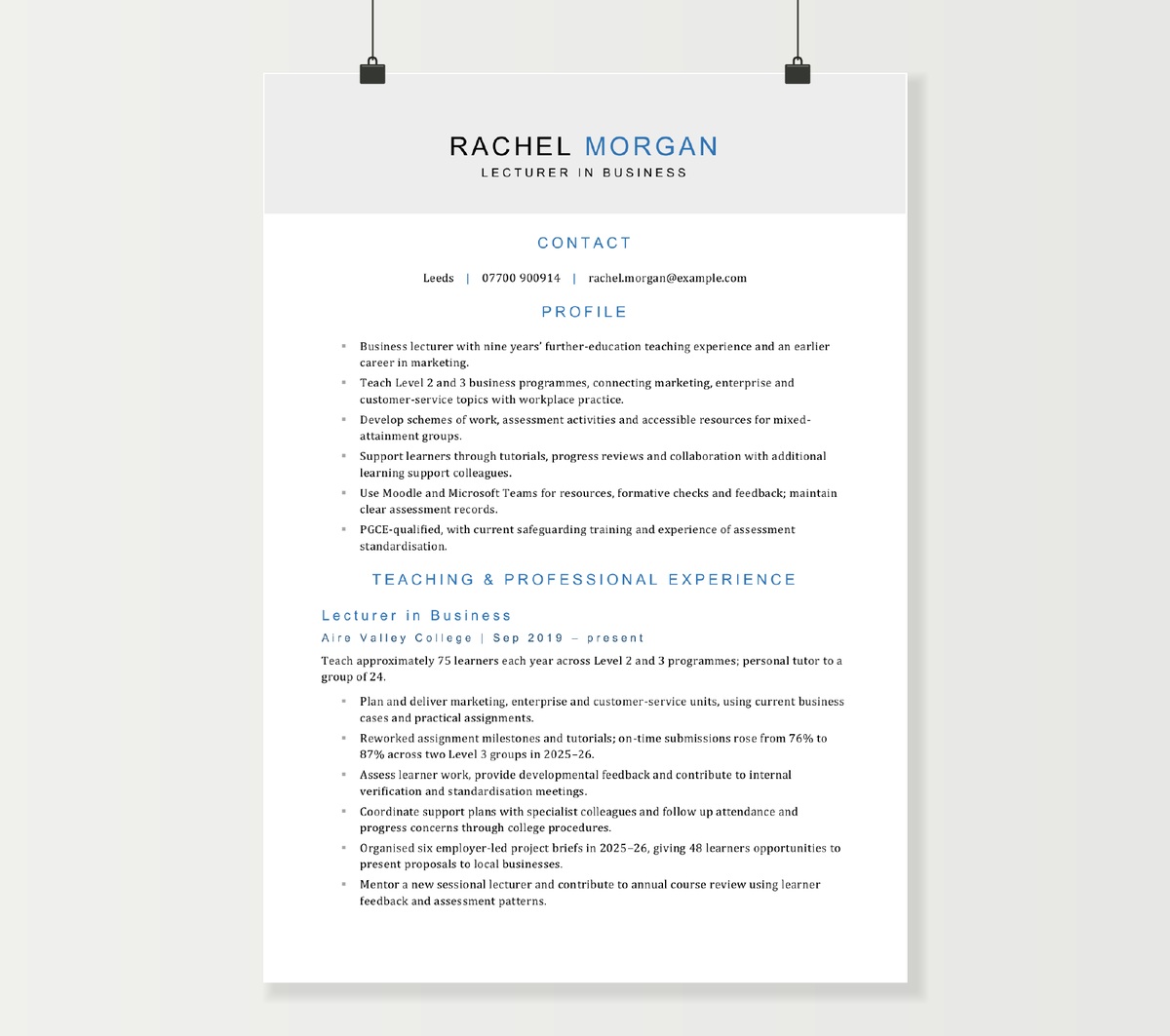
This lecturer CV template presents a business lecturer in further education, with earlier industry experience and a move from sessional teaching into a permanent post. The Word example shows curriculum delivery, assessment, student support and employer engagement. The guide also covers university applications, including how to balance teaching with research, publications and academic responsibilities.
Filename: FreeCVDownload_Lecturer.docx
Content of this CV template
Rachel Morgan
Lecturer in Business
Contact
Leeds | 07700 900914 | [email protected]
Profile
- Business lecturer with nine years’ further-education teaching experience and an earlier career in marketing.
- Teach Level 2 and 3 business programmes, connecting marketing, enterprise and customer-service topics with workplace practice.
- Develop schemes of work, assessment activities and accessible resources for mixed-attainment groups.
- Support learners through tutorials, progress reviews and collaboration with additional learning support colleagues.
- Use Moodle and Microsoft Teams for resources, formative checks and feedback; maintain clear assessment records.
- PGCE-qualified, with current safeguarding training and experience of assessment standardisation.
Teaching & professional experience
Lecturer in Business
Aire Valley College | Sep 2019 – present
Teach approximately 75 learners each year across Level 2 and 3 programmes; personal tutor to a group of 24.
- Plan and deliver marketing, enterprise and customer-service units, using current business cases and practical assignments.
- Reworked assignment milestones and tutorials; on-time submissions rose from 76% to 87% across two Level 3 groups in 2025–26.
- Assess learner work, provide developmental feedback and contribute to internal verification and standardisation meetings.
- Coordinate support plans with specialist colleagues and follow up attendance and progress concerns through college procedures.
- Organised six employer-led project briefs in 2025–26, giving 48 learners opportunities to present proposals to local businesses.
- Mentor a new sessional lecturer and contribute to annual course review using learner feedback and assessment patterns.
Sessional Lecturer in Business
Aire Valley College | Sep 2017 – Aug 2019
Delivered part-time business teaching while completing an in-service PGCE.
- Prepared lessons and resources for Level 2 groups, adapting explanations and activities to learners’ starting points.
- Marked assignments and maintained assessment records under the course leader’s guidance.
- Introduced weekly practice tasks to identify gaps before assessed work and discussed progress in tutorials.
- Contributed marketing case studies from industry and supported open evenings and course interviews.
Marketing Executive
Pennine Office Supplies | Jul 2012 – Aug 2017
Supported campaigns and customer research for a regional business supplier.
- Prepared campaign reports and presented customer feedback to the sales team.
- Delivered product briefings to colleagues and supervised two student work placements.
Qualifications
PGCE in Lifelong Learning
University of Huddersfield | 2019
BA (Hons) Business and Management — 2:1
Leeds Metropolitan University | 2012
Interests
Swimming, reading historical fiction and visiting galleries.
How to write a lecturer CV
A lecturer CV should make your subject expertise and your contribution to learning easy to assess. The balance depends on the post. A further-education college may need someone who can teach a vocational curriculum and support learners towards progression. A university may be recruiting for teaching, research or a combination of both. Start with that balance, then organise your evidence around it.
The example here focuses on further-education business teaching. A university applicant can use the same clarity of presentation while giving research, publications and academic service their own space where the role requires them.
Choose the right emphasis for the institution and post
Read the person specification alongside the main advert. Identify the subjects, learner groups and responsibilities the institution needs. A title such as Lecturer, Associate Lecturer or Lecturer in Practice can cover quite different work, so the duties are the better guide to what belongs near the top of your CV.
For an FE role, your opening might establish the qualifications or subjects you teach, the relevant learner groups, your teaching qualification and your industry background. For a teaching-focused university role, it might lead with undergraduate and postgraduate modules, assessment design, supervision and student support. For a research-and-teaching post, introduce your research area and its connection with the department as well.
Arrange the sections accordingly. An established teacher can lead with teaching appointments and achievements. An early-career researcher may place the doctorate and research experience before teaching. The reader should encounter the evidence that answers the vacancy’s priorities first.
Make the scope of your teaching clear
Give a concise account of what you taught and to whom. Include the subject, programme or qualification, level and teaching format where useful. Lectures, seminars, workshops, practical sessions, tutorials and online delivery demonstrate different experience.
Scale helps when it explains the role. You might have led a module with a large cohort, taught several small practical groups, supported adult returners or delivered to apprentices alongside their employment. State whether you were responsible for the whole module, a set of sessions or a particular assessment component.
A short scope sentence below each appointment can carry those facts without turning the employment history into a timetable. Rachel’s example identifies the programmes, approximate annual learner numbers and personal-tutor group before describing her contribution.
For applicants with a broad teaching portfolio, a compact selected-modules section can help. Group modules by subject or level and add your role. A list of module titles becomes more useful when the reader can see which you designed, led, taught or assessed.
Show curriculum and assessment work through a concrete change
Move beyond “planned and delivered lessons” by choosing a piece of development work. You may have redesigned a unit, introduced a new practical brief, revised assessment timing or updated resources to reflect current professional practice. Explain the learning need, your contribution and how the change was reviewed.
Assessment experience can include designing tasks, creating marking criteria, giving developmental feedback, moderating work and contributing to verification or standardisation. Select the terms used in your setting and explain your responsibility. Leading an assessment review and marking to an established rubric show different levels of ownership.
For university roles, dissertation and project supervision deserve specific evidence. State the level, subject area and scale of supervision, with relevant completions or responsibilities where helpful. For vocational teaching, practical assessment and coordination with workplace supervisors may be more important.
Digital tools belong alongside their purpose. Moodle, Canvas, Blackboard or Teams can support resources, formative assessment, feedback and communication. Describe an improvement in the learning experience or course organisation, rather than leaving the platform names to carry the whole claim.
Present learner support as part of teaching practice
Personal tutoring, academic guidance and work with support services can be substantial parts of a lecturer’s role. Explain the learner group, the support you provided and how you worked with colleagues. A brief example might describe coordinating a study plan, adapting resources or helping students prepare for the next stage of education or employment.
Inclusive teaching is strongest as evidence of a considered action. You could show how you made a resource easier to use, offered different ways to practise a skill or worked with specialist colleagues to address a barrier. Keep the emphasis on your professional contribution and the learning context.
In FE and other relevant settings, current safeguarding development and familiarity with the institution’s referral and recording arrangements can be included concisely. On the CV, the useful evidence is that student welfare forms part of your routine professional practice.
Use outcomes that the reader can interpret
Teaching achievements can be quantitative or qualitative. The strongest ones connect your action with a defined piece of evidence. On-time submission, completion, attendance, progression, feedback turnaround and student evaluation can each be useful when the cohort and period are clear.
In the example, an improvement in on-time submission is tied to revised milestones and tutorials across two groups during a stated academic year. That is a more informative result than an unexplained percentage increase in “student success”.
Choose the measure that reflects the work. A module evaluation differs from an institution-wide student survey; a unit result differs from a full qualification outcome. Identify the relevant level and your contribution so the reader can understand the evidence.
Other strong outcomes include a revised module approved for delivery, a successful external review of assessment practice, a resource adopted by colleagues or an employer project that gave students a useful experience. Peer observation and specific learner feedback can also support the account. A lecturer CV can be convincing without attaching a statistic to every activity.
Give research a structure when the vacancy requires it
For research-and-teaching applications, describe your research direction in a short, accessible introduction. Explain the questions you investigate, the methods or approaches you use and the contribution of your work. The panel needs to see how your experience connects with the department, alongside the details of individual outputs.
Use separate headings for the evidence that warrants them: research appointments or projects, publications, funding, supervision and knowledge exchange. For a collaborative project, identify your role and contribution. A concise explanation of the work is useful even when the project title is familiar within your discipline.
Present publications consistently, with enough bibliographic information to identify each output. Group selected or complete lists according to the application requirements and label the status of forthcoming work clearly. Research outputs may also include practice, performances, software, datasets or exhibitions where these are relevant to the discipline.
Funding entries should distinguish the project’s award from your role in securing or delivering it. Include the funder, project, dates and role, and use a value basis that is meaningful. An early-career applicant can show contribution to a proposal or funded project as well as awards held in their own name.
A teaching-focused post may still value scholarship: evaluating a teaching approach, sharing a resource or contributing to subject development. Give this work its appropriate context rather than forcing it into the structure of a research-intensive application.
Show professional practice and external engagement
Industry experience can provide important evidence for vocational, professional and practice-based lecturing. Bring forward the work that supports your teaching: current technical knowledge, project delivery, client practice, professional registration or links with employers.
Explain how that experience informed your educational contribution. You might have developed a realistic assignment, arranged a live brief, supported placements or introduced students to professional methods and expectations. Rachel’s CV connects earlier marketing work with business teaching and employer-led projects.
For experienced academics, external engagement may include consultancy, public engagement, professional-body work or partnerships. State the activity, your role and the useful outcome. This gives an employer a clearer picture than a general claim to have strong external networks.
Include the work that helps a course or department run
Lecturers contribute beyond their own sessions. Relevant evidence may include course review, admissions, recruitment events, assessment boards, quality processes, committee work and coordination with partner institutions. Select responsibilities that demonstrate the level of contribution needed for the next post.
Course or module leadership deserves a clear scope: the team, provision or process you coordinated and the improvement you delivered. Mentoring a new colleague, aligning assessment practice across a team or resolving a recurring timetable or resource issue can demonstrate leadership before a formal management title.
For senior applications, make the effect on colleagues and provision visible. The reader should be able to distinguish your own teaching delivery from the work through which you improved a wider programme.
Present qualifications and recognition precisely
List your relevant degrees and teaching qualifications with their full titles, institutions and dates. The subject and teaching context matter: a qualification in lifelong learning, a PGCert in higher education and a school-teaching qualification provide different information to a recruiter.
Where held, list professional recognition such as Advance HE Fellowship with its category and award date. This can sit alongside the teaching qualification while remaining a distinct entry. Include relevant professional registration or industry credentials for subjects where current practice is part of the appointment.
For qualifications in progress, state the current stage and expected completion date. Recent CPD earns space when it connects with the role, such as assessment, accessible teaching, safeguarding, supervision or developments in your discipline.
Build an early-career or career-change CV around relevant evidence
Graduate teaching, placement teaching, sessional work and guest sessions can all contribute to a first lecturer application. Describe the actual teaching, preparation, assessment or support you undertook. A few well-explained responsibilities can show more readiness than a broad claim of enthusiasm for education.
Applicants moving from industry can foreground subject expertise, staff training, mentoring, presentations and work with apprentices or placement students. Then show any teaching development or relevant educational experience. The aim is to make the transition understandable through the work already done.
For a teaching-led application, a concise CV can work well. A university post requesting a full academic CV may need more space for publications, funding and research. Follow the institution’s stated requirements and retain the detail the panel needs. The two-page example is a starting point for a particular lecturer profile, rather than a limit on every academic career.
Whichever Word CV design you use, keep your teaching scope, subject contribution and relevant outcomes easy to find. Those are the details that turn a list of appointments into a convincing application.
Lecturer CV FAQs
The requirement depends on the institution, subject and type of post. Some university roles require a doctorate or expect one close to completion; others accept relevant postgraduate qualifications or professional experience. FE roles often place particular emphasis on subject expertise and teaching capability. Use the person specification to establish the requirement and present the relevant qualifications and experience together.
Give the institution, topic and current stage, such as thesis submitted or expected submission date. If a viva or corrections stage is relevant, describe it briefly. This gives the panel a clear view of progress and timing alongside the research and teaching already completed.
Include them when they add useful evidence, with the module, academic year and response context where practical. A specific finding and the change you made in response can be more informative than a score alone. Peer review, assessment improvements and other evidence of teaching quality can complement student feedback.
List the institutions and dates clearly and identify the work as sessional, hourly paid or fractional. Give each entry its subjects, levels and responsibilities. Where several small contracts cover similar work, a grouped teaching-experience section can make the overall pattern easier to follow while retaining the individual appointments.
Yes, when you connect it with the advertised subject and responsibilities. Relevant evidence may include post-16 teaching, curriculum development, assessment, learner support and subject leadership. Explain the setting and qualification taught so the panel can assess how that experience relates to the college or university provision.
Use the CV to provide the career record and the statement to address the institution’s selection criteria with chosen examples. The same experience may appear in both, but the statement can explain why it demonstrates the required capability. Follow the application’s requested format and space limits, particularly where a portal asks separate criterion-based questions.
Place a clearly labelled link near your contact details or the relevant research or teaching section. Choose a page that helps the panel explore the evidence, such as an up-to-date publication profile or a short portfolio of teaching development. Keep the main CV sufficiently complete for the initial assessment without requiring the reader to follow every link.




