This network engineer CV template follows an engineer who has progressed from network support to maintaining connectivity across a regional business. The Word example combines Cisco switching, FortiGate firewalls, incident investigation and planned upgrades with clear evidence of service improvements. The guide covers operational and project roles, technical experience, certifications and routes into network engineering.
Filename: FreeCVDownload_Network_Engineer.docx
Content of this CV template
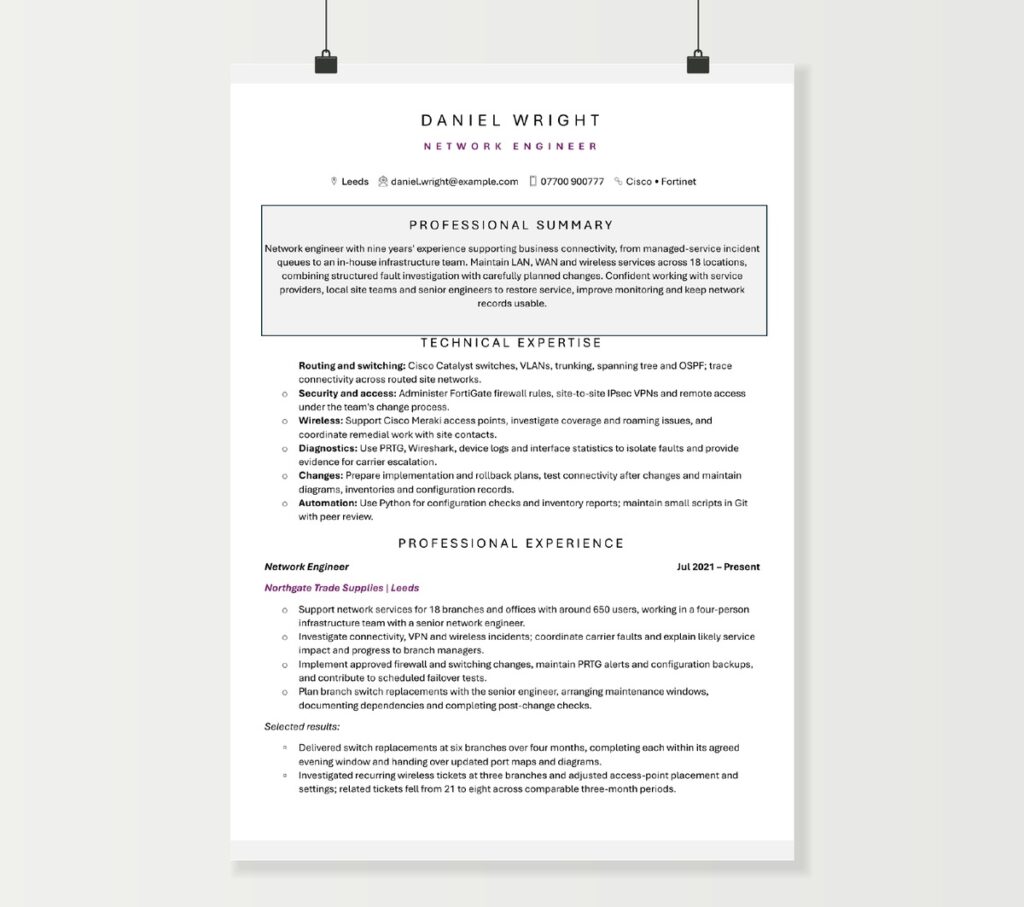
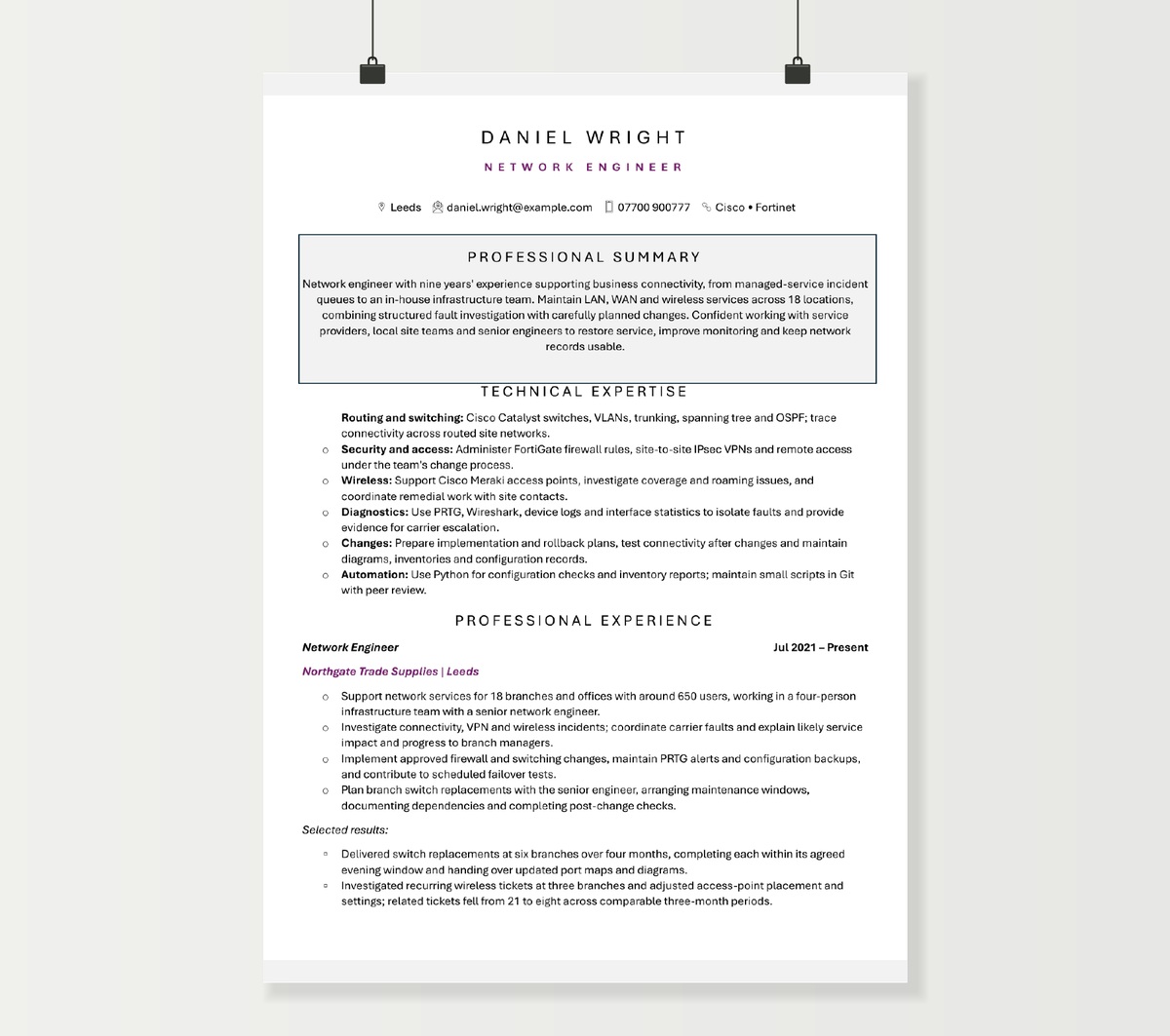
Daniel Wright
NETWORK ENGINEER
Leeds | [email protected] | 07700 900777 | Cisco • Fortinet
Professional summary
Network engineer with nine years' experience supporting business connectivity, from managed-service incident queues to an in-house infrastructure team. Maintain LAN, WAN and wireless services across 18 locations, combining structured fault investigation with carefully planned changes. Confident working with service providers, local site teams and senior engineers to restore service, improve monitoring and keep network records usable.
Technical expertise
- Routing and switching: Cisco Catalyst switches, VLANs, trunking, spanning tree and OSPF; trace connectivity across routed site networks.
- Security and access: Administer FortiGate firewall rules, site-to-site IPsec VPNs and remote access under the team's change process.
- Wireless: Support Cisco Meraki access points, investigate coverage and roaming issues, and coordinate remedial work with site contacts.
- Diagnostics: Use PRTG, Wireshark, device logs and interface statistics to isolate faults and provide evidence for carrier escalation.
- Changes: Prepare implementation and rollback plans, test connectivity after changes and maintain diagrams, inventories and configuration records.
- Automation: Use Python for configuration checks and inventory reports; maintain small scripts in Git with peer review.
Professional experience
Network Engineer | Jul 2021 – Present
Northgate Trade Supplies | Leeds
- Support network services for 18 branches and offices with around 650 users, working in a four-person infrastructure team with a senior network engineer.
- Investigate connectivity, VPN and wireless incidents; coordinate carrier faults and explain likely service impact and progress to branch managers.
- Implement approved firewall and switching changes, maintain PRTG alerts and configuration backups, and contribute to scheduled failover tests.
- Plan branch switch replacements with the senior engineer, arranging maintenance windows, documenting dependencies and completing post-change checks.
Selected results:
- Delivered switch replacements at six branches over four months, completing each within its agreed evening window and handing over updated port maps and diagrams.
- Investigated recurring wireless tickets at three branches and adjusted access-point placement and settings; related tickets fell from 21 to eight across comparable three-month periods.
Network Support Engineer | Sep 2017 – Jun 2021
Pennine Managed Networks | Bradford
- Joined the network support team after university, monitoring customer connections and investigating escalations from the service desk.
- Diagnosed LAN and WAN faults using device logs, ping and traceroute results, packet captures and service-provider circuit information.
- Completed supervised switch, firewall and VPN changes; prepared configuration backups and recorded test results for senior review.
- Maintained customer network diagrams and asset records, arranged site access and provided clear incident updates during outages.
Selected results:
- Built a Python inventory report for 70 managed switches, reducing the monthly manual compilation task from roughly three hours to 45 minutes, including checks.
- Reworked handover notes for ten recurring connectivity faults, helping the service desk gather the diagnostic information needed before escalation.
Qualifications & development
Cisco Certified Network Associate (CCNA) – recertified 2025; valid to 2028
BSc (Hons) Computer Networks, 2:1 – Leeds Beckett University, 2017
FortiGate administration and troubleshooting – employer training, 2023
Python for network operations – practical short course, 2024
Additional information
- Operational cover: Participate in a one-in-six on-call rota and planned out-of-hours maintenance; full UK driving licence.
- Communication: Produce concise incident summaries covering service impact, findings and follow-up actions for the infrastructure manager.
- Interests: Cycling, restoring old radios and cooking.
How to write a network engineer CV
A network engineer CV needs to make the reader comfortable with both your technical judgement and your ability to keep services running. A list of protocols says little about the networks you have supported, the decisions you have made or how you handle a change that affects users. Describe the environment first, then show the work you carried out within it.
The strongest evidence will depend on the vacancy. An internal network team may need someone who can investigate recurring faults and manage branch upgrades. A service provider may prioritise customer escalation and circuit delivery. A data-centre project may need deep experience of a particular fabric or migration. Give the most relevant work the most space.
Define the kind of network engineer you are
Use your opening profile to establish your experience, main environment and contribution. Useful distinctions include enterprise networks, managed services, data centres, campus networks, service-provider infrastructure and cloud connectivity. You can also clarify whether your work centres on operations, implementation, design or a combination.
For example, a branch-network engineer might lead with Cisco switching, firewall and VPN support, incident investigation and planned replacements across multiple sites. Someone applying for an ACI project should bring their fabric, policy and migration experience forward. Both are network engineers, but the same opening paragraph would undersell one of them.
Keep the profile selective. Three or four well-chosen sentences can connect your background to the job, leaving individual platforms and assignments for the sections below.
Give each role a recognisable network context
Under the employer, title and dates, add a short description of the estate and your remit. Numbers such as sites, users, managed devices, customer networks or team size help the reader interpret your experience. Choose the measures that explain the work rather than fitting every available number into the CV.
- For an internal role, describe the branches, offices, campuses or operational sites you support and the services they depend on.
- For an MSP or network service provider, explain your customer remit, escalation level and involvement in installations or changes.
- For a project role, identify the technology, migration or network layer, the delivery stage and your responsibility for implementation or design.
“Support connectivity for 18 locations in a four-person infrastructure team” gives a useful frame for the bullets that follow. It also makes it easier to distinguish independent responsibility from work delivered alongside a senior engineer. This matters when assessing whether your next move is a broader operational role or a step into technical leadership.
Organise technical skills around practical work
Group your skills so the reader can find the relevant knowledge quickly: routing and switching; security and access; wireless; diagnostics and monitoring; and automation, where relevant. Include the platforms you have used within those groups. Cisco Catalyst switching and Meraki wireless, for example, describe different parts of an estate.
Protocols become more useful when connected to an activity. Instead of a long string of abbreviations, explain that you investigate OSPF route issues, maintain VLAN and trunk configurations, support IPsec tunnels or use packet captures to isolate connectivity faults. A skills section can be concise while still showing the depth of your involvement.
Put the most important technologies in your employment evidence as well. If the vacancy centres on firewalls, give a relevant change, investigation or migration its own bullet. If it concerns wireless, show the environments and problems you have worked with: office coverage, warehouse roaming or a campus deployment will suggest different experience.
Show how you investigate incidents
“Troubleshot network issues” covers almost everything and reveals very little. Select an incident or recurring problem that demonstrates how you narrowed the cause, worked with others and followed the matter through. The CV does not need the full incident report; it needs enough detail to make your contribution clear.
A useful bullet can identify the affected service, the evidence you used, your intervention and the result. For instance: “Correlated interface errors and circuit tests across three sites, gave the carrier evidence of a recurring line fault and coordinated replacement work with local managers.” This shows more than naming a monitoring product.
Separate restoration from longer-term improvement where both were part of your work. Restoring a failed connection, identifying why it failed and improving alerts or documentation are different contributions. A senior operational application benefits from evidence of problem management as well as a busy ticket queue.
Describe changes, upgrades and migrations as deliverable work
Network changes involve planning as well as configuration. Give the reader a compact account of your part in scoping, implementation, testing and handover. Useful details include dependency checks, maintenance windows, coordination with site teams, rollback planning and the records you updated afterwards.
For a switch refresh, state the number or type of locations, what you prepared, what you implemented and how completion was checked. For a firewall migration, explain whether you reviewed rules, mapped objects, built configuration, tested services or led the cutover. These details make the boundary of your responsibility visible.
For design positions, bring forward design decisions and the documents that supported them. High-level and low-level designs, options assessments, capacity planning and resilience arrangements can be strong evidence when attached to an actual assignment. A short selected-projects section is useful when a major project would otherwise disappear inside a long list of operational duties.
Make reliability and improvement measurable
Network results are not always revenue figures. Completed migrations, reduced repeat incidents, quicker diagnosis, fewer unnecessary alerts, tested recovery arrangements and shorter manual tasks can all demonstrate value. Give the starting point, end point and period where these are available.
In this example, the fall in wireless tickets is tied to three branches and comparable three-month periods. The inventory script has a clearly bounded monthly task and includes time for checking its output. The reader can understand what changed and how large the improvement was.
Availability percentages need context to be meaningful: identify the service, measurement period and your contribution. For many applications, a concrete account of an incident reduction or a successfully completed refresh is more informative than a headline uptime figure. If the outcome was shared, describe the team result and the work you personally delivered.
Include the work that keeps a network supportable
Diagrams, address records, configuration backups, inventories and handover notes rarely make glamorous CV bullets, but they show whether another engineer could support the environment after your work. Connect documentation to its practical purpose: a replacement, an escalation, a recovery test or a transfer into support.
Communication also deserves specific evidence. You may explain an outage to a branch manager, agree a maintenance window with operations, challenge a carrier with diagnostic findings or help a service desk collect better information. A line about one of these activities is stronger than simply calling yourself a good communicator.
Include on-call experience and planned out-of-hours work where relevant. A driving licence can be useful for roles covering multiple sites. These details belong in a short additional-information section, while your technical contribution remains central.
Give automation and cloud experience the right weight
For Python, Ansible or another automation tool, explain the task you automated, the inputs and outputs, and how it was used. An inventory check, configuration comparison or repeatable deployment can be worth mentioning without becoming a software-development project. Testing, version control and peer review help demonstrate that the tool could be maintained by the team.
Cloud networking evidence should identify the platform and connectivity work. Site-to-site VPNs, routing, network segmentation, private connectivity and integration with an existing estate are more revealing than “Azure experience”. For a role whose main focus is cloud infrastructure, the DevOps engineer example offers another way to present infrastructure automation and operational delivery.
Give specialist technologies such as SD-WAN or data-centre fabrics prominence when they match the application. An operational branch-network CV can remain focused on its own strengths; a specialist application needs enough project detail to show what you actually configured, designed or supported.
Present certifications, education and recent development clearly
List the full certification title, awarding organisation and award or renewal date. An expiry or validity date can help where certification is a stated requirement. Keep full certifications, individual exams and training courses distinct so the reader can see your progress immediately.
For example, CCNA can sit in the qualifications section with its renewal date. Employer training in firewall administration belongs under professional development unless it led to a named vendor credential. A qualification in progress can include the exam or stage you are preparing for and a booked date where applicable.
Experienced engineers can keep their degree entry brief. Apprenticeship entrants and graduates may gain more from relevant modules, a placement or a networking project, especially where these provide their strongest evidence of troubleshooting, documentation or practical configuration.
Build a convincing first network-engineering application
If you are moving from desktop support or a service desk, bring forward network-related work: investigating connectivity, gathering diagnostic evidence, supporting access-point or switch replacements, maintaining records and coordinating escalations. Show how your responsibility has developed, even if you have not yet owned a large deployment.
One well-described lab or study project can support this evidence. State its purpose, topology, the technologies used, the failure or change you tested and what you documented. This allows the reader to assess your practical preparation separately from production experience.
For a more experienced applicant, use that space for live networks, complex incidents, design decisions, mentoring and delivery. The balance of the CV should develop with your career: early potential becomes evidence of dependable ownership and increasingly difficult work.
You can explore other layouts in the CV template library. Choose a structure that gives the right amount of space to your technical environment and strongest assignments, while keeping qualifications and supporting information easy to find.
Network Engineer CV FAQs
Use a headline that describes the role you are applying for and your relevant background. Keep the actual job titles in your employment history, adding a brief explanation of an unfamiliar internal title if useful. Someone moving from a network support role can make that progression clear through their profile and the increasing responsibility shown in their recent work.
It can be useful when it contains work a reviewer can understand quickly: a documented lab, an automation script, a configuration-validation tool or a clear testing record. A short README explaining the problem, setup and outcome makes the link easier to assess. A portfolio is less important than strong employment evidence for many operational roles; include it when it adds something the CV cannot show on its own.
If it remains relevant, list it with the award dates and make its historical status clear, for example ‘CCNA, held 2019–2022’. Put any current study or booked recertification separately. This lets the reader distinguish earlier formal study from your current technical experience and any active credentials required for the role.
Keep the employer and overall employment dates together, then select two or three assignments that show different aspects of your contribution. Describe the customer environment, project or support remit, dates where useful and your responsibility. Sector and scale descriptions can provide enough context where customer names are confidential. This keeps continuous employment clear while making the variety of your work visible.
Many applicants build their evidence through IT support, apprenticeships, vendor study and increasingly responsible network work. Give those routes a clear chronology and show the practical tasks you can already carry out. Where a vacancy specifies a degree or an equivalent background, connect your qualifications and experience to that requirement. The CV should make it easy to assess your readiness for the particular level of role.