
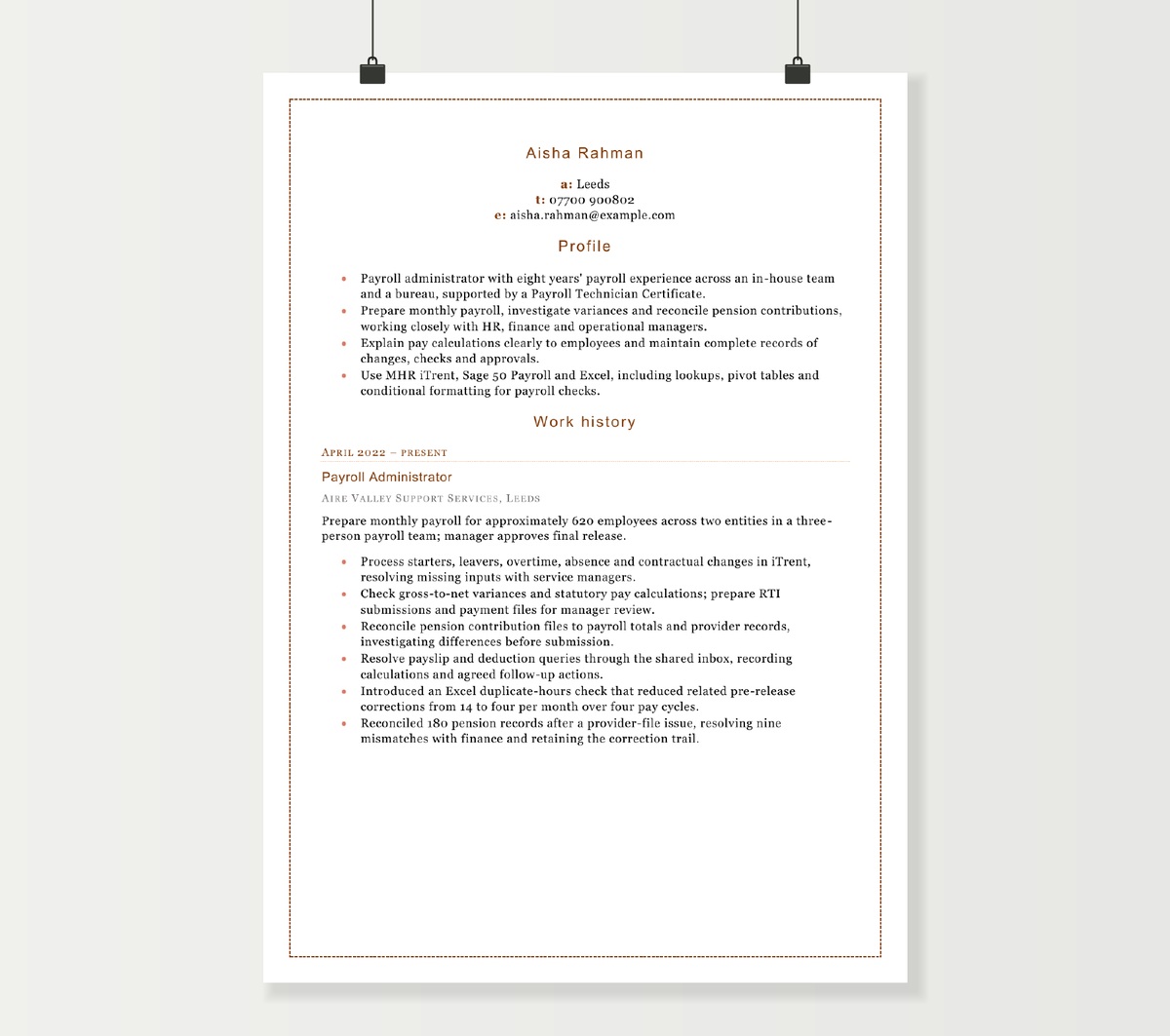
This payroll administrator CV template follows a candidate with in-house and bureau experience, progressing from office administration to payroll processing. The Word example shows payroll scope, reconciliations, pensions work and employee support. The guide covers how to present responsibility across the pay cycle, explain systems experience and build a strong application for an experienced or first payroll role.
Filename: FreeCVDownload_Payroll_Administrator.docx
Content of this CV template
Aisha Rahman
a: Leeds
t: 07700 900802
Profile
- Payroll administrator with eight years' payroll experience across an in-house team and a bureau, supported by a Payroll Technician Certificate.
- Prepare monthly payroll, investigate variances and reconcile pension contributions, working closely with HR, finance and operational managers.
- Explain pay calculations clearly to employees and maintain complete records of changes, checks and approvals.
- Use MHR iTrent, Sage 50 Payroll and Excel, including lookups, pivot tables and conditional formatting for payroll checks.
Work history
April 2022 – present
Payroll Administrator
Aire Valley Support Services, Leeds
Prepare monthly payroll for approximately 620 employees across two entities in a three-person payroll team; manager approves final release.
- Process starters, leavers, overtime, absence and contractual changes in iTrent, resolving missing inputs with service managers.
- Check gross-to-net variances and statutory pay calculations; prepare RTI submissions and payment files for manager review.
- Reconcile pension contribution files to payroll totals and provider records, investigating differences before submission.
- Resolve payslip and deduction queries through the shared inbox, recording calculations and agreed follow-up actions.
- Introduced an Excel duplicate-hours check that reduced related pre-release corrections from 14 to four per month over four pay cycles.
- Reconciled 180 pension records after a provider-file issue, resolving nine mismatches with finance and retaining the correction trail.
June 2018 – March 2022
Payroll Assistant
Brookfield Payroll Services, Leeds
Supported weekly and monthly payrolls for 18 small-business clients, covering around 240 employees.
- Entered approved hours, starter details and pay changes into Sage 50 Payroll.
- Prepared payroll summaries for senior review and client approval.
- Processed pension enrolments and contribution files under the team's checking process.
- Checked leaver calculations and prepared P45s; supported year-end P60 production.
- Followed up missing client inputs against agreed payroll cut-off dates.
- Created a client-input tracker that the team adopted for holiday cover.
September 2016 – May 2018
Office Administrator
Brookfield Payroll Services, Leeds
Provided administration and first-line client support for a payroll bureau.
- Logged incoming timesheets and routed them to the assigned processor.
- Maintained client contact and submission-calendar records.
- Checked new-client forms for missing information and arranged follow-up.
- Recorded telephone queries accurately for payroll colleagues.
- Filed authorised documents in the correct restricted-access client folders.
- Learned payroll input checks through supervised cover before promotion.
Qualifications and development
Payroll Technician Certificate, Level 3 | CIPP, 2021
Payroll legislation update, 2026 | Excel for payroll reconciliation, 2024
A levels: Business Studies, English Language and Maths | Leeds, 2016
Interests
Badminton, reading crime novels and weekend city breaks.
How to write a payroll administrator CV
A strong payroll administrator CV explains the payroll you worked on, the stages you handled and the checks that made your work dependable. Employers need to understand more than whether you entered figures into a system. They want to see how you dealt with changing employee information, found discrepancies and helped people understand their pay.
Start with your payroll experience rather than a general statement about being good with numbers. In-house processing, a client payroll bureau and coordinating an outsourced service involve different responsibilities. Making your background clear helps the reader assess how it fits their own operation.
Give the pay run a clear shape
Under each payroll job title, add a short sentence covering the size and frequency of the payroll, the number of entities or clients and the team arrangement. These details provide context for the rest of the entry.
For example, the downloadable CV describes monthly processing for approximately 620 employees across two entities in a three-person team, with a manager approving release. The previous role covers weekly and monthly payrolls for 18 small-business clients. Both settings are useful experience, but they place different demands on the administrator.
Headcount alone does not capture complexity. Hourly paid staff, variable overtime, several pension arrangements, different contractual terms or frequent starters and leavers can all affect the work. Choose the features relevant to the vacancy and explain them briefly. A smaller payroll with varied pay arrangements can provide stronger evidence for a particular post than a much larger, straightforward population.
Where your employer had a large workforce but you processed an allocated group, give the size of your own area and explain the wider team context. For bureau work, a typical client range and the pay frequencies can be more useful than one total employee figure.
Show where your responsibility starts and finishes
“End-to-end payroll” is useful shorthand when supported by the stages you actually handled. Use the employment bullets to show how work moved from source information through calculations, checks, approval and reporting.
- Inputs: collecting approved hours, processing employee changes, updating absence records and resolving incomplete information.
- Calculation and checking: reviewing pay variations, checking statutory payments or deductions and investigating exceptions.
- Completion: preparing payroll summaries, obtaining client approval, producing payment files or making authorised submissions.
- After the run: reconciling contributions, answering queries, preparing accounting information and retaining supporting records.
Select the stages that best demonstrate your experience. In a team with separate checking and approval, a sentence such as “Prepared gross-to-net reports and payment files for the payroll manager’s review” makes your contribution easy to understand. If you submitted Real Time Information (RTI) returns or handled payment release, give that responsibility its own clear wording.
An outsourced payroll arrangement can still involve substantial work. Explain how you gathered and validated inputs, reviewed the provider’s draft output, resolved discrepancies and coordinated approval. That account is more useful than treating the provider’s processing as an unexplained gap.
For statutory knowledge, connect the subject to a task: checking sick-pay calculations, processing family-leave payments, handling deductions or supporting year-end reporting. A CV needs evidence of application and current knowledge; it gains little from reproducing tax rates or explaining the calculation rules.
Use reconciliations and exception checks to demonstrate accuracy
Accuracy is a central requirement, but the word on its own says little about how you work. Describe the control or check you performed, what you compared and how you dealt with differences.
Strong examples include comparing gross pay with the previous period, checking starters against authorised records, matching a pension contribution file to payroll totals or identifying duplicate hours before the run was approved. If you worked on an investigation, explain the records involved and how the outcome was documented.
In the example CV, Aisha reconciles pension files to payroll and provider records. Her separate project covers 180 records and nine mismatches following a provider-file issue. The scale is specific, and the role of finance is visible. The reader can understand the work without seeing any employee’s personal circumstances.
Payroll audit support also benefits from detail. State whether you assembled change approvals, traced figures to source records, supplied sample evidence or resolved an outstanding documentation query. This shows how your record keeping supported review.
When you mention data handling, a practical detail can be enough: using restricted-access folders, following an approval trail or keeping an auditable record of changes. Give it proportionate space alongside the processing work.
Explain systems experience through payroll tasks
Name the payroll and HR systems you have used, then make their role apparent in the employment section. An employer looking for iTrent, Sage, COINS, IRIS, SAP or another package needs to know whether you entered changes, ran calculations, produced reports, resolved exceptions or supported testing.
Group current systems together in a compact skills line. Older software can stay under the relevant job where its context is clear. If you contributed to a system change, describe the part you owned: checking migrated employee records, preparing test cases, comparing parallel-run results or recording defects for the project team.
Excel skills are strongest when tied to a payroll purpose. Lookups may support employee-record matching; pivot tables can summarise changes by department; conditional formatting can draw attention to exceptions. The example’s duplicate-hours check demonstrates a practical use of Excel and gives a measured result.
A useful skills entry might read: “Excel: lookups and pivot tables for payroll reconciliations; conditional formatting for exception checks.” This gives a clearer picture than a rating such as “advanced Excel”. Where you use Power Query or other tools, explain the recurring task they support and how the output fits the checking process.
Give employee and client queries proper weight
Payroll query handling combines investigation with clear communication. Show the types of question you dealt with, how you found the answer and how you kept the person informed. Payslip explanations, changes in deductions, missing overtime and pension contributions can each demonstrate useful experience.
Describe the service arrangement too: a shared inbox, case-management system, allocated clients or direct contact with site managers. If the team worked to response targets, state your part in meeting them. A result should make clear whether it concerns first responses, completed cases or a backlog.
Complex queries often involve HR, finance, a provider or a senior payroll colleague. Mention that coordination where it mattered. Explaining an adjustment in plain language, documenting the calculation and agreeing the next action can be a strong bullet even when there is no numerical achievement.
For bureau applications, give client communication particular attention. Chasing missing inputs, clarifying instructions and obtaining approval across overlapping deadlines are part of delivering the service. For an in-house post, relationships with managers responsible for timesheets or absence information may deserve more space.
Distinguish pensions work from a general payroll list
Pension administration can be a substantial part of a payroll administrator role. Identify the work you carried out, such as enrolment records, opt-in or opt-out processing, contribution files, provider queries and reconciliations. Where a particular scheme matters to the vacancy, name it and describe your involvement.
Experience with a defined contribution workplace scheme, Teachers’ Pensions or another public-sector scheme can involve different records and reporting. Specific scheme experience belongs near the top of the relevant job entry when it is a strong match.
If your contribution concerned the payroll side of pensions, that is a useful scope to state. For example, preparing monthly contribution data and investigating rejected records tells the employer exactly what you can bring. A separate pensions qualification or substantial scheme-administration responsibility can then be presented alongside it.
Choose achievements that reflect payroll service quality
Good payroll results often come from improving a small but recurring part of the cycle. Useful achievements include reducing missing inputs at cut-off, making a check quicker, clearing a defined reconciliation backlog or improving the information available during holiday cover.
Use a baseline and period where they help. “Reduced duplicate-hours corrections from 14 to four per month over four pay cycles” identifies the problem and the measurement. It also makes clear that these were corrections made before release, which is different from errors in employees’ final pay.
Other results can be expressed through scope and completion: reconciling a set of historic records, documenting a procedure adopted by the team or supporting a successful parallel run for a system change. Explain your contribution to a team outcome, especially where a manager, provider or finance colleague owned the final decision.
Routine processing can still supply strong evidence. The number of payrolls, the range of pay frequencies and the responsibility you held during busy periods may be more useful than a percentage. Keep the measures connected to service quality and the work you performed.
Position qualifications and progression for the role you want
List a payroll qualification by its full title, level, provider or awarding body and completion year. For current study, add the expected completion date. A Payroll Technician Certificate, apprenticeship or another recognised course gives the reader more information than “payroll qualified”. Professional membership, where relevant, belongs in a separate line.
Recent development can help establish the currency of older qualifications. Choose a few relevant items, such as payroll legislation updates, pension administration or payroll-system training. State the subject and date rather than building a long list of every webinar attended.
For a first payroll role, use your previous work to show preparation for the tasks. Timesheet administration, checking records against source documents, handling numerical queries and working to repeated monthly deadlines are useful starting points. Explain any supervised payroll work and place relevant study prominently. The accounts assistant example may help if your route into payroll comes through a finance support role.
Experienced administrators should use recent work to show deeper responsibility: more complex reconciliations, a broader client portfolio, cover for colleagues or a defined improvement project. If you are applying for a role involving team leadership, payroll governance and final sign-off, the payroll manager CV guide addresses that next stage. Other formats are available in the template library.
Payroll Administrator CV FAQs
Yes, depending on the vacancy. Make experience with several entities, pay frequencies and overlapping deadlines visible, then show how you handled queries and obtained information from other people. These can support a move into client payroll. Where your background is one monthly payroll, explain its complexity and the responsibility you carried; that helps an employer assess the training needed for a client portfolio.
The titles overlap, and employers use them differently. Compare the duties, approval responsibility and required experience. This example can suit an officer application if the scope matches. Retain your actual employment titles and use the profile and job descriptions to show the level at which you worked.
Name the systems you have used and describe the comparable work you carried out, such as processing changes, running checks or producing reports. Previous experience of learning a new package or helping with a system transition is useful supporting evidence. An employer that treats its package as desirable may be more interested in sound payroll processing experience than an exact software match.
Keep the combined title and organise the bullets so the payroll responsibilities appear first for a payroll application. State the payroll population, your part in the cycle and the systems involved. Include HR duties that explain the flow of payroll information, such as contractual changes and absence records, then give other HR work proportionate space.
Show the payroll scope and responsibilities from your previous work, then add recent learning or practice that demonstrates current knowledge. A dated payroll update course, software refresher or relevant qualification in progress can help connect earlier experience with today's requirements. Put the career break in the chronology briefly so the employment dates are easy to follow.
Yes. Give the contract dates and its defined purpose, then describe the work completed: checking year-end records, preparing reporting data, reconciling pension contributions or resolving a documented backlog. Several short assignments can sit under a contract-work heading with a brief entry for each. Their value lies in the specific payroll experience and outcomes they add.




