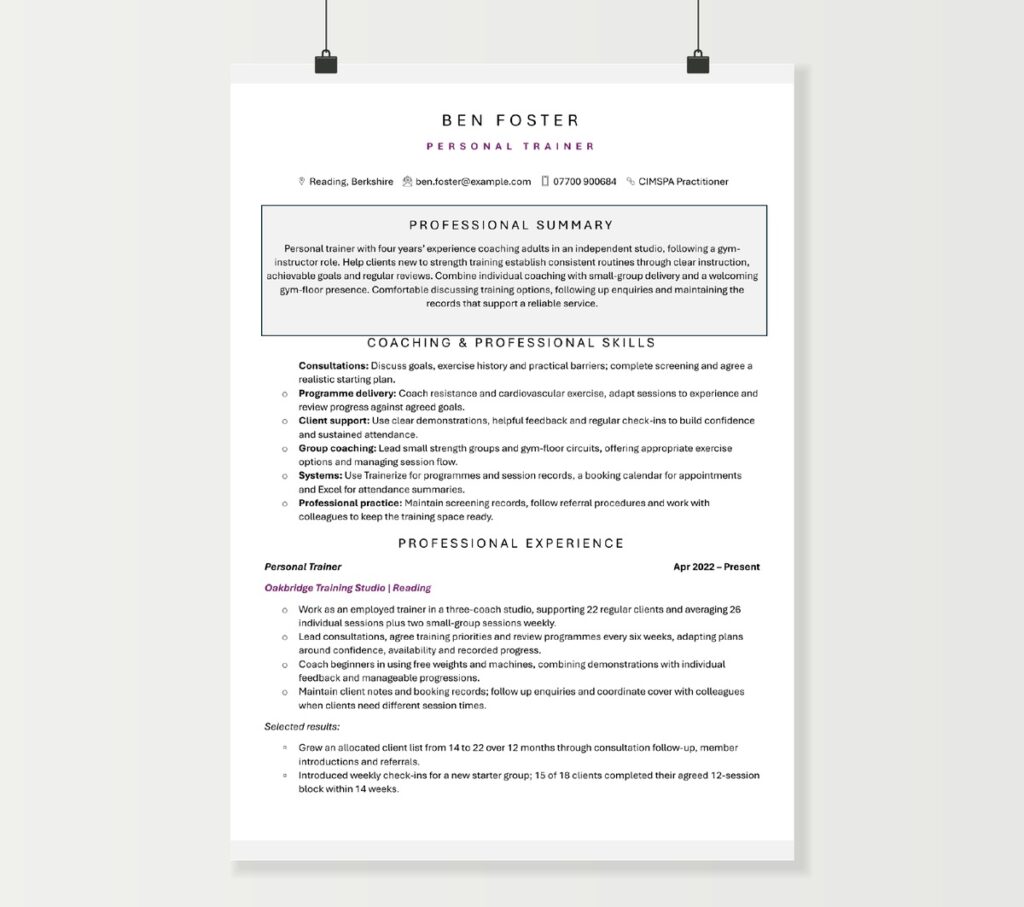
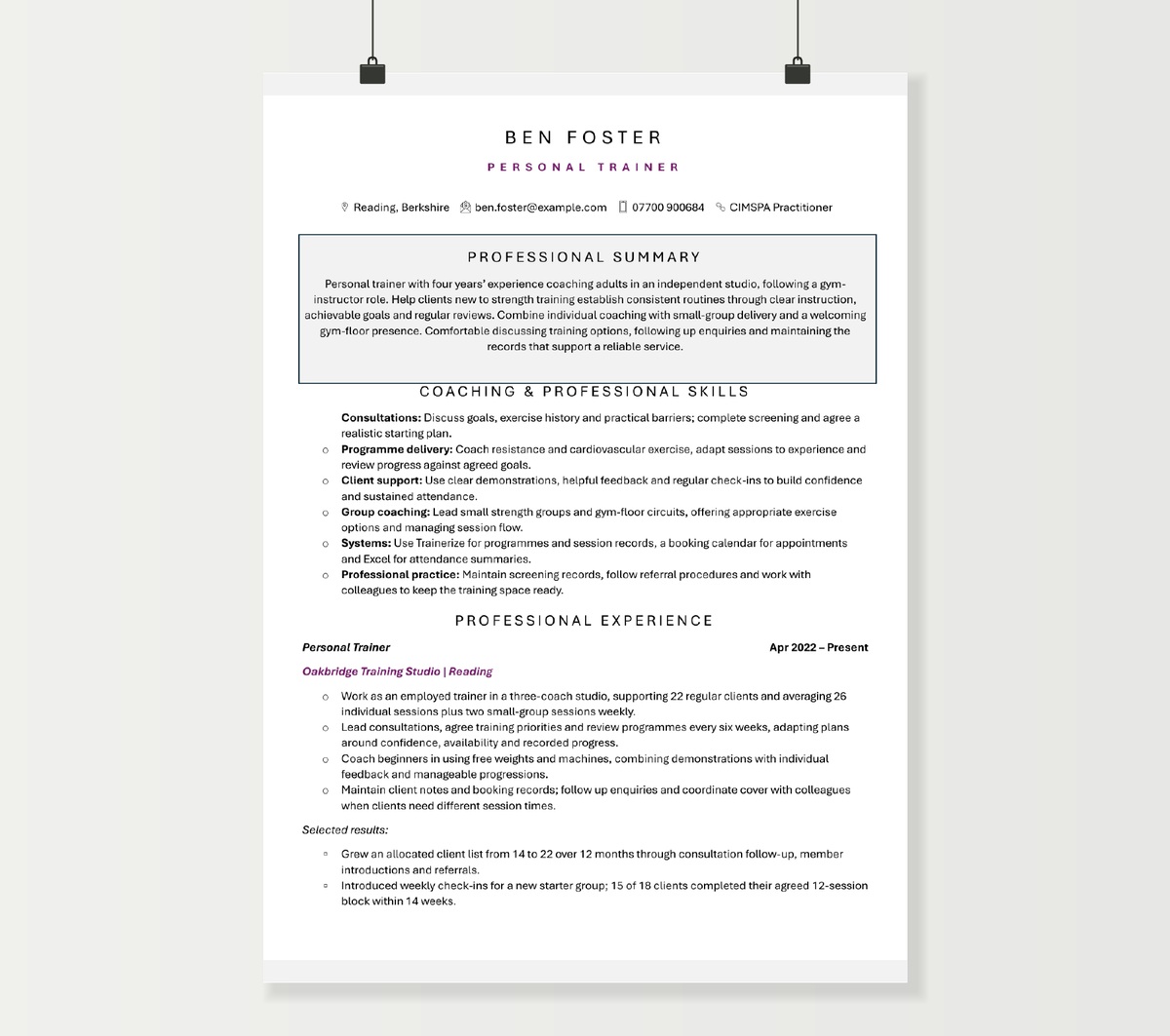
This personal trainer CV template follows an employed coach with experience in an independent studio and a membership gym. The Word example shows client consultations, programme reviews, gym-floor work and measured results. The guide covers applications for employed and self-employed opportunities, from a first qualified role to a more established coaching position.
Filename: FreeCVDownload_Personal_Trainer.docx
Content of this CV template
Ben Foster
PERSONAL TRAINER
Reading, Berkshire | [email protected] | 07700 900684 | CIMSPA Practitioner
Professional summary
Personal trainer with four years’ experience coaching adults in an independent studio, following a gym-instructor role. Help clients new to strength training establish consistent routines through clear instruction, achievable goals and regular reviews. Combine individual coaching with small-group delivery and a welcoming gym-floor presence. Comfortable discussing training options, following up enquiries and maintaining the records that support a reliable service.
Coaching & professional skills
- Consultations: Discuss goals, exercise history and practical barriers; complete screening and agree a realistic starting plan.
- Programme delivery: Coach resistance and cardiovascular exercise, adapt sessions to experience and review progress against agreed goals.
- Client support: Use clear demonstrations, helpful feedback and regular check-ins to build confidence and sustained attendance.
- Group coaching: Lead small strength groups and gym-floor circuits, offering appropriate exercise options and managing session flow.
- Systems: Use Trainerize for programmes and session records, a booking calendar for appointments and Excel for attendance summaries.
- Professional practice: Maintain screening records, follow referral procedures and work with colleagues to keep the training space ready.
Professional experience
Personal Trainer | Apr 2022 – Present
Oakbridge Training Studio | Reading
- Work as an employed trainer in a three-coach studio, supporting 22 regular clients and averaging 26 individual sessions plus two small-group sessions weekly.
- Lead consultations, agree training priorities and review programmes every six weeks, adapting plans around confidence, availability and recorded progress.
- Coach beginners in using free weights and machines, combining demonstrations with individual feedback and manageable progressions.
- Maintain client notes and booking records; follow up enquiries and coordinate cover with colleagues when clients need different session times.
Selected results:
- Grew an allocated client list from 14 to 22 over 12 months through consultation follow-up, member introductions and referrals.
- Introduced weekly check-ins for a new starter group; 15 of 18 clients completed their agreed 12-session block within 14 weeks.
Gym Instructor | Jun 2019 – Mar 2022
Riverside Fitness Club | Reading
- Delivered inductions and gym-floor support in a membership club, completing the Level 3 personal training qualification alongside employment.
- Showed new members how to use equipment, discussed initial goals and recorded induction notes for follow-up appointments.
- Led beginner circuits and supported members during staffed gym hours, adapting explanations for people with different levels of confidence.
- Checked the gym floor, reported equipment faults and worked with reception colleagues to resolve booking and membership enquiries.
Selected contributions:
- Set up a reminder routine for induction follow-ups; 52 of 60 new members attended their four-week review during the final quarter of 2021.
- Helped two new instructors learn the club’s induction and booking routines, sharing practical notes and demonstrating member conversations.
Qualifications & membership
Active IQ Level 3 Diploma in Personal Training – 2021
Active IQ Level 2 Certificate in Gym Instructing – 2019
Emergency First Aid at Work – completed May 2025
CIMSPA Personal Trainer Practitioner – current membership
Development & interests
- Recent learning: Coaching conversations workshop, 2025; studio strength-programming and first-aid refresher sessions, 2026.
- Team development: Share client-coaching reflections in fortnightly studio meetings and take part in observed-session feedback.
- Interests: Five-a-side football, cooking and weekend walks along the Thames.
Build a personal trainer CV around the clients you can help
A personal trainer CV should make your coaching easy to picture. The reader needs to understand who you work with, how you support their progress and what you contribute to the gym or studio. Qualifications establish your foundation; your examples show how you turn that foundation into a service clients want to use.
A list of training methods gives only part of the picture. Consultations, session planning, useful feedback, follow-up and dependable administration all affect the client’s experience. Choose evidence that shows the relationship between these parts of your work.
Match the CV to the working arrangement
Personal training opportunities can involve an employed coaching role, a self-employed business operating from a gym, or a combination of paid fitness-coach hours and independent PT sessions. Establish which arrangement the vacancy offers before deciding what to emphasise.
For an employed role, show how you contribute to the member experience and work with the rest of the team. Inductions, classes, gym-floor support, records, cover arrangements and maintaining a welcoming training space may sit alongside your individual sessions. A boutique studio may give more weight to consultations, detailed programme reviews, semi-private coaching and collaborative learning.
For a self-employed opportunity, include evidence that you can build and sustain a service: enquiries, consultations, client relationships, bookings and repeat business. Give the reader a sense of your current practice and the type of clients you work with. A small established client list can be useful evidence when its size and working pattern are clear.
If your previous role combined employment and self-employment, describe both capacities in the entry. For example, explain that you worked contracted fitness-coach shifts and ran a separate personal training business at the same club. This makes your working history and commercial responsibilities easier to assess.
Put qualifications where the recruiter can find them
Give your main personal training qualification its full title, awarding organisation and completion year. Include the relevant gym-instructing qualification where it helps establish your route into the role. For a newly qualified applicant, these details can sit near the top; an experienced trainer can also signal the main credential in the profile.
List CIMSPA membership separately, using your current professional status and occupation. This distinguishes the qualification you completed from your professional recognition. Where the vacancy specifies Personal Trainer Practitioner membership, make that status easy to identify.
First-aid training belongs in the same readily visible area, with the award and completion or renewal date. Other certificates should reflect the work you want to do. A relevant population specialism, group-exercise qualification or substantial coaching course can add useful depth; the CV should explain what it enables you to offer.
For professional development, select a few recent items that connect to your practice. “Coaching conversations workshop” becomes more useful alongside an example of improving client check-ins. An observed-session feedback process can show active development even when it does not lead to another certificate.
Explain your coaching through a client journey
Use your employment bullets to show how a client moves from first contact to ongoing training. You do not need to describe every stage in every job, but your recent experience should give a rounded picture.
Consultation and starting point
Describe the consultations or inductions you conduct and the information that shapes your planning: goals, experience, availability, confidence and relevant screening. This shows listening and judgement. For a gym-floor role, introducing an unfamiliar member to equipment and agreeing a useful follow-up may be your strongest starting example.
Programme design and session delivery
Identify the client group and training emphasis, then explain how you adapt the work. Coaching adults who are new to resistance training is a clearer description than a long list of exercises. If you work with more experienced clients, show the review process, the training decisions you own and how you respond to progress.
Keep the CV at the level of professional evidence. The employer needs to see that you can plan and coach appropriately; a full session prescription or a technical explanation of a training method usually belongs in a practical assessment or a separate work sample.
Review and continued participation
Show how you find out whether the plan is working. That might involve recorded performance, attendance, client feedback or a scheduled review. Explain what you did with that information: adjusted session frequency, changed the programme emphasis or helped a client find a routine that fitted their week.
For example, a bullet about introducing short check-ins can connect your communication to completion of a starter programme. This is particularly useful when coaching confidence and consistency is a substantial part of your work.
Choose results that describe useful progress
Personal training offers more ways to demonstrate impact than changes in body weight. Depending on your clients and the role, relevant evidence can include attendance, programme completion, agreed fitness goals, confidence using equipment, referrals or continuing engagement with training.
Give a result enough context to be meaningful. “High retention” leaves the reader guessing what was measured. State the group, period and outcome, such as how many new clients completed an agreed block of sessions. The example CV gives 15 completions from 18 starters over a defined period, so the scale is immediately clear.
Keep different measures distinct. An active client count tells the reader how many people you support; weekly session delivery describes workload; renewal or repeat-booking figures describe continued business. A client attending twice a week contributes two sessions but remains one client.
For individual progress, a short anonymised case can show more than a headline transformation. Explain the starting goal, your contribution and the relevant outcome. A client who moved from avoiding the gym to completing a consistent training block may be highly relevant to a role focused on beginners and member engagement.
Where formal measurements are limited, use concrete service evidence. You might have established regular programme reviews, taken over cover for a colleague’s clients or helped a new member become comfortable training independently. These examples show the value of your coaching without requiring every bullet to carry a statistic.
Present client growth as part of good service
Gyms and studios need trainers who can discuss their offer clearly and turn interest into an appropriate next step. Give sales and relationship-building work its proper place on the CV, especially for rental opportunities or roles with an expectation of developing a client list.
Useful evidence includes responding to enquiries, conducting discovery consultations, explaining session options, following up agreed next steps and receiving referrals from existing clients. Describe the route to growth so the result is connected to your work.
Grew an allocated client list from 14 to 22 over 12 months through consultation follow-up, member introductions and referrals.
For an established self-employed trainer, you could also describe managing renewals, planning availability or building relationships with local organisations. Revenue can be relevant when the vacancy has a commercial focus, but session delivery and sustained client relationships may give the recruiter a clearer picture of day-to-day performance.
If your earlier experience is in sales, hospitality or customer service, select examples that transfer to consultations and ongoing client contact. Pair them with your coaching qualification and practical experience so the application presents both sides of the role.
Show how you work within a gym or coaching team
A good trainer also helps create the environment in which sessions take place. Mention inductions, equipment checks, reporting faults, class cover or helping members on the gym floor when these are part of your role. A concise example can show that you notice what needs doing and communicate with colleagues.
For group delivery, state the format and approximate size where helpful. Coaching six people through individual programmes in a semi-private session differs from leading a class of 25 following the same routine. The distinction tells the reader something about observation, communication and managing several needs at once.
Specialist experience deserves similarly clear context. Name the relevant qualification, the clients or setting and your responsibilities. Where your work involves liaison with a physiotherapist or another professional, explain how that relationship informs your contribution. This gives the employer a practical account of your professional scope.
At senior level, add evidence of helping other coaches improve: observed-session feedback, mentoring, shared programming reviews or leading an onboarding improvement. Explain how much of the work you coordinated and what changed for the team or its clients.
Make digital tools and work samples support the coaching
Name the platforms you use for programming, client communication, booking and records, alongside the purpose of each. “Trainerize for programme delivery and session records” is easier to interpret than a software list. Experience with one platform can also demonstrate familiarity with the workflow when a new employer uses another.
For online or blended coaching, explain the service itself: live video sessions, scheduled reviews, asynchronous feedback or app-based programme delivery. Include evidence of keeping clients engaged between appointments and organising feedback reliably. This is stronger than treating “online coaching” as a standalone skill.
A small portfolio can help if it shows how you think as a coach. A concise programme case, a consultation outline or a short demonstration with clear explanations may be enough. Select material that is easy for a recruiter to review and uses anonymised information or material you have permission to share.
A professional social profile is useful when it demonstrates communication, teaching or a relevant service. Explain its role in your work if you include it. The CV can stand on its own through qualifications and coaching evidence; a large following is only one possible form of supporting material.
Build a first PT application from practical evidence
Newly qualified trainers can lead with their qualification and a short practical-experience section. Include supervised sessions, assessed consultations, programme casework or relevant gym-floor work, with dates and a clear description of the setting. Explain what you planned, delivered and learned from feedback.
Earlier work can provide useful evidence of reliability, explaining unfamiliar information, handling bookings or following up customer enquiries. Select those responsibilities and keep the connection to personal training visible. Your own participation in sport can add context, while the practical coaching examples show how you support someone else’s progress.
An established trainer should give more space to recent clients, coaching responsibility and service results. Review older qualifications and early jobs for the detail still relevant to the next post. The CV template collection offers alternative layouts if your experience needs a different balance of qualifications, work history and supporting material.
Personal Trainer CV FAQs
List the degree with its relevant practical content and any professional recognition it carries. The employer may still specify a recognised personal training qualification or CIMSPA status. If your degree programme also awarded or provided an endorsed route to that credential, show the credential separately so the recruiter can match it to the requirement.
Use the title and awarding organisation shown on the certificate, with the year achieved. Add current professional membership and recent development separately. If the employer needs to assess an older award against its current requirements, the qualification number or certificate can provide supporting detail during recruitment.
The CV itself is usually stronger with concise coaching evidence that can be read quickly. If a relevant portfolio includes client images, use material shared with the client's permission and explain the coaching context. A short account of goals, your contribution and progress can demonstrate your approach without photographs.
Some vacancies welcome trainees or applicants approaching qualification; others require completion before they can progress an application. Give the exact course title, provider and expected completion date, and separate assessed practical work from paid employment. This helps the employer judge both your current experience and when you would be ready to start.
A brief professional-details line can state that you hold current public liability and professional indemnity cover, where applicable to your practice. Detailed policy documents can be provided during onboarding. Keep the main CV focused on the coaching service, qualifications and business experience relevant to the gym arrangement.
Describe the service and the qualification supporting it. General healthy-eating guidance connected to training can be presented alongside lifestyle support. If you hold a separate nutrition qualification or work with a nutrition professional, make that distinction clear. The employer can then understand the nature and depth of the service you provide.
State the working pattern and use measures that fit it, such as sessions per available week, ongoing client relationships or completion of agreed programmes. A short explanation of a part-time period gives useful context. The application can then focus on the quality and scope of your coaching and your availability for the new role.