
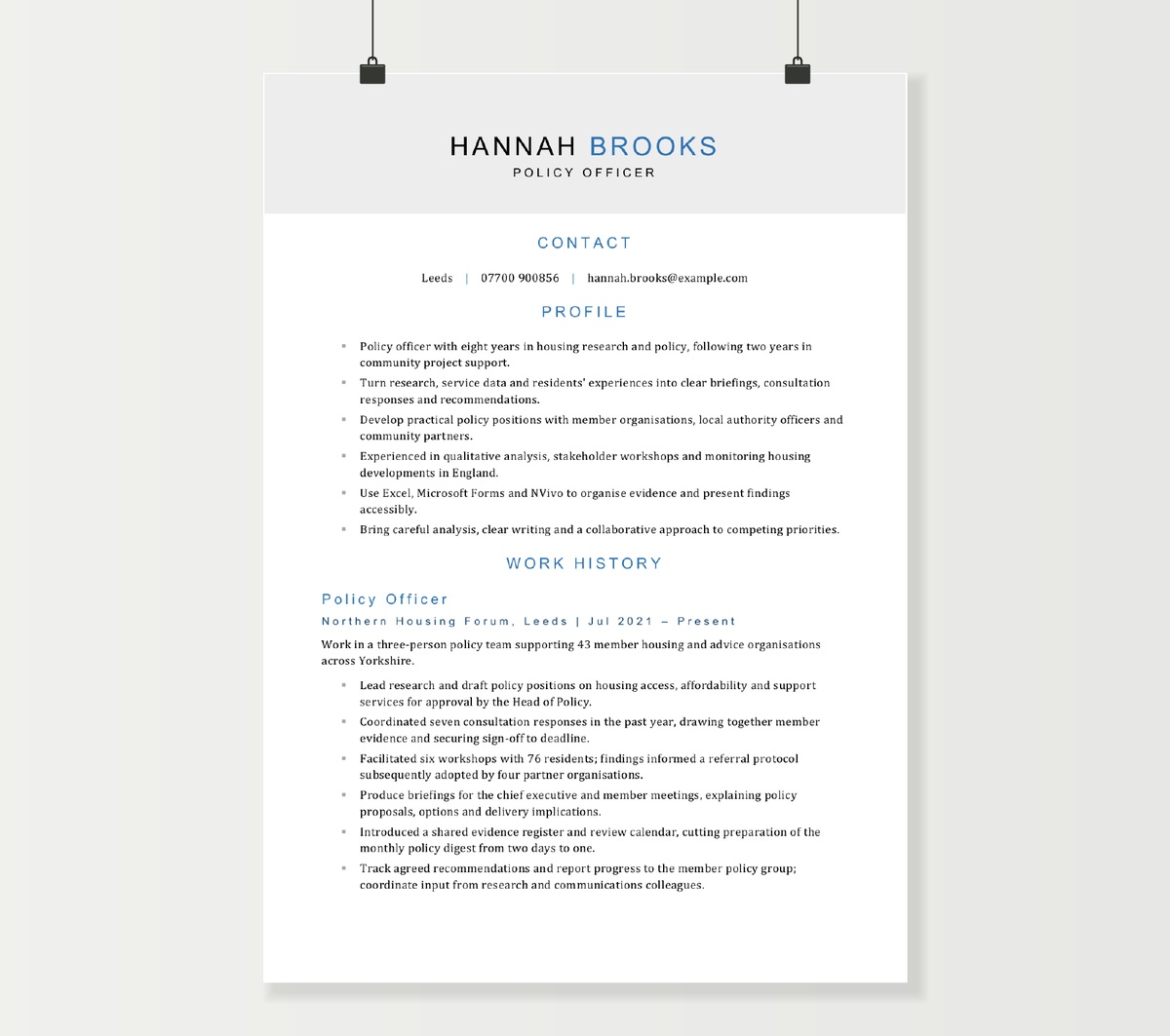
This policy officer CV template follows a career from community project support into housing policy research and development. The Word example shows how evidence, consultation and clear writing contribute to recommendations and practical changes. The guide covers policy applications in charities, membership organisations and the public sector, including how to present experience from another field.
Filename: FreeCVDownload_Policy_Officer.docx
Content of this CV template
Hannah Brooks
Policy Officer
Contact
Leeds | 07700 900856 | [email protected]
Profile
- Policy officer with eight years in housing research and policy, following two years in community project support.
- Turn research, service data and residents' experiences into clear briefings, consultation responses and recommendations.
- Develop practical policy positions with member organisations, local authority officers and community partners.
- Experienced in qualitative analysis, stakeholder workshops and monitoring housing developments in England.
- Use Excel, Microsoft Forms and NVivo to organise evidence and present findings accessibly.
- Bring careful analysis, clear writing and a collaborative approach to competing priorities.
Work history
Policy Officer
Northern Housing Forum, Leeds | Jul 2021 – Present
Work in a three-person policy team supporting 43 member housing and advice organisations across Yorkshire.
- Lead research and draft policy positions on housing access, affordability and support services for approval by the Head of Policy.
- Coordinated seven consultation responses in the past year, drawing together member evidence and securing sign-off to deadline.
- Facilitated six workshops with 76 residents; findings informed a referral protocol subsequently adopted by four partner organisations.
- Produce briefings for the chief executive and member meetings, explaining policy proposals, options and delivery implications.
- Introduced a shared evidence register and review calendar, cutting preparation of the monthly policy digest from two days to one.
- Track agreed recommendations and report progress to the member policy group; coordinate input from research and communications colleagues.
Research Assistant
Northern Housing Forum, Leeds | Sep 2018 – Jun 2021
Supported research projects on housing access and tenants' experience, reporting to the Policy Manager.
- Reviewed published research and official statistics, preparing evidence summaries and tables for policy reports.
- Coded 214 open-text survey responses in NVivo and identified themes for the lead researcher's review.
- Arranged interviews and focus groups, maintained consent records and prepared anonymised research extracts.
- Co-authored a member briefing on access to advice, used to plan a joint referral pilot with three local partners.
Project Administrator
Riverton Community Trust, Leeds | Sep 2016 – Aug 2018
Supported a community advice and engagement programme.
- Organised resident meetings, recorded actions and maintained the programme's attendance and feedback records.
- Prepared quarterly activity summaries for the project manager and coordinated information requests from delivery partners.
Qualifications and development
BA (Hons) Politics, 2:1
University of Leeds, 2016.
Professional development
Facilitation skills workshop, 2024; equality impact assessment training, 2023; NVivo qualitative analysis course, 2019.
Hobbies and interests
I enjoy hill walking, swimming and visiting small independent cinemas.
How to write a policy officer CV
A policy officer CV should show how you move from an issue to useful advice. Employers need to understand the subjects you have worked on, the evidence you can handle and the people your work helps to make decisions. A record of reports and meetings becomes much stronger when it explains what those activities contributed to a policy position, a service change or an agreed course of action.
Establish your policy context in the opening lines
State your main policy area, the type of organisation you work for and the level at which you operate. Housing policy for a local authority, national health policy for a professional body and international higher education policy involve different stakeholders and decision routes. Geography matters too: the relevant institutions and responsibilities can differ across England, Scotland, Wales and Northern Ireland.
Your profile can then connect that context to two or three strengths. For example, an officer with housing experience might foreground consultation, evidence synthesis and briefings for member organisations. Someone applying for an environmental policy role may place technical subject knowledge and implementation planning first. Use the employment section to substantiate those strengths with specific work.
When changing policy area, introduce the transferable capability and the bridge to the new subject. Research into access to public services, experience working with councils or analysis of regulatory proposals may travel well between sectors. Explain how you have previously developed knowledge of an unfamiliar issue; this gives an employer something concrete to assess alongside your interest.
Show the thinking behind your written outputs
“Wrote policy briefings” describes an output without explaining its value. Add the audience, the issue and what the document enabled. A briefing might prepare a chief executive for a meeting, compare options for a board, explain consultation proposals to members or support a response to a government announcement.
Choose one or two examples that show different kinds of writing. A short decision briefing demonstrates selection and clarity; a consultation response can demonstrate coordination and argument; a research report can demonstrate synthesis and depth. State your contribution where authorship was shared: lead drafter, researcher, editor or coordinator of specialist input.
Useful detail might read: “Synthesised member evidence and cost information into a board paper comparing three service options; the board approved a six-month pilot.” That line contains the analytical work, its audience and a decision. The substance matters more than describing yourself as an excellent writer.
Connect research methods to the question you answered
Present research experience through the policy question and the evidence used. Published studies, official statistics, service data, interviews, surveys and practitioner knowledge can each make a different contribution. Explain how you brought the relevant material together and what your analysis revealed.
For quantitative work, useful details might include the datasets compared, the level of analysis and the finding that informed a recommendation. For qualitative work, mention the participants or material, your analytical approach and how the themes were used. “Coded 214 open-text responses and summarised barriers to accessing advice for the lead researcher” is more informative than “experienced in qualitative research”.
Software belongs in this context. Excel may support analysis and charts; NVivo may support coding; a survey platform may support consultation administration. Specialist statistical or geographic tools deserve prominence where the role calls for them. A compact skills section can help scanning, but the work history should show what you produced with those tools.
Explain how consultation changed the recommendation
Consultation experience is strongest when it goes beyond the number of sessions arranged. Set out who contributed, your role in reaching or supporting them, how you analysed the responses and what changed in the resulting proposal. Where accessibility or participation was a particular challenge, include the practical contribution you made to hearing from the affected group.
The example CV links resident workshops to a referral protocol adopted by partner organisations. Other useful outcomes include a revised implementation timetable, an additional option considered, clearer eligibility guidance or changes to the questions in a later consultation. These demonstrate that engagement affected the work.
Keep activity and outcome measures distinct. Seventy-six participants describes the scale of engagement; adoption by four partners describes a subsequent result. Both can be useful in the same account because they answer different questions. A small, carefully chosen group of specialist contributors can also provide valuable evidence without a large participation figure.
Make stakeholder relationships specific
Identify the groups you worked with and the purpose of the relationship: service users, elected members, government officials, researchers, regulators, member organisations, campaign teams or delivery partners. Then explain what you coordinated or resolved. Securing specialist input before a deadline, agreeing a common position or bringing operational concerns into a policy paper all demonstrate relationship skills.
Where views differed, a concise account of how you presented options or found common ground can be especially useful. For a public-sector role, experience preparing balanced advice and working through formal decision processes may be central. For a membership body, the challenge may be reconciling members’ different priorities into an agreed position.
Public affairs, campaigning and policy development often overlap. Make your own responsibilities visible within that collaboration. You might have produced the evidence and recommendations while colleagues led parliamentary engagement, or you may have done both. Specific actions give the reader a clearer picture than a broad statement about influencing stakeholders.
Describe influence at the stage you can evidence
Policy outcomes can take years and involve many organisations. A CV can still show meaningful progress at earlier stages: an agreed organisational position, a recommendation included in a strategy, an invitation to provide further evidence, an approved pilot or a change to implementation guidance.
Choose verbs that capture your contribution. “Drafted the evidence submission used by the coalition” and “coordinated the member working group that agreed the final response” describe different but valuable work. Where your recommendation was adopted, identify the decision-making body and the relevant change. Where a wider policy changed later, explain the connection between your work and that process.
Improvements to the policy team’s work can also be achievements. A better evidence register, a clearer sign-off process or a more useful monitoring digest may save time and make advice more reliable. Include the result where you measured it, while keeping substantive policy contributions prominent.
Include delivery, review and political awareness
Some policy jobs focus on developing positions; others also involve implementing strategies, supporting funding bids or monitoring action plans. If your remit extends into delivery, explain the handover to operational colleagues, the milestones you followed or how feedback informed a revision. That helps employers see whether you can connect an approved policy with practical constraints.
Political awareness is best shown through relevant work: preparing a briefing ahead of a committee meeting, responding to a legislative timetable, coordinating a consultation deadline or adapting advice after a change in national policy. Naming the decision process is usually more useful than listing every institution you have encountered.
For government applications, the Policy Profession standards offer a useful way to review evidence across strategy, democracy and delivery. Use the parts relevant to the appointment to identify gaps or stronger examples in your own record.
Make a first policy application from the experience you have
Research, service delivery, casework, campaigning, administration and volunteering can all produce evidence relevant to an entry-level policy role. Select tasks that involved understanding a problem, gathering information, explaining findings or coordinating people around a deadline. A service role might have given you a close view of recurring barriers; a project role might demonstrate consultation support and accurate reporting.
Academic work can help where professional examples are limited. Present a relevant dissertation or project in a few lines: question, evidence, method and conclusion. A strong undergraduate project may be more useful than a long module list. Once your policy employment provides better evidence, let it take most of the space.
Qualifications vary by appointment. List your degree or other relevant study clearly, and include training such as facilitation, research methods or impact assessment where it connects to the role. Apprenticeship routes can also be relevant to new entrants. The vacancy’s essential criteria determine which educational details deserve emphasis.
Give experienced work enough context without losing the thread
For an established officer, organise recent roles around the portfolio, a few substantial pieces of work and the contribution you made to the team. If you managed staff or commissioned external research, state the scope. If you led a workstream without line-management responsibility, describe that leadership through planning, coordination and review.
A short selected-projects section can help when your best work spans several policy areas. Choose projects that demonstrate different capabilities rather than giving each report its own entry. Keep the dates and organisational context clear so the reader can connect them to your employment history.
The CV’s structure should make those examples easy to find. If you need a different visual starting point, the CV template library contains other editable designs. The important choice is how much space the design gives your evidence, writing and policy responsibilities.
Policy Officer CV FAQs
Yes, as a record from which to select evidence. Use the form's criteria and questions to organise the submitted application, expanding the relevant CV examples where more detail is requested. Some public-sector and apprenticeship employers assess only their form, so the CV can support preparation even when it is not an attachment.
A small number of relevant published reports can help, particularly where your contribution is identified. Add a short description beside each link, such as lead author or research contributor. If the employer asks for a sample, choose one suited to the audience and format requested; a concise briefing may demonstrate the required skill better than a long academic paper. For unpublished work, an agreed extract or a separately prepared sample can be appropriate.
It can provide relevant evidence of research, briefing, consultation or organising. Describe the work and your responsibility clearly. When applying to an impartial public-sector organisation, examples of balanced analysis and working constructively with people holding different views can help demonstrate the fit. The employer's application guidance will explain any specific disclosure or eligibility requirements.
Describe the stage you completed and what the work contributed. An options appraisal may have established that a proposal was not viable, or research may have been used in a revised programme. Those are useful results. A short reference to the change in direction gives the reader context without turning the CV into a detailed project history.
Usually a selected list works better on the main CV. Prioritise publications relevant to the policy area or evidence the employer needs, with title, date and your contribution. A separate publications page can hold a fuller record when research is a substantial part of your career. For co-authored work, the contribution note helps the reader understand the skills you brought.




