
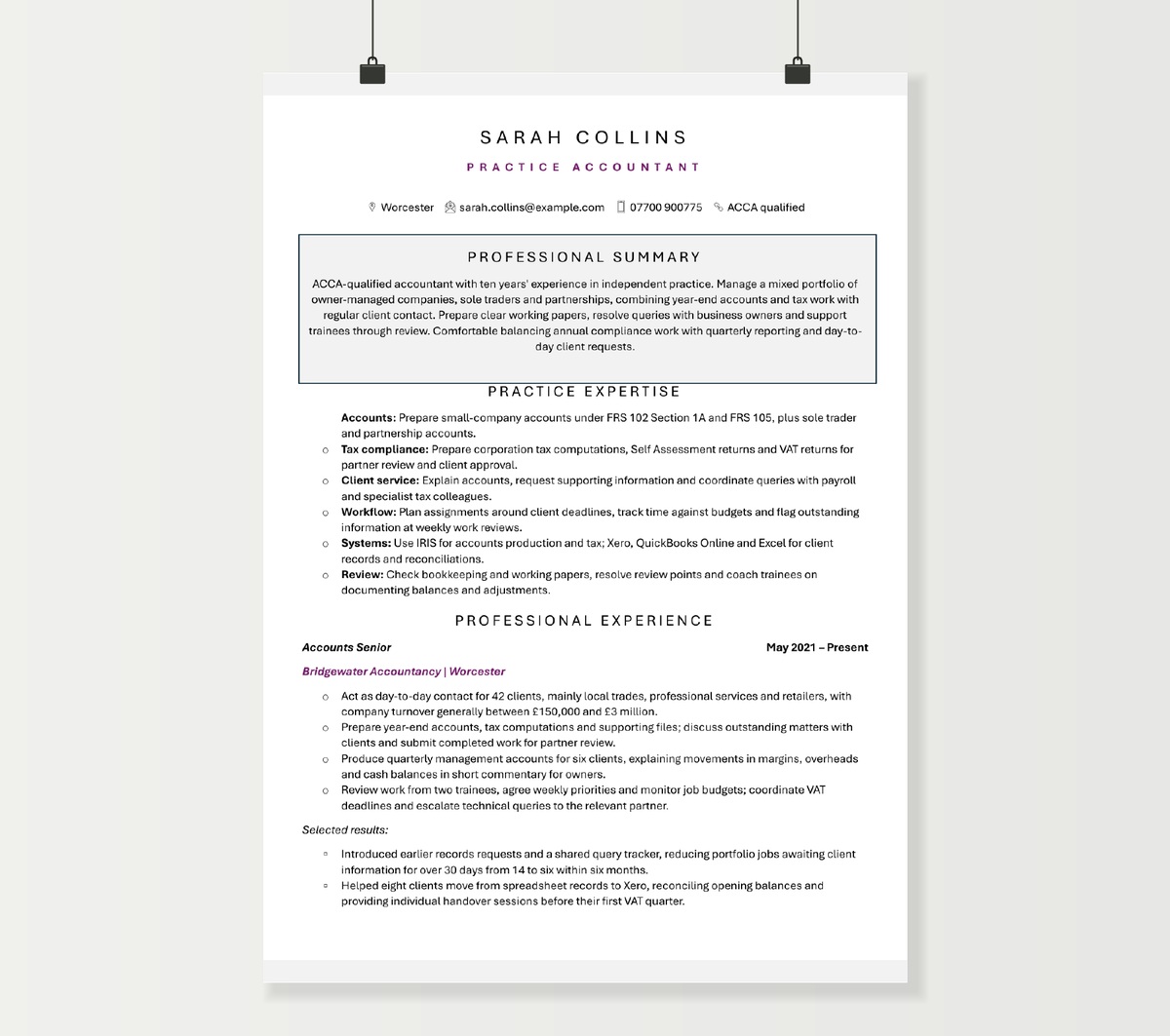
This practice accountant CV template presents an ACCA-qualified accounts senior who looks after owner-managed businesses in an independent firm. The Word example brings together accounts preparation, tax compliance, client relationships and support for junior colleagues. The guide explains how to present general practice experience, from trainee assignments to responsibility for a client portfolio.
Filename: FreeCVDownload_Practice_Accountant.docx
Content of this CV template
Sarah Collins
PRACTICE ACCOUNTANT
Worcester | [email protected] | 07700 900775 | ACCA qualified
Professional summary
ACCA-qualified accountant with ten years' experience in independent practice. Manage a mixed portfolio of owner-managed companies, sole traders and partnerships, combining year-end accounts and tax work with regular client contact. Prepare clear working papers, resolve queries with business owners and support trainees through review. Comfortable balancing annual compliance work with quarterly reporting and day-to-day client requests.
Practice expertise
- Accounts: Prepare small-company accounts under FRS 102 Section 1A and FRS 105, plus sole trader and partnership accounts.
- Tax compliance: Prepare corporation tax computations, Self Assessment returns and VAT returns for partner review and client approval.
- Client service: Explain accounts, request supporting information and coordinate queries with payroll and specialist tax colleagues.
- Workflow: Plan assignments around client deadlines, track time against budgets and flag outstanding information at weekly work reviews.
- Systems: Use IRIS for accounts production and tax; Xero, QuickBooks Online and Excel for client records and reconciliations.
- Review: Check bookkeeping and working papers, resolve review points and coach trainees on documenting balances and adjustments.
Professional experience
Accounts Senior | May 2021 – Present
Bridgewater Accountancy | Worcester
- Act as day-to-day contact for 42 clients, mainly local trades, professional services and retailers, with company turnover generally between £150,000 and £3 million.
- Prepare year-end accounts, tax computations and supporting files; discuss outstanding matters with clients and submit completed work for partner review.
- Produce quarterly management accounts for six clients, explaining movements in margins, overheads and cash balances in short commentary for owners.
- Review work from two trainees, agree weekly priorities and monitor job budgets; coordinate VAT deadlines and escalate technical queries to the relevant partner.
Selected results:
- Introduced earlier records requests and a shared query tracker, reducing portfolio jobs awaiting client information for over 30 days from 14 to six within six months.
- Helped eight clients move from spreadsheet records to Xero, reconciling opening balances and providing individual handover sessions before their first VAT quarter.
Accounts Semi Senior | Sep 2016 – Apr 2021
Hawthorn & Vale Accountants | Droitwich
- Joined as a trainee accountant and progressed to accounts semi senior in 2019 while completing ACCA studies and practical experience.
- Prepared accounts from client bookkeeping records, including bank reconciliations, accruals, prepayments and fixed-asset schedules for senior review.
- Drafted corporation tax computations and personal tax returns, gathered missing information and cleared review points with the supervising accountant.
- Maintained bookkeeping and quarterly VAT records for small businesses using Xero and QuickBooks Online; answered routine client queries.
Selected results:
- Standardised supporting schedules for six recurring quarterly assignments, reducing preparation and review time from around two days to one and a half per quarter.
- Took on direct records collection for 18 year-end clients in the final year, keeping the senior informed of missing items and agreed delivery dates.
Qualifications & development
ACCA membership – admitted in 2020
BSc (Hons) Accounting and Finance, 2:1 – University of Worcester, 2016
UK accounts and tax update programme – annual professional development
Reviewing working papers and coaching trainees – employer training, 2024
Additional information
- Client meetings: Prepare discussion notes and follow up agreed actions, including referrals to colleagues for specialist advice.
- Professional development: Keep an annual CPD record covering reporting updates, tax compliance and practical client-service skills.
- Interests: Gardening, weekend walks in the Malvern Hills and baking.
How to write a practice accountant CV
A practice accountant’s CV should make it easy to picture the clients and assignments you could take on. A partner recruiting an accounts senior needs to understand the types of accounts you prepare, the tax work you handle, how independently you deal with clients and where your work enters the firm’s review process. Your qualification matters, but it sits alongside that practical picture.
Start with the kind of practice role you want. General accounts and tax, outsourced finance, audit and a specialist client portfolio can all sit within an accountancy firm, yet each requires a different emphasis. Arrange your evidence around the vacancy’s actual workload. For a predominantly audit appointment, the external auditor example offers a more suitable starting point for presenting assignments and audit responsibility.
Give the reader a useful picture of your client portfolio
“Managed a varied portfolio” leaves the most interesting questions unanswered. Explain what made it varied: limited companies, sole traders, partnerships, directors’ personal tax affairs or a particular industry. Add a sensible indication of scale, such as the number of clients, an approximate turnover range or the proportion needing regular management accounts.
Client count is most helpful alongside complexity. Looking after 50 straightforward annual compliance clients is a different job from serving 15 businesses with monthly reporting, payroll coordination and frequent advice requests. A short opening sentence beneath your job title can establish that context before you describe individual tasks.
For example: “Day-to-day contact for 35 owner-managed companies, including six with monthly reporting requirements; prepared annual accounts and corporation tax files for manager review.” This tells the reader about your workload, service mix and place in the team without requiring a list of client names.
If sector knowledge is a strength, connect it to the work. A portfolio of farms and landed estates, property businesses, medical practices or charities can involve distinctive records and reporting requirements. Name the relevant client types and the assignments you handled. That is more persuasive than adding “sector specialist” to a profile without supporting detail.
Show what happens between receiving records and completing the file
Accounts preparation is central to many practice roles, but “prepared statutory accounts” can describe very different levels of work. State whether you worked from client bookkeeping, a trial balance or incomplete records, and what you took responsibility for before review.
- For a trainee or semi senior, useful evidence includes reconciling control accounts, preparing supporting schedules, investigating discrepancies and clearing review points.
- For an accounts senior, describe planning the assignment, resolving more complex queries, preparing the accounts and tax file, and discussing outstanding matters with the reviewer.
- For an assistant manager or client manager, show file review, allocation of work, technical decisions within your remit and responsibility for progressing assignments through approval.
Refer to accounting frameworks where they help establish relevant experience. “Prepared small-company accounts under FRS 102 Section 1A and micro-entity accounts under FRS 105” is informative when those are the clients you served. Group, charity or other specialist reporting experience deserves its own evidence if it features in the role you are seeking.
Choose one or two examples of judgement behind the preparation work. You might have resolved differences between a client’s ledger and supporting records, assembled a clear explanation of an unusual transaction, or coordinated information needed by a specialist colleague. The CV needs the issue, your contribution and the resulting progress, rather than a lengthy account of the accounting treatment.
Make the accounts, tax and outsourced-finance mix clear
A broad practice CV can include corporation tax, personal tax, VAT, bookkeeping, management accounts and payroll-related work. Give each the space its importance deserves. An accounts-heavy candidate may need two concise tax bullets; an experienced mixed-tax accountant will need considerably more detail about the returns, clients and advisory work involved.
Useful tax descriptions name both the work and the stage you handled: preparing computations, drafting returns, responding to client queries, resolving review points or coordinating submission after approval. For personal tax, identify relevant client groups or income types where these strengthen the application. For corporation tax, explain how the computation and supporting schedules fitted into your accounts assignments.
Recurring services deserve visible treatment too. State the reporting frequency and client responsibilities for management accounts or outsourced finance. “Produced monthly management accounts for four businesses and discussed debtor movements with owners” shows more than “management accounting experience”. A practice can value the ability to maintain a dependable monthly service as much as annual accounts production.
Bookkeeping and VAT experience can be a strong foundation for progression. Explain how you moved from maintaining records to checking them, discussing queries directly and taking on more complete assignments. The bookkeeper CV example is useful if those services currently make up most of your work.
Describe client communication as part of the accounting work
“Excellent communication skills” is less useful than a brief description of what clients rely on you to explain or resolve. You may gather records from busy owners, make a set of accounts understandable, clarify why a balance has changed, or turn a meeting into a practical list of follow-up actions.
Include who you communicate with and how much responsibility you hold. Being the first contact for routine queries, attending meetings with a partner and leading regular management-accounts discussions are all valuable, but they indicate different experience. If you coordinate with tax specialists, payroll colleagues or clients’ internal finance teams, describe that connection where it matters.
Client service can also produce credible achievements. Examples include establishing an earlier records timetable, helping a new client understand the firm’s reporting requirements or resolving a recurring information gap. Explain what became easier or more dependable for the client and the practice. This makes relationship management tangible without relying on a generic claim about customer satisfaction.
Present software by the work you do with it
Separate practice production systems from clients’ accounting records. IRIS, CCH or TaxCalc may be central to accounts and tax preparation; Xero, QuickBooks or Sage may be the ledgers you work with every day. A reader should be able to see which tools you use for which tasks.
A compact skills section could group accounts production and tax, cloud bookkeeping and Excel. Then use your employment history to show the more substantial work: configuring a client’s records, reconciling a migration, checking imported balances, supporting a new reporting process or training the client to provide better information.
For Excel, the strongest description is usually practical. Preparing lead schedules, reconciling ledger exports, maintaining job trackers or analysing client data says more about your usefulness than a star rating. Specific features such as pivot tables, lookup functions or Power Query are worth naming when they are part of that work.
If you are changing software environments, make the common work visible. Preparing and reviewing a complete accounts file in one system provides useful context for a firm using another. Keep the systems you have used prominent while showing the accounting processes you can carry across.
Use achievements that reflect how a practice operates
Practice results often concern reliable delivery, review quality, client service and the use of staff time. There is plenty to say beyond tax savings or winning large new accounts. Look for a change you helped make and a measure that explains its value.
- Workflow: fewer assignments held up by missing records, a shorter interval between receiving complete records and sending a draft, or a clearer schedule for recurring returns.
- Quality: better supporting schedules, fewer repeated review queries on a defined type of job, or a more consistent handover to the reviewer.
- Commercial contribution: jobs delivered within agreed budgets, additional recurring services taken up by existing clients, or improved visibility of unbilled work.
- Client systems: completed migrations, training sessions and a smoother first reporting cycle after a change.
- People: a trainee taking on more complete assignments after your coaching, or a useful review checklist adopted by the team.
Add context to figures. A reduction from 14 to six long-outstanding client queries is easier to understand with the period and the process change alongside it. Time savings should identify the assignment or group of jobs involved. For fee growth, explain whether you introduced work, developed an existing relationship or delivered services sold by a partner.
You can also show impact without a percentage. Taking responsibility for a previously partner-managed reporting meeting, completing a difficult records reconstruction or organising an orderly handover of a portfolio can provide strong evidence when the scope is clear.
Explain progression through preparation, review and ownership
Practice titles vary. One firm’s semi senior may handle work another allocates to an accounts senior. Keep your actual title and let the responsibilities explain the level. If you progressed within the same firm, show the promotion dates and how your work expanded.
Early experience should demonstrate a sound accounting foundation and increasing independence. At senior level, give more space to complex assignments, client contact and support for junior staff. For a client-manager move, show how you planned a portfolio, reviewed work, considered job budgets and kept partners informed of matters needing their attention.
Be specific about supervision. Reviewing two trainees’ working papers and giving feedback is meaningful experience even if you do not conduct their appraisals. If you also allocate jobs, approve leave or manage performance, include that wider remit. The distinction helps a firm see where you can contribute immediately and what your next step might be.
Put qualification status and relevant development in the right place
For qualified applicants, place ACA or ACCA status near the top and include the qualification or membership date in the education section. For AAT-qualified and experience-led applicants, lead with the practice work you can take responsibility for, then set out your qualifications and relevant development clearly.
Students should state the qualification being studied, the stage reached and a realistic expected completion date where useful. If you have completed exams and are progressing through the remaining membership requirements, give that precise status. This helps employers understand your study-support needs as well as your technical progress.
Recent CPD is most useful when linked to the work you want: an accounts and tax update programme, relevant reporting changes, a specialist client sector or development in file review. Experienced applicants rarely need a long list of every webinar. Select the items that add information beyond an established professional qualification.
A first practice CV can draw on placements, bookkeeping work, an accounts role in industry or substantial assessed work. Focus on reconciliations, supporting schedules, handling queries and completing work for review. Someone moving from industry should also show evidence of juggling separate deadlines and dealing with different stakeholders, since a practice role involves several clients with competing priorities. Your experience section should make that transition understandable without trying to present an industry role as previous practice employment.
Practice Accountant CV FAQs
Use a clear heading that fits the work you are seeking, such as Practice Accountant or Accounts Senior. Keep the titles held with each employer in your career history. If an internal title is unusual, a short explanation of the function in brackets can help. There is no need to prepare separate CV histories simply because firms use different titles for comparable accounts and client responsibilities.
It depends on the position. Many accounts and tax roles have little or no audit work, while mixed appointments can include a substantial audit allocation. Read the responsibilities as well as the title. For a mixed vacancy, give a concise indication of your accounts/audit split and describe your contribution to audit assignments. For a wholly accounts role, prioritise the client and preparation work that matches it.
Use business types, approximate size ranges and service requirements. A description such as 'owner-managed retailers and trades businesses, including quarterly management reporting' gives a useful picture without naming organisations. For an individual achievement, a broad description of the client and assignment is normally enough to explain the challenge and your contribution.
Include these where you hold them and they are relevant to the appointment, particularly roles involving practice leadership or specific audit responsibilities. Present them separately from your main professional qualification so their purpose is clear. An ordinary employed accounts role may have no requirement for either; the vacancy's stated responsibilities should determine the emphasis.
Group a series of short assignments beneath a clear contract or self-employed heading, with dates and selected firm assignments underneath where useful. Describe the files, clients and systems you handled, the review arrangements and the reason for the engagement, such as year-end capacity or portfolio cover. Longer assignments or a substantial change in responsibility can have their own entries. This keeps the experience readable while showing the breadth of practice environments.




