
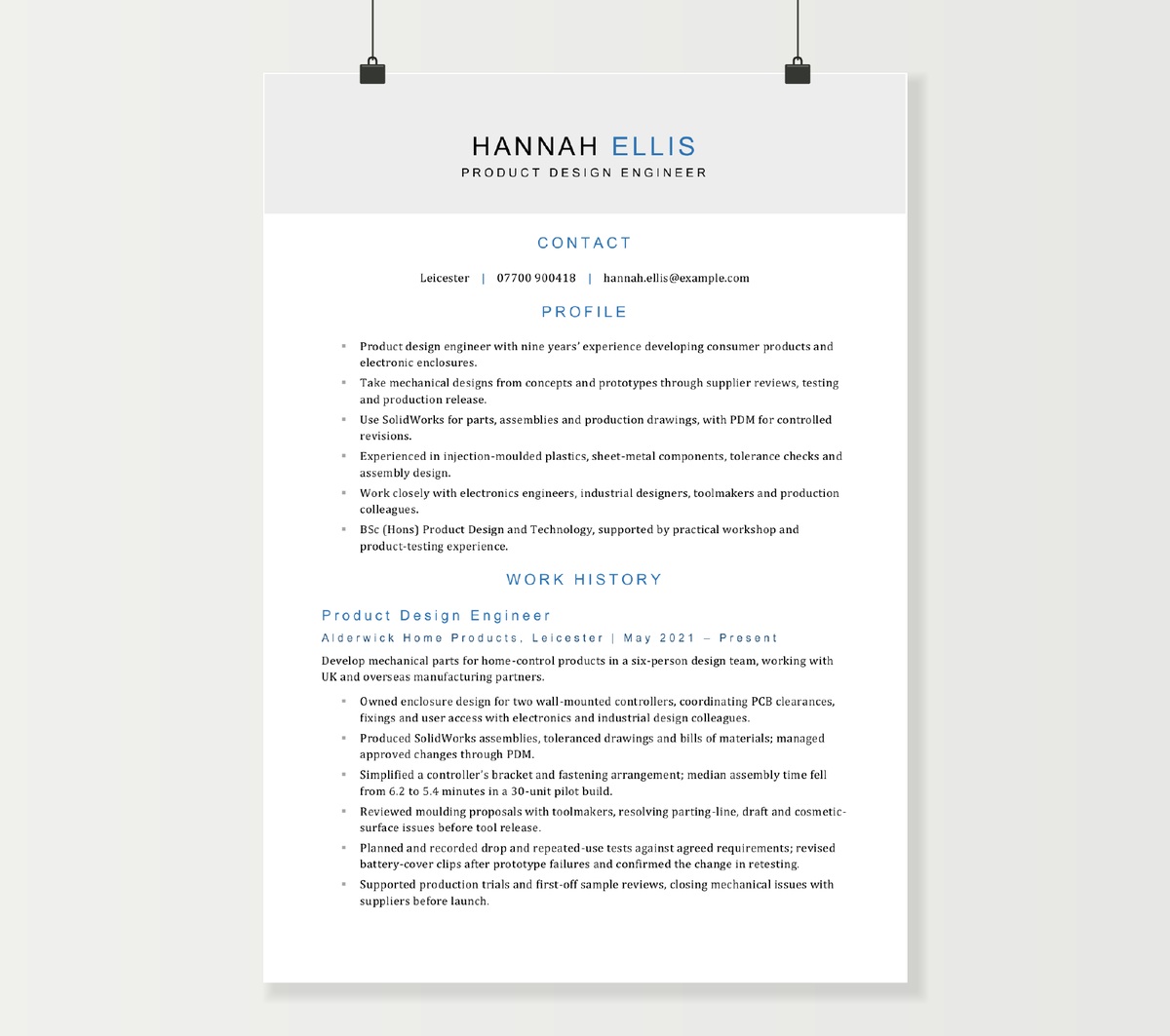
This product design engineer CV template follows an engineer developing physical products, from early concepts and prototypes to manufacturing release. The Word example combines consumer-product experience with CAD, testing, supplier reviews and practical design improvements. The guide explains how to present engineering projects, technical decisions and the work behind a finished product, whether you are a graduate or an experienced designer.
Filename: FreeCVDownload_Product_Design_Engineer.docx
Content of this CV template
Hannah Ellis
Product Design Engineer
Contact
Leicester | 07700 900418 | [email protected]
Profile
- Product design engineer with nine years’ experience developing consumer products and electronic enclosures.
- Take mechanical designs from concepts and prototypes through supplier reviews, testing and production release.
- Use SolidWorks for parts, assemblies and production drawings, with PDM for controlled revisions.
- Experienced in injection-moulded plastics, sheet-metal components, tolerance checks and assembly design.
- Work closely with electronics engineers, industrial designers, toolmakers and production colleagues.
- BSc (Hons) Product Design and Technology, supported by practical workshop and product-testing experience.
Work history
Product Design Engineer
Alderwick Home Products, Leicester | May 2021 – Present
Develop mechanical parts for home-control products in a six-person design team, working with UK and overseas manufacturing partners.
- Owned enclosure design for two wall-mounted controllers, coordinating PCB clearances, fixings and user access with electronics and industrial design colleagues.
- Produced SolidWorks assemblies, toleranced drawings and bills of materials; managed approved changes through PDM.
- Simplified a controller’s bracket and fastening arrangement; median assembly time fell from 6.2 to 5.4 minutes in a 30-unit pilot build.
- Reviewed moulding proposals with toolmakers, resolving parting-line, draft and cosmetic-surface issues before tool release.
- Planned and recorded drop and repeated-use tests against agreed requirements; revised battery-cover clips after prototype failures and confirmed the change in retesting.
- Supported production trials and first-off sample reviews, closing mechanical issues with suppliers before launch.
Design Engineer
Marlowe Product Development, Nottingham | July 2017 – April 2021
Worked on consumer accessories and small-appliance projects for consultancy clients, reporting to a senior design engineer.
- Developed concepts into CAD models, machined prototypes and 3D-printed assemblies for design reviews.
- Compared materials and manufacturing options using supplier quotations, lead times and functional requirements.
- Reworked a handheld product housing around standard fasteners, reducing unique fastener types from five to two.
- Prepared drawings and prototype test summaries; presented design options and outstanding risks at client meetings.
Product Design Placement Student
Marlowe Product Development | July 2015 – June 2016
Completed a year in industry during a four-year degree.
- Built and measured prototypes, recording fit issues for the design team.
- Updated drawings and assembled presentation models under engineer supervision.
Qualifications and development
BSc (Hons) Product Design and Technology — 2:1
Loughborough University | 2017
Technical development
SolidWorks advanced assemblies training (2023); geometric dimensioning and tolerancing workshop (2024); design for injection moulding workshop (2025).
Hobbies and interests
I enjoy climbing, restoring old furniture and visiting exhibitions.
How to write a product design engineer CV
A product design engineer CV needs to make the engineering behind a product visible. A finished object might look simple, but the work could have involved resolving assembly tolerances, choosing a manufacturing process, testing a mechanism or changing a design after a tooling review. Those decisions are often more useful to a hiring manager than a list of software or a photograph of the launch.
Start with the kind of products you develop, the stages you work on and the responsibility you take. An engineer designing moulded consumer products has a different story from someone developing medical-device mechanisms or precision-machined equipment. Your CV should make that context clear before the reader reaches the technical detail.
Define your product and engineering experience in the profile
Use the opening profile to establish your engineering territory: product category, materials or processes, and development stage. Add your main CAD package where it is central to the role, then one useful indication of scope. For example, experience taking electronic enclosures through prototypes and supplier sample approval says considerably more than “creative engineer with excellent CAD skills”.
The profile can also explain the next step in your career. A consultancy engineer moving in-house might emphasise staying involved through tooling and production trials. An engineer seeking a senior role might foreground responsibility for design reviews, technical decisions and other engineers’ work. Select the experience that connects your background to the vacancy, rather than trying to fit your entire technical vocabulary into the opening paragraph.
Build the work history around a few worthwhile products
Choose projects that show different aspects of your capability. One might demonstrate a difficult mechanism, another a successful transfer to manufacture, and another an improvement to an existing product. Three projects showing the same kind of CAD modelling add less than a smaller selection that reveals the range of engineering decisions you can handle.
Within each job, give enough context to understand the assignment, then concentrate on your contribution:
- The product and constraint: what you were developing and the main challenge, such as a compact enclosure, repeated operation, cleaning access or a cost limit.
- Your responsibility: the assembly, mechanism, drawings, test programme or release activity you owned.
- The decision or deliverable: what you changed, specified, built, checked or handed over.
- The outcome and stage: what the work established and whether the design reached a prototype, pilot build, tooling release or production.
This does not mean writing a long case study under every employer. A short scope sentence and well-chosen bullets are usually enough. “Designed the battery enclosure, coordinated the PCB interface and resolved fit issues during the pilot build” gives the reader a clear work package. “Worked on innovative consumer products” leaves nearly everything unexplained.
For consultancy work, group related projects under the consultancy employer. Product categories and technical constraints can make the work understandable where client names are confidential. If a product did not reach launch during your involvement, its achieved development stage can still demonstrate substantial work: an approved concept, a tested prototype or a released drawing pack is meaningful evidence.
Show what your CAD skills produce
SolidWorks, Creo, Inventor, CATIA and other CAD packages mean different things on different CVs. A useful skills entry identifies the tasks you can carry out: parametric parts, assemblies, surfacing, sheet metal, configurations or production drawings. Then support the most relevant capabilities in the employment or project sections.
For example, complex surface modelling matters when the role involves shaped consumer products; assembly structures and interface control may matter more for a mechanism or electromechanical system. Select the features that explain your work. A percentage bar beside “SolidWorks” cannot communicate that distinction.
Give drawing and release work its own space where it forms part of your experience. Tolerancing, geometric dimensioning and tolerancing (GD&T), tolerance stacks, bills of materials and product data management (PDM) show how you communicate a design for manufacture and maintain it through changes. Describe the deliverable or problem: a critical fit checked across mating components, a supplier drawing clarified, or a released assembly updated after an engineering change.
Simulation belongs in the same evidence-led approach. If finite element analysis helped you compare a bracket design, explain the engineering question and the decision it informed. Where the work included a physical test or a specialist review, that context helps the reader understand how the analysis fitted into development.
Connect materials and manufacturing knowledge to design choices
A list containing “plastics, metals, injection moulding, CNC” gives a starting point. A stronger CV shows what you designed for those processes. This might be an injection-moulded enclosure, a sheet-metal chassis, a machined mechanism or an overmoulded grip.
Use one or two bullets to show how manufacturing considerations changed the design. Relevant examples include agreeing a parting line with a toolmaker, simplifying a fastening arrangement, choosing a finish to suit use conditions or resolving a difficult assembly sequence. There is no need to explain the manufacturing process itself; the CV needs to communicate the engineering judgement you exercised.
Supplier work is particularly valuable when it extends beyond sending CAD files. Describe design reviews, quotation comparisons, tooling feedback, sample inspection, production trials or the closure of technical queries. If you worked with overseas manufacturers, explain what you coordinated and which decisions you helped resolve. Travel alone says little about your contribution.
Make prototype and test work part of the story
Prototyping experience is strongest when the CV shows what the prototype was intended to establish. A visual model, a fit-check assembly and a functional test rig answer different questions. Identify the purpose, the work you carried out and what happened next.
For testing, connect an agreed requirement to an observation and a design response. The example CV’s battery-cover work does this: prototype failures led to a clip revision and a retest. That gives a hiring manager a view of practical development rather than simply asserting “problem-solving skills”.
Documentation can be important evidence too. Test plans, recorded results, issue logs and verification reports show how your work supported a decision. In a regulated product environment, name the relevant quality-system or design-control experience and the records you contributed. Keep the description at the level of your role: preparing evidence, reviewing it, coordinating a specialist or authorising a defined decision are different responsibilities.
A project with a difficult result can still strengthen a CV. Discovering a failure before tooling, identifying an unsuitable material or recommending that a concept be reworked may be the most valuable part of your contribution. Explain the useful decision that followed.
Choose outcomes that suit engineering work
Product engineering achievements often involve part count, assembly time, mass, packaging size, test performance, tooling changes or production issues. Choose the measure that best explains the design improvement and give enough context for the reader to interpret it.
The example CV reports an assembly-time change during a 30-unit pilot. Naming the pilot matters: the result describes the tested build, rather than an unspecified saving across the whole factory. Similarly, a reduction from five fastener types to two is useful because the before-and-after comparison is clear.
Where cost is relevant, distinguish a supplier quotation, an agreed production cost and a saving measured after implementation. For a shared project, connect the outcome to your work package: the enclosure redesign, test fixture or supplier issue you handled. A concise account of that contribution is often more persuasive than attaching the entire product’s commercial success to one person.
Some strong outcomes do not need a percentage. A mechanical issue closed before tool release, a design accepted at review or an assembly transferred successfully to a production team can all be worthwhile achievements. State the result and the engineering work that enabled it.
Use a portfolio to extend the CV
A product-design portfolio is useful when it helps someone inspect work that a CV can only summarise. Link to a focused selection near your contact details, or provide a clearly named portfolio file where the application invites one. The CV should still explain your role and achievements without requiring the reader to open another document first.
For an engineering application, select images that show development as well as the finished product. A sequence might include the requirement, an early concept, a CAD section, a prototype and the change resulting from a test. Brief captions should identify your contribution, the development stage and the decision each image illustrates.
A polished rendering can show form and presentation skill. A drawing detail, physical prototype or assembly photograph can show a different kind of competence. Choose the balance that fits the vacancy. When commercial work cannot be shared, an anonymised summary, permitted detail or relevant university project can still demonstrate your approach. State what portfolio material is available so the reader knows what to expect.
Emphasise different evidence as your career develops
For a graduate or placement applicant, selected academic projects may deserve space above short, unrelated employment. Give the project brief, your individual work, the tools and processes used, and what you built or tested. In a group project, a defined responsibility—such as designing the mechanism or planning fit tests—makes your contribution easy to assess. Workshop experience, placement work and a developed final-year project can provide substantial evidence before your first permanent design role.
With more experience, lead with delivered engineering work. Education can move lower, while employment shows increasing scope: from producing parts under review to owning assemblies, coordinating suppliers or supporting production release. A senior application benefits from examples of technical review, design prioritisation, mentoring and decisions made across competing requirements. Show those activities even where you have not held a formal management title.
List the actual degree, HNC, HND, apprenticeship or other relevant qualification, with the institution and completion date. Recent technical training earns its place when it supports the work you are seeking: advanced CAD, tolerancing, a manufacturing process or sector-specific quality requirements. Keep professional registration or membership in a clearly labelled entry where applicable, separate from short-course attendance.
If the vacancy is centred more heavily on machinery, mechanical analysis or engineering systems, the mechanical engineer CV example offers another useful way to organise technical experience. For a product-development role, keep the emphasis on the products, interfaces, decisions and development stages that your reader needs to understand.
Product Design Engineer CV FAQs
Yes, where the work is a good match. Keep your employment title and use the profile and project bullets to explain your product-development experience. Work on enclosures, mechanisms, consumer products or electromechanical assemblies can transfer well. The vacancy’s responsibilities are more informative than the title alone: some product design roles focus on physical engineering, while others concern digital interfaces or industrial styling.
Check whether the named package is essential or preferred. Put your main package alongside the relevant work you perform in it, such as complex assemblies, drawings or surface modelling. If you have used the employer’s package during a course, previous job or project, give that context separately. This helps the reader distinguish transferable modelling and design experience from familiarity with their particular software.
Engineering changes can make a strong product design CV. Explain the product issue, the design revision and the evidence used to approve it. A change that improves assembly, addresses a field failure, accommodates a replacement component or extends a product range demonstrates valuable development work. Include revision control and coordination with production where those formed part of the task.
Describe the specific design work and its measured or observable result: reduced material mass, fewer components, improved access for repair, a replaceable wear part or a packaging change. Include any performance or manufacturing constraint the design still had to meet. If you contributed to a lifecycle assessment, name your input and the method used; otherwise, the practical design improvement can stand on its own.
Usually a portfolio or requested work sample gives drawings more room to be understood. Use the CV to describe the drawing work and its purpose, then refer to the relevant portfolio project. Choose a sample that remains readable at the size supplied and add a short caption explaining your contribution, the manufacturing process and the feature the reader should examine.
Use one dated freelance or consultancy heading, then select the most relevant assignments beneath it. Identify the product category, project period and your work package where this helps explain overlap. A clear assignment structure shows how you handled several clients without making each short project look like a separate permanent job.




