
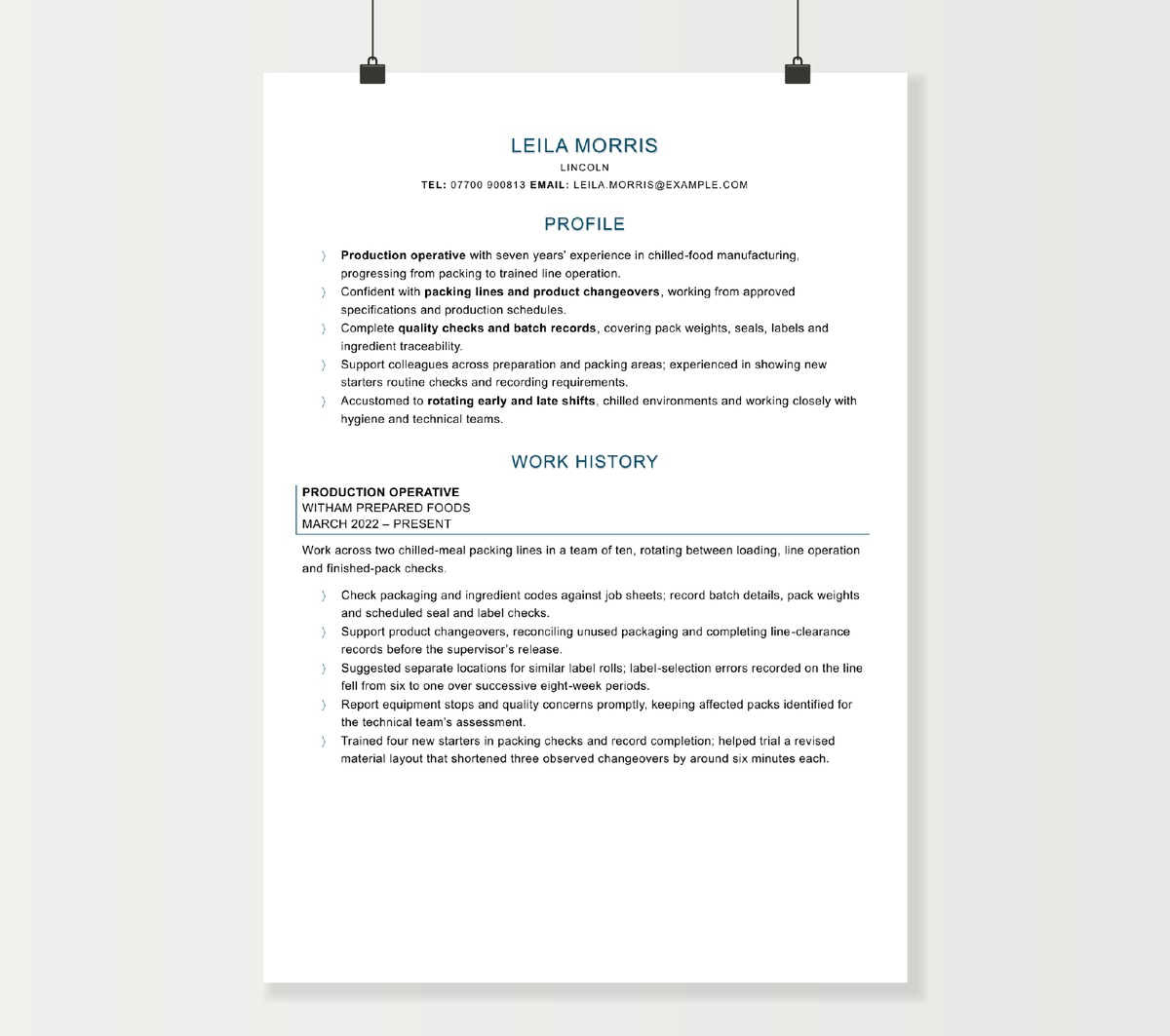
This production operative CV template shows an experienced food-production worker progressing from packing into line operation and colleague training. The downloadable Word example includes quality checks, batch records and practical improvements on the shop floor. The guide also covers assembly and other manufacturing settings, agency work and applications for a first factory role.
Filename: FreeCVDownload_Production_Operative.docx
Content of this CV template
LEILA MORRIS
LINCOLN
tel: 07700 900813 email: [email protected]
PROFILE
- Production operative with seven years’ experience in chilled-food manufacturing, progressing from packing to trained line operation.
- Confident with packing lines and product changeovers, working from approved specifications and production schedules.
- Complete quality checks and batch records, covering pack weights, seals, labels and ingredient traceability.
- Support colleagues across preparation and packing areas; experienced in showing new starters routine checks and recording requirements.
- Accustomed to rotating early and late shifts, chilled environments and working closely with hygiene and technical teams.
WORK HISTORY
PRODUCTION OPERATIVE
WITHAM PREPARED FOODS
MARCH 2022 – PRESENT
Work across two chilled-meal packing lines in a team of ten, rotating between loading, line operation and finished-pack checks.
- Check packaging and ingredient codes against job sheets; record batch details, pack weights and scheduled seal and label checks.
- Support product changeovers, reconciling unused packaging and completing line-clearance records before the supervisor’s release.
- Suggested separate locations for similar label rolls; label-selection errors recorded on the line fell from six to one over successive eight-week periods.
- Report equipment stops and quality concerns promptly, keeping affected packs identified for the technical team’s assessment.
- Trained four new starters in packing checks and record completion; helped trial a revised material layout that shortened three observed changeovers by around six minutes each.
PACKING OPERATIVE
FENLAND FRESH PRODUCE
AUGUST 2019 – FEBRUARY 2022
Joined through an agency in August 2019 and became a permanent employee in February 2020, packing chilled salads and prepared vegetables.
- Weighed portions, assembled packs and checked presentation against product photographs and job instructions.
- Recorded use-by codes and packaging batches, referring mismatches to the line leader before continuing the affected work.
- Supported cleaning and end-of-run checks, maintaining separation of ingredients and equipment between product runs.
- Learned three packing stations and covered colleagues during breaks, helping maintain a steady flow through the line.
QUALIFICATIONS & TRAINING
LEVEL 2 AWARD IN FOOD SAFETY FOR MANUFACTURING
HIGHFIELD QUALIFICATION – 2022
Completed alongside practical food-production work and site induction.
SIX GCSEs, INCLUDING ENGLISH AND MATHEMATICS
LINCOLN – 2019
SITE TRAINING
ALLERGEN AWARENESS AND MANUAL HANDLING – 2025; PACKING-LINE OPERATION REFRESHER – 2026
INTERESTS
Swimming, baking and volunteering at occasional local community events.
How to write a production operative CV
A production operative CV should help a supervisor picture you on their shop floor: the products you have handled, the stations you can work, the checks you complete and the way you contribute to a reliable shift. “Worked on a busy production line” gives only a starting point. A few details about the work itself can make the same experience much more persuasive.
Start with the production setting
State what you make or assemble near the beginning of your CV. Chilled meals, electrical assemblies, plastic components and printed packaging involve different materials, equipment and quality requirements. Your profile can then connect that setting with your strongest experience: packing, assembly, machine operation, inspection or preparing materials.
For an experienced applicant, three or four sentences are usually enough to establish the type of production, breadth of station training and a useful strength. For a first factory role, lead with relevant practical work, following instructions and working steadily as part of a team. A specific connection is more useful than a string of descriptions such as hardworking, motivated and enthusiastic.
The example above places food production first, then explains line operation, checks and colleague training. For an assembly vacancy, those details might instead be component preparation, use of specified tools, visual inspection and following an assembly sequence.
Describe your part in the line
Under each employer, give a short explanation of the product and your position in the process. Then choose duties that reveal what you actually handled. Loading a machine, assembling parts, inspecting finished goods and packing orders are distinct activities even when they share the same job title.
- Food production: identify preparation or packing tasks, product types, chilled or ambient working and the checks recorded at your station.
- Assembly: describe the components, tools or fixtures used and how you followed work instructions or checked completed units.
- Packaging and general manufacturing: explain material loading, finishing, labelling, counting, inspection or movement between production stages.
Include the range of stations you can cover when flexibility is a strength. “Trained across three packing stations, including portioning and label checks” gives a clearer picture than “flexible worker”. If you were signed off for a more skilled station or asked to support new starters, show that progression within the role.
Make quality checks concrete
Quality is a substantial part of production work, but “maintained high standards” leaves the reader guessing. Name the checks you performed and the records you completed. These might involve pack weights, seals, date codes, component orientation, dimensions, surface finish or quantities against a job sheet.
A good bullet can combine the check, the reference used and what you did with an exception. For example: “Checked assembled housings against visual standards and recorded rejected units for the line leader’s review.” This shows attention to detail through work rather than a personal claim.
Traceability also deserves space where it is part of the job. Recording batch numbers, material codes or production counts shows that you understand how your station connects with the wider operation. If records were entered on a terminal or handheld device, describe the entries you made; a lengthy software section is rarely necessary for routine production recording.
Explain machinery experience at the right level
“Machine experience” can mean anything from loading parts to setting up a new product run. Make the activity clear. You might operate a packing machine to established settings, replenish materials, carry out scheduled checks, assist with changeovers or report stoppages. A setter or technician will usually have a different range of responsibilities.
Name equipment where it helps the new employer recognise relevant experience, followed by its purpose if the name is unfamiliar outside your factory. For many applications, “tray-sealing and labelling equipment” is more informative than a model number alone. Where the vacancy specifies a particular process or machine, give that experience appropriate prominence.
Changeovers can provide useful evidence of organisation. Describe your contribution to preparing materials, clearing the previous job, checking the new packaging or recording the handover. This makes the task understandable without turning the CV into a set of operating instructions.
Show output and improvement in context
Production results are often shared across a team or line. Identify that context so the reader can understand the scale of your contribution. You could describe a typical shift volume, the number of product lines covered or a small improvement you helped introduce. The number becomes useful when it is connected to a task.
For example, a bullet about helping a ten-person team pack a daily order programme gives operational scale. A bullet about reorganising frequently used materials and shortening observed changeovers shows a specific improvement. These tell different parts of the story and can work well together.
When describing a reduction in rejects or stoppages, include the period or comparison that makes the result meaningful. The example CV gives the line’s recorded label-selection errors across two eight-week periods and identifies the practical suggestion behind the change. It also keeps a small changeover trial separate from a claim about permanent factory-wide productivity.
You can write a strong CV without detailed production figures. Being trained on additional stations, trusted to show new starters the work, selected for a product trial or able to identify a recurring defect are useful achievements. Explain what changed or why the responsibility mattered.
Present safety and hygiene through your responsibilities
Make this part of your experience relevant to the environment. For food roles, that may mean cleaning records, allergen awareness, ingredient separation, line clearance and working with the technical team. In assembly or general manufacturing, it may mean workstation checks, handling equipment, keeping access routes clear or reporting damaged tools.
A concise description of routine responsibilities is stronger than a broad promise to follow every policy. Include relevant training with its title and date, especially where it helps the reader understand your preparation for the setting. Site training belongs here too; it can be valuable even when it is not an externally awarded qualification.
Make agency work and shift experience easy to follow
If you worked at one factory through an agency and later joined permanently, show the full assignment period and note the change in employment arrangement. This makes the continuity visible. Several short assignments can be grouped under the agency with the main placements and production settings underneath.
For each substantial placement, keep the evidence that adds something new: a different material, assembly task, station or working pattern. Repeating the same packing duties under six short assignments can hide the breadth of what you learned.
Shift availability is particularly useful when a vacancy involves nights, early starts or rotating patterns. A short statement near your contact details or in additional information can answer that practical question. Mention a driving licence or access to transport when it helps explain how you can reach the advertised site and shift times.
Build a first production CV from practical evidence
Retail, warehouse, cleaning, catering and other hands-on work can provide relevant examples. Look for occasions when you followed a sequence, checked quantities, handled stock, maintained a work area, worked to a deadline or passed information to the next person. Keep the original job title and explain the connection through the bullet points.
A school or college workshop project can also be useful when it shows assembly, measurement, careful use of tools or checking a finished item. Describe your own task and the completed result. For a first job, this evidence may deserve more space than a very short employment history.
List relevant qualifications and recent training clearly, including English and maths where requested. Employers offering full training may place more weight on practical readiness and learning than on a long certificate list. For applications focused mainly on picking, packing and despatch, the warehouse operative example offers another way to present that experience. Where your work centres on controlling a manufacturing process, compare the process operator CV for a more technical emphasis.
Production Operative CV FAQs
Yes, but bring the transferable work forward: following a defined sequence, checking finished items, recording results, maintaining an organised station and working with the rest of the line. Add any relevant tool, component or workshop experience. Keep food-specific detail where it demonstrates care and consistency, while giving the target assembly work the most relevant evidence.
Include it when material movement is relevant to the vacancy, giving the truck category, training provider and completion or refresher date. It helps the employer understand your previous training and what assessment or familiarisation may be needed for their site. If the role is entirely at a production station, more recent line experience may deserve the space.
Keep your formal job title and add the occasions and duties you covered, such as allocating stations, checking paperwork or passing the shift handover to the supervisor. If this became a regular responsibility, give an indication of frequency. This shows progression and trust while making the level of experience easy to assess.
Describe the product, your stations, the checks you completed and any additional responsibilities you gained. You can still explain a practical improvement or a problem you helped resolve without a numerical result. If it helps clarify why the job ended, a short note that the site closed is sufficient.
Give it an entry when it is recent or provides your strongest production experience. A few focused bullets can show the product, checks and pace of work. If you have several similar seasonal assignments, a grouped entry can make the dates and range of settings easier to follow.




