
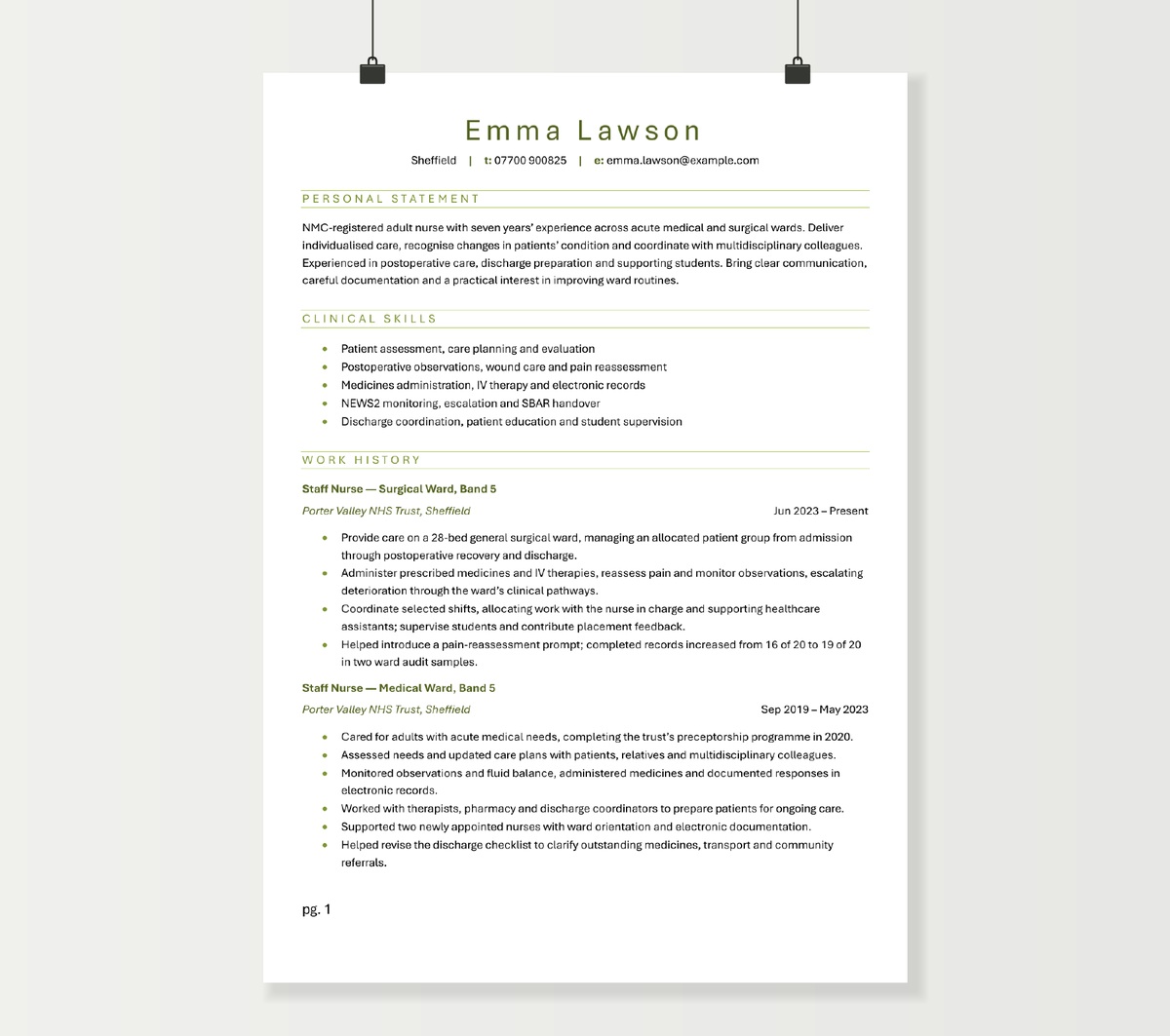
This registered nurse CV template follows an adult nurse with medical and surgical ward experience. The Word example covers assessment, medicines administration, discharge planning, student support and a small ward improvement project. The guide explains how to present nursing experience for different settings, including applications for a first registered post or a move into a new specialty.
Filename: FreeCVDownload_Registered_Nurse.docx
Content of this CV template
Emma Lawson
Sheffield | t: 07700 900825 | e: [email protected]
Personal statement
NMC-registered adult nurse with seven years’ experience across acute medical and surgical wards. Deliver individualised care, recognise changes in patients’ condition and coordinate with multidisciplinary colleagues. Experienced in postoperative care, discharge preparation and supporting students. Bring clear communication, careful documentation and a practical interest in improving ward routines.
Clinical skills
- Patient assessment, care planning and evaluation
- Postoperative observations, wound care and pain reassessment
- Medicines administration, IV therapy and electronic records
- NEWS2 monitoring, escalation and SBAR handover
- Discharge coordination, patient education and student supervision
Work history
Staff Nurse — Surgical Ward, Band 5
Porter Valley NHS Trust, Sheffield
Jun 2023 – Present
- Provide care on a 28-bed general surgical ward, managing an allocated patient group from admission through postoperative recovery and discharge.
- Administer prescribed medicines and IV therapies, reassess pain and monitor observations, escalating deterioration through the ward’s clinical pathways.
- Coordinate selected shifts, allocating work with the nurse in charge and supporting healthcare assistants; supervise students and contribute placement feedback.
- Helped introduce a pain-reassessment prompt; completed records increased from 16 of 20 to 19 of 20 in two ward audit samples.
Staff Nurse — Medical Ward, Band 5
Porter Valley NHS Trust, Sheffield
Sep 2019 – May 2023
- Cared for adults with acute medical needs, completing the trust’s preceptorship programme in 2020.
- Assessed needs and updated care plans with patients, relatives and multidisciplinary colleagues.
- Monitored observations and fluid balance, administered medicines and documented responses in electronic records.
- Worked with therapists, pharmacy and discharge coordinators to prepare patients for ongoing care.
- Supported two newly appointed nurses with ward orientation and electronic documentation.
- Helped revise the discharge checklist to clarify outstanding medicines, transport and community referrals.
Healthcare Assistant
Oakfield Care Home, Sheffield
Sep 2014 – Aug 2016
- Supported older residents with personal care, meals and mobility before starting nurse training.
- Recorded food and fluid intake and reported changes to the registered nurse.
- Helped residents maintain familiar routines and join activities of their choice.
- Worked with colleagues to provide consistent care during day and evening shifts.
Qualifications
BSc (Hons) Nursing (Adult) — 2:1
Sheffield Hallam University
2016 – 2019
- Nursing and Midwifery Council: Adult registration, current; first registered 2019.
- Preceptorship completed 2020; practice supervisor preparation completed 2022.
- Venepuncture, cannulation and IV therapy competencies assessed in post.
Continuing professional development
Trust learning and clinical development
2025 – 2026
- Basic life support, safeguarding and infection prevention updates (2026); wound care and pain management workshops (2025).
Hobbies and interests
- Walking: Regular visits to the Peak District.
- Music: Singing with a local community choir.
- Gardening: Growing vegetables at home.
Additional information
Experienced across day, night and weekend rotas; full UK driving licence.
How to write a registered nurse CV
A nursing CV needs to establish your registration, clinical setting and level of responsibility quickly. The reader should be able to see the patients you care for, the judgement your role requires and the contribution you make to the wider team. “Compassionate and hardworking” is a reasonable description of many nurses; the detail of your practice is what makes the application informative.
Use the vacancy’s clinical area and person specification to decide which experience deserves most space. An acute ward, a community service and a nursing home may all recruit registered nurses, but they will look for different evidence of readiness for the role.
Put registration and clinical identity near the top
State your NMC registration field clearly, such as adult or mental health nursing, and make your current status easy to find. Follow this with your main clinical experience and the type of appointment you are seeking. A short profile might establish several years in acute medicine, experience supporting discharge and an interest in moving into community nursing.
Keep qualifications and registration distinct. Your nursing degree or diploma records your education; your NMC registration establishes your professional status. A specialist qualification, prescribing qualification or additional registration can sit alongside these when it is relevant to the vacancy.
For a newly qualifying applicant, give the expected course completion date and the current stage of registration. This allows an employer recruiting to a preceptorship or graduate cohort to understand your likely availability.
Explain the setting before listing duties
For each nursing post, give the employer, ward or service, dates and role title. Include the band where it helps explain an NHS appointment. A short opening line can establish the specialty, patient group and service: an acute medical ward, an older people’s rehabilitation unit or a community team covering home visits.
Ward size or caseload context can be useful, but your own responsibility should remain clear. A 28-bed ward does not mean one nurse provided all 28 patients’ care. Describe your allocated patient group, delegated caseload or coordination role so the reader understands how the service operated.
Where your experience spans rotations, group them beneath the employer and give the specialties and dates. Select the work most relevant to the new post, while retaining enough breadth to show how your skills developed.
Show assessment, judgement and follow-through
A duties list often stops at observations, medicines and documentation. A stronger account shows how you used information: assessed a patient’s needs, identified a change, escalated concerns, coordinated input and reviewed the plan.
Choose examples at the level of your role. For acute nursing, these might involve recognising deterioration, organising competing care needs or preparing a complex discharge. For community work, they might show review of a delegated caseload, coordination with another service or support for a patient managing care at home.
Use concise descriptions of the clinical situation and your contribution. A CV needs enough context to demonstrate judgement, while a supporting statement or interview can explore the episode in more depth. Describe the care need and actions in general terms so the example is understandable without personal patient details.
Make clinical skills relevant to the appointment
Group skills around the care you deliver. For a surgical ward, postoperative monitoring, pain reassessment, wound care, IV therapy and discharge education may deserve attention. For another service, long-term condition support, mental health assessment, rehabilitation or palliative care may be more relevant.
Give important competencies context in your experience. “Venepuncture and cannulation competencies assessed in post” tells a reader something different from listing a course attended. Where local assessment or recent practice matters, a brief date or description can clarify your readiness for the new setting.
Electronic patient records, medicines systems and clinical communication tools are useful supporting skills. Explain what you used them for: recording assessments, maintaining care plans, medicines administration or structured handover. A recognisable system name can help, but it should accompany the clinical work rather than dominate the section.
Adapt the evidence to the nursing environment
In acute hospital applications, prioritise assessment, changing acuity, medicines, escalation, discharge coordination and teamwork across a shift. Include relevant specialty experience and any additional competencies the person specification highlights.
For community posts, show how you organise visits or a delegated caseload, maintain continuity, communicate with families and other services, and use clinical records away from a ward environment. Relevant wound care, long-term condition or end-of-life experience can help establish the fit. Travel arrangements belong in a brief additional-information line where they are part of the role.
For care-home nursing, bring out assessment and review over time, medicines management, clinical guidance to care colleagues, communication with relatives and coordination with GPs or visiting professionals. Shift leadership and decision-making with different levels of on-site support may be particularly useful evidence.
For mental health or other specialist nursing, make the field of registration and the service context explicit. Select the assessment, therapeutic, communication and coordination experience relevant to that post. The adult ward example above provides a structure; the clinical evidence should reflect your own nursing field and setting.
Demonstrate communication through care
Useful communication examples show what the conversation or handover achieved. You might have helped a patient understand discharge arrangements, adapted information to their communication needs, brought family concerns into a care review or ensured a community team received the information needed for follow-up.
Multidisciplinary working is stronger when the CV identifies the contribution. Coordinating with pharmacy over discharge medicines, therapists over mobility needs and a discharge team over ongoing support demonstrates how your nursing work fits into the patient’s pathway.
Safeguarding, dignity and advocacy can also be evidenced through practice. A concise example of recognising a concern, using the appropriate referral route or securing support for a patient’s expressed needs is more useful than repeating a policy title.
Describe leadership at the level you have exercised it
Leadership can appear well before a formal management post. Coordinating selected shifts, allocating work, supporting a new colleague or contributing to a ward improvement can all show growing responsibility. Give the scope and frequency where they help the reader understand your experience.
For a more senior appointment, add evidence of how you organised the team, dealt with changing demand, developed colleagues or followed up service issues. Explain the result, such as clearer handover, improved completion of a check or a new colleague becoming confident with a ward process.
Student support deserves specific wording. State whether you acted as a practice supervisor, practice assessor or another source of learning support, and include relevant preparation. Describe what you did: planned learning opportunities, gave feedback, contributed evidence or assessed progress within your designated role.
Use improvement evidence that fits nursing work
Clinical audit, quality improvement and learning from incidents can give a nursing CV valuable substance. Describe the issue, your contribution, the change and what was reviewed afterwards. Even a small project can show that you notice problems and help improve practice.
For example, an audit of pain-reassessment documentation can be expressed as completed records rising from 16 of 20 to 19 of 20 after a prompt was introduced. The sample size makes the result understandable, and the wording identifies a documentation improvement rather than implying a wider clinical outcome.
Other evidence might include a revised discharge checklist, a clearer stock-check routine, teaching delivered to colleagues or follow-up actions from a safety discussion. Numbers are useful when they explain scale or change. A concrete description of an adopted improvement can be just as effective when there is no suitable numerical measure.
Select training that supports the next role
Keep a clear record of your nursing qualification, relevant specialist study and selected recent development. Include current training that the vacancy particularly values, with dates where currency matters. A short section is usually easier to assess than a complete export of mandatory-learning records.
Show the effect of development where possible. A wound-care workshop is more useful when an experience bullet shows subsequent involvement in assessment, documentation or work with the tissue-viability team. Practice-supervision preparation becomes meaningful alongside evidence of supporting students.
Revalidation and a job application serve different purposes. Your CV can state current registration and highlight relevant development; the detailed reflective accounts and supporting records remain part of your professional portfolio. This keeps the application focused on the appointment.
Present a first post, a specialty move or a return
For a first registered post, place education and selected placements prominently. Give the setting, dates, patient groups and the responsibilities you developed under supervision. A final placement can provide useful examples of prioritisation, documentation, communication and preparation for registered practice.
Earlier healthcare support work can demonstrate continuity and understanding of care environments. Keep the registered-nurse evidence distinct from those earlier duties. The care assistant CV example can help you describe that part of your history succinctly.
For a specialty change, connect your existing skills to the new service, then identify relevant learning or exposure. A nurse moving from a ward into the community might foreground discharge planning, patient education and coordination with outside teams. A returning nurse can make recent preparation, supervised practice or return-to-practice study prominent alongside earlier clinical experience.
Use the CV to support NHS application forms
Some nursing vacancies use a CV, while others shortlist from an application form and supporting information. A well-prepared CV still gives you a useful record of employment, registration, skills and examples, but each application needs the evidence in the format requested by the employer.
Use the person specification to select examples for supporting information. Expand the most relevant CV points into short accounts showing the situation, your contribution and the result. This is particularly helpful for criteria such as prioritisation, multidisciplinary working, supervision and improvement, where a skills label alone leaves the assessor with little to evaluate.
Registered Nurse CV FAQs
Make your registration field and current status clear. If the employer asks for your PIN in the CV or an application field, provide it there. Otherwise, a concise registration line is sufficient for the CV, with the identifying details supplied through the employer's recruitment process when requested.
Keep the substantive post as its own entry and group bank or agency work under the relevant employer or agency, with dates and the main settings covered. Explain whether the work was occasional or regular. Select assignments that add clinical breadth rather than repeating the same duties for every ward.
Some community services recruit newly qualified nurses and provide preceptorship and development support; others require particular experience. Use the vacancy criteria to judge the fit. In the application, draw on relevant placements, assessment and care-planning experience, patient communication and your understanding of working across services.
Use the original job title with a short explanation where needed, then identify the country, clinical setting, patient group and responsibilities. State your UK NMC registration status separately so the employer can understand both your experience and your readiness for the advertised role. Relevant achievements and competencies remain useful even when local systems or job titles differ.
Usually, your registered employment provides stronger recent evidence. Retain a placement when it adds something directly relevant to a specialty move that your later jobs do not show. Otherwise, summarise the degree and give the space to current clinical responsibility, development and results.
Choose an example of how you adapted care or communication to a patient's needs. This could involve arranging communication support, explaining an unfamiliar care plan, helping a family participate in discharge discussions or responding to a concern about dignity. Describe your action and its practical effect in a short, general account.




