This research scientist CV template follows a cell biologist from doctoral research and a postdoctoral role into biotechnology. The Word example connects laboratory methods with research decisions, reproducible results and collaboration. The guide also covers computational and environmental research, academic applications and scientists entering industry.
Filename: FreeCVDownload_Research_Scientist.docx
Content of this CV template
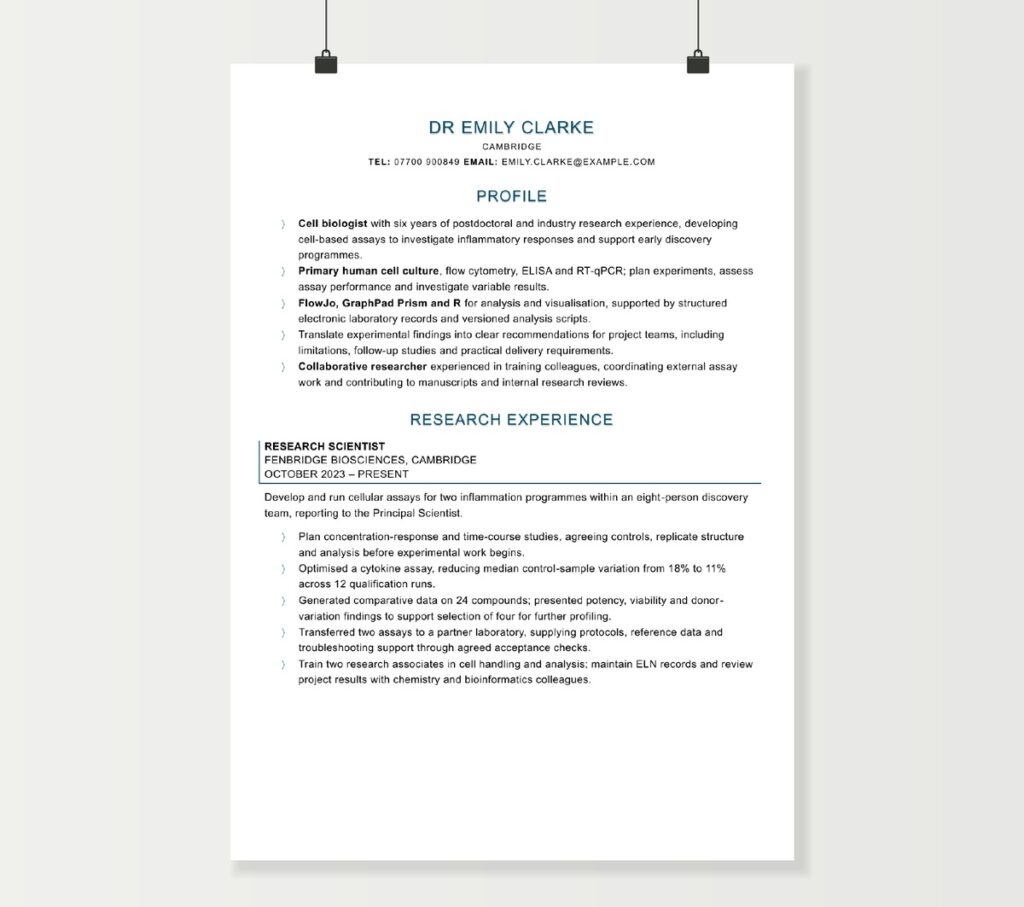
DR EMILY CLARKE
CAMBRIDGE
tel: 07700 900849 email: [email protected]
PROFILE
- Cell biologist with six years of postdoctoral and industry research experience, developing cell-based assays to investigate inflammatory responses and support early discovery programmes.
- Primary human cell culture, flow cytometry, ELISA and RT-qPCR; plan experiments, assess assay performance and investigate variable results.
- FlowJo, GraphPad Prism and R for analysis and visualisation, supported by structured electronic laboratory records and versioned analysis scripts.
- Translate experimental findings into clear recommendations for project teams, including limitations, follow-up studies and practical delivery requirements.
- Collaborative researcher experienced in training colleagues, coordinating external assay work and contributing to manuscripts and internal research reviews.
RESEARCH EXPERIENCE
RESEARCH SCIENTIST
FENBRIDGE BIOSCIENCES, CAMBRIDGE
OCTOBER 2023 – PRESENT
Develop and run cellular assays for two inflammation programmes within an eight-person discovery team, reporting to the Principal Scientist.
- Plan concentration-response and time-course studies, agreeing controls, replicate structure and analysis before experimental work begins.
- Optimised a cytokine assay, reducing median control-sample variation from 18% to 11% across 12 qualification runs.
- Generated comparative data on 24 compounds; presented potency, viability and donor-variation findings to support selection of four for further profiling.
- Transferred two assays to a partner laboratory, supplying protocols, reference data and troubleshooting support through agreed acceptance checks.
- Train two research associates in cell handling and analysis; maintain ELN records and review project results with chemistry and bioinformatics colleagues.
POSTDOCTORAL RESEARCH ASSOCIATE
UNIVERSITY OF LEICESTER
OCTOBER 2020 – SEPTEMBER 2023
Investigated immune-cell signalling in inflammatory disease, combining donor-derived cell studies with molecular and functional readouts.
- Designed experiments with the group lead, managed sample schedules and analysed results using Prism, FlowJo and reproducible R scripts.
- Identified a reagent-lot effect behind inconsistent results and introduced reference controls that restored comparability across subsequent experiments.
- Contributed experimental data and figures to two peer-reviewed papers; presented findings at departmental seminars and a national immunology meeting.
- Co-supervised two MSc projects and maintained shared protocols, reagent records and equipment booking arrangements.
QUALIFICATIONS & DEVELOPMENT
PhD CELL BIOLOGY
UNIVERSITY OF LEICESTER — 2016–2020
Thesis: regulation of inflammatory signalling in human monocytes. Awarded September 2020.
MBiol BIOLOGICAL SCIENCES — FIRST CLASS
UNIVERSITY OF LEEDS — 2016
RECENT DEVELOPMENT
EXPERIMENTAL DESIGN, R ANALYSIS & FLOW CYTOMETRY — 2024–2026
INTERESTS
Pottery classes, cycling and singing with a community choir.
How to write a research scientist CV
A research scientist CV needs to show what you investigate, how you approach the work and what your contribution enables. A list of techniques establishes familiarity; a well-chosen research example shows how you use those techniques to answer a question. Make it easy for a scientific reviewer to identify your specialism and for a broader recruitment panel to understand its relevance.
The strongest structure depends on the destination. A biotechnology employer may prioritise assay development and programme decisions. A university group may look first for closely related research, publications and methodological independence. An environmental institute may need evidence of model evaluation, field data and collaboration across agencies. Organise the CV around the work you would be joining.
Make your scientific focus clear at the top
Use the opening profile to connect your field, level of experience and most relevant capability. “Research scientist with experience in laboratory techniques” leaves the reader to discover everything important. “Cell biologist developing primary-cell assays for inflammatory disease research” immediately gives them a useful starting point. Add the kind of responsibility you hold: delivering experiments within a programme, developing a method, leading a work package or directing a research area.
When changing fields, identify the bridge. Experience characterising complex biological samples, modelling uncertain systems or developing imaging methods may transfer well even when the application changes. Explain that connection through the research experience below the profile, using the terminology the new team will recognise.
Describe research projects as scientific contributions
For each substantial project, establish the question, your role, the approach and the useful result. A thesis title alone rarely does this. A short project summary followed by two or three specific contributions is easier to assess than a dense abstract with no clear account of your work.
- Question or objective: the mechanism, material, model, measurement or problem being investigated.
- Your contribution: experiments you designed, a pipeline you developed, analysis you led or a method you adapted.
- Evidence produced: a dataset, validated comparison, protocol, publication, prototype or recommendation.
- Consequence: what the team could conclude, prioritise, reproduce or investigate next.
For example, “Ran assays for a discovery project” says little about scientific judgement. “Compared cellular activity and viability across a compound series, using the combined results to recommend candidates for further profiling” gives the reader both the work and its purpose. Add scale or a measured result when it improves understanding.
Large collaborations benefit from a clear division between the programme’s aim and your own work package. State where you led, where you contributed and which specialists you worked with. This makes a team achievement more informative, particularly when a paper or consortium includes many contributors.
Give methods enough context to be meaningful
Group technical expertise around the work: experimental systems, analytical methods and data tools, for example. A cell scientist might distinguish primary human cells from established cell lines, flow cytometry acquisition from downstream analysis, and routine use of an assay from developing it. A materials scientist could specify the material class, characterisation techniques and connection to performance testing. An environmental scientist might identify field sampling, remote-sensing data and model evaluation separately.
Choose the detail that helps someone judge readiness for their project. Instrument models, software versions or assay formats deserve space when they are relevant to the vacancy or demonstrate unusual expertise. Otherwise, the technique, sample context and level of responsibility usually communicate more.
Place your strongest methods in recent experience as well as in a compact skills section. “Developed and transferred two cell-based assays” carries more evidence than an isolated “assay development” label. For a technique used during an earlier degree, its location within that project naturally indicates when and how you used it.
Show what makes your results dependable
Research teams need to understand how you handle variability and incomplete evidence. Use a brief example of improving controls, comparing batches, investigating inconsistent results, checking sample provenance or making an analysis reproducible. Explain the practical change and the effect on confidence in the findings.
A useful troubleshooting achievement might identify a source of variation and show that subsequent runs became comparable. A computational example might describe a documented pipeline that another team reproduced on a new dataset. These are stronger than a general claim to be meticulous because they reveal the scientific problem you addressed.
Quality-system experience should have a setting. Work in exploratory research, a regulated laboratory and a clinical study can involve different records, approvals and responsibilities. Where relevant, name the environment and your contribution to procedures, review, sample tracking or study documentation. The validation engineer example is also useful when your next role focuses on formal qualification and validation rather than research delivery.
Connect data analysis to the research question
For computational roles, name the language or platform alongside the scientific task. R for statistical analysis, Python for a processing pipeline, command-line tools for sequence analysis and specialist simulation software each tell a different story. Include the data type, relevant scale and how you evaluated the result.
For an experimental scientist, analysis deserves more than a software list too. Describe how you compared conditions, assessed variation or combined different readouts. The CV does not need an explanation of the statistical test; it needs enough information to show how analysis supported a conclusion. Reusable scripts, documented environments, shared code and clear visualisations can demonstrate that others could understand and extend the work.
Choose outputs that suit the application
Academic applications often benefit from a selected publications section, particularly when a few papers closely match the group’s work. Use consistent citations, highlight your name where helpful and make your contribution visible if authorship position alone does not explain it. An ORCID record or institutional profile can provide the full list while the CV draws attention to the most relevant work.
Industry applications may be better served by results embedded in experience: a method transferred to another team, evidence that changed a programme decision, a dataset delivered for a milestone or a technical problem resolved. Publications can remain, but they need not displace the work the employer is recruiting you to do.
Research outputs also include software, datasets, protocols, patents and technical reports. Give their status and your role. A released dataset with clear documentation can be substantial evidence even where the associated paper is still being prepared. Select outputs for their relevance and scientific contribution, rather than relying on a publication count to carry the whole application.
Use measures that describe scientific progress
Useful figures may describe assay variation, successful method transfer, sample or dataset coverage, turnaround time, reproducibility across sites or delivery of a research milestone. Explain the comparison: the readout, period, dataset or reference method. “Improved reproducibility” becomes more useful when the reader can see what was measured and across how many runs.
Research does not always produce a positive result or an immediate commercial return. A well-supported decision to stop a line of investigation, a resolved inconsistency or a clearer boundary on a model’s usefulness can be valuable. Present the evidence and the decision it supported. This gives the achievement substance without forcing every project into a percentage improvement.
Make collaboration and increasing independence visible
Describe how you worked with other disciplines and what you exchanged: assay requirements with chemists, data structures with analysts, measurement needs with clinical partners, or model findings with policy researchers. Presentations and reports are strongest when their audience and purpose are clear.
For progression to senior scientist, show the shift in responsibility. This could include selecting approaches, planning work across several researchers, reviewing data, managing external work, shaping proposals or developing colleagues. Distinguish day-to-day supervision, student co-supervision and formal line management so the reader can understand the scale of your leadership.
Funding experience is useful when the role involves proposals or programme development. State your contribution to the scientific case, work plan, costing or reporting, together with the outcome and award context where relevant. A clear account of your role is more persuasive than an unexplained grant value.
Present doctoral work, qualifications and early experience
Put a PhD where it is most useful to the reader. For a first postdoctoral application, research experience can contain a substantial doctoral entry covering the question, methods, independence and outputs, with the degree also recorded in education. For an established scientist, recent work will usually need more space and the thesis can be summarised briefly.
Give the subject, institution and award or expected completion date. For applicants approaching completion, distinguish thesis submission from the expected award. Relevant Master’s projects, industrial placements, research assistant work and substantial undergraduate projects can all supply evidence for roles that accept degree-level entry or equivalent experience.
Choose training that adds something beyond the degree title: a relevant analytical method, specialist facility training, experimental design or research management. A long list of general induction courses rarely explains scientific readiness as well as a small selection tied to the intended work.
Adapt the document to the application route
A focused two-page CV is often effective for an industry scientist application. An academic research CV may need additional space for selected publications, funding, teaching and research service. Follow the requested format and use the opening pages to establish fit, whatever the eventual length.
Where a person specification or supporting statement is required, use the CV to provide the clear chronology and research evidence, then use the statement to connect that evidence to the criteria. This is particularly helpful when moving between disciplines: the reviewer can follow both your scientific development and the reason your experience fits their project.
Research Scientist CV FAQs
Yes, depending on the role. Some research posts accept a relevant degree, while others consider a Master's qualification with substantial experience. Postdoctoral posts usually specify a PhD or an accepted equivalent. For degree-entry or experience-based applications, give prominent evidence of research delivery, method development and increasing independence so the employer can assess your route against its requirements.
Separate published papers, preprints and work under review, or label the status clearly in each citation. Include a DOI or repository link for a public preprint. A manuscript in preparation can be described as an ongoing output within the project entry; its usefulness depends on how close it is to the work you are applying for.
Describe the scientific problem at an appropriate level, your methods, responsibility and the decision or milestone supported. Material classes, assay types and broad programme areas can give substantial context without revealing a compound identity or unpublished programme detail. Public patents, publications and approved presentations can provide supporting evidence where available.
It is useful when code is an important research output and the repository helps a reviewer understand your work. A well-documented analysis, reusable package or reproducible workflow is more informative than a large collection of unfinished notebooks. For predominantly experimental roles, a publications record, protocol contribution or research portfolio may be more relevant.
Give each appointment its dates and research purpose. Consecutive extensions in the same group can sit under one employer entry, with the projects or funding periods explained beneath it. Separate appointments deserve separate entries when the work, institution or responsibility changed. This lets the reader see continuity and scientific development within fixed-term research careers.
Include them when the application asks for their details on the CV. Otherwise, they can usually be supplied in the application form or later in the process. Choose referees who can discuss relevant aspects of your work, such as research independence, experimental capability or collaboration, and confirm their willingness and current contact details before submitting them.