
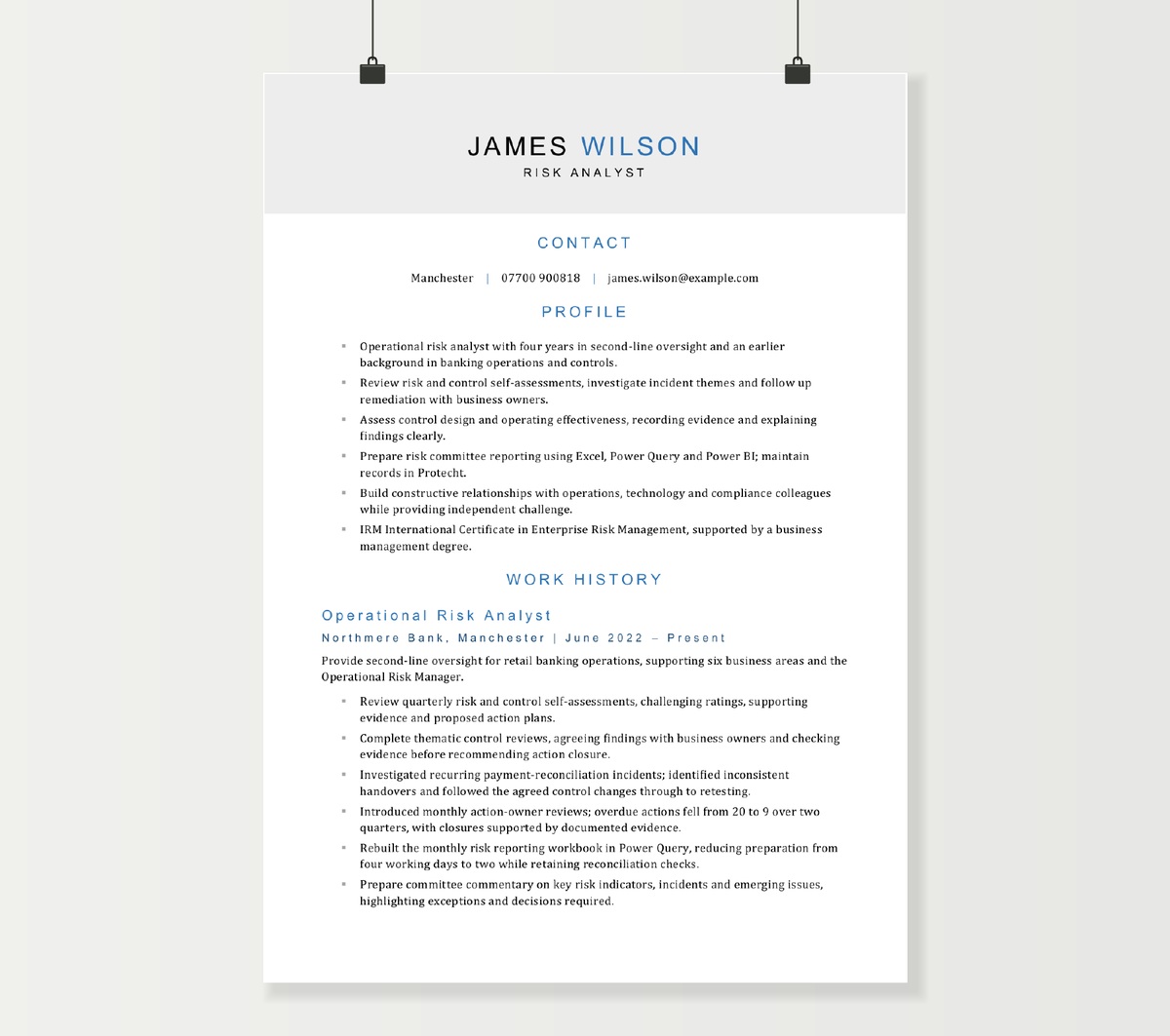
This risk analyst CV template follows an operational risk professional with experience in banking operations, control reviews and second-line oversight. The Word example shows how to connect risk assessments, reporting and stakeholder work with practical outcomes. The guide also explains how to focus your CV for credit, information and third-party risk roles.
Filename: FreeCVDownload_Risk_Analyst.docx
Content of this CV template
James Wilson
Risk Analyst
Contact
Manchester | 07700 900818 | [email protected]
Profile
- Operational risk analyst with four years in second-line oversight and an earlier background in banking operations and controls.
- Review risk and control self-assessments, investigate incident themes and follow up remediation with business owners.
- Assess control design and operating effectiveness, recording evidence and explaining findings clearly.
- Prepare risk committee reporting using Excel, Power Query and Power BI; maintain records in Protecht.
- Build constructive relationships with operations, technology and compliance colleagues while providing independent challenge.
- IRM International Certificate in Enterprise Risk Management, supported by a business management degree.
Work history
Operational Risk Analyst
Northmere Bank, Manchester | June 2022 – Present
Provide second-line oversight for retail banking operations, supporting six business areas and the Operational Risk Manager.
- Review quarterly risk and control self-assessments, challenging ratings, supporting evidence and proposed action plans.
- Complete thematic control reviews, agreeing findings with business owners and checking evidence before recommending action closure.
- Investigated recurring payment-reconciliation incidents; identified inconsistent handovers and followed the agreed control changes through to retesting.
- Introduced monthly action-owner reviews; overdue actions fell from 20 to 9 over two quarters, with closures supported by documented evidence.
- Rebuilt the monthly risk reporting workbook in Power Query, reducing preparation from four working days to two while retaining reconciliation checks.
- Prepare committee commentary on key risk indicators, incidents and emerging issues, highlighting exceptions and decisions required.
Operations Controls Analyst
Northmere Bank, Manchester | February 2019 – May 2022
Worked within the first-line operations team, testing controls across payments and customer-account administration.
- Sampled completed transactions, documented exceptions and discussed corrective actions with team leaders.
- Maintained risk-event records and analysed repeat errors, distinguishing processing issues from missing evidence.
- Coordinated a review of 45 control descriptions, clarifying ownership, frequency and the records needed for testing.
- Supported audit evidence requests and tracked operational actions to agreed deadlines.
Banking Operations Administrator
Northmere Bank, Manchester | September 2016 – January 2019
Supported customer-account maintenance and payment processing in a retail banking operations team.
- Reconciled daily processing reports and investigated unmatched items with colleagues.
- Recorded exceptions and escalated unresolved discrepancies through established checks.
Qualifications and development
BA (Hons) Business Management — 2:1
Manchester Metropolitan University | 2016
Professional development
IRM International Certificate in Enterprise Risk Management (2024); Power BI reporting workshop (2025); internal operational resilience training (2026).
Hobbies and interests
I enjoy five-a-side football, cooking and exploring new walking routes.
How to write a risk analyst CV
A strong risk analyst CV makes your judgement visible. The reader should be able to see what you assessed, which evidence you considered, what you concluded and how that conclusion affected a decision or a control. A list of risk frameworks and reporting responsibilities gives much less insight into your contribution.
Start by identifying the risk discipline and business setting of the vacancy. An operational risk analyst in a bank, a credit portfolio analyst and an information risk analyst may share parts of their toolkit, but the evidence that makes each application convincing is different.
Make your specialism clear at the top
Use the profile to establish your business context, experience and strongest relevant work. For an operational risk role, that could be second-line oversight of retail banking, risk and control self-assessments and thematic reviews. For credit risk, it might be a lending portfolio, customer or sector analysis, watchlist monitoring and the decisions supported by your analysis. Information risk applicants can identify the technology environment and the assessments or assurance work they cover.
The example CV builds on a consistent progression from banking operations into controls and then independent oversight. Its earlier experience helps explain why the candidate understands the processes being reviewed. Your own profile can make a similar connection between your background and the role you are seeking.
A short statement such as “Operational risk analyst supporting payments and customer operations, with experience in control reviews, incident analysis and committee reporting” gives the reader a useful frame for everything that follows. Add a distinctive strength or result if it helps distinguish your application.
Explain where you sit in the risk process
State your team and reporting context beneath each recent job title. In organisations using a three-lines model, first-line ownership, second-line oversight and internal audit have different responsibilities. An employer needs to understand whether you operated a control, assessed it independently, advised its owner or provided audit assurance.
Useful context includes the business areas covered, products or services involved, geographical reach and frequency of the reporting cycle. “Second-line analyst supporting six retail banking business areas” is more informative than “responsible for enterprise risk management”. For a smaller organisation, describe the actual arrangement in ordinary language.
Within the bullets, verbs such as reviewed, challenged, tested, recommended, presented and approved identify your contribution. If a manager or committee made the decision, describe the analysis or recommendation you supplied and the action that followed. This makes your influence easier to understand.
Show what sits behind a risk assessment
For operational risk applications, risk and control self-assessments (RCSAs) deserve space when they form a meaningful part of your work. Include the processes assessed and your contribution: facilitating workshops, reviewing risk descriptions, testing the basis of ratings, examining control evidence or following up actions. The number of assessments can show scale, but the quality of your challenge often tells the more interesting story.
Choose a bullet that links an observation to a consequence. For example, a review might have identified that a control depended on a single person, or that a risk rating did not reflect recent incidents. The CV can briefly explain the evidence, the recommendation and the resulting change to ownership, escalation or monitoring.
Risk registers are worth mentioning in this context. Describe how you used them to keep risks, owners, treatments and review dates meaningful. If you improved the taxonomy or reconciled duplicate records, explain how that helped reporting or accountability.
Distinguish control reviews from routine checks
Control-testing experience is stronger when the reader can see the type of control and the nature of your assessment. Reviewing whether a payment approval control is suitably designed is different from sampling transactions to check that approvals took place. Both can be relevant; describe the part you carried out.
A concise bullet can identify the process, review scope, finding and follow-up. You might have tested access recertification evidence, reviewed reconciliation exceptions or assessed supplier oversight records. Include how findings were documented and agreed, especially where your work led to a retest or a change in the control.
For applicants moving from audit, bring this evidence forward. Your audit experience can demonstrate sampling, evidence assessment and clear findings, while the risk application should also show your understanding of ongoing monitoring and business ownership.
Connect incidents and indicators with action
Describe incident work as a chain of analysis. Recording events is one part; investigating recurring causes, checking classifications, identifying themes and monitoring corrective actions adds the evidence of analytical judgement. Select a case where your work changed the understanding of a problem or the response to it.
For key risk indicators, say which risks the indicators tracked and how you used the information. Reviewing a threshold breach, investigating its cause and taking a clear explanation to the risk owner is more useful CV evidence than simply producing a dashboard. Where you helped develop indicators, describe the data source, rationale or resulting improvement in visibility.
Risk committee reporting deserves a similar treatment. Identify the audience and the contribution you made: reconciling source data, drafting commentary, separating persistent issues from one-off movements, explaining uncertainty or setting out decisions needed. Preparing papers and presenting them are different experiences, and either can earn a place on the CV.
Present results that fit risk work
Risk achievements are often improvements in control quality, timely action or decision-making. Useful measures include overdue remediation, the age of unresolved incidents, review coverage, reporting preparation time, evidence quality and completion of planned assessments. Give the period and scope so the reader can interpret the result.
In the example, overdue actions fall from 20 to 9 across two quarters, and reporting preparation falls from four working days to two. These figures explain specific improvements without requiring a financial valuation of risk. A qualitative result can be equally strong: a revised escalation route, a clearer control owner or a committee decision based on your analysis.
Where a result belongs to a wider programme, describe your contribution and then the programme outcome. For credit portfolios, relevant measures may include arrears movements, exposure concentrations or review turnaround, with enough context to distinguish analytical findings from the effect of wider market changes. For control testing, the significance of a finding matters alongside the number of tests completed.
Match tools and technical detail to the vacancy
Present software alongside its use. Excel could support reconciliations, exception analysis and scenario comparisons; Power Query could prepare recurring data; Power BI could bring together indicators and commentary. A governance, risk and compliance platform such as Protecht or Archer can be described through the records, workflows or reports you used.
SQL, Python, R or SAS become more prominent in data-intensive credit, market and model-risk roles. Include the analytical task, dataset and output: extracting portfolio records, monitoring a model, comparing scenarios or analysing time series. For these applications, a compact technical section and selected project may deserve more space than general administration.
Information risk candidates can show how technical understanding supported assessments of cloud services, access controls, data flows or third parties. Outsourcing specialists can emphasise due diligence, supplier registers, material issues and remediation. The CV should help a hiring manager see the depth of your relevant experience, with supporting detail in the employment bullets.
Give constructive challenge a concrete example
“Strong stakeholder skills” becomes convincing when attached to a situation. You may have worked through a disputed finding with an operations manager, explained a trend to a committee, or helped a supplier owner agree a practical action plan. Describe the issue and the outcome of the discussion.
Show how you combined evidence with an understanding of the business. Agreeing a workable control change, clarifying an unresolved risk for escalation or gaining better information from a technical team demonstrates more than saying you influenced senior stakeholders. Where your work crosses compliance, the compliance officer example offers another way to present monitoring and advice, while retaining the distinct focus of your risk role.
Choose qualifications and early-career evidence with purpose
List relevant qualifications with their full title, awarding body and completion date. The IRM International Certificate in Enterprise Risk Management is one way to demonstrate structured risk knowledge. A numerical degree, specialist financial-risk study or technical security qualification may carry more weight for a different specialism. Give current study its expected completion date and keep the most relevant learning easy to find.
For an experienced analyst, recent work usually provides the strongest evidence, followed by qualifications and focused development. For a first risk role, move relevant degree projects, placements or control responsibilities higher. A project can explain the question, evidence, method, conclusions and limitations in a few lines.
Operations, compliance, audit and reporting backgrounds can all supply useful examples. Bring forward exception investigation, process mapping, evidence checking and recommendations. Someone moving from an analytical role can use the data analyst CV example for ideas on presenting a project, then make the risk question and decision explicit in their own application.
Progression is clearest when the CV shows how the work changed: from collecting evidence to assessing it, from preparing reports to explaining findings, or from assisting a review to managing a defined piece of it. Those distinctions help employers judge readiness for the next level.
Risk Analyst CV FAQs
Use the process, scale and nature of the issue to explain your work without identifying customers or disclosing internal findings. For example, describe a review of payment controls across several teams, the kind of weakness assessed and the improvement agreed. An anonymised account can still show your judgement, evidence and influence clearly.
Yes, if your work improved reporting coverage or made previously hidden issues visible. Explain that context and give supporting evidence, such as more complete records, faster reporting or better follow-up. The useful result is the improvement in information and response; the incident count alone does not explain whether the underlying risk improved or worsened.
Keep the official title in your employment history and add a short description of the analytical scope. If you investigate trends, assess evidence or prepare recommendations, give those activities prominent bullets. Your profile can state the risk analyst role you are seeking and connect it with the relevant work you already do.
Describe the actual stage of work and your relationship to the model. Monitoring might involve recurring performance measures and investigating changes; validation involves an independent assessment within the organisation’s validation arrangements. Identify the model type, tests or analysis you completed, review audience and resulting recommendation so the employer can place your experience accurately.
It can help for a first role or a move into more technical analysis. One well-explained project using public data can show how you framed a risk question, checked the data, analysed uncertainty and reached a recommendation. A short project entry with a link is usually more useful than a large collection of unexplained charts. Operational risk applicants may get more value from a clear case study than from a code repository.
Give each assignment its business context and defined deliverable, such as a control review, remediation programme or reporting improvement. Label contract roles clearly and show what was handed over at completion. Where several assignments were through one consultancy, group them beneath that employer with individual project dates and a concise result for each.




