
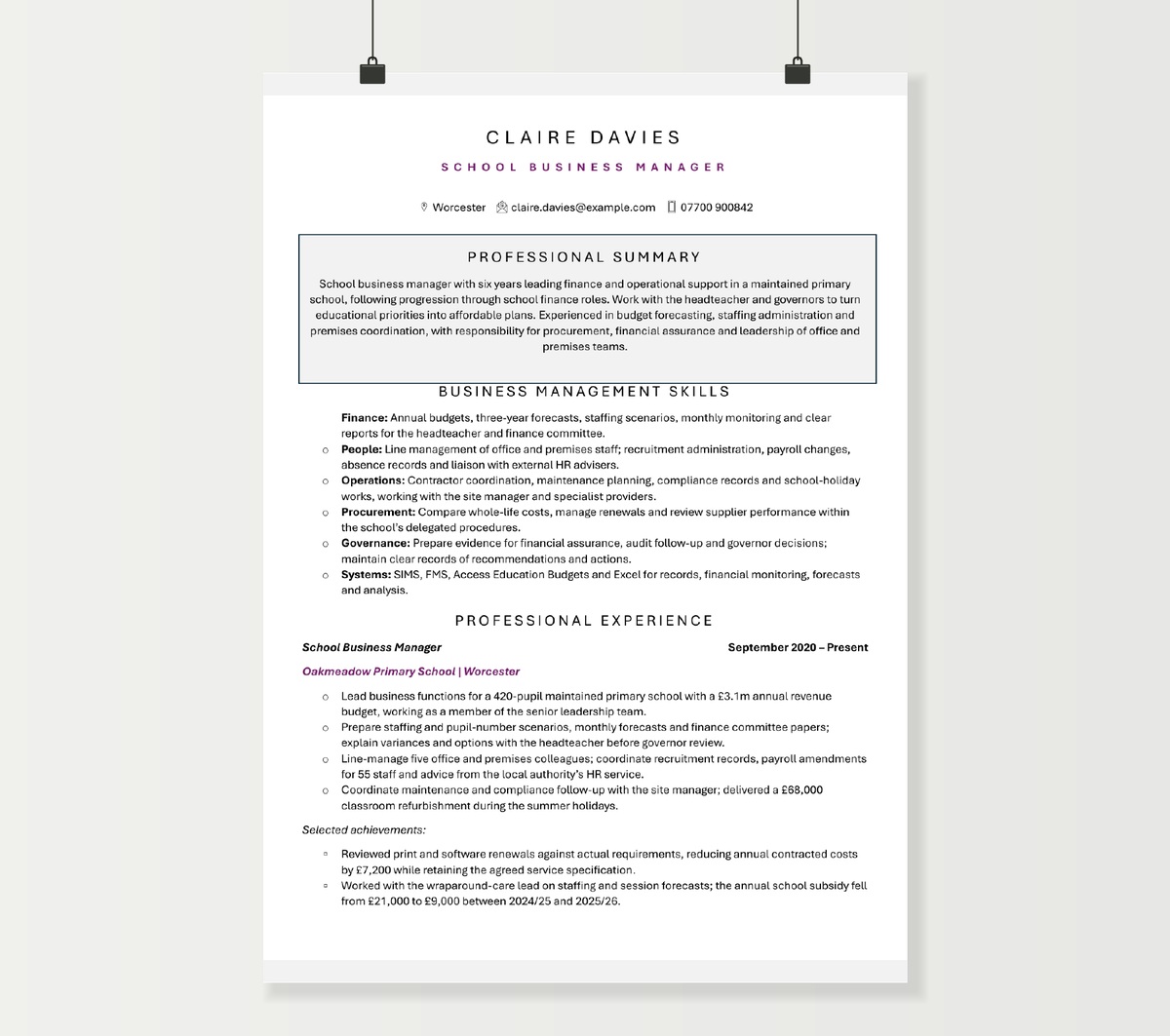
This school business manager CV template follows a school finance professional into leadership of a primary school’s business functions. The Word example combines budget planning, staffing administration, premises and supplier management with measured improvements. The guide covers maintained schools, academies and applications from other sectors, helping you explain both operational responsibility and strategic contribution.
Filename: FreeCVDownload_School_Business_Manager.docx
Content of this CV template
Claire Davies
SCHOOL BUSINESS MANAGER
Worcester | [email protected] | 07700 900842
Professional summary
School business manager with six years leading finance and operational support in a maintained primary school, following progression through school finance roles. Work with the headteacher and governors to turn educational priorities into affordable plans. Experienced in budget forecasting, staffing administration and premises coordination, with responsibility for procurement, financial assurance and leadership of office and premises teams.
Business management skills
- Finance: Annual budgets, three-year forecasts, staffing scenarios, monthly monitoring and clear reports for the headteacher and finance committee.
- People: Line management of office and premises staff; recruitment administration, payroll changes, absence records and liaison with external HR advisers.
- Operations: Contractor coordination, maintenance planning, compliance records and school-holiday works, working with the site manager and specialist providers.
- Procurement: Compare whole-life costs, manage renewals and review supplier performance within the school’s delegated procedures.
- Governance: Prepare evidence for financial assurance, audit follow-up and governor decisions; maintain clear records of recommendations and actions.
- Systems: SIMS, FMS, Access Education Budgets and Excel for records, financial monitoring, forecasts and analysis.
Professional experience
School Business Manager | September 2020 – Present
Oakmeadow Primary School | Worcester
- Lead business functions for a 420-pupil maintained primary school with a £3.1m annual revenue budget, working as a member of the senior leadership team.
- Prepare staffing and pupil-number scenarios, monthly forecasts and finance committee papers; explain variances and options with the headteacher before governor review.
- Line-manage five office and premises colleagues; coordinate recruitment records, payroll amendments for 55 staff and advice from the local authority’s HR service.
- Coordinate maintenance and compliance follow-up with the site manager; delivered a £68,000 classroom refurbishment during the summer holidays.
Selected achievements:
- Reviewed print and software renewals against actual requirements, reducing annual contracted costs by £7,200 while retaining the agreed service specification.
- Worked with the wraparound-care lead on staffing and session forecasts; the annual school subsidy fell from £21,000 to £9,000 between 2024/25 and 2025/26.
Finance Assistant / School Finance Officer | September 2012 – August 2020
Brookfield Community School | Worcester
- Joined as a Finance Assistant and progressed to School Finance Officer in 2016, supporting the business manager in a 900-pupil secondary school.
- Processed orders and invoices, reconciled accounts and prepared monthly budget-monitoring schedules for department heads.
- Maintained staffing-cost records and checked payroll changes against approved contracts and absence information before submission to the provider.
- Coordinated supplier renewals, maintained the asset register and assembled evidence for internal audit and the Schools Financial Value Standard review.
Selected achievements:
- Introduced a shared order-query register and regular follow-up; invoices awaiting order confirmation fell from 34 to 12 over one school term.
- Prepared a costed replacement schedule for 90 classroom computers, supporting a phased purchase plan within the agreed three-year budget.
Qualifications & development
ILM Level 4 Diploma for School Business Managers – Completed 2020
AAT Level 3 Diploma in Accounting – Completed 2015
IOSH Managing Safely – Completed 2022
A levels: Business Studies, Mathematics and English – Worcester Sixth Form College, 2012
Additional information
- Recent training: Safer recruitment refresher (2025), information governance and school budget planning updates (2026).
- Professional involvement: Attend local school business manager network meetings and share practical budgeting and procurement experience.
- Interests: Swimming, gardening and visiting historic houses.
How to write a school business manager CV
A school business manager CV should show how you make resources, people and operations work for the school. Financial accuracy matters, but so does explaining a staffing decision to the headteacher, keeping a premises project on schedule and giving governors useful information. The strongest applications connect these responsibilities to decisions and outcomes.
Begin by understanding the vacancy’s remit. One school may need a broad business leader overseeing several support services; another may place more emphasis on finance while a trust team handles HR, estates or procurement. Build the CV around the responsibility you would be taking on.
Establish the size and structure of your role
Introduce your current post with the school phase, approximate pupil numbers, organisational setting and budget or service scope. State whether you work in a maintained school, standalone academy, multi-academy trust or independent school. Include multiple sites, a nursery or other provision when they materially affect the work.
Make reporting relationships clear. Working directly with a headteacher and governing body differs from managing school-level operations within a central trust structure. Identify the teams you lead and the functions delivered by external providers or colleagues. This helps the reader understand both your autonomy and the support around you.
For example, “Lead business functions in a 420-pupil maintained primary school, with a £3.1m revenue budget and five office and premises staff” gives a useful frame. A trust-based applicant could instead describe responsibility for three schools, local budget monitoring and coordination with central finance and HR.
Explain what you do with the budget
Budget size is useful context, but the CV also needs to show how you plan, monitor and advise. Describe annual budgeting, in-year forecasts, longer-term planning and the assumptions you help leaders assess. Staffing costs, pupil-number changes, grant income and service commitments can each be relevant.
Choose examples in which your analysis supported a decision. You might have modelled alternative staffing arrangements, phased an ICT replacement programme or explained the effect of falling rolls. State what you prepared, who used it and what was agreed. This demonstrates the ability to make financial information usable within school leadership.
Financial control deserves space too. Reconciliations, commitment tracking, payroll checks, delegated authorisation and audit follow-up can show the dependable foundation beneath the forecasts. Experienced applicants can select one or two improvements rather than filling the CV with every transaction type they oversee.
Use the right financial context. In England, maintained-school work may include the Schools Financial Value Standard and local authority arrangements. Academy experience may involve the Academy Trust Handbook, the trust’s scheme of delegation and reporting to central finance. Describe the work you carried out within those arrangements, with the relevant jurisdiction clear.
Present value for money alongside service quality
Procurement examples should explain the service being bought and the result of your work. Contract reviews, supplier comparisons, renewals and performance discussions can demonstrate commercial judgement. Include the scope of your involvement, particularly where a local authority or trust procurement team managed the formal process.
A saving is most useful when the reader knows whether it is annual, one-off or forecast, and what stayed within the agreed service. For example: “Reviewed print and software renewals against actual requirements, reducing annual contracted costs by £7,200 while retaining the service specification.” That explains both the method and the result.
Other worthwhile outcomes include a more reliable catering service, a coordinated maintenance contract or a replacement plan that spreads cost across several years. Fundraising, lettings and wraparound provision may also be relevant. Distinguish income from the net contribution after staffing and operating costs, so the financial effect is easy to understand.
Show leadership of people and support services
Name the teams you manage and give a sense of their size. Office, premises, catering, cleaning and technical staff can have very different work patterns and supervision needs. A specific example of setting priorities, arranging cover, improving a handover or developing a colleague gives substance to “team leadership”.
Explain your HR responsibilities at the level you perform them. Recruitment administration, contract changes, absence records, payroll liaison and advice to managers are all valuable. If an external HR service supplies specialist advice, show how you coordinate that support and help leaders act on it.
For payroll, state whether you process it directly, authorise changes, check reports or liaise with a provider. A bullet about checking staffing changes against approved records says more than “responsible for payroll”. At a more senior level, include relevant workforce planning and leadership-team discussions, with the resulting action or decision.
Make premises and compliance work visible
A school’s operational calendar is distinctive. Work often needs to fit around teaching, examinations, events and holiday periods. Use project examples to show how you coordinated contractors, stakeholders and deadlines within that environment.
For a refurbishment, identify the value and scope, your part in planning or procurement and the completion milestone. For routine premises work, explain how you monitored outstanding actions with the site manager, maintained records or organised specialist inspections. Describe the management contribution, while making the roles of technical advisers and contractors clear.
Safeguarding-related administration, safer recruitment records, visitor arrangements, data protection and business continuity can be relevant to this role. Select the areas you actually oversee and state the practical work involved. Formal responsibilities such as designated safeguarding lead or data protection officer should appear as specific appointments when they form part of your post.
Demonstrate how you work with governors and school leaders
A useful report helps someone make a decision. In your CV, explain the reports, options or recommendations you prepared and the audience they served: the headteacher, finance committee, governing body or trust executive team.
For example, a forecast identifying an emerging pressure can show more judgement than a general statement that budgets were balanced. Describe how you presented the issue, assessed choices with leaders and tracked the agreed response. Where you inherited a difficult financial position, progress against an agreed recovery plan can be strong evidence.
Connect business work to the school’s priorities in concrete terms. A phased purchase may protect classroom provision; a holiday works programme may make rooms ready for the new term; a revised support rota may improve office cover. These are meaningful outcomes in their own right and help explain the educational purpose of your work.
Use systems to support the story
List the finance, budgeting, management information and HR systems that are relevant to the vacancy, with a short description of your use. The reader needs to know whether you build staffing forecasts, prepare financial reports, maintain personnel records or coordinate statutory returns.
School systems vary considerably. Experience with SIMS, Arbor, Bromcom, FMS, Access Education, IMP, Xero or another platform is most useful when connected to a task. Excel deserves similar detail where it supports reconciliations, scenario modelling or analysis. A compact systems section can be reinforced by examples under your employment history.
If you have supported a system change, explain your part in preparing data, checking balances, testing workflows, training colleagues or resolving issues after launch. This can demonstrate both attention to detail and the ability to manage operational change.
Show readiness for the next level
Experienced school business managers should foreground the decisions, teams and resources they lead. Keep routine tasks brief enough to leave room for planning, improvements and governor-facing work. Applicants seeking a larger school or wider trust role can show how they have handled increasing complexity, multiple stakeholders or cross-school projects.
If you are progressing from school finance or administration, identify where you have already taken on broader responsibility: preparing a budget section, coordinating a supplier review, supervising staff or covering part of the business manager’s role. The school administrator CV example can help you present the earlier foundation without letting routine office duties dominate the application.
Applicants from another sector should translate relevant scale and responsibility into terms a school can assess. Financial planning, staff management, procurement and facilities work transfer well when supported by clear examples. Explain any experience of education governance, volunteering or school-related training separately, so the reader can see how you are building knowledge of the setting.
Keep qualifications precise and relevant
Give the full title, level, awarding body and completion date of school business qualifications. Older CSBM or DSBM awards can remain under their original names. Relevant accounting, HR, management and health and safety qualifications also deserve space, particularly when they support a major part of the advertised remit.
For study in progress, state the course and expected completion date. Add selected recent development in areas such as school finance, safer recruitment, procurement or information governance. Practical responsibility and qualifications should reinforce each other throughout the CV.
Schools frequently use an application form and supporting statement. Keep the CV as a clear record of your career, achievements and training, then use that evidence to address the individual person specification through the requested application process. The CV template library provides other editable layouts if you need a different balance between career history and qualifications.
School Business Manager CV FAQs
Follow the school’s stated process. Many school vacancies require a full application form and supporting statement and do not accept a CV as a substitute. The CV remains useful as an organised record of your employment, qualifications and achievements, from which you can prepare the requested sections.
The requirement depends on the remit and person specification. Some roles place particular weight on school finance or a school business qualification; others accept broader business experience. Present your accounting training alongside the budgets, controls and reporting you have managed. A trust chief financial officer role has a different level of financial responsibility and should be assessed against its own requirements.
Name the employer or federation, show the schools and phases covered, and explain which responsibilities were shared or school-specific. Give the combined budget or staff scope where useful, then choose an example of coordinating priorities across sites. This helps an employer see how you handled complexity rather than simply counting locations.
Yes, particularly when it provides relevant education context alongside experience from another sector. Put it in a separate governance or voluntary section with the dates, committee responsibilities and contribution. Financial scrutiny, premises planning or strategic discussion can strengthen the application when your role in the decision is clear.
Describe the starting position, the analysis you provided and the agreed actions you helped deliver. Progress might involve a more reliable forecast, a costed recovery plan, improved control of commitments or a reduced projected shortfall. State the period and your contribution so the reader can assess the work in context.
It can help explain the working pattern and scope, especially where you also cover specified holiday weeks or projects. Include it briefly with the job details if relevant to the application. Keep the main emphasis on the functions, responsibilities and outcomes you manage within that arrangement.




