
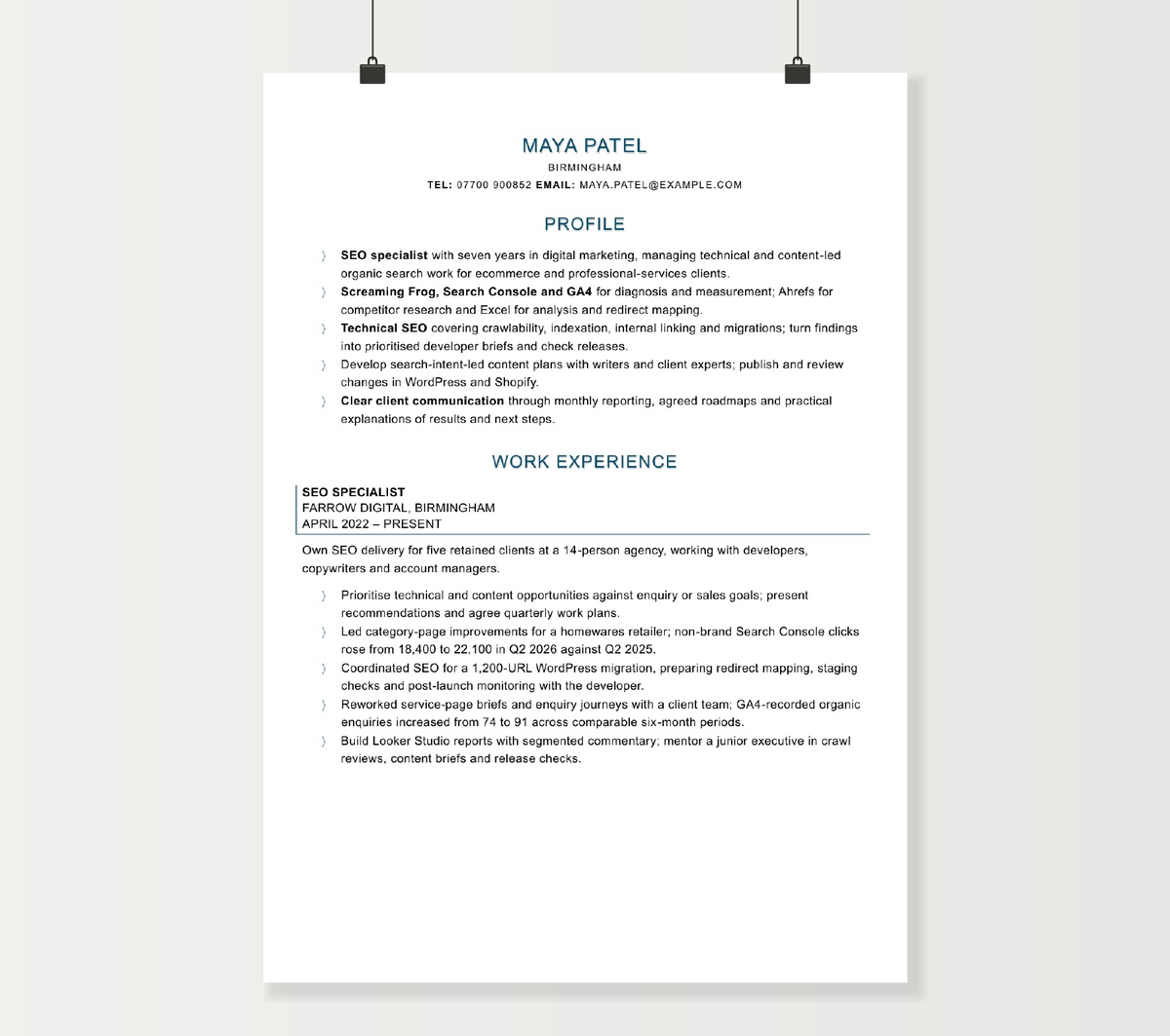
This SEO specialist CV template shows an agency career progressing from digital marketing support to ownership of organic search work across several clients. The Word example includes technical projects, content collaboration, reporting and measured results. The guide explains how to present the work behind your performance figures for agency, in-house and entry-level applications.
Filename: FreeCVDownload_SEO_Specialist.docx
Content of this CV template
MAYA PATEL
BIRMINGHAM
tel: 07700 900852 email: [email protected]
PROFILE
- SEO specialist with seven years in digital marketing, managing technical and content-led organic search work for ecommerce and professional-services clients.
- Screaming Frog, Search Console and GA4 for diagnosis and measurement; Ahrefs for competitor research and Excel for analysis and redirect mapping.
- Technical SEO covering crawlability, indexation, internal linking and migrations; turn findings into prioritised developer briefs and check releases.
- Develop search-intent-led content plans with writers and client experts; publish and review changes in WordPress and Shopify.
- Clear client communication through monthly reporting, agreed roadmaps and practical explanations of results and next steps.
WORK EXPERIENCE
SEO SPECIALIST
FARROW DIGITAL, BIRMINGHAM
APRIL 2022 – PRESENT
Own SEO delivery for five retained clients at a 14-person agency, working with developers, copywriters and account managers.
- Prioritise technical and content opportunities against enquiry or sales goals; present recommendations and agree quarterly work plans.
- Led category-page improvements for a homewares retailer; non-brand Search Console clicks rose from 18,400 to 22,100 in Q2 2026 against Q2 2025.
- Coordinated SEO for a 1,200-URL WordPress migration, preparing redirect mapping, staging checks and post-launch monitoring with the developer.
- Reworked service-page briefs and enquiry journeys with a client team; GA4-recorded organic enquiries increased from 74 to 91 across comparable six-month periods.
- Build Looker Studio reports with segmented commentary; mentor a junior executive in crawl reviews, content briefs and release checks.
DIGITAL MARKETING ASSISTANT
FARROW DIGITAL, BIRMINGHAM
SEPTEMBER 2019 – MARCH 2022
Supported SEO and website delivery for local-service and ecommerce clients, reporting to the digital marketing manager.
- Researched search intent and competitors, drafted page briefs and updated approved copy, titles and internal links in WordPress.
- Reviewed crawl and Search Console findings, recorded issues for developers and checked completed changes against the original brief.
- Standardised monthly reporting inputs for six clients, reducing preparation time from a full day to around five hours.
- Maintained Google Business Profile information for a 12-location client and coordinated location-page updates with branch contacts.
QUALIFICATIONS & DEVELOPMENT
BA (Hons) MARKETING — 2:1
NOTTINGHAM TRENT UNIVERSITY — 2019
Dissertation examined online information search and purchase decisions in specialist retail.
GOOGLE ANALYTICS CERTIFICATION
RENEWED 2026
RECENT DEVELOPMENT
TECHNICAL SEO, JAVASCRIPT RENDERING & AI SEARCH WORKSHOPS — 2025–2026
INTERESTS
Bouldering, sketching and visiting independent cinemas.
How to write an SEO specialist CV
An SEO specialist CV should show how you turn a search problem or opportunity into work that gets delivered. Employers can recognise a list of familiar tools quickly. What helps them assess you is the connection between diagnosis, priorities, implementation and results, together with the people and websites involved.
Choose the evidence that fits the vacancy. A technical ecommerce role, a content-led agency position and a local-search specialist job may share a title while asking for quite different strengths. Give the reader a clear view of your particular experience before listing the broader skills that support it.
Make your SEO remit clear at the top
Use your profile to identify the websites and work you know best. Useful distinctions include agency or in-house experience, ecommerce or lead generation, local or international search, and technical or editorial emphasis. Add the level of responsibility: supporting delivery, owning accounts, setting a roadmap or leading a team.
A statement such as “SEO specialist managing technical and content work across five ecommerce and professional-services accounts” tells a recruiter more than a general promise to increase visibility. Follow it with one or two strengths that appear in your work history. If migrations, large catalogues or multi-location businesses are central to the vacancy, make that experience easy to find.
Keep the official job titles in your employment history. Where a broad title hides substantial SEO responsibility, explain the remit directly beneath it. This lets someone with a Digital Marketing Executive title demonstrate specialist work without making the chronology confusing.
Choose results that reveal the work behind the change
For each substantial achievement, include the website context, your action, the result and the period. A percentage alone gives very little information. Non-brand clicks for a defined set of category pages, qualified enquiries from organic landing pages or revenue for an agreed product group are much easier to interpret.
The example CV uses a category-page project and compares Q2 with the same quarter a year earlier. That gives the work a scope and a sensible time reference. Your own evidence might instead involve a migration, a content consolidation project, better local visibility or recovery from an indexation problem. Choose the comparison that reflects the project and the data available.
Identify the measure correctly. Search Console clicks, GA4 organic sessions, recorded enquiries and attributed revenue describe different stages of a journey. State the source when it helps the reader understand the result. For conversion figures, name what counted as a conversion or enquiry; for rankings, give the tracked topic or query group rather than an isolated position.
A short qualifying phrase can make an achievement more informative: a stable tracking setup, the same seasonal period, a defined page group or work delivered alongside a content team. You do not need a methodological appendix. Give enough context for the reader to see the contribution and ask useful follow-up questions.
Show technical SEO from finding to release
Technical experience is stronger when it follows an issue through to implementation. Describe what you investigated, how you prioritised it, what you specified or changed, and how you checked the release. “Audited websites” leaves all of those stages unclear.
For example, a CV bullet could describe identifying duplicate filter pages in an ecommerce crawl, agreeing a change with developers and validating the affected templates after release. The detail demonstrates your role without becoming a tutorial on faceted navigation. Choose a few relevant examples from indexation, rendering, internal architecture, structured data, performance or crawl analysis.
Make the division of work visible. If you produced requirements and acceptance checks while a developer implemented the change, that is valuable delivery experience. If you also edited code, templates or configuration, explain the scope. Employers need to understand both your technical depth and your ability to work within a development process.
Website scale can add useful context: the number of indexable URLs, product categories, locales or templates affected. Pair that scale with a specific responsibility. Large numbers become meaningful when the reader can see the complexity you handled.
Give migrations their own compact project evidence
A migration can be one of the most useful projects on an SEO CV because it combines planning, technical judgement and coordination. State what changed: domain, platform, URL structure, design or international setup. Then identify the parts you owned, such as requirements, redirect mapping, staging checks, launch support or post-launch monitoring.
Include a result that fits the project. This could be completion of agreed checks, resolution of a defined set of issues, recovery of affected landing pages or performance over a stated monitoring period. “Successful migration” becomes much clearer when you explain what success meant and your contribution to achieving it.
If you supported a senior specialist, describe your specific workstream. A carefully checked redirect map or a well-run post-launch issue log is credible early-career evidence. For senior applicants, bring out decisions about priorities, release dependencies and communication with the wider business.
Connect keyword and content work to useful decisions
Keyword research deserves more than a mention in the skills section. Show what it changed: the pages you proposed, content you consolidated, a category structure you refined or briefs you prepared for writers and subject experts. Explain how the work related to customer questions and the commercial purpose of the site.
For content-focused roles, give the reader evidence of editorial judgement. This might include reviewing existing material, preparing a brief that resolved an intent mismatch, coordinating specialist input or improving a group of service pages. If you wrote or edited the final content, say so; if your role was strategy and review, show that contribution clearly.
For authority-building work, explain the type of campaign and your responsibility within it. Researching a useful asset, developing an outreach angle, coordinating with digital PR or securing relevant coverage are different activities. A case study should make the quality and purpose of the work understandable alongside any link or referral result.
Match the evidence to agency, in-house and local-search work
Agency applications benefit from the number and type of accounts, ownership of work plans, client communication and coordination with account managers. Include whether you presented recommendations, managed expectations, supported pitches or contributed to retention and account growth. Keep these details connected to your SEO role.
In-house applications often need stronger evidence of sustained ownership. Show how you worked with product, engineering, merchandising, content or analytics teams, and how SEO priorities entered their plans. A release you helped secure and validate can say more about your effectiveness than the number of recommendations in an audit.
For local-search roles, describe the business model and location scope. Relevant evidence may include Google Business Profile management, location-page projects, branch coordination and reporting on enquiries or visits using the available measures. A twelve-location service business presents a different workload from one independent shop, so give that context.
International experience also needs a clear scope. Name the markets, languages or regional sites and the work you handled, such as coordinating local content, reviewing international targeting or supporting a platform change. A reader should be able to distinguish direct delivery from wider team exposure.
Use tools to explain your capabilities
Group a selective set of tools by purpose. Search Console and GA4 may support performance investigation; Screaming Frog or Sitebulb may support crawling and validation; Ahrefs or Semrush may support competitor and content research. Excel, Google Sheets, Looker Studio or SQL can show how you analyse and communicate the information.
Bring the most relevant tools into a project or employment bullet too. “Used crawl exports and Search Console data to prioritise category-page fixes” is easier to assess than a row of software logos. Include CMS experience such as WordPress, Shopify or Adobe Commerce where it relates to publishing, troubleshooting or delivery responsibilities.
For technical vacancies, specify the depth of your HTML, CSS, JavaScript, log-file or scripting experience through work completed. A small automation that improved recurring analysis can be a strong example. The adjacent web developer CV guide may help applicants who also have substantial implementation responsibilities present those projects clearly.
Present AI-search experience through defined work
Where a vacancy mentions AI search, GEO or AEO, explain the work you have undertaken rather than adding every label to the profile. You might have monitored a defined set of search experiences, compared how a brand was represented, reviewed content changes or tested a reporting approach. State the scope and the decisions your findings informed.
If you used AI within your SEO workflow, describe the task and the improvement: organising research, drafting a first-pass brief, comparing page groups or speeding up a repeated analysis. Include how you reviewed the output as part of the delivery process. This demonstrates practical judgement and a useful application, which is more informative than describing yourself as an AI expert.
Give exploratory projects an appropriate place in the CV. A brief development or project entry can show curiosity and recent experience while your established delivery record remains the centre of the application.
Use a portfolio to add depth beyond the CV
A small selection of readable case studies can help when an employer wants to see your approach. Choose work with a clear problem, your role, the main decisions, delivery and results. An annotated chart or a concise explanation of a technical project is often more helpful than a gallery of dashboards.
Keep the CV self-contained: its achievement bullets should still make sense before anyone opens a link. Place a portfolio link in the contact area or a short selected-projects section. For client work, an anonymised sector and project description can preserve the substance of the case while keeping the detail suitable for sharing.
Build an entry-level CV around practical evidence
For a first SEO role, a small website, volunteer project, placement or relevant marketing assignment can demonstrate useful skills. Explain the starting point, your analysis, the changes you made and what you could observe afterwards. If a recommendation has not yet been implemented, describe the completed audit and prioritisation work as the project’s output.
Education and certifications can support that evidence. List the course or award, provider and completion date, then select the learning most relevant to the vacancy. A Google Analytics certification or technical SEO course is clearer alongside a practical application. You can use the digital marketing executive example to organise broader campaign experience while bringing your SEO work forward.
Experienced applicants should give more space to projects, judgement and progression. Show how your contribution developed from carrying out tasks to choosing priorities, coordinating delivery, explaining results or helping other specialists improve their work. Those changes make the next career step convincing.
SEO Specialist CV FAQs
Yes. Explain the completed stage and its output: a prioritised audit, approved content plan, migration map or implemented release. If performance monitoring is still under way, state that briefly. The reader can assess the quality and scope of your contribution without needing a traffic-growth figure for every project.
Use a comparison the data can support. You might report a consistent period after the change, a stable Search Console measure or a defined page group with comparable tracking. Add a short note identifying the measurement basis. Where the main achievement was repairing tracking or reporting, describe that work and the improvement in usable information.
Client names can provide context when the work is public and suitable to share. Sector, website type, market and project scale can be equally useful when names are confidential. Make your role clear, particularly where several specialists or agencies contributed. A short anonymised case can still demonstrate substantial expertise.
It can be, especially if it goes beyond a tool export. Show which findings you investigated, the priorities you chose and the rationale for a few specific recommendations. A small implemented project adds another kind of evidence, but an audit can demonstrate analysis and communication before you have access to make site changes.
Use a dated freelance entry with the types of clients, services and level of responsibility, then select a few projects. Group overlapping assignments so the chronology stays readable. Include useful commercial experience such as scoping work, agreeing priorities and reporting to clients alongside the SEO delivery.
It can be a useful case if your response shows strong analysis and judgement. Explain the affected area, the investigation you carried out, the actions agreed and the subsequent evidence. A challenging period can demonstrate prioritisation and stakeholder communication as well as a straightforward growth project.




