This digital marketing executive CV template shows how to connect hands-on campaign work with customer enquiries and useful improvements. The Word example follows a marketing assistant into a role covering paid search, email, website content and reporting. The guide explains how to present your channel strengths, campaign decisions and results, whether you work in-house, for an agency or are applying for your first digital role.
Filename: FreeCVDownload_Digital_Marketing_Executive.docx
Content of this CV template
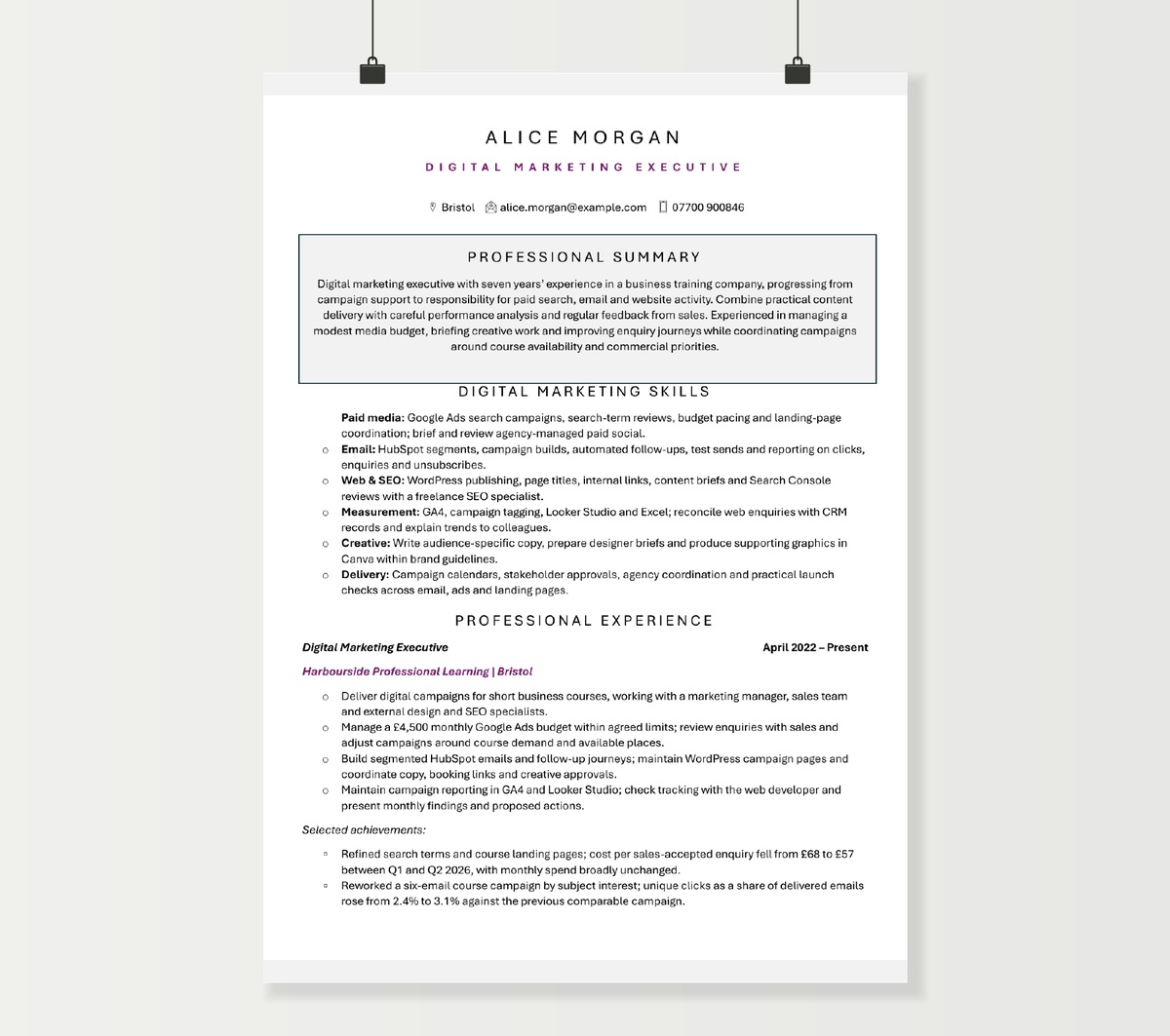
Alice Morgan
DIGITAL MARKETING EXECUTIVE
Bristol | [email protected] | 07700 900846
Professional summary
Digital marketing executive with seven years’ experience in a business training company, progressing from campaign support to responsibility for paid search, email and website activity. Combine practical content delivery with careful performance analysis and regular feedback from sales. Experienced in managing a modest media budget, briefing creative work and improving enquiry journeys while coordinating campaigns around course availability and commercial priorities.
Digital marketing skills
- Paid media: Google Ads search campaigns, search-term reviews, budget pacing and landing-page coordination; brief and review agency-managed paid social.
- Email: HubSpot segments, campaign builds, automated follow-ups, test sends and reporting on clicks, enquiries and unsubscribes.
- Web & SEO: WordPress publishing, page titles, internal links, content briefs and Search Console reviews with a freelance SEO specialist.
- Measurement: GA4, campaign tagging, Looker Studio and Excel; reconcile web enquiries with CRM records and explain trends to colleagues.
- Creative: Write audience-specific copy, prepare designer briefs and produce supporting graphics in Canva within brand guidelines.
- Delivery: Campaign calendars, stakeholder approvals, agency coordination and practical launch checks across email, ads and landing pages.
Professional experience
Digital Marketing Executive | April 2022 – Present
Harbourside Professional Learning | Bristol
- Deliver digital campaigns for short business courses, working with a marketing manager, sales team and external design and SEO specialists.
- Manage a £4,500 monthly Google Ads budget within agreed limits; review enquiries with sales and adjust campaigns around course demand and available places.
- Build segmented HubSpot emails and follow-up journeys; maintain WordPress campaign pages and coordinate copy, booking links and creative approvals.
- Maintain campaign reporting in GA4 and Looker Studio; check tracking with the web developer and present monthly findings and proposed actions.
Selected achievements:
- Refined search terms and course landing pages; cost per sales-accepted enquiry fell from £68 to £57 between Q1 and Q2 2026, with monthly spend broadly unchanged.
- Reworked a six-email course campaign by subject interest; unique clicks as a share of delivered emails rose from 2.4% to 3.1% against the previous comparable campaign.
Marketing Assistant | September 2019 – March 2022
Harbourside Professional Learning | Bristol
- Supported the marketing manager with course launches, website updates, customer emails and event communications across a changing training calendar.
- Prepared copy and image briefs, checked course dates and prices with operations, and published approved content through WordPress.
- Built email campaigns in Mailchimp, maintained audience records and checked display, links and booking details before scheduled sends.
- Collated weekly website and enquiry figures in Excel; helped sales colleagues identify the campaigns associated with incoming enquiries.
Selected achievements:
- Coordinated the refresh of 42 course pages before the autumn programme launch, resolving conflicting dates and outdated booking links with operations.
- Created a shared campaign asset register and approval checklist, giving the team a reliable record of final copy, artwork and release dates.
Qualifications & development
BA (Hons) Marketing, 2:1 – University of the West of England, 2019
CIM Level 4 Certificate in Professional Digital Marketing – Completed 2022
Google Ads Search Certification – Renewed 2026
Google Analytics Certification – Completed 2026
Additional information
- Recent development: Practical workshops on GA4 reporting, accessible email content and creative testing during 2025–26.
- Working relationships: Regularly brief freelance designers and web developers; translate campaign requirements into clear deliverables and review feedback.
- Interests: Film photography, coastal walks and trying new recipes.
How to write a digital marketing executive CV
A digital marketing executive CV should show how you get campaigns from an idea to a measurable customer response. Employers need to understand the channels you can handle, the work you personally deliver and how you use results to improve the next decision. A page of platform names leaves all three questions unanswered.
Read the balance of the role before choosing your evidence. One digital executive may spend most of the week on paid acquisition; another may manage website content, email and agency requests. Lead with the part of your experience that matches that balance, then show the supporting skills that make you effective across the customer journey.
Make your channel strengths clear in the opening profile
Give the reader a compact picture of your commercial setting, strongest channels and level of responsibility. “Digital marketing executive in B2B training, managing paid search, email and website campaigns” is more useful than “creative, data-driven digital native”. Add one distinguishing contribution: improving enquiry quality, building repeat-purchase campaigns or coordinating digital launches across several brands.
For an agency background, mention the types of accounts and campaigns you support. For an in-house role, identify the product, audience or business model. Generating enquiries for a professional service, selling retail products and acquiring app subscribers involve different conversion journeys; that context helps employers interpret your results.
Build experience around complete campaigns
Use one or two strong campaigns to connect otherwise separate tasks. Explain the objective and audience, your responsibilities, the channels involved and the result or next action. This gives the reader a better sense of your judgement than separate bullets saying you wrote copy, updated a website and sent newsletters.
A useful campaign entry might explain that you promoted a new training programme to existing customers, built segmented emails, coordinated a landing page and tracked enquiries with sales. The detail that earns space is the connection between those actions: how the audience influenced the message, how the page supported the offer and what you learned from the response.
Include the practical delivery work that makes campaigns reliable. Briefing a designer, securing product approval, checking a booking journey and organising a launch calendar are valuable when you show the scale or complication involved. A multi-brand launch with several approval owners is stronger evidence of coordination than the phrase “excellent organisational skills”.
Describe paid media responsibility precisely
For Google Ads, Meta or other paid platforms, state what you manage: campaign setup, search-term reviews, audiences, creative testing, budget pacing or performance reporting. Add a sensible indication of scale, such as monthly spend, number of accounts or the markets served. Explain whether you controlled allocations within an agreed budget or recommended changes to a manager.
Agency coordination also deserves clear credit. If specialists operated the accounts, describe your briefs, asset delivery, review meetings and decisions on recommendations. Employers can then see the commercial and project responsibility you held. For a hands-on vacancy, bring direct platform work higher in the CV.
Choose results that match the objective. Cost per qualified enquiry matters for lead generation; acquisition cost and subscription conversion may matter for a subscription service. Return on ad spend can be useful for ecommerce, with enough context to identify the campaign period and whether the figure comes from the advertising platform or another reporting source.
Show what you contributed to search and website performance
“SEO” covers a wide range of work. Identify the parts you have delivered: keyword research, content briefs, on-page changes, internal linking, technical issue coordination or reporting through Search Console. Connect them to a useful output, such as improving a group of service pages or supporting a website migration.
For content and CMS work, include the type and volume of publishing, the platform and the checks or approvals involved. Updating 40 course pages with operations and checking booking links shows more than “WordPress experience”. Accessibility, consistent product information and content maintenance can be significant strengths in organisations where website accuracy matters as much as acquisition.
Where you have supported technical improvements, explain the collaboration. For example, you may have identified an issue in a crawl report, prioritised it with a developer and checked the published change. The CV needs that contribution and its effect, without becoming an explanation of how to run a crawl.
Give email and CRM work its own evidence
Describe the audience logic behind email activity. Customer interests, purchase history, membership stage or course enquiries are more informative than “sent regular campaigns”. Mention the platform alongside the work: segmentation, campaign builds, automated journeys, database maintenance, testing or reporting.
Results should help the employer understand the customer response. Clicks, enquiries, bookings and repeat purchases often explain an email’s contribution more clearly than open rate alone. If open rate is relevant, pair it with a downstream measure and the reporting context. A change in the audience or measurement setup can affect comparisons.
Recurring communications also count. A dependable member newsletter may serve retention and information needs rather than immediate sales. Show how you gathered contributions, kept information timely and used reader behaviour or feedback to improve it.
Turn reporting into evidence of judgement
Put the decision after the data. A dashboard is a useful output, but the stronger CV bullet explains what it revealed and what happened next: a budget moved, a confusing page changed, an audience split or a low-quality lead source investigated with sales.
For each important result, include enough context to make it intelligible:
- The measure and its meaning, such as sales-accepted enquiries rather than all form submissions.
- The period or comparison, including the baseline where useful.
- Your action and the part of the campaign you controlled.
- Relevant scale or conditions, such as broadly unchanged spend or a particular product range.
In the example CV, the paid-search result specifies both the enquiry definition and the quarters compared. The email result defines clicks as a share of delivered messages. These small additions let an employer judge the evidence without filling the CV with a reporting appendix.
Measurement work can itself be an achievement. Reconciling CRM enquiries with campaign reports, standardising campaign tags or resolving duplicate conversion events may improve the team’s decisions even before a revenue effect is established. Describe the reporting problem, your contribution and the useful change.
Balance creative work with performance
Give creative judgement a place alongside analytics. Explain the audience, format and brief: adapting a complex service into a short paid-social video, writing a clear landing-page proposition or coordinating several creative variants around one offer. Where relevant, add the testing result and the change adopted.
Social media evidence should reflect the role’s purpose. Community responses, event promotion and membership communications require different evidence from direct acquisition. If social strategy, content production and community management dominate your experience, the social media manager example offers another way to organise that material.
Use a skills section that explains how you work
Group tools around delivery: paid media, email and CRM, website and search, analytics, creative production. A short description beside each group gives a recruiter something to assess. “GA4 and Looker Studio: campaign reporting and enquiry analysis” conveys more than a row of logos or a five-star rating.
Prioritise the systems relevant to the vacancy and support the most important ones in your experience. Comparable CMS or email-platform experience is easier to recognise when the underlying work is clear. Keep qualifications separate from practical capability so employers can see both your learning and its application.
Choose portfolio evidence that makes decisions visible
A small portfolio can be particularly useful when your contribution includes copy, creative briefs, email or landing pages. Select a few cases with different strengths. For each, show the objective, audience, your contribution, a relevant extract and the result or learning. A screenshot becomes much more useful when the reader knows why you chose that message or layout.
Use approved public work, redacted extracts or an anonymised account of the project where commercial information is restricted. A clear written case study can demonstrate your thinking without account access or customer-level data. Link to the relevant cases from the CV so the employer can inspect them quickly.
Present qualifications and early experience in proportion
Degrees, apprenticeships and professional qualifications can all support an application. List the exact award and date, followed by a small selection of relevant platform certifications or recent training. For an experienced executive, successful delivery should take more space than a long course catalogue.
For a first role, use a substantial university, apprenticeship, voluntary or personal project to show a brief, audience, deliverables and evaluation. A small campaign with a clear purpose is useful even when the budget was tiny. Explain what you produced, how you assessed it and what you would change. Placements and customer-facing work can add evidence of deadlines, audience understanding and collaboration.
As your experience grows, replace introductory project detail with stronger commercial evidence. Progression can mean greater channel ownership, larger budgets, more complex coordination or better measurement; it does not require a management title. If your target role combines these responsibilities with broader events, brand and offline activity, compare the marketing executive CV before deciding which evidence to lead with.
Digital Marketing Executive CV FAQs
Use a separate freelance entry with dates, client types and the services you delivered. Explain whether it was part-time alongside employment and select a few projects that demonstrate the target role’s requirements. Group small assignments together so the career history remains easy to follow; distinguish ongoing account work from a single campaign or website project.
Use an approved range, percentage change or operational measure that still explains the scale and contribution. You might describe a regional campaign, the number of product lines supported or a reduction in reporting time. An anonymised case study can explain the objective and decisions while keeping commercially sensitive figures private.
Include them when they formed a useful part of a relevant workflow. Explain the task and your contribution, such as developing draft creative variants, summarising research or speeding up routine reporting before review. A concrete workflow and useful outcome provide stronger evidence than a broad claim to be an AI expert. For search-focused roles, describe any actual work on emerging search visibility separately from established SEO experience.
Yes, when it demonstrates a valuable decision. Briefly explain the problem you identified, the change you recommended and the subsequent learning or improvement. This works especially well when you stopped ineffective spend, clarified an audience assumption or changed a weak customer journey. Choose a compact example that shows judgement and adds something your successful campaigns do not.
Bring forward the experience that connects channel delivery with the wider business: understanding the proposition, working with sales or product teams, managing approvals and following results beyond the initial click. State the sectors and account responsibilities you handled. This helps an in-house employer see how your experience will translate into sustained ownership of one brand or product portfolio.
Include an account when it offers relevant evidence, such as a substantial creative project, audience development or specialist content connected to the vacancy. Add a short explanation of its purpose and your work. A professional portfolio or LinkedIn profile is usually a more direct route to your evidence when personal accounts mainly document everyday life.