
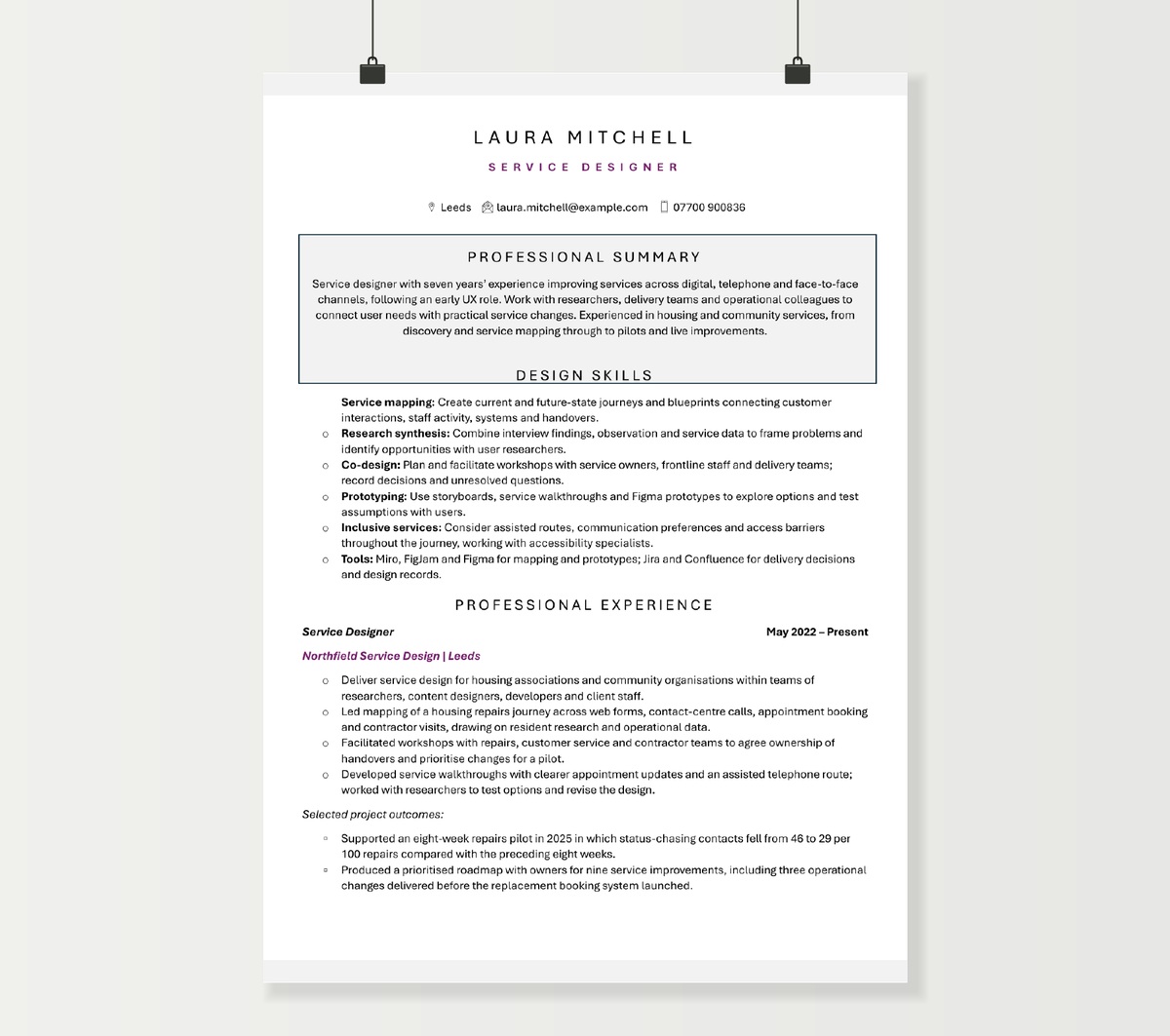
This service designer CV template follows a designer who moved from UX into end-to-end service work. The Word example connects research, service blueprints and collaborative design with changes to housing and community services. The guide explains how to choose project evidence, describe your contribution and support the CV with useful portfolio material.
Filename: FreeCVDownload_Service_Designer.docx
Content of this CV template
Laura Mitchell
SERVICE DESIGNER
Leeds | [email protected] | 07700 900836
Professional summary
Service designer with seven years’ experience improving services across digital, telephone and face-to-face channels, following an early UX role. Work with researchers, delivery teams and operational colleagues to connect user needs with practical service changes. Experienced in housing and community services, from discovery and service mapping through to pilots and live improvements.
Design skills
- Service mapping: Create current and future-state journeys and blueprints connecting customer interactions, staff activity, systems and handovers.
- Research synthesis: Combine interview findings, observation and service data to frame problems and identify opportunities with user researchers.
- Co-design: Plan and facilitate workshops with service owners, frontline staff and delivery teams; record decisions and unresolved questions.
- Prototyping: Use storyboards, service walkthroughs and Figma prototypes to explore options and test assumptions with users.
- Inclusive services: Consider assisted routes, communication preferences and access barriers throughout the journey, working with accessibility specialists.
- Tools: Miro, FigJam and Figma for mapping and prototypes; Jira and Confluence for delivery decisions and design records.
Professional experience
Service Designer | May 2022 – Present
Northfield Service Design | Leeds
- Deliver service design for housing associations and community organisations within teams of researchers, content designers, developers and client staff.
- Led mapping of a housing repairs journey across web forms, contact-centre calls, appointment booking and contractor visits, drawing on resident research and operational data.
- Facilitated workshops with repairs, customer service and contractor teams to agree ownership of handovers and prioritise changes for a pilot.
- Developed service walkthroughs with clearer appointment updates and an assisted telephone route; worked with researchers to test options and revise the design.
Selected project outcomes:
- Supported an eight-week repairs pilot in 2025 in which status-chasing contacts fell from 46 to 29 per 100 repairs compared with the preceding eight weeks.
- Produced a prioritised roadmap with owners for nine service improvements, including three operational changes delivered before the replacement booking system launched.
Junior UX Designer / Service Designer | Sept 2016 – April 2022
Bridgewater Digital Studio | Leeds
- Joined as a Junior UX Designer and progressed to Service Designer in 2019, supporting local government and voluntary-sector projects.
- Designed and tested booking and application flows, working with content designers and developers on clear information and usable interactions.
- Mapped community advice journeys with researchers and frontline staff, including referral, appointment preparation and follow-up support.
- Created service blueprints and facilitated design reviews to connect proposed digital changes with staff capacity, referral rules and support arrangements.
Selected project outcomes:
- Helped simplify an advice appointment journey; successful completion rose from five of eight participants in the first research round to seven of eight in the next round.
- Created a shared design-decision record that linked research findings to proposed changes and gave client teams a usable handover at the end of discovery.
Education & development
BA (Hons) Graphic Design, 2:1 – Sheffield Hallam University, 2016
Service design development – Employer programme: research synthesis, service mapping and prototyping, 2019
Inclusive design workshops – Accessible journeys and assisted service routes, 2023
Facilitation development – Working with conflicting priorities and remote co-design, 2025
Additional information
- Portfolio: Selected service case studies and annotated design artefacts available on request.
- Design community: Facilitate monthly peer critiques and support a junior designer with service mapping and presentation skills.
- Interests: Film photography, hill walking and learning the piano.
Writing a service designer CV
A service designer CV needs to make your contribution to a service understandable before someone opens your portfolio. The reader should be able to identify the people using the service, the problem you worked on, your place in the team and the decisions your work supported. “Created journey maps and facilitated workshops” names activities, but leaves the most interesting part of the story untold.
Choose evidence that shows how you connected the user’s experience with the organisation delivering it. That might involve a digital application, a telephone conversation, a physical appointment, a policy decision or a handover between teams. A strong CV makes these connections visible and shows where your design work made a difference.
Choose projects that reveal how you think
Select projects for their relevance and substance. A small service improvement can be a better lead example than a high-profile transformation where your involvement was limited. Look for work that lets you explain an important problem, a useful discovery, a difficult trade-off or a meaningful change.
For each selected project, establish four things: the service and user group; the challenge or stage; your contribution; and the resulting decision or outcome. These can fit into a short role introduction and two or three bullets. The detailed story belongs in the portfolio or interview.
The example CV uses a housing repairs journey spanning web forms, calls, appointments and contractor visits. That context gives meaning to the design work. It then identifies stakeholder agreement, an assisted route and a measured pilot result. The reader can see a service being improved, rather than a collection of design methods.
Choose a second project that adds another dimension. It could show discovery work alongside live improvement, internal colleague services alongside customer services, or a complex handover alongside a relatively simple transaction. Several near-identical project summaries use space without showing much more of your capability.
Show the service beyond the screen
Explain the relevant service boundaries. Who was trying to achieve what, and which channels, teams or systems were involved? “Redesigned an online booking form” gives a narrower impression than “Mapped the appointment journey from referral through preparation, booking and follow-up”. Either can be valuable, but they describe different responsibilities.
When you mention a service blueprint, state what it helped the team understand or decide. Perhaps it exposed a duplicate check, an unclear handover, a policy constraint or a mismatch between a digital promise and staff capacity. The CV needs the significance of the blueprint more than the names of every layer it contained.
Useful wording might be: “Mapped the referral journey with frontline teams and identified an unowned handover delaying appointments; agreed a revised route with the service manager.” This links the artefact to an operational issue and a decision. It also gives the reader something specific to explore at interview.
For internal services, name the users and their goal just as clearly as you would for a public-facing project. Identity management, staff onboarding and case-management platforms still involve people navigating a service. Make the complexity understandable without requiring specialist knowledge of the client’s organisation.
Connect research with a design choice
Describe how evidence changed the direction of your work. Sources may include interviews, observation, complaints, contact-centre information, service performance data or usability sessions. Explain your part in gathering or interpreting that evidence, especially where a dedicated user researcher led the research.
“Worked with a researcher to synthesise resident interviews and repairs contact data, prioritising appointment updates for the pilot” says more than “Data-driven designer”. It establishes the evidence, the collaboration and the decision. Other useful examples show a rejected assumption, a reframed problem or a change to the intended service scope.
Prototyping also benefits from a reason. Name the uncertainty you explored and the form of prototype where relevant: a storyboard, a role-played service walkthrough, a paper process or an interactive flow. Show what you learned and how the proposal changed. A service designer can provide strong prototyping evidence without presenting every project as a polished interface.
Make collaboration and influence specific
Facilitation is more convincing when the reader understands what the group needed to resolve. Identify the participants, the disagreement or question and the output. Agreeing service ownership, prioritising competing needs or bringing policy and operational colleagues into the same decision can be substantial achievements.
Explain how you worked with researchers, content and interaction designers, business analysts, engineers, product managers and delivery colleagues. Focus on the collaboration that mattered to the project. A list of every discipline in the team is less useful than a clear account of how you helped turn insight into a deliverable change.
For senior roles, show how you handled ambiguity and influenced direction. You may have challenged an assumed constraint, helped a sponsor reconsider a proposed solution or established a shared approach across several teams. These examples demonstrate seniority even when you had no direct reports.
If you do manage people, give that responsibility its own evidence: team size, coaching, quality reviews or development of the design practice. This makes it easy to distinguish design leadership from formal line management.
Give inclusion a place in the project story
Show the access need you considered and its effect on the design. Examples include maintaining a telephone route alongside a digital service, supporting someone acting on another person’s behalf, improving preparation information or changing a handover for users who need additional assistance.
Describe collaboration with accessibility specialists and researchers where it contributed to the outcome. “Inclusive design” becomes more meaningful when connected to a decision, such as offering an alternative appointment-confirmation method following research with people who could not reliably receive text messages.
Technical accessibility knowledge can support the CV, but service inclusion extends beyond a screen’s compliance. Select evidence appropriate to your role: the journey, channels, communication and support arrangements as well as any interface work you personally delivered.
Use outcomes that fit the stage of the work
Different stages produce different kinds of results. In discovery, a useful outcome may be an agreed problem definition, a service boundary, a prioritised opportunity or evidence that changes the investment decision. In an experimental phase, it may be a tested concept or a resolved assumption. In a live service, it may be fewer avoidable contacts, better completion, shorter waiting or smoother handovers.
Include the context needed to interpret a number. For service performance, give the measure and period. For a pilot, identify it as a pilot. For research sessions, actual participant counts are often more helpful than percentages: “Seven of eight participants completed the task in the second round” gives a clearer picture of a small study.
The example’s repairs result is expressed as contacts per 100 repairs, with an eight-week comparison period. This is more informative than a raw reduction in calls when service volume may change. The earlier appointment result uses counts from two small research rounds; it describes evidence from testing rather than a population-wide success rate.
Where several teams contributed, connect your own work to the shared outcome. “Designed the appointment-update journey used in a pilot that…” gives both the contribution and the result. Qualitative outcomes also deserve space when they are concrete: an agreed operating model, a delivery roadmap with owners or a decision to retain an assisted route.
Make the CV and portfolio work together
The CV should provide a concise account of your experience. The portfolio should let someone examine the reasoning and evidence behind selected projects. Use matching project names or descriptions so the connection between the two is easy to follow.
Put a portfolio link near your contact details when you have a suitable public site. If your work is better shared privately, a short “Selected case studies available on request” line is useful. A PDF presentation, annotated examples or a structured case study can serve the purpose; the substance matters more than having a custom website.
For each case study, make your role, team, stage and constraints clear. Choose a few readable artefacts and explain why each mattered. An annotated section of a blueprint showing the handover you changed is often more useful than a huge canvas that cannot be read at normal size. Include a decision, iteration or lesson, not only the final output.
Confidential work can be represented through an agreed anonymous description and suitably redacted or recreated excerpts. This still allows you to explain the problem and your thinking while keeping the case study appropriate for sharing. The CV itself normally needs only the concise project summary.
Match your experience to the type and level of role
For government applications, show the service stages and standards you have worked with where relevant. Explain your actual contribution to discovery, alpha, beta, live improvement or a service assessment. The Government Digital and Data service designer framework can help you compare the evidence expected at different levels. Individual vacancies may also ask for separate written examples or a portfolio presentation.
Commercial roles may give more weight to customer journeys, operating models, business priorities and delivery across product teams. Consultancy roles can additionally value client influence, adapting to unfamiliar organisations and building a client’s own capability. Choose projects and language that make those aspects of your work easy to find.
For an entry-level application, a substantial study, voluntary or work-based project can lead the evidence section. Explain who you worked with, what information you had, how your proposal developed and the outcome reached. Earlier customer-facing or operational work can be valuable when it shows your understanding of how services actually function.
Applicants moving from UX or business analysis should show the relevant bridge: wider journey work, operational dependencies, collaborative problem framing or implementation across channels. The business analyst CV example is useful for comparing how discovery, stakeholder decisions and delivery evidence can be presented from a related role.
Keep qualifications and tools proportionate to your experience. List relevant degrees, courses and recent development, then use employment and project evidence to show application. Figma, Miro and similar tools can sit in a compact skills section with their purpose. A recruiter should finish the CV understanding the services you can help improve, as well as the software you use to communicate your work.
Service Designer CV FAQs
Yes, when the work provides useful evidence. State the stage reached and the outcome of your involvement: an agreed problem, a tested concept, a decision to stop or a handover to another team. A project that changed direction after research can show sound design judgement. Explain the reason concisely and give priority to the part you contributed.
A shared career history can support both, but the opening profile and selected examples should follow the vacancy. Service design applications usually need more evidence of the whole journey, operational arrangements and cross-team decisions. UX roles may place greater weight on interaction behaviour and interface testing. A focused version helps the employer see the experience most relevant to their role.
Keep the consultancy as the employer, with its dates, then use short project labels beneath that role. Give each selected client assignment a service context, your contribution and a result. This preserves a clear employment history while showing breadth. If a client name is confidential, describe the organisation and service sufficiently for the reader to understand the work.
Coding is not a universal requirement. Many roles need you to work effectively with engineers, understand constraints and help test service concepts. If you build coded prototypes or have relevant technical experience, explain where you used it. Where the vacancy emphasises facilitation, mapping and service strategy, those examples are likely to deserve more CV space.
Keep the employment title and add a brief description of the service design remit. For example, a customer experience role might include journey research, service mapping and co-design with operational teams. Project bullets can demonstrate that work directly, while the profile explains the direction of your application. This makes the connection clear without obscuring your career history.
A discreet portfolio link in the CV is usually sufficient unless the employer specifies another process. Prioritise the requested documents and written questions. When work must be shared privately, mention that selected case studies are available and prepare them for the interview stage. The CV should remain understandable on its own.




