
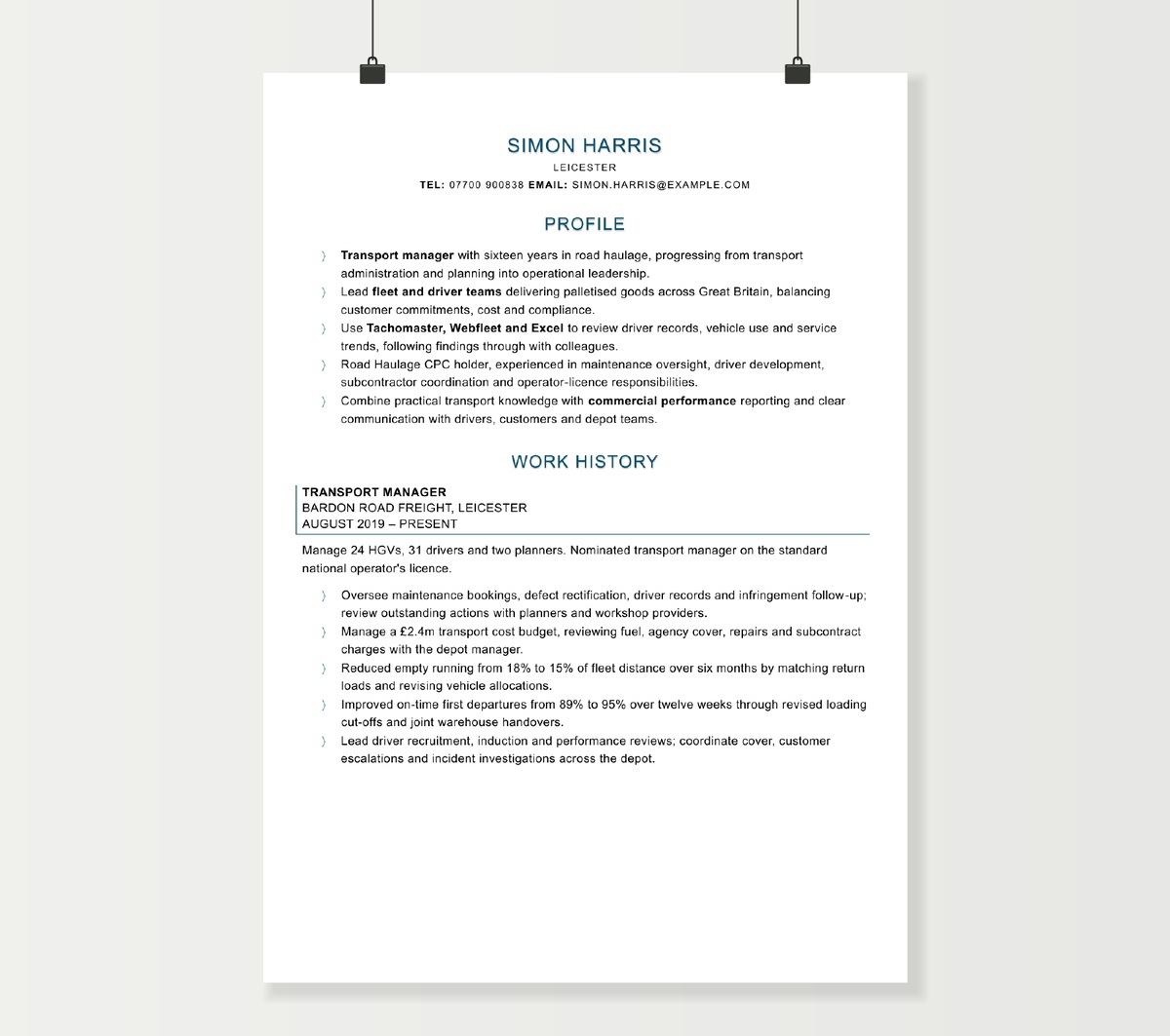
This transport manager CV template presents a road-haulage career progressing from transport administration and planning into fleet management. The Word example covers nominated transport manager responsibility, driver leadership and practical improvements to vehicle use and departure performance. The guide explains how to show the scale, demands and results of your own transport operation.
Filename: FreeCVDownload_Transport_Manager.docx
Content of this CV template
SIMON HARRIS
LEICESTER
tel: 07700 900838 email: [email protected]
PROFILE
- Transport manager with sixteen years in road haulage, progressing from transport administration and planning into operational leadership.
- Lead fleet and driver teams delivering palletised goods across Great Britain, balancing customer commitments, cost and compliance.
- Use Tachomaster, Webfleet and Excel to review driver records, vehicle use and service trends, following findings through with colleagues.
- Road Haulage CPC holder, experienced in maintenance oversight, driver development, subcontractor coordination and operator-licence responsibilities.
- Combine practical transport knowledge with commercial performance reporting and clear communication with drivers, customers and depot teams.
WORK HISTORY
TRANSPORT MANAGER
BARDON ROAD FREIGHT, LEICESTER
AUGUST 2019 – PRESENT
Manage 24 HGVs, 31 drivers and two planners. Nominated transport manager on the standard national operator's licence.
- Oversee maintenance bookings, defect rectification, driver records and infringement follow-up; review outstanding actions with planners and workshop providers.
- Manage a £2.4m transport cost budget, reviewing fuel, agency cover, repairs and subcontract charges with the depot manager.
- Reduced empty running from 18% to 15% of fleet distance over six months by matching return loads and revising vehicle allocations.
- Improved on-time first departures from 89% to 95% over twelve weeks through revised loading cut-offs and joint warehouse handovers.
- Lead driver recruitment, induction and performance reviews; coordinate cover, customer escalations and incident investigations across the depot.
TRANSPORT PLANNER
MIDLAND FREIGHT LINES, LEICESTER
AUGUST 2010 – JULY 2019
Joined as Transport Administrator in 2010 and became Transport Planner in 2013, coordinating regional collections and national deliveries.
- Allocated work to eighteen vehicles, checked route feasibility and adjusted plans around driver availability and booked delivery windows.
- Liaised with drivers and customers during delays, recording revised arrival times and recovery arrangements in the transport system.
- Coordinated planned maintenance with the transport manager and checked that replacement vehicles were available for scheduled work.
- Introduced a shared collection-status tracker, giving the late shift a clear record of outstanding jobs and customer commitments.
QUALIFICATIONS & DEVELOPMENT
TRANSPORT MANAGER CPC — ROAD HAULAGE
COMPLETED 2016
Road haulage professional competence qualification; completed while working as a transport planner.
TRANSPORT MANAGER CPC REFRESHER
TWO-DAY COURSE, 2025
FURTHER TRAINING AND EDUCATION
IOSH MANAGING SAFELY – 2022; THREE A LEVELS – 2010
INTERESTS
Cycling, gardening and going to live music with friends.
How to write your transport manager CV
A transport manager CV should give an employer a clear picture of the operation you can run. Fleet size is a starting point, but the type of vehicles, the work they do, the driver team and your commercial and compliance responsibilities explain much more. A mixed fleet making timed deliveries presents different demands from a tanker operation, a utility fleet or a passenger service.
Build your CV around the decisions you make and the results you can explain. An employer needs to see how you keep vehicles available, support drivers, manage disruption and use transport resources effectively. Your qualifications establish part of your suitability; your employment examples show how you put that knowledge to work.
Describe the operation before listing your duties
Give each recent role a short scope statement. Include the fleet you manage, vehicle types, driver and office team numbers, operating centres and the nature of the work. If you oversee several depots, explain whether you manage local supervisors or lead drivers directly. Distinguish an owned or leased fleet from capacity provided by subcontract hauliers.
The example CV identifies 24 HGVs, 31 drivers and two planners, alongside nominated transport manager responsibility. That tells the reader about both the operation and Simon’s position within it. For a multi-site role, an introduction could instead describe the number of operating centres, the management structure and the balance of own-fleet and contracted work.
Choose details that reveal complexity. Multi-drop rounds, retail delivery slots, night trunking, bulk liquids, chilled goods, irregular project movements and cross-border work can each change what the employer needs from a manager. Use the terms that describe your experience and give the most relevant work prominence.
Your profile can then summarise the match: the kind of transport operation, your management experience, relevant CPC and one or two areas of strength. A profile centred on commercial haulage will read differently from one aimed at a council passenger service. If your remit combines transport with substantial warehouse and stock responsibility, the logistics manager CV example offers a useful comparison.
Make operator-licence responsibility explicit
Where you are or have been the nominated transport manager, state that clearly within the relevant job. Identify the licence type and the operation covered where useful. If you support the nominated manager through planning, records or compliance checks, describe that contribution in the same practical way. The distinction helps a recruiter understand the level of responsibility you have already held.
Give evidence of the systems you oversee and what you do with their findings. Useful CV material includes reviewing maintenance arrangements, following up defects, checking driver records, investigating infringements, preparing for audits or reporting unresolved issues to senior management. The value lies in your involvement and follow-through, rather than the number of regulatory acronyms in the skills section.
An improvement example might explain that you brought together maintenance bookings and vehicle availability in a shared schedule, assigned owners to outstanding actions and reduced last-minute vehicle substitutions. An audit example can identify the scope reviewed and how you closed the resulting actions. A brief description of a working control is more informative than “responsible for all compliance”.
For specialist operations, make the relevant experience visible: dangerous goods, waste movements, passenger transport or international journeys. A UK CV should also reflect the jurisdiction in which you worked. The licence context and actual responsibilities matter more than a broad claim of knowing every transport regulation.
Connect driver leadership with daily performance
Driver management deserves more than a team size. Show how you recruit, induct, brief, coach and support people across the shifts you manage. Include planners, dispatchers and supervisors where they are part of your team. If you have worked in a unionised operation, that experience can be particularly relevant to employers with similar arrangements.
Choose a people example with an operational consequence. You might have improved new-driver familiarisation, introduced a more useful shift briefing or worked with a driver trainer on a recurring issue. Explain what changed and how you assessed whether it helped. This makes your leadership contribution visible without turning the CV into a catalogue of HR processes.
Incident and infringement work can also demonstrate management judgement. Describe your role in reviewing the information, speaking with the people involved, agreeing corrective actions and checking subsequent performance. Where the work involved HR, insurers, a workshop or a customer, make that collaboration clear.
For a first management application, draw out the leadership already present in a planning or supervisory role. Coordinating holiday cover, briefing a shift, supporting inductions or deputising for the transport manager can establish progression. Give the scope and frequency so the employer can distinguish occasional cover from a regular responsibility.
Use service and utilisation results with clear measures
Transport measures become persuasive when the reader can understand the comparison. State what was measured, the period and the change you helped produce. Useful evidence can include departure performance, delivery punctuality, empty running, vehicle availability, failed deliveries, waiting time or claims.
Simon’s first-departure result is linked to loading cut-offs and warehouse handovers. That explains his intervention and the part of the operation affected. The empty-running result uses the share of fleet distance over six months, rather than leaving the reader to guess whether the change concerns miles, journeys or vehicles.
- Service: identify the customer group, routes or depot and the definition of an on-time movement.
- Utilisation: say whether you mean vehicle use, loaded mileage, pallet capacity, payload or productive hours.
- Availability: describe the vehicle group, period and maintenance or planning change behind the result.
- Quality: put damage, complaints or failed deliveries in the context of the work completed.
Explain the operating circumstances where they affect the result. Seasonal peaks, a fleet change or a new customer contract may make a direct before-and-after comparison less straightforward. A short phrase identifying comparable routes or volumes can make the achievement easier to assess.
Some strong examples need few numbers. Maintaining service during a depot move, coordinating a difficult breakdown recovery or introducing a workable handover between shifts can demonstrate your contribution through the scale of the task, the decisions made and the outcome.
Show commercial control, including bought-in transport
Be clear about which costs you influence. A manager who reviews fuel, driver cover and subcontract charges has a different remit from one responsible for a full depot profit and loss account. Include a budget or cost base where it adds context, then select an example showing how you used that responsibility.
For haulage and 3PL roles, cost per mile, drop or pallet can help explain commercial performance. Define the measure and its scope. If you improved fuel consumption, describe the operational change and measurement basis; a fall in the fuel bill could also reflect price or mileage changes. Where you made a business case for vehicles, technology or additional staff, show the recommendation and what was approved or achieved.
Subcontractor management can be an important part of the story. Explain your role in selecting hauliers, agreeing rates, planning capacity, monitoring service and resolving problems. If you changed the balance between own-fleet work and subcontracting, outline the commercial or service reason and the result. This demonstrates a broader decision than arranging cover for a single load.
For an own-account fleet, the value may lie in dependable service to the business, controlled distribution costs or better use of capacity. Frame achievements around those objectives. The operations manager example can help if you also need to present wider depot budgets and departmental leadership.
Present transport systems through the decisions they support
Group tools by their purpose: transport planning, tachograph analysis, fleet maintenance, telematics and reporting. Name the systems you use, then give enough detail to show your level of involvement. Planning routes, reviewing exceptions, configuring reports and helping introduce a system are different kinds of experience.
In the example, Tachomaster and Webfleet sit alongside the work Simon carries out with driver records and vehicle-use data. Your CV might instead describe how a transport management system supports load allocation and proof-of-delivery queries, or how maintenance software helps you review vehicle availability with a workshop provider.
Excel is most useful when connected to a decision: comparing agency costs, analysing recurring delays or reviewing customer-route profitability. If you helped implement a new system, describe your contribution to testing, record preparation, staff training or the changeover. Explain the operational benefit in the same section.
Make qualifications and recent development easy to assess
Give the exact Transport Manager CPC held, including road haulage or passenger transport, with the award year. Put it near the top of the CV when it is central to the vacancy, then record the full detail under qualifications. The government’s qualification guidance explains the distinction between the two transport sectors.
Recent development helps an employer understand how you maintain your knowledge. Include relevant refresher training with the completion date, plus focused learning in areas such as incident investigation, fleet safety, leadership or specialist operations. In the example, the CPC award and the later two-day refresher are separate entries.
For experienced managers, use the employment history to show the responsibilities held since qualification. For newly qualified applicants, connect the award to planning, fleet administration, driving or supervisory experience that demonstrates readiness for the target role. A newly qualified CPC holder may bring many years of operational knowledge, so give that experience proper weight.
Finish with the progression the employer needs to see. Earlier roles can explain how you developed practical transport judgement; the most recent roles should show the scale of your decisions and leadership. The template library includes other layouts if your career needs more space for several depots, contracts or assignments.
Transport Manager CV FAQs
They are separate qualifications with different purposes. Driver CPC relates to professional driving, while Transport Manager CPC demonstrates professional competence for managing the relevant transport operation. If you hold both, list them separately with clear titles. This helps an employer assess your management qualification and any driving duties included in the vacancy.
You do not need a driving licence to qualify for Transport Manager CPC. An employer may require a particular driving entitlement for its own role, especially where duties include vehicle movements or driving cover. Check the vacancy's requirements. If driving is part of your background, include the relevant licence categories and explain how that experience supports your understanding of the operation.
Use the designation on the qualification. Older National CPCs remain relevant to standard national goods-vehicle licences; they are distinct from international professional competence. Put recent refresher training and development alongside the original award so an employer can assess both scope and current knowledge. If the vacancy involves international responsibility, check its qualification requirement carefully.
Yes, where the vacancy is open to someone taking that step. State the qualification and your practical transport responsibilities clearly, including work supporting a nominated manager. Planning, maintenance coordination, driver-record reviews, supervision and audit preparation can all help demonstrate readiness. Assistant transport manager or deputy roles may also provide a suitable progression route when a vacancy expects previous nominated responsibility.
Use a clearly dated external transport management or consultancy entry, then summarise the operators or assignments beneath it. Give the type of operation, fleet scale, your agreed remit and significant work completed for each, using a sector description where an operator name is confidential. Make the overlapping dates clear so the reader can understand the workload and how you organise your responsibilities.




