
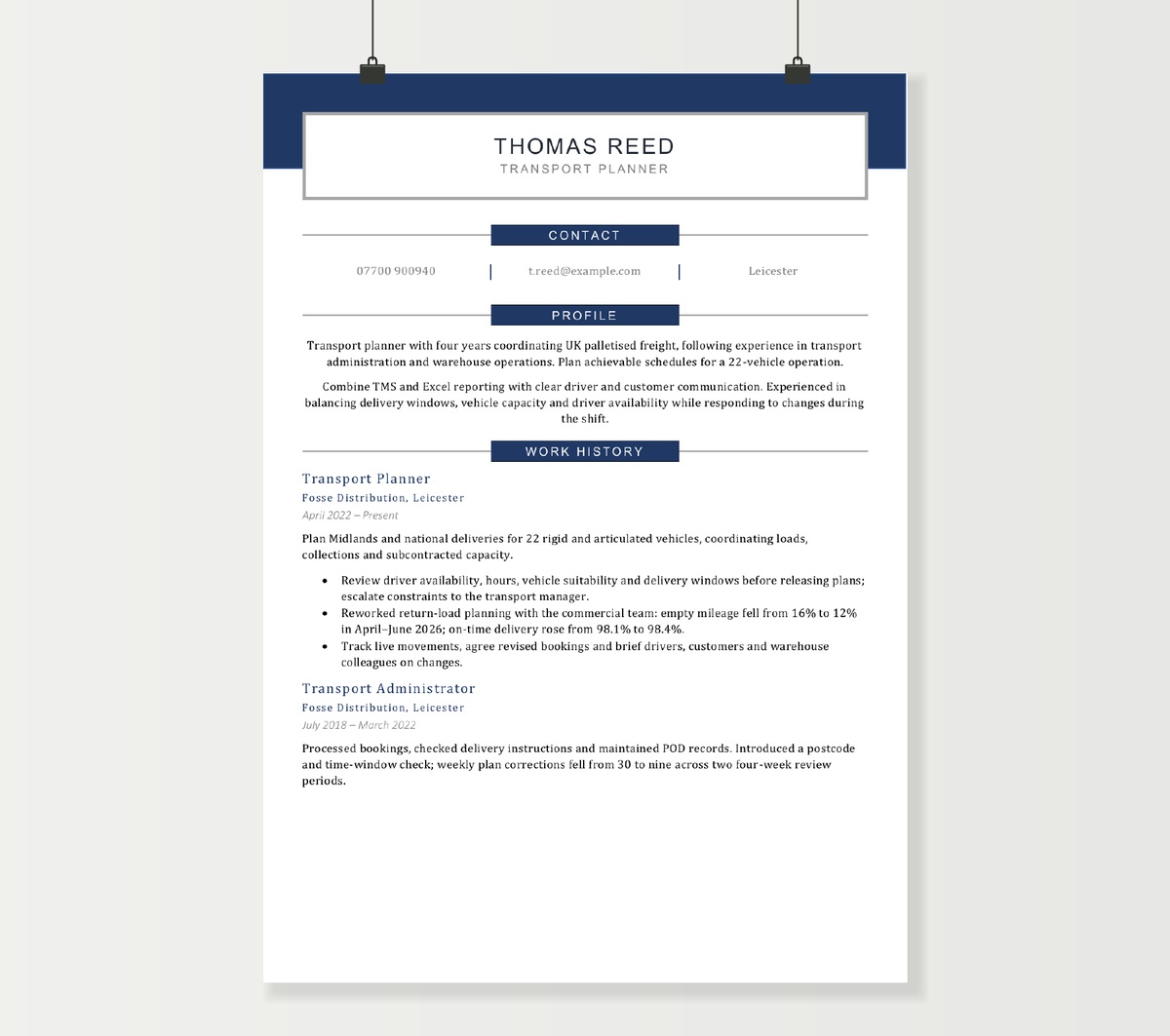
This transport planner CV template follows a warehouse and transport administrator into UK road-haulage planning. The Word example shows fleet allocation, practical use of transport systems and measured improvements to service and utilisation. The guide also explains how to adapt your evidence for transport consultancy roles, where the same job title describes a different kind of work.
Filename: FreeCVDownload_Transport_Planner.docx
Content of this CV template
Thomas Reed
Transport Planner
CONTACT
07700 900940
Leicester
PROFILE
Transport planner with four years coordinating UK palletised freight, following experience in transport administration and warehouse operations. Plan achievable schedules for a 22-vehicle operation.
Combine TMS and Excel reporting with clear driver and customer communication. Experienced in balancing delivery windows, vehicle capacity and driver availability while responding to changes during the shift.
WORK HISTORY
Transport Planner
Fosse Distribution, Leicester
April 2022 – Present
Plan Midlands and national deliveries for 22 rigid and articulated vehicles, coordinating loads, collections and subcontracted capacity.
- Review driver availability, hours, vehicle suitability and delivery windows before releasing plans; escalate constraints to the transport manager.
- Reworked return-load planning with the commercial team: empty mileage fell from 16% to 12% in April–June 2026; on-time delivery rose from 98.1% to 98.4%.
- Track live movements, agree revised bookings and brief drivers, customers and warehouse colleagues on changes.
Transport Administrator
Fosse Distribution, Leicester
July 2018 – March 2022
Processed bookings, checked delivery instructions and maintained POD records. Introduced a postcode and time-window check; weekly plan corrections fell from 30 to nine across two four-week review periods.
Warehouse Operative
Harborough Trade Supplies, Leicester
September 2016 – June 2018
Prepared palletised orders and supported the despatch team.
Checked quantities and delivery notes, reported discrepancies and staged pallets by route. Coordinated urgent orders with supervisors and maintained clear shift handovers.
QUALIFICATIONS
Transport planning refresher
Fosse Distribution — internal training
2025
Drivers’ hours and working time, planning exceptions and TMS controls.
Level 3 Diploma in Business Administration
City & Guilds — work-based study
2019
Eight GCSEs at A*–C, including English and Maths
Leicester
2016
SKILLS
Planning systems
Mandata TMS: jobs, allocation, status updates and POD records.
Operational reporting
Excel: lookups, pivot tables and service/empty-mileage reviews.
Driver and customer liaison
Clear instructions, timely delay updates, debriefs and shift handovers.
UK distribution
Palletised freight, vehicle capacity, delivery windows and subcontractor coordination.
Leicester, Leicestershire
How to write a transport planner CV
A transport planner CV needs to establish what you plan, the decisions you make and the results of those decisions. For a haulage employer, that may mean a workable daily allocation of loads, vehicles and drivers. For a consultancy or local authority, it may mean transport studies, scheme appraisal and advice about future travel. Make your specialism clear in the opening lines.
Thomas’s example is a road-haulage CV. It combines practical distribution experience with planning systems, communication and two improvements that an operations manager can assess. If your background is in transport strategy or development planning, use the project-focused guidance below to shape the content around your own work.
Give the employer a picture of your operation
Start each relevant job with a short description of its scope. Useful details include the type of freight, fleet size, geography, delivery pattern and whether you plan company vehicles, subcontractors or both. A pallet-network depot, supermarket distribution operation and container-haulage business have different planning demands.
Choose two or three details that explain the complexity. Twenty-two vehicles with timed collections and deliveries is more informative than “busy transport office”. In a larger operation, distinguish the fleet allocated to you from the total company fleet. If you share planning responsibility across a shift team, say how your work is divided.
Identify the planning horizon: next-day routes, live replanning, night trunking or a recurring schedule. Multi-depot work, seasonal peaks, backloads and cross-border movements can be useful differentiators where they match the vacancy. The aim is to let the reader recognise the environment you could contribute to.
Show how your plans become workable movements
A list of “routing, scheduling and allocation” gives little sense of judgement. Explain the constraints you bring together: vehicle type and capacity, driver availability, delivery windows, loading arrangements, collection priorities and the time needed to complete the work.
Your bullets can then show a decision or improvement. For example, you might have reorganised a collection sequence around a customer’s booking slots, paired return loads with available capacity or revised a plan after a vehicle became unavailable. Include the outcome that mattered to the operation, such as keeping a priority delivery on schedule or avoiding an additional subcontracted movement.
Geographical knowledge becomes stronger evidence when connected to a planning area and a task. Regularly allocating multi-drop work across the Midlands, managing national trunk routes or arranging movements between UK ports tells an employer more than “excellent UK geography”.
For specialist traffic, bring forward the relevant planning knowledge. This could include port booking systems, temperature-controlled distribution, vehicle logistics or time-critical deliveries. Explain the work you handled and the systems or coordination involved; the CV does not need a catalogue of every possible freight specialism.
Present compliance knowledge through your responsibilities
For road-haulage roles, show how drivers’ hours, working time and vehicle availability enter your planning decisions. A useful bullet might describe checking available hours before allocation, flagging an unachievable schedule and agreeing a revised plan with the transport manager.
Keep the level of responsibility clear. Day-to-day planning, supporting compliance records and holding the nominated transport manager role are different kinds of experience. If you have managed tachograph administration, maintenance schedules or inspection availability, state the part you owned and who you worked with.
Training belongs beside this evidence. Give a relevant course or internal refresher its proper title and date. If you hold a transport manager CPC, name the qualification and awarding body. The government’s transport manager guidance explains that professional route; it is useful context when a vacancy combines planning with formal management responsibilities.
Connect TMS, tracking and Excel to the work
Name the transport management system you have used and describe the functions you know. Job creation, load allocation, route updates, subcontractor instructions and proof-of-delivery records are more informative than a software name standing alone.
If you use route-optimisation software, explain your role in preparing or checking the plan. There is a difference between entering orders, reviewing proposed routes against operating constraints and maintaining planning parameters. Make that distinction visible so an employer can judge the depth of your experience.
Live tracking and telematics experience can support evidence about monitoring progress and communicating delays. Describe how you used the information, such as identifying a late running vehicle, revising a booking or investigating the cause of a missed delivery.
Excel deserves the same treatment. Link lookups, pivot tables or recurring reports to a practical output: checking duplicate bookings, reviewing empty mileage, comparing subcontractor costs or reporting service performance. A small but dependable report used in the daily operation can be more persuasive than a long list of advanced features.
Measure efficiency alongside service
Choose measures that reflect the part of planning you influence. These may include empty mileage, vehicle utilisation, on-time delivery, failed collections, subcontracted cost, avoidable waiting or the number of corrections needed before a plan is released.
Define the measure enough for it to be understood. State the period and scope, and use the same basis for the comparison. A percentage of empty kilometres and a count of empty journeys tell different stories. For a cost result, explain whether it concerns a route, contract or wider operation.
Thomas’s return-load example gives the empty-mileage change and the service result for the same quarter. This lets the reader assess the improvement as an operational outcome. When a change was developed with a commercial, warehouse or operations team, identify your contribution to that shared work.
Useful results also include better information. Fewer incorrect postcodes, more complete delivery instructions or quicker retrieval of PODs can reduce disruption and customer queries. Show the change you introduced and a clear before-and-after measure if the operation tracked one.
Make communication and disruption handling concrete
A planner works through drivers, warehouse teams, customers, other depots and subcontractors. Name the relationships that matter in your job and explain the purpose of the contact. Confirming a revised delivery window, arranging loading priorities and obtaining an accurate delay update each demonstrate a different contribution.
Use one concise example of handling a change under pressure. Set out the problem, your decision and the result. The strongest example usually shows prioritisation and communication together, rather than simply saying that you work well in a demanding environment.
Shift handovers deserve space where the operation runs beyond your own working hours. Explain how you recorded outstanding collections, driver availability, vehicle issues and customer commitments so the next planner could act on current information.
For a senior planner, add evidence of reviewing colleagues’ plans, coaching new starters, allocating work across the desk or coordinating peak capacity. If your responsibilities extend to budgets, formal compliance oversight and people management, the transport manager CV offers a useful comparison of emphasis.
Use project evidence for consultancy and public-sector planning
For transport strategy, development planning or consultancy applications, organise the experience around the projects and outputs you contributed to. Identify the scheme or study, its purpose, your analytical work and how the findings were used. A short selected-project section can help when several commissions sit within one employment entry.
Relevant outputs may include a transport assessment, travel plan, strategic study, business case, scheme appraisal or monitoring and evaluation report. Explain whether you gathered and checked data, developed an analysis, drafted the report, presented findings or coordinated delivery. This establishes your contribution within a multidisciplinary team.
Give analytical tools context in the same way. Where the vacancy asks for modelling, GIS or specialist assessment software, connect each tool to an output and the decision it informed. For a strategy or appraisal role, the ability to explain assumptions, compare options and communicate conclusions may deserve more space than a software inventory.
Stakeholder work can be an important differentiator. Describe presentations, workshops or consultation support and the groups involved. An example of turning technical findings into clear advice for a client, authority or project team helps demonstrate that your analysis can inform a real decision.
For experienced consultants, include delivery to programme and budget, review responsibility, bids or support for junior colleagues where relevant. Put degrees, relevant professional membership and progress towards professional recognition in a clear qualifications section. For a graduate, a substantial university project can carry more detail, especially if it shows useful analysis and a well-supported recommendation.
Show a credible route into planning
Transport administration, dispatch, customer service and warehouse roles can provide a strong foundation for a first logistics planning job. Bring forward bookings, delivery instructions, driver contact, system accuracy and any supervised allocation or cover you have undertaken.
Thomas’s earlier roles explain why he understands the information needed at dispatch and the effect of an inaccurate booking. His work-based qualification supports that progression without dominating a CV built around current experience.
A career changer can use comparable evidence of scheduling, resource allocation and responding to changing priorities, then make any transport-specific training visible. Choose a layout from the CV template library that gives your strongest relevant evidence enough room, whether that is operational work or an early-career project.
Transport Planner CV FAQs
The vacancy will tell you whether it is required, desirable or outside the role. Many operational planning posts focus on practical planning experience and knowledge of transport constraints. A post that includes the formal transport manager function has additional requirements. List a CPC by its full title when relevant, and distinguish it from Driver CPC.
Yes. Driving experience can provide valuable knowledge of delivery sites, journey times, loading constraints and communication with the traffic office. On the CV, add evidence of planning-related work such as route coordination, debrief support, customer bookings or covering the transport desk. Relevant system and Excel experience will help explain your readiness for the office-based responsibilities.
Include the category or licence information when driving, shunting, site visits or travel between depots forms part of the role. For a desk-based planning vacancy, it may be a brief additional detail rather than a main qualification. Practical experience with vehicle types can still be useful even when driving is not part of the new job.
Name your own system and describe the functions you use: entering jobs, allocating loads, updating movements, managing PODs or producing reports. This makes the transferable workflow visible. If you have helped change systems or trained colleagues, a short example can also show how you learn a new planning environment.
Often, when traffic planner means operational haulage scheduling. Compare the responsibilities: driver allocation, routing, customer bookings and fleet utilisation usually indicate closely related work. Traffic engineering, modelling or highway scheme planning is a different emphasis and calls for project and technical evidence.
Use clear employer or agency names and dates, then describe the operation supported on each significant assignment. A single agency entry can group several short placements, with selected examples showing freight type, systems and responsibility. This keeps repeated duties manageable while preserving the breadth of your experience.
A short availability line is useful when the advertised shift pattern is a practical requirement. You can also show previous shift-based planning or handover experience in the work history. Keep the detailed discussion of start times and rota arrangements for the recruitment conversation.




