
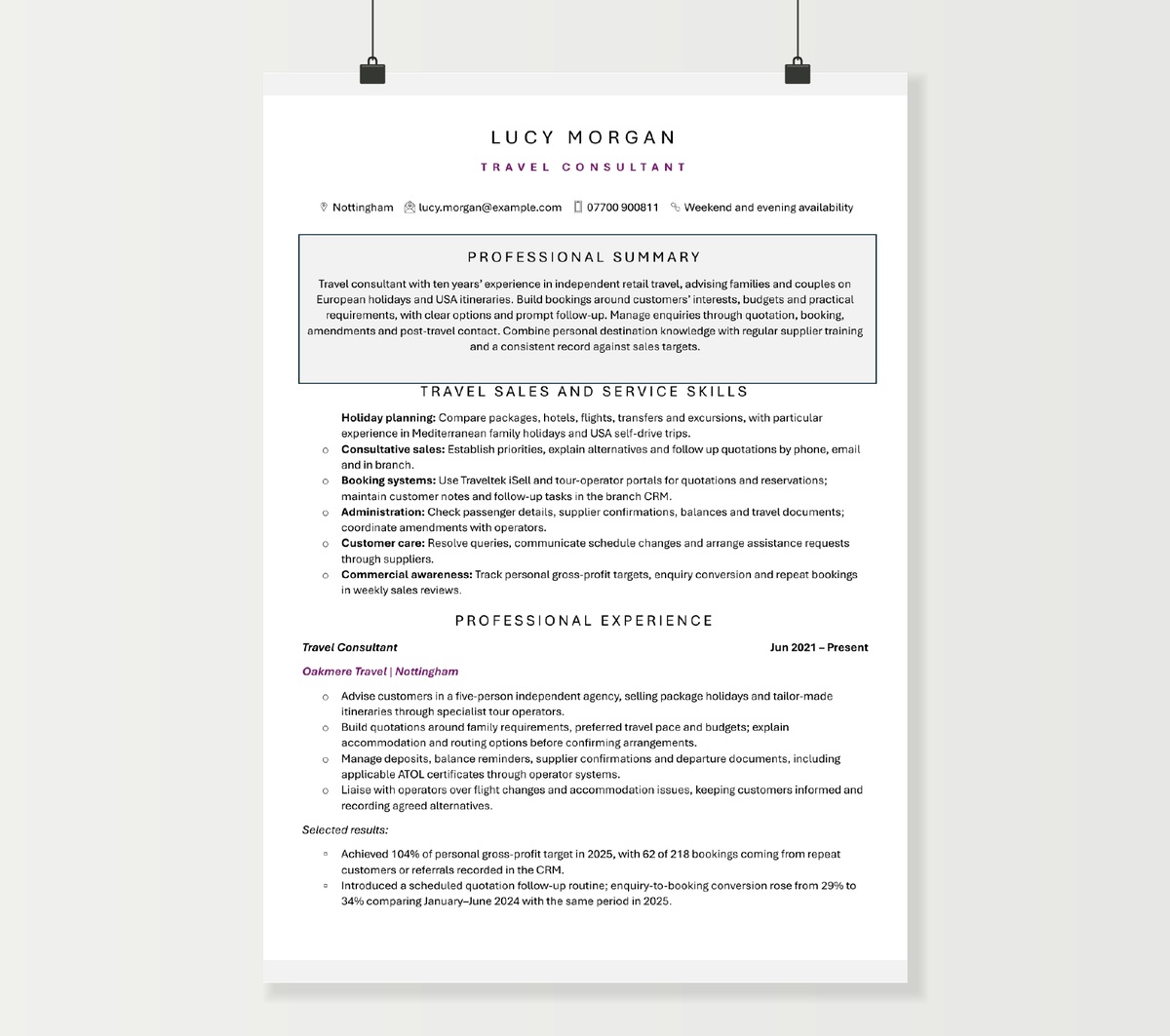
This travel consultant CV template follows an experienced leisure-travel adviser selling package holidays and tailor-made trips. The Word example combines destination knowledge, sales results, booking administration and customer care. The guide explains how to present those strengths for retail, specialist and business-travel roles, including applications from people moving into travel from another sales or service background.
Filename: FreeCVDownload_Travel_Consultant.docx
Content of this CV template
Lucy Morgan
TRAVEL CONSULTANT
Nottingham | [email protected] | 07700 900811 | Weekend and evening availability
Professional summary
Travel consultant with ten years’ experience in independent retail travel, advising families and couples on European holidays and USA itineraries. Build bookings around customers’ interests, budgets and practical requirements, with clear options and prompt follow-up. Manage enquiries through quotation, booking, amendments and post-travel contact. Combine personal destination knowledge with regular supplier training and a consistent record against sales targets.
Travel sales and service skills
- Holiday planning: Compare packages, hotels, flights, transfers and excursions, with particular experience in Mediterranean family holidays and USA self-drive trips.
- Consultative sales: Establish priorities, explain alternatives and follow up quotations by phone, email and in branch.
- Booking systems: Use Traveltek iSell and tour-operator portals for quotations and reservations; maintain customer notes and follow-up tasks in the branch CRM.
- Administration: Check passenger details, supplier confirmations, balances and travel documents; coordinate amendments with operators.
- Customer care: Resolve queries, communicate schedule changes and arrange assistance requests through suppliers.
- Commercial awareness: Track personal gross-profit targets, enquiry conversion and repeat bookings in weekly sales reviews.
Professional experience
Travel Consultant | Jun 2021 – Present
Oakmere Travel | Nottingham
- Advise customers in a five-person independent agency, selling package holidays and tailor-made itineraries through specialist tour operators.
- Build quotations around family requirements, preferred travel pace and budgets; explain accommodation and routing options before confirming arrangements.
- Manage deposits, balance reminders, supplier confirmations and departure documents, including applicable ATOL certificates through operator systems.
- Liaise with operators over flight changes and accommodation issues, keeping customers informed and recording agreed alternatives.
Selected results:
- Achieved 104% of personal gross-profit target in 2025, with 62 of 218 bookings coming from repeat customers or referrals recorded in the CRM.
- Introduced a scheduled quotation follow-up routine; enquiry-to-booking conversion rose from 29% to 34% comparing January–June 2024 with the same period in 2025.
Trainee / Travel Consultant | Sep 2016 – May 2021
Riverside Holidays | Nottingham
- Joined as a trainee and progressed to travel consultant in 2018, handling short-haul packages, city breaks and cruise enquiries.
- Prepared options, confirmed availability and completed bookings under branch procedures, developing confidence in telephone and face-to-face sales.
- Maintained accurate customer records, checked ticket and accommodation details and followed up outstanding balances.
- Supported customers with cancellations, refunds and revised travel plans during 2020, liaising with tour operators and documenting each case.
Selected contributions:
- Helped coordinate a cruise information evening for 24 customers; followed up enquiries that produced seven bookings over the next six weeks.
- Created a shared pre-departure checklist covering documents, transfers and outstanding requests, adopted by the four-person branch team.
Education & development
Level 3 Extended Diploma in Travel and Tourism – New College Nottingham, 2016
Tour-operator product and booking updates – ongoing, most recent 2026
USA self-drive itinerary workshop – supplier training, 2025
Booking documentation and customer-care refresher – employer training, 2026
Additional information
- Destination experience: Personal travel in Florida, Portugal and Greece; educational visit to Crete in 2024, including family-hotel inspections.
- Colleague support: Help new starters navigate operator portals and practise quotation follow-up conversations.
- Interests: Walking, photography and going to the theatre.
How to write a travel consultant CV
A good travel consultant CV shows how you turn a customer’s plans into a suitable booking and look after the details that follow. Destination knowledge matters, but so do sales conversations, accurate reservations, supplier relationships and help when arrangements change. The balance depends on whether you are applying to a high-street agency, a tailor-made specialist or a business-travel company.
Make the type of travel you sell clear
Open with your market and strongest experience. A retail adviser selling family packages and cruises has a different profile from a country specialist designing complex itineraries or a business-travel consultant handling corporate accounts. Identify your customer base, destinations or products, and the responsibilities you take from enquiry to completion.
A useful profile might combine independent-agency experience, a Mediterranean and USA specialism, ownership of bookings and a record against a defined sales target. For a corporate role, reservation systems, service standards, fare knowledge and handling changes are likely to deserve earlier attention. A country specialist can lead with regional knowledge and the ability to create and sell personalised trips.
Keep “passion for travel” connected to something the employer can use. An understanding of realistic journey times, the differences between resorts or the needs of a particular customer group gives that enthusiasm substance. Your employment examples should then show how you apply it.
Demonstrate destination knowledge through recommendations
A list of countries visited provides only part of the picture. Choose the destinations relevant to the job and explain the kind of knowledge you offer: family hotels, self-drive routes, rail journeys, cruise products or specialist activities. Distinguish personal travel, educational visits, supplier training and destinations you regularly sell. Each can be valuable for a different reason.
For a specialist application, a compact destination-experience section can be worthwhile. Include the area, nature of the visit and any practical insight that supports the role. A recent hotel inspection programme may be more useful than a long list of holidays. For broader retail travel, one or two lines within skills or additional information are usually enough.
Use a work example to show how recommendations meet the customer’s brief. You might have adjusted a touring route to suit the client’s preferred pace, compared different accommodation options for a family or coordinated transfers around a late arrival. The CV needs the judgement you brought to the booking, not a detailed itinerary.
Explain your sales contribution with the right figures
Travel sales measures can look similar while describing very different things. Total booking value, commission, gross profit and personal earnings are separate figures. Name the measure and time period so the reader can interpret the result. If your employer uses gross-profit targets, an achievement against that target is often more useful than an unlabelled revenue figure.
Conversion is helpful when the starting group is clear. Does it mean bookings from new enquiries, formal quotations or qualified leads? State the basis and compare similar periods. The example CV compares the same six months in successive years, giving the result more context in a seasonal industry. A new consultant can use progress towards target or a smaller successful campaign where that is the strongest available evidence.
Repeat and referral business can show the value of customer relationships. Give the count or share of bookings and explain the period. Pair the result with the service or follow-up behind it: remembering preferences, responding to an enquiry promptly or keeping contact after the trip. A general claim of excellent service becomes much more convincing when the work and outcome sit together.
For a retail branch, relevant achievements may also include a destination evening, a cruise promotion or enquiries generated through local social media. Explain what you organised, your part in the follow-up and the resulting bookings. For a business-travel role, service measures, account retention and handling complex changes may be more relevant than retail sales campaigns.
Show how you manage a booking after the sale
Include the operational work that keeps travel arrangements accurate: passenger details, supplier confirmations, payment deadlines, requests, documentation and amendments. State which parts you own and where you liaise with an operator or specialist team. This is particularly useful for applicants whose job title sounds sales-focused but whose responsibilities cover the complete customer journey.
A short example of resolving a problem can demonstrate calm communication and organisation. It might involve a changed flight schedule, an unavailable hotel, a transfer discrepancy or a cancellation. Describe how you worked with the supplier and kept the customer informed, then give the outcome. The point is to show your contribution without filling the CV with the customer’s travel history.
Assistance and accessibility requests can also be relevant. Present the way you gathered requirements, recorded them and coordinated confirmations with suppliers. For travel-information responsibilities, explain how you used current official advice and operator guidance. The FCDO travel-advice pages are a useful reference where this forms part of your work.
Be specific about booking systems and ticketing
Separate reservation platforms, tour-operator portals, customer records and global distribution systems. A recruiter needs to know what you can do in each. “Traveltek iSell for quotations and reservations; branch CRM for customer history and follow-up” gives a clear picture of retail work. “Amadeus” on its own leaves open whether you search fares, build bookings, issue tickets or handle exchanges and refunds.
If GDS work is central to the vacancy, put the system and practical functions in the skills section, supported by your recent employment. Mention recency where it helps: regular current use, previous daily use or completed training. A course can demonstrate preparation, while workplace examples show how you use the system under real booking deadlines.
For corporate travel, also describe the customers and arrangements involved: individual travellers or groups, domestic and international journeys, air and rail, hotels, changes and out-of-hours support. Account travel policies, approvals and service expectations can be useful context. Choose the parts of the workflow you actually handle so the application is easy to match to the role.
Present product training and qualifications in a useful order
Relevant travel and tourism qualifications, apprenticeships and reservation-system training belong in a clear education or development section. Add selected destination, cruise-line or tour-operator training where it supports the vacancy. An experienced adviser can summarise ongoing product updates, reserving individual entries for the most substantial or relevant learning.
First-hand knowledge and sales experience may carry more weight than an extensive course list. For a destination-specialist vacancy, put the relevant travel experience where it will be seen quickly. For a first role, coursework in itinerary planning or customer service can help, especially when you explain a practical project and the decisions it involved.
Language skills are useful when their application is clear. State the language and level, and mention customer or supplier communication where relevant. Working rotas, weekends and telephone or home-based service can be addressed briefly if they are part of the advertised role.
Build a strong application when you are new to travel
Retail, hospitality and contact-centre experience can supply valuable evidence: finding out what a customer needs, comparing options, meeting a target, keeping accurate records and resolving a problem. Develop a few of those examples, then add destination knowledge and relevant learning. The customer service CV example offers a useful starting point for presenting service experience.
Personal travel becomes most persuasive when it demonstrates something transferable to the job. Planning a multi-stop journey can show research and attention to practical details; independent travel may develop local knowledge useful to a specialist employer. Keep the focus on the relevant experience rather than making the CV a travel diary.
For experienced applicants moving between leisure and corporate travel, explain the bridge. Customer relationships, booking accuracy and disruption handling may transfer well, while systems or account-policy experience may need separate development. If your next step is branch leadership, give added space to coaching, team targets, rota cover and supplier events alongside your personal sales record.
Travel Consultant CV FAQs
It depends on the role. Business-travel and air-ticketing vacancies often specify GDS experience, while many retail agencies use tour-operator portals or other booking platforms and provide training. Match your systems section to the work described in the advert. If you have completed GDS training, give the course and functions covered; if you use a system at work, show the reservations or ticketing tasks you handle.
A short dated entry can explain the chronology and add relevant destination knowledge. Select the regions and type of travel that support the application, especially for a country-specialist role. A few practical details about independent routes, longer stays or language use are usually more useful than listing every place visited.
Identify the trading arrangement and dates, then describe the customers, products and booking responsibilities you managed. Show how you generated enquiries, maintained relationships and handled administration, alongside sales results with a clear measure and period. If a host agency or operator supplied booking and fulfilment services, explain your own part of the customer journey so the employer can assess the experience accurately.
Experience handling ATOL documentation is best placed in booking administration or compliance responsibilities. Describe the work you performed, such as checking and supplying applicable certificates through the operator's system. A related training course can sit under development with its title and date. ATOL concerns the travel business and protected bookings; it is not a personal travel-consultant qualification.
Describe the volume and complexity of bookings, the types of itineraries you handled, repeat customer relationships and examples of enquiries taken through to completion. Written recognition, increased responsibility, mentoring or a successful customer event can also provide evidence. A clearly explained booking or service outcome gives a reader more to assess than an unsupported statement that you were a top performer.




