
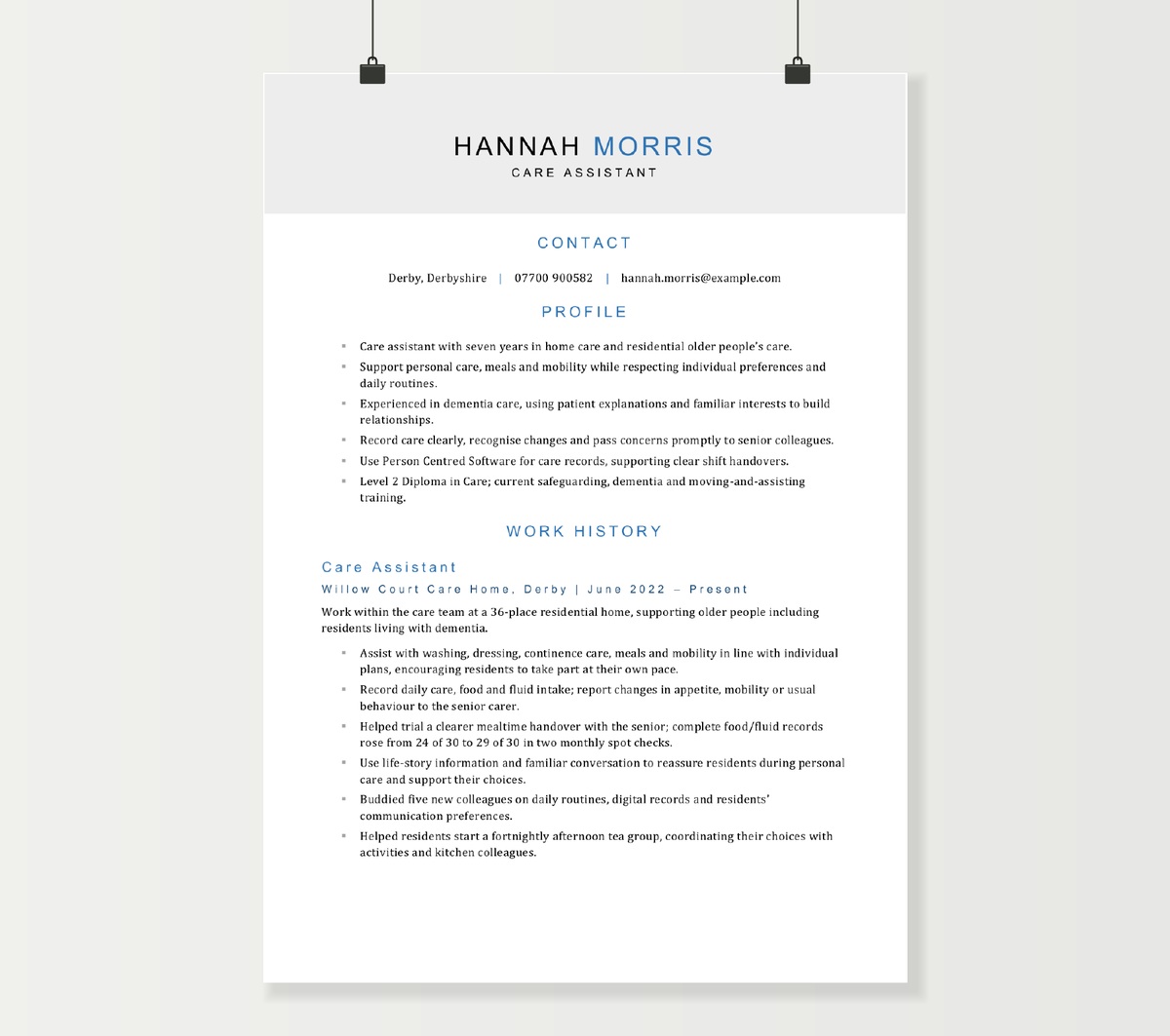
This care assistant CV template follows an applicant with experience in home care and a residential dementia setting. The Word example shows how to describe everyday care, resident preferences, records and teamwork. The guide covers first care jobs, experienced applications and progression, with practical advice for both care homes and domiciliary services.
Filename: FreeCVDownload_Care_Assistant.docx
Content of this CV template
Hannah Morris
Care Assistant
Contact
Derby, Derbyshire | 07700 900582 | [email protected]
Profile
- Care assistant with seven years in home care and residential older people’s care.
- Support personal care, meals and mobility while respecting individual preferences and daily routines.
- Experienced in dementia care, using patient explanations and familiar interests to build relationships.
- Record care clearly, recognise changes and pass concerns promptly to senior colleagues.
- Use Person Centred Software for care records, supporting clear shift handovers.
- Level 2 Diploma in Care; current safeguarding, dementia and moving-and-assisting training.
Work history
Care Assistant
Willow Court Care Home, Derby | June 2022 – Present
Work within the care team at a 36-place residential home, supporting older people including residents living with dementia.
- Assist with washing, dressing, continence care, meals and mobility in line with individual plans, encouraging residents to take part at their own pace.
- Record daily care, food and fluid intake; report changes in appetite, mobility or usual behaviour to the senior carer.
- Helped trial a clearer mealtime handover with the senior; complete food/fluid records rose from 24 of 30 to 29 of 30 in two monthly spot checks.
- Use life-story information and familiar conversation to reassure residents during personal care and support their choices.
- Buddied five new colleagues on daily routines, digital records and residents’ communication preferences.
- Helped residents start a fortnightly afternoon tea group, coordinating their choices with activities and kitchen colleagues.
Domiciliary Care Assistant
Trent Homecare, Derby | September 2019 – May 2022
Visited regular clients at home on morning and evening rounds across Derby.
- Provided personal care, prepared meals and supported household tasks according to each client’s care plan.
- Gave medication prompts, recorded support and reported concerns to the office through the agreed escalation process.
- Completed mobile visit notes and alerted the coordinator to changes, delays or additional support needs.
- Worked alongside colleagues on two-person visits and supported clients returning home after hospital stays.
Retail Assistant
Cedar Home, Derby | August 2016 – August 2019
Served customers in a homeware store, handling purchases, enquiries and returns.
- Helped customers with product choices, allowing extra time when needed.
- Balanced the till and handed outstanding customer queries to the next shift.
Qualifications and training
Level 2 Diploma in Care
Work-based learning | 2021; Care Certificate completed 2019
Recent workplace training
Safeguarding adults, infection prevention and moving and assisting (2026); dementia care and nutrition/hydration updates (2025).
Hobbies and interests
I enjoy swimming, baking for friends and family, and visiting local gardens.
Writing a care assistant CV that shows how you care
A care assistant CV needs to make everyday work visible. Helping someone get ready in the morning can involve understanding their preferences, communicating patiently, supporting movement, noticing a change and recording what happened. A good application shows that combination of practical care and attention to the person.
Employers will also want to understand your setting. Experience in a residential home, a nursing home and a domiciliary service can transfer, but each involves a different pattern of work and team support. Use your profile and recent employment to establish where you have worked, who you have supported and what you are ready to contribute.
Lead with the experience that fits the vacancy
For an experienced applicant, the profile can bring together your care background, a relevant qualification and the type of work you do well. “Care assistant with seven years across home care and residential dementia care” gives a clearer starting point than “hardworking individual seeking a rewarding position”. Follow it with evidence of your strengths, such as personal care, communication with residents, accurate care records or supporting colleagues.
Choose the emphasis to suit the post. A care home recruiting for a dementia unit needs to see that experience early. A home-care provider covering rural visits needs to understand your community experience and practical travel arrangements. A night post may place particular value on familiarity with night routines, observation, reassurance and clear morning handovers.
For a first care job, use the profile to connect your previous experience to the work. Customer-facing employment, volunteering or family caring can demonstrate listening, reliability and respectful assistance. Give the employer something concrete to build on: supporting a regular customer who needed more time, helping organise a community activity or coordinating appointments during a period of family care.
Build your employment section around the care setting
Residential and nursing homes
Under the job title and dates, describe the home and the people you support. State whether the service provides residential, dementia or nursing care, and explain your place in the team. The home’s size gives context, while your bullets show your own responsibilities. Mention work with senior carers, nurses, activities staff or kitchen colleagues where it explains how care is coordinated.
A care assistant in a nursing home may work closely with registered nurses; that relationship is useful evidence in its own right. Describe the observations you pass on, the planned care you provide and any additional tasks for which you have completed training and assessment. An employer should be able to see both your practical experience and how you use the support around you.
Domiciliary and live-in care
For home care, make independent working and continuity visible. Explain whether you completed visiting rounds, longer individual shifts or live-in placements. Describe how you followed the person’s plan, completed visit records, kept the office informed and worked with a colleague on two-person calls when required.
Travel and scheduling are part of the context, but the strongest bullets still concern care. “Completed morning and evening visits for a regular group of clients, recording changes and contacting the coordinator when additional support was needed” is more helpful than a bare number of calls. For live-in work, include the placement pattern and relevant household responsibilities alongside personal care and companionship.
Replace broad duty labels with useful detail
“Assisted with daily living” can cover a great deal. Select the parts of your work that matter to the vacancy and describe them plainly. Personal care, continence care, meals, hydration, movement and companionship may all belong in the employment section, but they need not become a long list of isolated keywords.
- Personal care: explain the support you provide and how you take account of preferences, routines and participation.
- Meals and drinks: describe assistance, recording and communication with the care or catering team, including experience of following individual plans.
- Moving and assisting: identify relevant practical experience, such as working with a colleague and using equipment specified in the person’s plan.
- Medication: state whether your role involves reminders, assistance, administration or recording, with relevant training or competency assessment where applicable.
- Companionship: give an example of how you helped someone maintain an interest, relationship or preferred activity.
Use one or two examples to show how these responsibilities connect. “Supported residents with meals at their preferred pace, recorded intake and passed concerns to the senior carer” conveys practical care, observation and teamwork in one sentence. The CV gives an employer evidence of your work; it does not need to explain a care procedure step by step.
Make dementia experience specific
If you have supported people living with dementia, explain the experience rather than leaving “dementia care” in a skills list. You might use familiar routines, life-story information, patient explanations or individual communication preferences. Show how you adapted your approach to help someone feel comfortable and take part in their day.
A useful example is: “Used residents’ life-story information and familiar interests to build conversation during personal care, sharing helpful approaches with colleagues.” It shows continuity across the team as well as your own relationship with residents. Another applicant might describe helping someone settle into a new home or participating in an activity chosen with the person and their family.
Training supports these examples. Give the course or workplace update and its date in the training section, then use employment bullets for practical application. If your experience spans different levels of support, explain the setting and responsibilities that are most relevant to the post you want.
Show observation, recording and follow-through
Care assistants often notice changes because they know a person’s usual routine. A CV can show this attentiveness through a brief example of recognising and reporting a concern. Describe the observation, who you informed and any agreed follow-up you supported. This helps the employer understand your communication and judgement without requiring a detailed account of someone’s health.
Care records are another source of strong evidence. Name the types you use, such as daily notes, food and fluid charts, repositioning records, visit logs or medication records. If you use a digital care system, include its name alongside the task. “Person Centred Software: daily care notes and food/fluid records” tells the reader more than a general statement about computer skills.
Include handovers where they demonstrate continuity. You might pass on a change in mobility, an appointment, a preference or an action awaiting a senior colleague’s review. Experienced applicants can also describe helping new staff understand recording routines or contributing to a small documentation improvement.
Present safeguarding as part of professional practice
List relevant safeguarding training and give evidence of recognising, recording and escalating concerns through the service’s process. A short description of your responsibility is usually enough. For example, “Recorded concerns promptly and passed them to the senior carer, keeping the next shift informed of agreed actions.” This shows how training connects to day-to-day work.
Infection prevention and safe working can be presented in the same way. Make the application relevant to the setting: using agreed precautions during personal care, supporting colleagues with local routines or completing the records required in your role. A focused entry is easier to assess than a paragraph of policy names.
Choose achievements that reflect good care
Care achievements are often improvements in experience, consistency or teamwork. Helping a resident resume a valued activity, introducing a useful handover prompt or supporting new colleagues can all provide evidence. The result should explain why the contribution mattered, not simply restate that you completed your duties.
In the example CV, the mealtime-record improvement includes the number of records checked and identifies the senior colleague’s involvement. That gives the reader a manageable result with context. Other measures might include the number of colleagues you buddied, a recurring activity you helped residents establish or completion of an agreed improvement across a particular period.
A qualitative result can be equally useful: “Worked with activities staff to arrange a quieter version of a group session, enabling residents who preferred smaller gatherings to take part.” This describes a thoughtful adaptation and its purpose. Where an achievement belongs to a team, make your part clear through verbs such as helped, coordinated, contributed or introduced with colleagues.
Make qualifications and current learning easy to find
Give formal qualifications their full titles, levels and completion dates. A Level 2 Diploma in Care, an older NVQ or a relevant qualification from another country can each be presented clearly using the title awarded. If you are studying, add the expected completion date. An employer can then relate the qualification to its own requirements.
The Care Certificate and the Level 2 Adult Social Care Certificate are different. The first is an induction framework; the second is a regulated qualification. List the award or programme you completed by its correct name. Keep formal qualifications distinct from short workplace courses so a recruiter can quickly understand your preparation.
Choose training that supports the application: dementia care, safeguarding, moving and assisting, infection prevention, nutrition and hydration, medication or end-of-life care where relevant. Dates and practical competency reviews can be useful, particularly for tasks central to the new post. Group routine updates into a readable section, leaving room for employment evidence.
For applicants returning to care, distinguish established experience from recent learning. Your earlier care work still explains what you know; current updates, refresher training or supervised return-to-work experience show how you are preparing to resume. The FAQ below covers how to organise that return in the chronology.
Show readiness for a senior role
Progression needs evidence of responsibility beyond your own care allocation. Bring forward experience of leading a shift, allocating work, supporting care-plan reviews, checking records, administering medication within your role or developing colleagues. State whether these responsibilities were part of your substantive job or gained through deputising.
Separate informal help from structured leadership by describing what you did. Buddying a new starter, conducting a supervision meeting and taking charge of a shift are different contributions. Each can be valuable, but a clear description helps the employer assess your readiness for its particular senior post.
Applicants moving towards roles with a stronger focus on independent living and individual goals may also find the support worker CV guide useful. Choose the emphasis that fits the service rather than relying on the job title alone.
Finish with practical details that help the employer plan
For community work, state your driving licence and access to transport if relevant to the vacancy. For shift-based roles, a concise availability line can clarify days, nights or weekend arrangements. Languages may also be useful when they help you communicate with the people the service supports; describe your level in practical terms.
Keep the employment chronology easy to follow, including bank work, agency placements and relevant caring periods. If you prefer another presentation, browse the CV templates, then retain the same emphasis on setting, care responsibilities, communication and current learning.
Care Assistant CV FAQs
Keep your earlier care roles with their original dates, then add a brief entry for the intervening period so the sequence is clear. In the profile, bring forward the setting and responsibilities you know well. Recent training, refresher learning or supervised return-to-work experience can sit near the top. This allows the employer to see both your established background and your current preparation.
Yes. Include the employer, country, dates and type of service, then describe responsibilities in terms a UK recruiter can readily understand. Give qualifications their awarded titles, with an English translation where useful, and state any UK recognition or registration separately. Explaining the team structure and your personal-care, recording or medication responsibilities helps the reader assess how your experience relates to the vacancy.
Give unpaid family caring its own clearly labelled entry rather than presenting it as an employed post. Dates and a few relevant responsibilities can explain both useful experience and a period away from paid work. Focus on what you did, such as coordinating appointments, helping with routines or communicating with services. If you were formally employed as a personal assistant, list that as employment and describe the arrangement.
Keep the title shown on your certificate, together with the level and year awarded. A newer qualification name describes a different award, not a replacement label for your own. Add recent workplace learning separately so the employer can see how you have continued developing. Where a vacancy asks for a qualification or equivalent, your original award and relevant experience provide the information needed for that assessment.
They are usually best supplied in the employer’s application form or when requested. You can use the CV space for your care experience and training. Prepare the employment dates and appropriate work contacts in advance, particularly if you have moved between agencies or services. If the vacancy explicitly asks for referees with the CV, follow that format and confirm the details with the referees first.
List each agency with its dates so the employment record remains clear, then summarise the types of placements and responsibilities beneath it. Give extra detail to a long assignment or a setting that is especially relevant to the new job. Where agencies overlapped, label the work as bank or temporary and make the overlap clear. A separate short list of selected placements can help if it adds useful context.




