
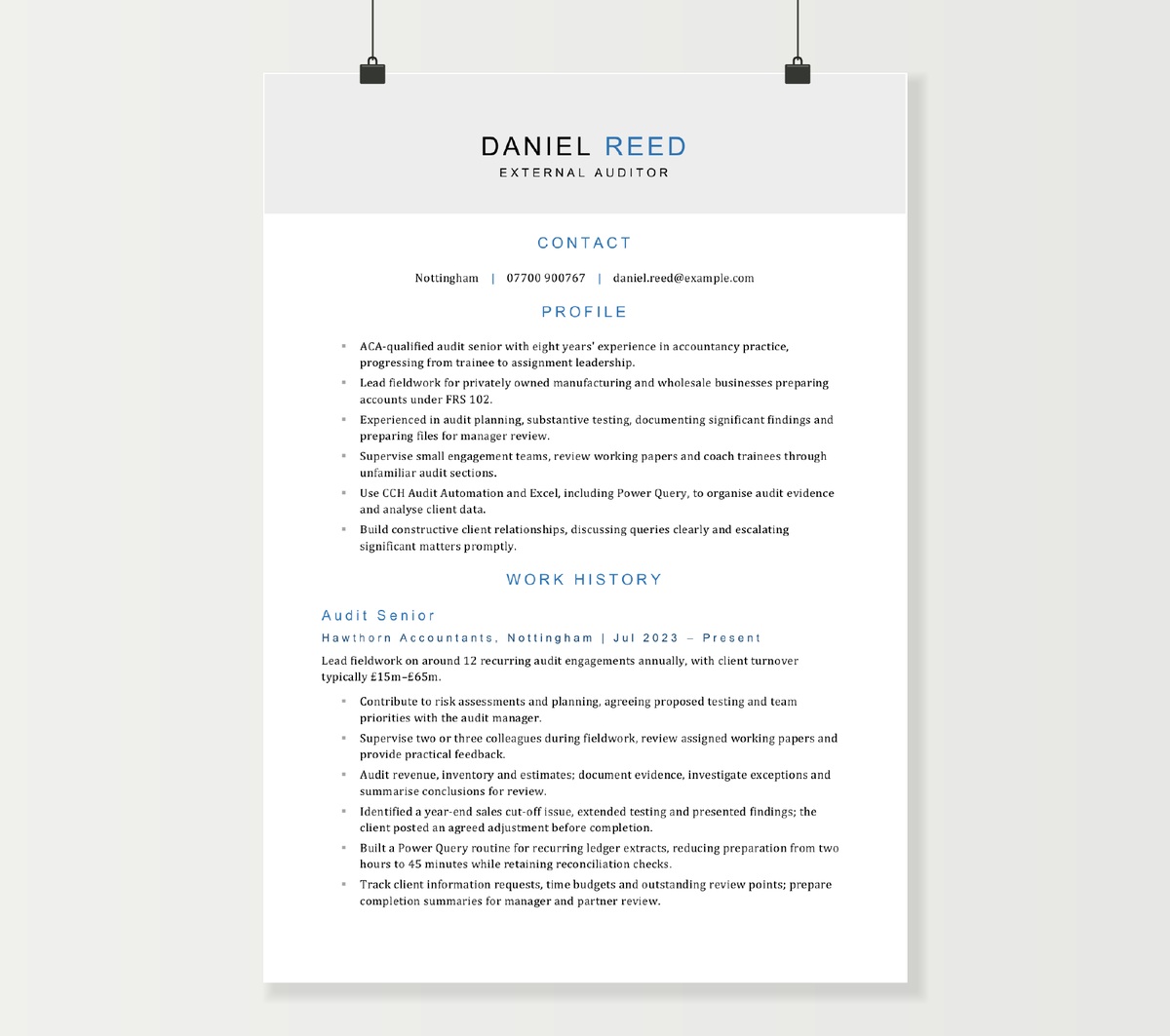
This external auditor CV template follows an ACA-qualified audit senior with experience of privately owned manufacturing and wholesale businesses. The Word example shows progression from trainee to leading fieldwork, reviewing junior colleagues' work and preparing files for manager review. The guide covers audit trainees, experienced seniors and applicants moving towards management or a different client specialism.
Filename: FreeCVDownload_External_Auditor.docx
Content of this CV template
Daniel Reed
External Auditor
Contact
Nottingham | 07700 900767 | [email protected]
Profile
- ACA-qualified audit senior with eight years' experience in accountancy practice, progressing from trainee to assignment leadership.
- Lead fieldwork for privately owned manufacturing and wholesale businesses preparing accounts under FRS 102.
- Experienced in audit planning, substantive testing, documenting significant findings and preparing files for manager review.
- Supervise small engagement teams, review working papers and coach trainees through unfamiliar audit sections.
- Use CCH Audit Automation and Excel, including Power Query, to organise audit evidence and analyse client data.
- Build constructive client relationships, discussing queries clearly and escalating significant matters promptly.
Work history
Audit Senior
Hawthorn Accountants, Nottingham | Jul 2023 – Present
Lead fieldwork on around 12 recurring audit engagements annually, with client turnover typically £15m–£65m.
- Contribute to risk assessments and planning, agreeing proposed testing and team priorities with the audit manager.
- Supervise two or three colleagues during fieldwork, review assigned working papers and provide practical feedback.
- Audit revenue, inventory and estimates; document evidence, investigate exceptions and summarise conclusions for review.
- Identified a year-end sales cut-off issue, extended testing and presented findings; the client posted an agreed adjustment before completion.
- Built a Power Query routine for recurring ledger extracts, reducing preparation from two hours to 45 minutes while retaining reconciliation checks.
- Track client information requests, time budgets and outstanding review points; prepare completion summaries for manager and partner review.
Audit Semi-Senior
Hawthorn Accountants, Nottingham | Sep 2021 – Jun 2023
Delivered audit sections for owner-managed businesses following qualification and progression from trainee.
- Completed testing of cash, receivables, payables and fixed assets, documenting results and following up exceptions.
- Attended inventory counts, recorded observations and linked count evidence to subsequent audit work.
- Coordinated information requests with client finance teams and highlighted delays affecting planned fieldwork.
- Helped two trainees develop their working-paper documentation through regular feedback and worked examples.
Audit Trainee
Hawthorn Accountants, Nottingham | Sep 2018 – Aug 2021
Completed ACA training alongside supervised audit assignments across the firm's business client portfolio.
- Prepared audit schedules, agreed balances to supporting records and maintained organised evidence references.
- Assisted with year-end accounts preparation and developed practical understanding of financial reporting under FRS 102.
Qualifications and development
ACA — ICAEW Chartered Accountant
Qualified and admitted to membership, 2021
Recent professional development
Firm training in audit of estimates, revenue recognition and FRS 102 updates (2025–2026); Excel Power Query training (2024).
Hobbies and interests
I enjoy playing badminton, cooking and exploring new places by train.
How to write an external auditor CV
An external audit CV needs to show the assignments you can handle and how you contribute to a well-supported audit conclusion. A recruiter should be able to see your client experience, technical grounding and level of responsibility without having to infer them from the reputation of your firm. The strongest evidence usually comes from a few carefully chosen engagements: what made them demanding, which parts you delivered and how you brought the work through review and completion.
Make your audit background clear at the top
Use the profile to establish your qualification status, current level and principal client market. An ACA-qualified senior auditing privately owned manufacturers has a different starting point from a part-qualified associate in financial services or a manager working with public-sector bodies. Both the CV title and opening paragraph can make that distinction quickly.
Include the experience most relevant to the next role. For a general practice vacancy, this might be leading audits of owner-managed businesses under UK GAAP. For a specialist team, sector exposure, group work or a particular reporting framework may deserve the space instead. “Experienced in audit, finance and compliance” gives much less information than a concise account of the clients and work you know.
The example uses the page title external auditor and the employment title Audit Senior. Retain the job titles that explain your progression, then use the profile and role descriptions to connect them with the vacancy.
Describe a client portfolio without turning it into a client list
Start each substantial role with a short description of its scope. Relevant details include the main sectors, approximate client size, listed or privately owned status, group structures and the number of assignments you typically handle. Select the details that change the complexity of the audit. Turnover helps contextualise a trading business; assets, fund structures or regulated activities may be more informative for another portfolio.
For example, “Led fieldwork for privately owned manufacturing groups with overseas components” tells a prospective employer something useful about the work. Add the reporting framework and your own responsibility where they matter. A long list of anonymous industries is less helpful if it leaves the reader unsure whether you led the assignments or completed one section on each.
Aggregate descriptions and size bands can convey substantial experience without naming clients. For a particularly relevant engagement, explain its characteristics: multiple locations, a first-year audit, a complex revenue stream or a demanding reporting timetable. This gives the reader a reason to value the experience.
Show what you owned at each stage of an audit
“Planning to completion” is useful shorthand, but supporting it with specific responsibilities makes the claim persuasive. Organise your evidence around the parts of an assignment you personally handled:
- Planning: understanding the business, contributing to risk assessment and materiality, proposing an approach, arranging resources or coordinating information requests.
- Fieldwork: leading a team, carrying out or reviewing testing, investigating exceptions and maintaining communication with the client and engagement manager.
- Completion: resolving review points, evaluating outstanding matters, preparing summaries and contributing to reporting for the appropriate review level.
A trainee might present responsibility for cash, receivables or fixed assets. A senior could show ownership of fieldwork and the first review of trainees’ work. An assistant manager may coordinate several engagements and review more complex sections. Spell out those differences through the verbs and examples in your employment history.
If you work in a delivery centre or on components of a group audit, explain the handover: the instructions you worked to, sections completed, reporting delivered and contact with the wider team. That can demonstrate substantial responsibility even where another office owns the overall engagement.
Make technical judgement visible through your examples
A skills section can identify areas such as revenue recognition, inventory, estimates, going concern or group audit. Your work history should then develop the areas most relevant to the job. The useful story is the matter you encountered, how you investigated it and how you documented or communicated the conclusion.
In the example CV, the sales cut-off bullet connects an identified issue with extended testing and an adjustment before completion. It shows judgement and follow-through without needing a lengthy technical explanation. Another applicant might describe assessing the evidence for an estimate, resolving an inconsistency between records or preparing a clear summary of a significant matter for the manager.
Keep reporting frameworks and audit standards intelligible. FRS 102 and IFRS describe financial reporting knowledge; ISA (UK) relates to the audit work. Grouping everything under a single “accounting standards” label loses that distinction. Connect the framework to the assignments on which you applied it, and reserve a separate skills line for a specialist area when it is central to the vacancy.
For sector moves, identify the transferable work as well as the gap you are bridging. Experience reviewing estimates, challenging explanations and documenting evidence may travel well; the sector-specific accounting issues will still shape how a specialist recruiter reads the CV.
Choose results that demonstrate audit quality and delivery
Audit achievements do not need to resemble a sales CV. Good outcomes include a significant matter resolved before reporting, clearer evidence for review, a more effective client information process, a successful first-year assignment or a junior colleague becoming able to handle a section independently.
Numbers are useful where they establish scale or make a change understandable. You might give the size of the team supervised, number of locations covered, assignments coordinated or time saved in preparing a recurring data extract. Where you present a process improvement, explain what changed and what the measure covers. Reducing ledger preparation from two hours to 45 minutes is a specific result; it says nothing by itself about the duration or quality of the whole audit.
For deadline and budget evidence, include the circumstances. Completing fieldwork within an agreed allocation while dealing with a first-year client is more informative than “always met deadlines”. If delivery involved several people, explain your contribution: coordinating requests, reallocating work, discussing delays or helping clear outstanding matters.
Some of your best evidence will be qualitative. A well-written example of resolving an awkward technical question can earn more space than an isolated percentage with little connection to the work.
Present software as part of the evidence trail
Name the audit platforms you have used and connect them to the work: maintaining files, documenting tests, referencing evidence, reviewing working papers or clearing review notes. This is more useful than a bare claim of “excellent IT skills”. It also helps a firm assess how readily your experience will transfer to its own systems.
For Excel, identify the functions or tools that materially affect your work. PivotTables, lookups and Power Query may support ledger analysis, reconciliations or repeatable data preparation. Explain the purpose in an experience bullet if it produced a useful result. The example’s Power Query routine belongs in the CV because it improved a recurring task and retained the reconciliation checks.
Experience with analytics tools, journal testing or larger datasets can be valuable, especially in bigger teams. Describe whether you prepared the data, selected or ran analyses, investigated outputs or incorporated the findings into the audit file. That distinction gives a recruiter a much clearer picture of your capability than the name of a product alone.
Show client communication, review and team development
Client contact in external audit often involves asking precise questions, obtaining usable evidence and discussing issues with finance staff under time pressure. Choose an example that shows how you maintained progress: agreeing request priorities, explaining a finding clearly or bringing a developing issue to the manager early enough to address it.
Separate engagement supervision from permanent line management. “Supervised three trainees during fieldwork” describes a different responsibility from conducting appraisals for three direct reports. Both can be valuable; presenting the arrangement clearly helps the reader understand your readiness for the next level.
For senior and assistant manager roles, show how you reviewed work and helped colleagues improve. Assigning sections, giving feedback on evidence and conclusions, discussing review points and adapting coaching to experience are all useful evidence. A brief outcome, such as a trainee progressing to a new section or taking greater ownership on a later assignment, makes development work tangible.
At manager level, shift more space towards managing a portfolio, allocating resources across engagements, handling technical consultations, reviewing complex work and communicating with partners or those charged with governance. Keep enough delivery detail to demonstrate the audit background behind those responsibilities.
Give qualifications and progression the right prominence
State the professional qualification, awarding body and completion or membership date clearly. Qualified applicants can put this near the top as well as in the qualifications section. For part-qualified applicants, a precise summary of progress and the next planned milestone helps firms understand the stage reached and any ongoing training requirements.
Professional examinations and practical responsibility develop alongside each other. Show promotions and increasing ownership in your employment history, even when they occurred within one firm. The example separates trainee, semi-senior and senior appointments so the reader can follow the progression without three repetitive descriptions of the employer.
Relevant continuing development can strengthen a CV where it connects with the work sought: an update on a reporting framework, auditing estimates, sector regulation or a tool used in delivery. A short selection is easier to assess than a record of every annual training session.
For trainees and school leavers, education, placements and employment can carry more of the application. Prioritise evidence of working accurately with records, following a question through, communicating with different people and meeting commitments. An accounting placement or reconciliation task can provide a useful example; customer-facing work can demonstrate the communication and organisation needed when visiting clients.
Adjust the balance for a different kind of audit role
A mixed accounts and audit role benefits from a clear account of how your time is divided and which work you complete independently. Separate accounts preparation, tax work and audit responsibilities so a recruiter can see the depth of each. For a predominantly external audit post, give the most relevant audit assignments priority rather than allowing routine accounts duties to dominate.
Moving into a specialist team calls for selective emphasis. Financial services experience may make regulatory knowledge and complex instruments more relevant; manufacturing may make inventory, costing and multi-site work more prominent. Public-sector, charity and group assignments have their own reporting and stakeholder contexts. Present the experience you can discuss in depth and explain why it is relevant to the new portfolio.
If your next move is into industry, the emphasis changes again. The financial accountant CV example shows how reporting, controls and year-end responsibilities can lead the application. For an external audit vacancy, keep the centre of gravity on audit delivery, evidence, judgement and review.
External auditor CV FAQs
The two roles share analytical and communication skills, but their remit differs. External financial-statement audit experience is usually organised around client engagements, reporting frameworks, audit evidence and completion. Internal audit applications tend to place more emphasis on risk-based reviews, governance, operational controls and reporting recommendations within an organisation. If you are moving between them, explain the relevant assignments and responsibilities rather than relying on the word auditor to make the connection.
Signing rights are separate from the experience and qualifications normally presented for an audit senior appointment. Many audit professionals deliver and review work within an engagement team while the authorised individual signs the statutory report. List your professional membership and any separately held audit status precisely. In the ICAEW route, the ACA, Audit Qualification and approval as a Responsible Individual are distinct; an Audit Qualification alone does not confer signing authority.
Give the jurisdiction, client sectors, reporting frameworks and auditing standards you used, alongside your actual qualification and membership status. Then show the parts that transfer directly, such as leading fieldwork, reviewing evidence, group reporting or managing client queries. Any UK audit assignments or relevant technical development can be highlighted separately. This lets the recruiter assess your existing depth and the local experience you have already developed.
Yes, when they add relevant evidence or explain your recent history. State whether the work was a secondment, fixed-term appointment or contract, give the dates and describe the client work or reporting exposure gained. A secondment within the same employer can sit under that employment entry. Several short contracts can be grouped clearly when doing so makes the timeline easier to follow.
Keep the formal job title and add a short explanation of the responsibility where helpful, such as leading fieldwork or acting as day-to-day engagement contact. Firms use associate, executive, senior and assistant manager differently. Team size, review responsibilities, qualification status and the audit stages you owned usually provide a more reliable comparison than changing the title itself.




