
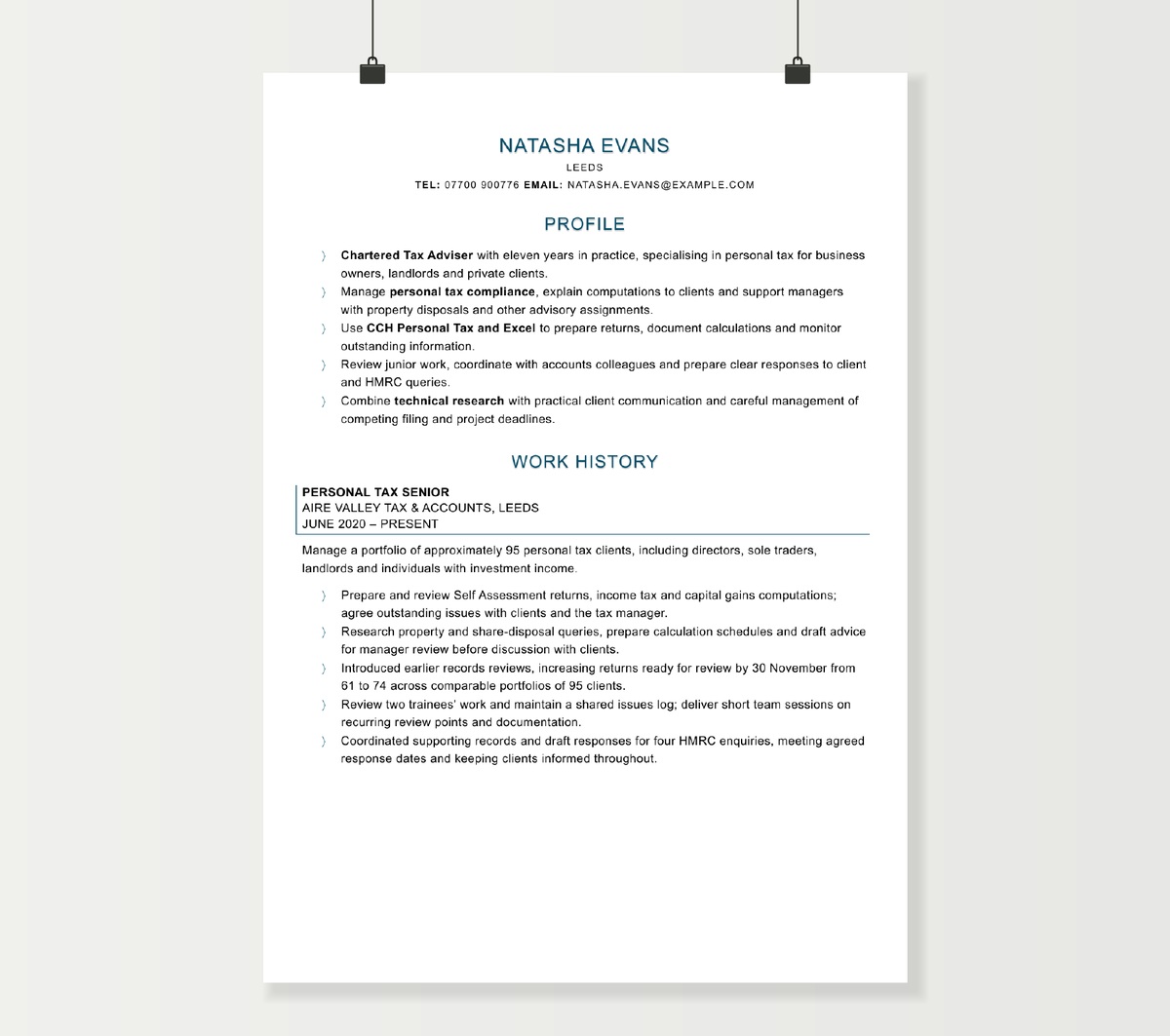
This tax specialist CV template follows a Chartered Tax Adviser working in personal tax, with experience of client portfolios, computations, advisory support and junior review. The editable Word example shows progression from tax assistant to senior. The guide also explains how to adapt the emphasis for corporate tax, indirect tax, employment tax and roles within an organisation or HMRC.
Filename: FreeCVDownload_Tax_Specialist.docx
Content of this CV template
NATASHA EVANS
LEEDS
tel: 07700 900776 email: [email protected]
PROFILE
- Chartered Tax Adviser with eleven years in practice, specialising in personal tax for business owners, landlords and private clients.
- Manage personal tax compliance, explain computations to clients and support managers with property disposals and other advisory assignments.
- Use CCH Personal Tax and Excel to prepare returns, document calculations and monitor outstanding information.
- Review junior work, coordinate with accounts colleagues and prepare clear responses to client and HMRC queries.
- Combine technical research with practical client communication and careful management of competing filing and project deadlines.
WORK HISTORY
PERSONAL TAX SENIOR
AIRE VALLEY TAX & ACCOUNTS, LEEDS
JUNE 2020 – PRESENT
Manage a portfolio of approximately 95 personal tax clients, including directors, sole traders, landlords and individuals with investment income.
- Prepare and review Self Assessment returns, income tax and capital gains computations; agree outstanding issues with clients and the tax manager.
- Research property and share-disposal queries, prepare calculation schedules and draft advice for manager review before discussion with clients.
- Introduced earlier records reviews, increasing returns ready for review by 30 November from 61 to 74 across comparable portfolios of 95 clients.
- Review two trainees' work and maintain a shared issues log; deliver short team sessions on recurring review points and documentation.
- Coordinated supporting records and draft responses for four HMRC enquiries, meeting agreed response dates and keeping clients informed throughout.
TAX ASSISTANT
NORTHFIELD ACCOUNTANCY, HARROGATE
SEPTEMBER 2015 – MAY 2020
Joined as a graduate tax assistant and progressed to responsibility for an allocated personal tax workload after completing ATT.
- Prepared returns and supporting schedules covering employment, self-employment, property and investment income for senior review.
- Reconciled client information to supporting statements, obtained missing records and maintained clear notes of assumptions and queries.
- Built an Excel records tracker for 60 clients, giving the senior a weekly view of outstanding information and review-ready returns.
- Assisted with capital gains calculations and HMRC correspondence; worked with the accounts team to resolve differences in sole-trader figures.
QUALIFICATIONS & DEVELOPMENT
CHARTERED TAX ADVISER (CTA)
CHARTERED INSTITUTE OF TAXATION – 2021
CIOT member since 2021; continuing professional development in personal tax, capital gains and technical writing.
ASSOCIATION OF TAXATION TECHNICIANS (ATT)
QUALIFIED AND ADMITTED TO MEMBERSHIP – 2018
BSc (HONS) ECONOMICS, 2:1
UNIVERSITY OF LEEDS – 2015
INTERESTS
Playing badminton, going to live music and walking in the Yorkshire Dales.
How to write a tax specialist CV
A tax CV needs to establish your area of expertise quickly. Personal tax, corporation tax, VAT, employment taxes and international tax can involve different clients, documents, systems and decisions. A clear profile tells the reader where your experience lies and what sort of work you can take responsibility for.
Follow that with evidence of your contribution: the returns you prepare or review, the technical questions you research, the advice you develop and the people who use it. Qualifications provide an important reference point, while the assignments in your employment history show how you apply that knowledge.
Make your specialism visible before listing technical terms
Lead with the tax area, level and setting most relevant to the vacancy. “CTA-qualified personal tax senior managing a portfolio of business owners and landlords” gives a much clearer starting point than “experienced finance professional with strong tax knowledge”. An in-house candidate might instead introduce UK corporation tax compliance, group reporting and work with finance teams.
Describe your main specialism first, then relevant supporting experience. For a mixed-tax role, an approximate division between personal and corporate work can help. For international work, identify the countries or cross-border issues involved and whether you provided local technical input, coordinated overseas advisers or managed the overall project.
Use the employment history to add depth to that opening description:
- Personal and private-client tax: describe the client mix, return complexity, capital gains work, relevant trusts or estate work, and your involvement in advice.
- Corporate tax: explain the entities or groups covered, computations and returns, reporting or provisioning work, and specific advisory assignments.
- Indirect tax: identify the business model and jurisdictions, return or review responsibilities, reconciliations, controls and commercial projects involving VAT or other relevant taxes.
- Employment tax: show the employers or workforce arrangements involved and your contribution to compliance, reviews, employee reward or specific advice projects.
- International tax and transfer pricing: name the relevant workstreams, your analytical or technical contribution, and how you worked with colleagues or advisers across jurisdictions.
Select the areas that explain your experience. A focused account of one substantial specialism can be much stronger than a long catalogue of taxes with no indication of depth.
Show the level of ownership behind compliance work
“Responsible for tax compliance” leaves the reviewer to guess what you actually handled. Say whether you gathered information, prepared computations, reviewed returns, cleared technical points, coordinated approval or managed the filing schedule. Those stages reveal the level of independence you have developed.
Set out the scale in terms that fit the role. A personal-tax portfolio might be described by client numbers and the mix of income or transactions. Corporate tax work may be better explained through the number and complexity of entities. An indirect-tax role might involve several registrations, reporting jurisdictions and local finance teams.
Volume is only part of the picture. Add a sentence about complexity or recurring issues where useful: incomplete records, investment statements from several sources, group information from different finance teams, or reconciliations between tax reporting and the ledger. This helps an employer understand the work behind the numbers.
For early-career applicants, well-prepared schedules and effective resolution of review points are substantial evidence. At senior level, show how you plan the work, review others’ output and move unresolved matters towards a decision. If your current post combines accounts preparation and tax, the practice accountant example can help you organise that mixed responsibility before emphasising the tax work relevant to your next move.
Turn advisory assignments into concise evidence
A good advisory bullet explains the client’s or business’s question, your contribution and the output. “Supported tax planning” is difficult to assess. “Researched the tax implications of a proposed property disposal, prepared comparison schedules and drafted advice for manager review” gives a much more useful picture.
Choose assignments that demonstrate different aspects of your work. One may show technical research; another might show leading a client discussion, defining a project’s scope or coordinating the information required from solicitors and finance colleagues. A senior specialist can also show how they priced work, managed a budget and delivered the agreed advice.
Where an assignment had several contributors, describe your own workstream and its connection to the overall result. For example, you may have prepared the calculations underlying a report, reviewed the tax treatment of a particular transaction or managed the client information process. Each can be strong evidence at the appropriate level.
Explain the practical use of your output. Did it allow a client to compare options, give a finance team a documented position, support a transaction timetable or identify a matter requiring specialist input? The CV should convey why the work mattered, without reproducing the advice itself.
Demonstrate technical judgement through research and writing
Tax knowledge is more convincing when connected to a question you have worked through. Briefly describe how you established the facts, researched the issue and presented a reasoned conclusion. This is particularly valuable for applicants moving from routine compliance towards more complex advisory or enquiry work.
Written communication deserves explicit evidence. Technical notes, advice letters, responses to HMRC, briefings for a finance director and guidance for colleagues serve different audiences. Name the documents you produce and explain your responsibility for them, including review arrangements where relevant.
You can demonstrate communication without making every bullet a case study. A line about explaining calculations to business owners, presenting an issue to a review panel or preparing a briefing for non-tax colleagues can show how your technical work becomes usable. For senior roles, add evidence of making a recommendation and explaining the implications clearly.
Recent professional development can support this account of your judgement. A short selection of relevant technical updates, specialist training or writing and review development is usually more informative than a long list of webinar titles.
Present HMRC contact and enquiry work precisely
Experience with HMRC might range from resolving a routine account query to managing a complex enquiry. Identify the type of work and what you contributed: assembling records, checking computations, drafting correspondence, attending meetings or coordinating the response with senior advisers.
A useful bullet can cover the issue, your role and progress achieved. For example, coordinating a complete evidence pack and meeting an agreed response date demonstrates organisation and technical understanding even when the case remains open. Where you managed an enquiry through to an outcome, describe the outcome at the level your role supports.
For applicants working within HMRC, explain the tax area, case complexity and decision-making responsibilities. Risk assessment, analysis of evidence, collaboration with technical specialists and communication with taxpayers or representatives can all be important. Translate internal team names or grade-specific shorthand so that a reader outside that part of the organisation can understand the work.
Adapt the emphasis for practice, in-house and public-sector roles
The same technical background may support more than one career direction, but the evidence should reflect the setting. In practice, employers often need to see how you serve a portfolio, deliver projects, manage fees or budgets and work with partners. For an in-house role, give more space to how tax fits into reporting, transactions, systems and business decisions.
An in-house CV can show relationships with finance, legal, HR, procurement or operations, depending on the specialism. Describe what you needed from those teams and what you helped them decide or deliver. If you manage external advisers, distinguish coordinating their work from preparing the technical analysis yourself.
Controls and process improvements are particularly useful evidence in an organisation with recurring reporting obligations. You might have improved source-data checks, documented a review procedure, clarified ownership of reporting inputs or tested a system change. Explain the specific process and result. For roles with substantial group reporting responsibilities, the financial accountant example may also help you present the connection between tax and the accounts.
Public-sector applications may assess your CV against specified technical criteria and require a particular format. Organise the work examples around those criteria, preserving enough detail about your analysis, decisions and achievements for the assessor to understand them.
Choose results that show value beyond a tax-saving figure
Tax work can deliver value through reliable compliance, clear advice, better evidence, improved controls and well-managed decisions. A reduction in tax payable is only one possible result. Select measures that fit the work you actually do and explain the comparison.
- Earlier completion: more returns ready for review by the same checkpoint, with a comparable portfolio size.
- Stronger process: fewer outstanding information requests, shorter reconciliation time or a clearer audit trail for a recurring calculation.
- Project delivery: an advice report, review or implementation completed to the agreed scope and timetable.
- Team capability: trainees able to prepare more complete files, useful technical briefings or a reduction in repeated review points.
- Commercial contribution: additional advisory work commissioned, better job-budget visibility or a successful handover of recurring work.
When a financial outcome is relevant, identify what the figure represents: a refund received, an agreed adjustment, a cash-flow timing benefit or an estimated consequence of advice. Add the period and your contribution. This gives the figure meaning and helps the employer discuss the assignment with you.
Outcomes can also be qualitative. A well-documented position that enabled a decision, a complex case moved to the next stage or a difficult handover completed successfully can be worth including. Explain the obstacle and what your work made possible.
Connect software, qualifications and progression to your next role
Software belongs in the CV when it helps an employer understand how you work. Name the tax production systems you use, such as CCH, IRIS or TaxCalc, alongside relevant Excel or reporting work. For in-house candidates, include the finance systems and data sources that matter to reconciliations and tax reporting.
Give significant systems work its own evidence. Testing a tax calculation after an upgrade, improving a data import or checking a new reporting workflow shows more than simply listing the application. If your role involves technical research tools, connect them to the research and written outputs described elsewhere.
State professional qualifications and current status clearly. CTA, ATT, an accountancy qualification, ADIT or relevant HMRC training may be important depending on the role. Include dates and, where useful, a relevant specialism. Students can show the stage reached and expected completion, while applicants who have completed exams can explain their current membership position.
For a first tax role, draw on relevant placements, accounts work, analytical projects or assessed tax work. Show evidence of interpreting information, preparing a reasoned calculation or explanation, and responding to feedback. As your experience grows, shift the emphasis towards completed assignments, client or business responsibility, review and judgement. The result should show a recognisable direction of progression within tax, rather than simply an expanding list of technical terms.
Tax Specialist CV FAQs
Choose a heading that makes your function clear for the vacancy, and add your specialism where useful, such as Personal Tax Specialist or Corporate Tax Accountant. Keep the titles you held in the employment history. If you hold the CTA designation, Chartered Tax Adviser is the professional title. The detail of your work matters more than matching every possible job-title variation.
Yes, the experience and qualifications structure can be adapted, but follow that campaign's instructions about identifying details, document format and word limits. Some campaigns request a name-blind CV and assess each role description against specific criteria. Prepare a separate application version that follows those requirements, giving the assessor the responsibilities and achievements they have asked for.
Name the jurisdictions and tax regimes you worked with, then highlight relevant common ground such as computations, evidence analysis, review, international coordination and technical writing. Give UK assignments or study their own clear place so the reader can see your current exposure. For a cross-border role, explain how your overseas knowledge connects to the transactions, people or entities the employer serves.
Include a small selection when they support the specialism or level you are applying for. Give the topic, audience and your contribution, such as authoring a technical article or delivering training to a finance team. A relevant public publication can have a link; internal sessions can be described by subject and audience. These are particularly useful evidence of communicating complex material and developing colleagues.
Yes. Some specialist posts centre on technical advice, research or ownership of a particular tax area, with no direct reports. Emphasise the assignments you lead, the decisions or recommendations you contribute to and the colleagues who rely on your expertise. For vacancies that include team management, add any review, coaching, work allocation or formal management experience so the employer can assess that part of the role separately.




