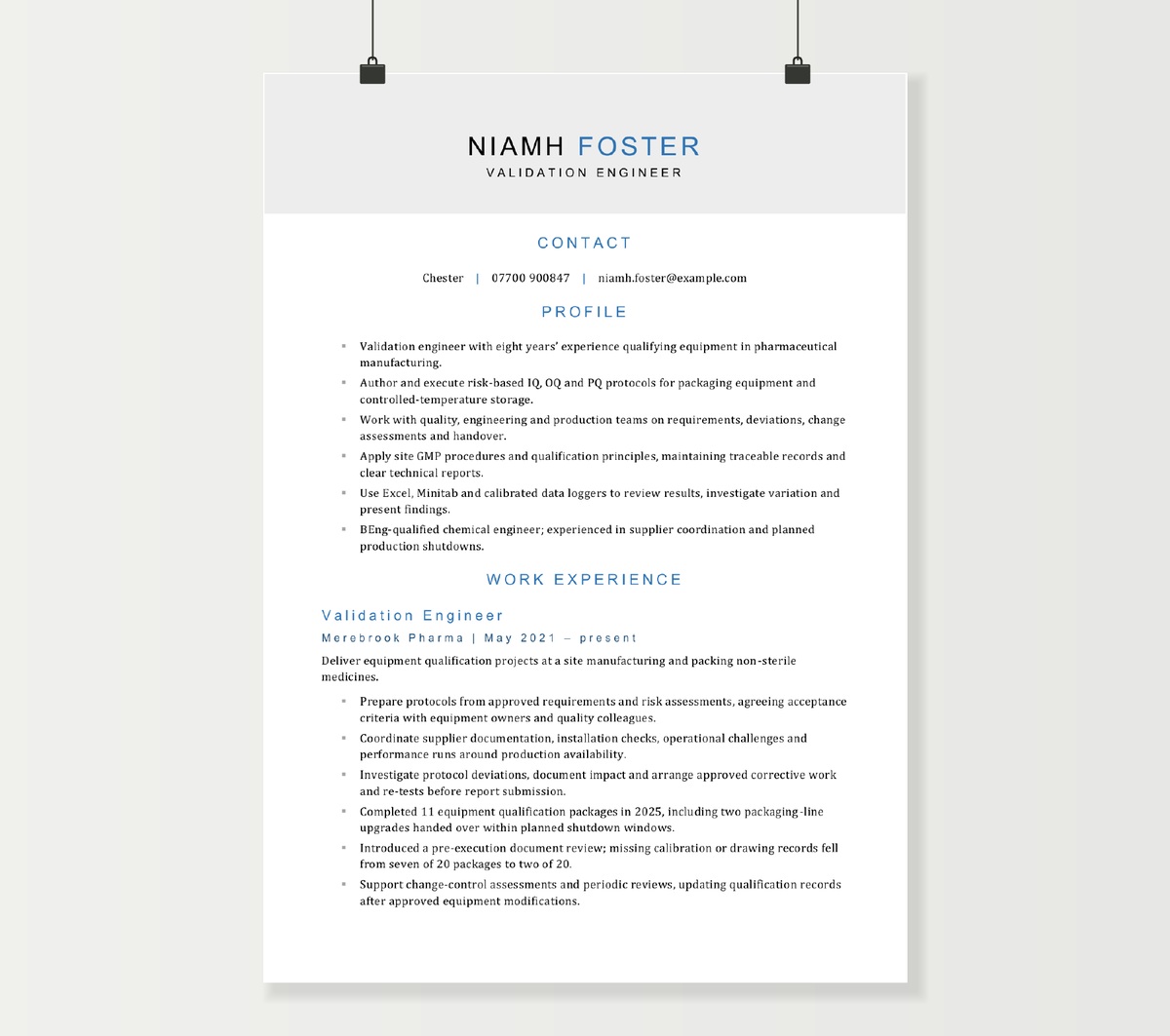
This validation engineer CV template uses a pharmaceutical equipment-validation example, showing progression from graduate engineering through technician work to project responsibility. The Word CV brings together qualification protocols, practical execution, deviation follow-up and handover. The guide also explains how to position computerised systems, cleanroom and product-validation experience for the right vacancy.
Filename: FreeCVDownload_Validation_Engineer.docx
Content of this CV template
Niamh Foster
Validation Engineer
Contact
Chester | 07700 900847 | [email protected]
Profile
- Validation engineer with eight years’ experience qualifying equipment in pharmaceutical manufacturing.
- Author and execute risk-based IQ, OQ and PQ protocols for packaging equipment and controlled-temperature storage.
- Work with quality, engineering and production teams on requirements, deviations, change assessments and handover.
- Apply site GMP procedures and qualification principles, maintaining traceable records and clear technical reports.
- Use Excel, Minitab and calibrated data loggers to review results, investigate variation and present findings.
- BEng-qualified chemical engineer; experienced in supplier coordination and planned production shutdowns.
Work experience
Validation Engineer
Merebrook Pharma | May 2021 – present
Deliver equipment qualification projects at a site manufacturing and packing non-sterile medicines.
- Prepare protocols from approved requirements and risk assessments, agreeing acceptance criteria with equipment owners and quality colleagues.
- Coordinate supplier documentation, installation checks, operational challenges and performance runs around production availability.
- Investigate protocol deviations, document impact and arrange approved corrective work and re-tests before report submission.
- Completed 11 equipment qualification packages in 2025, including two packaging-line upgrades handed over within planned shutdown windows.
- Introduced a pre-execution document review; missing calibration or drawing records fell from seven of 20 packages to two of 20.
- Support change-control assessments and periodic reviews, updating qualification records after approved equipment modifications.
Validation Technician
Merebrook Pharma | Jul 2018 – Apr 2021
Executed approved qualification activities under engineer supervision, progressing to protocol drafting.
- Prepared calibrated loggers and test equipment for storage mapping and equipment checks.
- Recorded results, reconciled raw data and raised unexpected observations for investigation.
- Compiled traceability and supporting records for engineer and quality review.
- Standardised logger-location diagrams across six storage areas, reducing clarification requests during report review.
Graduate Process Engineer
Northbank Process Products | Sep 2016 – Jun 2018
Supported production trials and equipment improvement projects in a chemical manufacturing plant.
- Collected operating data and prepared trial summaries with production and maintenance teams.
- Updated equipment records and followed up supplier actions during installation projects.
Qualifications
BEng (Hons) Chemical Engineering, 2:1
University of Manchester | 2016
Professional development
GMP and data integrity refresher, 2026; practical equipment qualification, 2024; Minitab process analysis, 2023. Site training in deviation investigation and change control.
Interests
Hill walking, baking and learning Spanish.
How to write a validation engineer CV
A validation engineer CV needs to make the technical setting clear immediately. Qualifying pharmaceutical production equipment, validating a computerised laboratory system and testing a defence product all involve evidence and acceptance criteria, but employers look for different experience. Start with the systems or processes you work on, the industry and the stages you can deliver.
The example here is centred on pharmaceutical equipment qualification. Use its approach to explaining scope, responsibility and results, then choose the technical detail that belongs to your own specialism. A strong CV lets an engineering or quality manager see what you could take responsibility for on their site.
Define your validation specialism before listing methods
In the profile, identify your principal area: equipment and utilities qualification, process or cleaning validation, computerised systems, analytical methods, cleanrooms or product verification and validation. Add the types of equipment, manufacturing environment or product that make your experience relevant. Non-sterile packaging, aseptic processing and laboratory systems are useful distinctions.
Give the reader an indication of independence. You may execute approved protocols, author packages, coordinate several disciplines or review work as a technical specialist. Pair this with a relevant qualification or substantial experience. This is more informative than a profile dominated by “GMP, IQ/OQ/PQ, CSV, CAPA” without any account of what you have done.
Use projects to show your part in the lifecycle
Choose projects that demonstrate different aspects of your capability. A new equipment installation may show requirements and supplier coordination; a modification may show impact assessment and requalification; a periodic review may show how you maintained an established system. Several similar installations usually need less space than a smaller set with distinct technical value.
For each substantial project, include the system or equipment, its purpose, your deliverables and the outcome. Identify the stages you handled, such as user requirements, risk assessment, supplier testing, installation qualification, operational qualification, performance qualification or final reporting. Expand unfamiliar abbreviations once where space permits, while retaining the terminology recruiters will recognise.
Make the verbs do useful work. “Authored”, “executed”, “reviewed”, “coordinated” and “approved” describe different responsibilities. A bullet explaining that you authored protocols and coordinated execution for two packaging-line upgrades gives a clearer picture than “responsible for validation”. Where quality or a system owner provided final approval, describe how you prepared the evidence for that decision.
Explain the technical substance of protocols and testing
Show what made a protocol meaningful: links to approved requirements, risk-based test coverage, defined acceptance criteria and a clear record of results. In a concise CV entry, one or two details are enough to demonstrate that you understand why the tests were selected.
For practical work, identify the equipment or methods you used and the purpose. Temperature mapping with calibrated loggers, packaging-line challenge tests and utilities qualification are concrete evidence. An employer can then distinguish hands-on execution from document coordination.
For data analysis, connect the tool with the question. Excel or Minitab might support variation analysis, trend review or comparison against acceptance criteria. Describe the analysis and the decision it informed. A software name by itself gives little indication of the technical depth involved.
Give deviations and change control proper weight
Unexpected results are a useful place to demonstrate engineering judgement. A strong experience bullet can describe the issue, your investigation, the people involved and how the approved resolution was evidenced. This might involve checking the test setup, identifying an equipment fault, assessing impact or coordinating corrective work and re-testing.
Keep the distinction between carrying out a test and closing its evidence trail visible. Reporting a deviation, contributing to root-cause analysis, following actions and assembling the final report can show sustained ownership. These details are often more persuasive than a claim to have completed a large number of protocols.
For change control, give an example of what changed and your contribution to the assessment. A replacement component, revised operating range or software upgrade creates a different validation question from a new installation. Explain the scope you assessed and the documentation or testing you delivered after the change was agreed.
Present quality knowledge through applied work
List the standards, guidance and quality systems relevant to the target environment, then support the important ones with experience. In pharmaceutical work, that may include qualification principles, site GMP procedures, data integrity, document control and validation master planning. In other sectors, requirements management, product standards or system assurance may be more central.
Data integrity evidence can be practical: reconciling source records, checking traceability, resolving incomplete information or contributing to a controlled electronic workflow. Explain what you did and how it improved the reliability or reviewability of the evidence. A list of quality acronyms is much less useful.
Describe audit involvement at the right level. Preparing a technical evidence pack, answering questions about an assigned system and following up actions are all worthwhile. Identify the part you supported so the reader can assess your experience of technical scrutiny.
Show how you work with production, quality and suppliers
Validation projects often depend on other people’s equipment, records and time. Explain how you coordinated those dependencies: agreeing execution windows with production, resolving supplier documentation gaps, organising specialist tests or keeping a system owner informed of an issue affecting handover.
Include the constraints that made the work demanding. A shutdown, limited equipment availability, several vendors or a live manufacturing schedule can show project skill without requiring a project-manager title. Give the scale where it helps, such as the number of systems or concurrent packages.
If your contribution extends into installation and commissioning, the commissioning engineer CV may help you decide which earlier project stages deserve space. Keep validation deliverables and acceptance evidence prominent when that is the vacancy’s main purpose.
Choose outcomes that reflect evidence quality
Useful results include equipment handed over for intended use, fewer returned packages, clearer traceability, resolved deviations, reduced repeat work and completion within an agreed shutdown. The strongest measure connects your action to a specific improvement.
Give a denominator or comparison when it adds meaning. In the example CV, missing supporting records fell from seven of 20 packages to two of 20 after a pre-execution review was introduced. The reader can see the scale and the practical change, rather than just a percentage.
Speed can be relevant, particularly when you improved preparation or coordination. Explain the process improvement that enabled it and the accepted output. Successful qualification rests on useful evidence, so “completed faster” becomes more convincing when the CV also shows how requirements and review were handled.
Adapt the emphasis for other validation disciplines
Computerised systems: identify the system type and intended use, the lifecycle activities you carried out and your collaboration with IT, quality and users. Risk assessment, requirements traceability, testing, electronic records and lifecycle maintenance may deserve more space than physical installation. Name GAMP or other frameworks in the context of work you performed.
Product and systems validation: foreground requirements, test scenarios, success criteria, integration, defect investigation and evidence for design decisions. Requirements tools such as DOORS or modelling tools belong alongside the projects where you used them. A candidate with manufacturing or product-development experience may also find the manufacturing engineer example useful when organising earlier roles.
Cleanrooms and critical ventilation: identify the premises and systems tested, relevant competence or training, instrumentation and reporting responsibility. Field work, fault findings and communication of remedial recommendations may matter more than a pharmaceutical protocol-authoring history. Specify the scope of any appointments or qualifications so employers can understand their relevance.
Process, cleaning or analytical method validation: describe the processes or methods involved, your role in protocol design and execution, and the analysis or report you contributed. The boundaries between laboratory and site-manufacturing work should be clear, especially when a vacancy concentrates on one of them.
Organise qualifications, contract work and progression
Give the exact engineering or science qualification, institution and completion date. Relevant vocational experience can also be important. Select recent technical development that strengthens the target application, such as equipment qualification, computerised systems, statistics or data integrity. Practical evidence should remain easy to find beside the training.
For contract careers, show each assignment’s dates and scope, with the main deliverables beneath it. Short assignments can demonstrate a coherent sequence of installations, remediation or specialist reviews. Group minor projects where that makes the history clearer, while retaining enough detail to explain the technical setting.
Early-career applicants can use supervised execution, graduate projects, laboratory work and production trials to show careful records, data interpretation and problem investigation. Explain your contribution and the review arrangements. Experienced applicants should bring forward planning, technical decisions, package ownership and support for colleagues. That progression is more useful than repeating the same protocol-execution bullet under every role.
Validation Engineer CV FAQs
Yes, where your experience connects with the role. Bring forward equipment trials, controlled documentation, data analysis, investigations and changes you helped assess. Explain the parts of validation you have already supported and the relevant technical environment. For a site-manufacturing vacancy, distinguish this evidence from routine laboratory testing so the employer can see the connection clearly.
State the current stage and the deliverables completed, such as approved requirements, an issued protocol or completed installation checks. Include your ongoing responsibility and the planned next stage where useful. This gives the employer concrete evidence of progress without requiring a final handover result.
A short, anonymised project summary can be useful, particularly for specialist or contract applications. Describe the system, technical challenge, your role, deliverables and outcome. An approved high-level diagram or public project description may help, but the CV can stand on a clear written account without sharing protocols, proprietary parameters or client records.
Group similar equipment and highlight the types relevant to the vacancy. A concise scope statement can cover routine experience, leaving room for projects with different technical challenges. Add specific models when familiarity with them materially helps the employer assess your fit, rather than turning the CV into an asset register.
Describe the technical and coordination responsibility you held: setting package priorities, reviewing drafts, guiding execution, resolving interfaces or mentoring a technician. Include the number of systems, packages or colleagues involved where useful. Technical leadership can be substantial even when formal staff management sits elsewhere.
Include them when the vacancy makes them relevant, for example a defence site or a role involving regular customer visits. State current clearance or travel availability briefly and accurately, using the employer’s application process for detailed checks. For a single-site pharmaceutical role, technical scope and validation experience will usually deserve more prominent space.