This gas engineer CV template follows an apprentice-trained engineer into domestic servicing and breakdown work. The Word example brings together current qualifications, fault-finding, job records and experience in occupied homes. The guide covers how to present domestic, commercial, installation and newly qualified experience for the right role.
Filename: FreeCVDownload_Gas_Engineer.docx
Content of this CV template
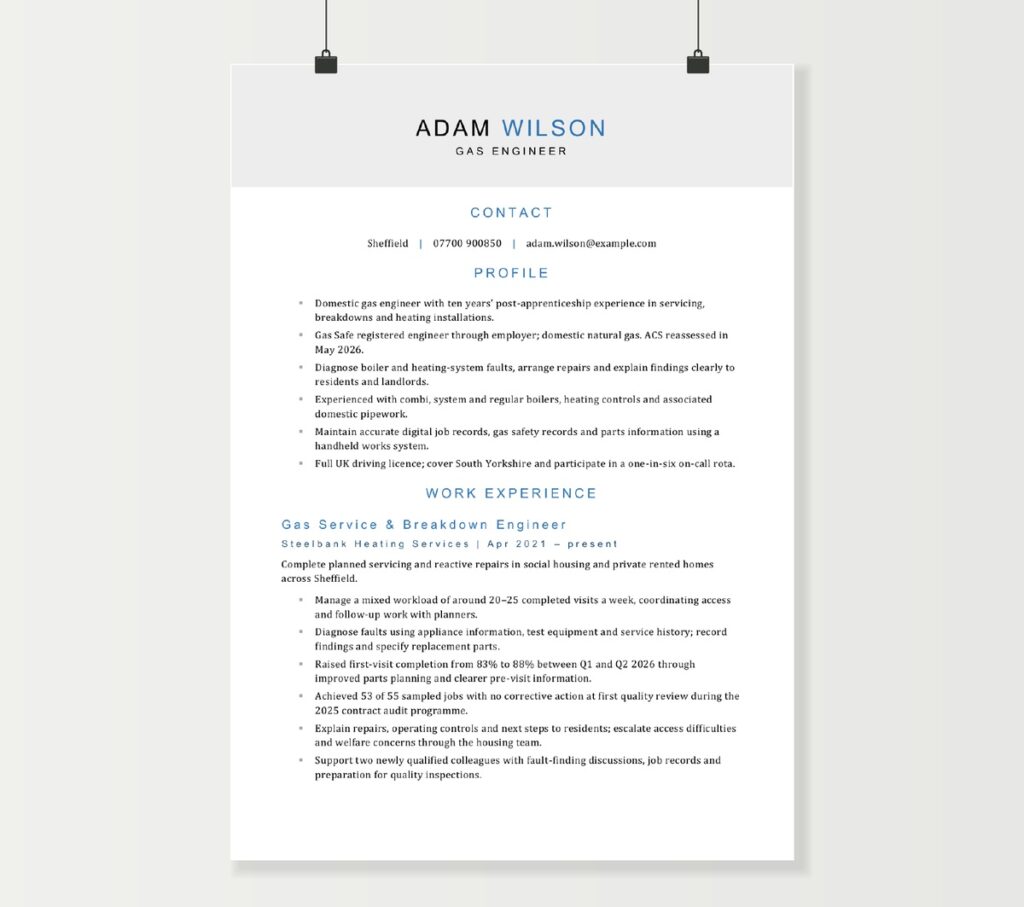
Adam Wilson
Gas Engineer
Contact
Sheffield | 07700 900850 | [email protected]
Profile
- Domestic gas engineer with ten years’ post-apprenticeship experience in servicing, breakdowns and heating installations.
- Gas Safe registered engineer through employer; domestic natural gas. ACS reassessed in May 2026.
- Diagnose boiler and heating-system faults, arrange repairs and explain findings clearly to residents and landlords.
- Experienced with combi, system and regular boilers, heating controls and associated domestic pipework.
- Maintain accurate digital job records, gas safety records and parts information using a handheld works system.
- Full UK driving licence; cover South Yorkshire and participate in a one-in-six on-call rota.
Work experience
Gas Service & Breakdown Engineer
Steelbank Heating Services | Apr 2021 – present
Complete planned servicing and reactive repairs in social housing and private rented homes across Sheffield.
- Manage a mixed workload of around 20–25 completed visits a week, coordinating access and follow-up work with planners.
- Diagnose faults using appliance information, test equipment and service history; record findings and specify replacement parts.
- Raised first-visit completion from 83% to 88% between Q1 and Q2 2026 through improved parts planning and clearer pre-visit information.
- Achieved 53 of 55 sampled jobs with no corrective action at first quality review during the 2025 contract audit programme.
- Explain repairs, operating controls and next steps to residents; escalate access difficulties and welfare concerns through the housing team.
- Support two newly qualified colleagues with fault-finding discussions, job records and preparation for quality inspections.
Domestic Gas Engineer
Hallam Plumbing & Heating | Sep 2016 – Mar 2021
Installed, serviced and repaired domestic gas heating systems for homeowners and small letting agents.
- Completed boiler replacements and associated heating work, including commissioning records and customer handovers.
- Planned materials and coordinated installation dates with customers and other trades.
- Maintained service records and followed up parts orders and return appointments.
- Introduced appliance-detail photographs with parts requests, reducing incorrect orders from six to two across successive three-month periods.
Plumbing & Heating Apprentice
Hallam Plumbing & Heating | Sep 2012 – Aug 2016
Combined college study with supervised plumbing, heating installation and maintenance work.
- Prepared materials, installed domestic pipework and developed practical customer-service skills.
- Completed workplace evidence and progressed into a qualified domestic gas role.
Qualifications
ACS: CCN1, CENWAT, CKR1, HTR1
Reassessed May 2026 | Certificates expire May 2031
Level 3 NVQ Diploma in Plumbing and Heating
Completed 2016. Recent development: boiler manufacturer diagnostics, 2025; asbestos awareness and working in occupied homes, 2026.
Interests
Five-a-side football, camping and restoring an old motorcycle.
How to write a gas engineer CV
A gas engineer CV should let an employer establish your working scope quickly: the gas and appliance categories you cover, whether your experience is mainly servicing, breakdowns or installations, and the customers or sites you work with. Qualifications open the conversation; the experience section shows how you deliver the work.
Start with the role you want. A domestic service contractor, commercial facilities team and gas network operator need substantially different evidence. The same broad job title can cover all three, so make your specialism clear before the reader reaches the employment history.
Put gas qualifications and registration where they can be found
Use a clearly labelled qualifications section with the relevant ACS codes, assessment dates and certificate expiry dates. For a domestic role, this might include CCN1 and the appliance categories requested in the vacancy. Group related certificates together where their dates match; show separate dates where they differ. This makes the information easy to check without filling the opening profile with abbreviations.
Present your Gas Safe status separately from your qualification record. An employed engineer can explain that they are registered through their employer, while a self-employed applicant can describe their own registered business. Relevant work categories matter as well as current registration. The HSE guidance on checking gas competence explains where these appear on the engineer’s card.
Add other qualifications that support the particular job, such as unvented hot water, water regulations, relevant electrical training or specialist plant training. Keep these identifiable as separate areas of competence. For a commercial vacancy, use the exact certificate titles or codes and relate them to the plant and work described in your experience.
Define your technical scope in practical terms
A profile such as “Domestic gas engineer specialising in servicing and breakdowns across occupied housing” gives the reader an immediate picture. Add the main fuel type, useful system experience and level of independence. For commercial work, identify the settings and equipment: plantrooms, heating installations, commercial appliances or multi-site facilities, as appropriate.
Within each job, describe the work mix. Someone carrying out mostly annual servicing has different recent experience from an engineer handling reactive boiler faults or a programme of heating replacements. A short scope sentence prevents the reader from treating all years in the trade as interchangeable.
Relevant manufacturers and boiler types can help a service employer assess familiarity with its installed base. Use a focused selection and connect it to actual work. “Servicing and breakdown diagnosis on combi, system and regular boilers” is more useful than a long list of brands with no indication of what you did.
Show fault-finding through the result of your judgement
Breakdown experience deserves more than “diagnosed and repaired faults”. Describe the range of problems, the information you use and how you follow the repair through. This might include interpreting service history, identifying a recurring system issue, specifying the right part or explaining the next visit to a resident.
A concise CV bullet could describe resolving a recurring loss-of-heating problem after reviewing earlier call-outs and identifying the underlying control issue. The point is to show diagnostic responsibility and a useful outcome. The CV does not need a step-by-step testing procedure or detailed instructions for carrying out gas work.
For more experienced applicants, include how colleagues rely on your knowledge. Supporting difficult diagnoses, reviewing job information, advising on parts and helping newly qualified engineers prepare for inspections all demonstrate technical progression. Give the context so this is distinguishable from formal supervision or management.
Make installation experience cover the whole job
For installation roles, explain the projects you complete and your responsibility within them. Boiler replacements, heating conversions, new installations and associated pipework can involve different planning and coordination. State whether you work independently, as part of a pair or alongside other trades.
Good evidence can cover surveying or gathering job information, planning materials, coordinating access, completing installation work, commissioning documentation and handing the system over to the customer. Choose the parts you are responsible for and show how the job reaches completion.
If you have worked on a planned replacement programme, give a meaningful scale and period alongside quality or handover evidence. A project completed across a defined group of homes is easier to understand than an unexplained total of installations accumulated over an entire career.
Include records, inspections and follow-up
Digital job updates, gas safety records, commissioning records, photographs and parts requests are part of delivering the work. Explain how you use the employer’s handheld or scheduling system and what information you leave for planners, supervisors and the next engineer.
Quality reviews provide useful achievements. You might describe results from a defined sample of inspected jobs, fewer returned records after improving documentation, or a recurring issue resolved through follow-up. State what was reviewed and the period or sample involved. This is more informative than a broad claim of perfect compliance.
Where the role includes identifying unsafe situations, give concise evidence of your responsibility for assessment, documentation, customer communication and escalation under the employer’s procedures. Keep the emphasis on professional judgement and records rather than turning the CV into a technical manual.
Present productivity alongside the work involved
Completed visits, first-visit resolution, repeat attendance, parts availability and service delivery can all strengthen a CV. Their value depends on context. Twenty mixed service and breakdown visits are different from twenty short inspections, and an installation programme is different again. Name the type of workload and the period behind the figure.
For first-time-fix or first-visit-completion figures, use the measure recorded by your employer and explain what changed. Better pre-visit information, improved van stock or more accurate parts identification gives the reader a reason for the result. Pair productivity with evidence of workmanship, records or customer outcomes where space allows.
Some strong contributions are straightforward operational improvements: clearer appliance details on parts orders, fewer avoidable return visits or more dependable handovers between shifts. A small, well-explained improvement can be more persuasive than a large figure with no clear basis for comparison.
Give customer and site communication proper weight
In occupied homes, explain how you keep customers informed about access, disruption, repairs and follow-up. Experience with social housing, private landlords, homeowners or vulnerable residents gives useful context. A brief example of coordinating with a housing officer or planner can show how you resolve practical barriers to completing work.
Commercial engineers may instead need to show communication with facilities managers, site contacts and other contractors, including planning around building use and service interruptions. Explain your role in arranging work and passing on technical findings. Employers need to know that your information supports the wider maintenance service.
For mobile positions, include your base, normal coverage area and full driving licence where relevant. On-call or standby experience can sit in the profile or current job. This gives a clearer picture of the working pattern than a generic claim to be flexible.
Position commercial, LPG and network experience accurately
A commercial CV should connect qualifications with the equipment and sites where you use them. Describe planned and reactive work, relevant heating systems, inspections, records and coordination with site teams. Plant complexity and your responsibility often communicate more than the number of buildings alone.
For LPG work, identify the fuel and relevant application alongside the corresponding competence and experience. For network roles, bring forward the appropriate network qualifications, emergency response, pipework, excavation or team responsibilities. These applications need their own evidence rather than a domestic boiler CV with a different headline.
If your experience spans several areas, lead with the one most relevant to the vacancy and retain the others in a compact supporting section. The field service engineer CV example can also help with presenting mobile workload, service records and customer-site responsibility.
Build a newly qualified CV around practical development
For an apprentice or newly qualified applicant, make the qualification stage, completed assessments and workplace experience easy to follow. Explain the systems encountered, supervised tasks, customer contact and the evidence gathered through training. State which responsibilities developed as you progressed.
A training placement can be a substantial experience entry when it describes real work in enough detail. Give the setting and your contribution, including practical preparation, records and interaction with customers or colleagues. Earlier plumbing, maintenance or customer-facing employment may also help demonstrate readiness for the working environment.
For experienced engineers, shorten the apprenticeship entry and give recent service, installation or technical-support work more space. Manufacturer training and relevant refreshers are useful when they connect to the systems you currently work on or the responsibilities you want next.
Make self-employed and subcontract work easy to follow
Use a clear business or self-employed entry with dates, coverage and services. Describe the customer base and work you deliver, then add relevant responsibilities such as quoting, ordering, scheduling, invoicing or coordinating subcontractors. This shows both engineering and the organisation required to run the workload.
Several short contracts can be grouped under a subcontracting period where that makes the chronology clearer. Identify the main contracts or settings and highlight meaningful changes in scope. For a move into employment, bring forward the technical and customer-service experience that fits the vacancy, together with any experience working to another organisation’s systems and quality requirements.
Gas Engineer CV FAQs
State your current registration arrangement and relevant work scope on the CV. If the employer requests a number, provide the identifier it asks for, distinguishing your engineer licence number from the business registration number. A card scan is usually better supplied through the employer's requested document-checking process than embedded in the CV.
List the current certificates and their expiry dates, then add the booked reassessment month. If you are applying while completing an additional category, place that separately as training or assessment in progress. The employer can then see both your present position and the planned development.
The core qualification and employment information overlaps, but the evidence should change emphasis. Service and breakdown applications benefit from diagnostic range, repair outcomes, repeat-visit handling and digital records. Installation applications need more detail on the types of projects completed, materials planning, coordination, commissioning records and handover.
Yes. Domestic heating systems, pipework, installation planning, fault investigation and working in customers' homes can all be relevant. Present this experience alongside your gas training and qualification stage, with a clear account of the supervised work completed during your development. This helps an employer judge the practical foundation you bring.
Give it a separate qualification or development entry, including the technology, course or award and date. If you also have practical installation or servicing experience, describe that in the relevant employment entry. Keeping training and delivery experience visible separately helps employers assess your readiness for mixed heating work.
Include items the particular contract asks for, such as a suitable vehicle, equipment or relevant insurance details. Keep the main CV focused on scope, qualifications and delivery experience. Rates and detailed commercial terms are usually clearer in the accompanying response or contractor application, where they can be matched to the proposed work.