
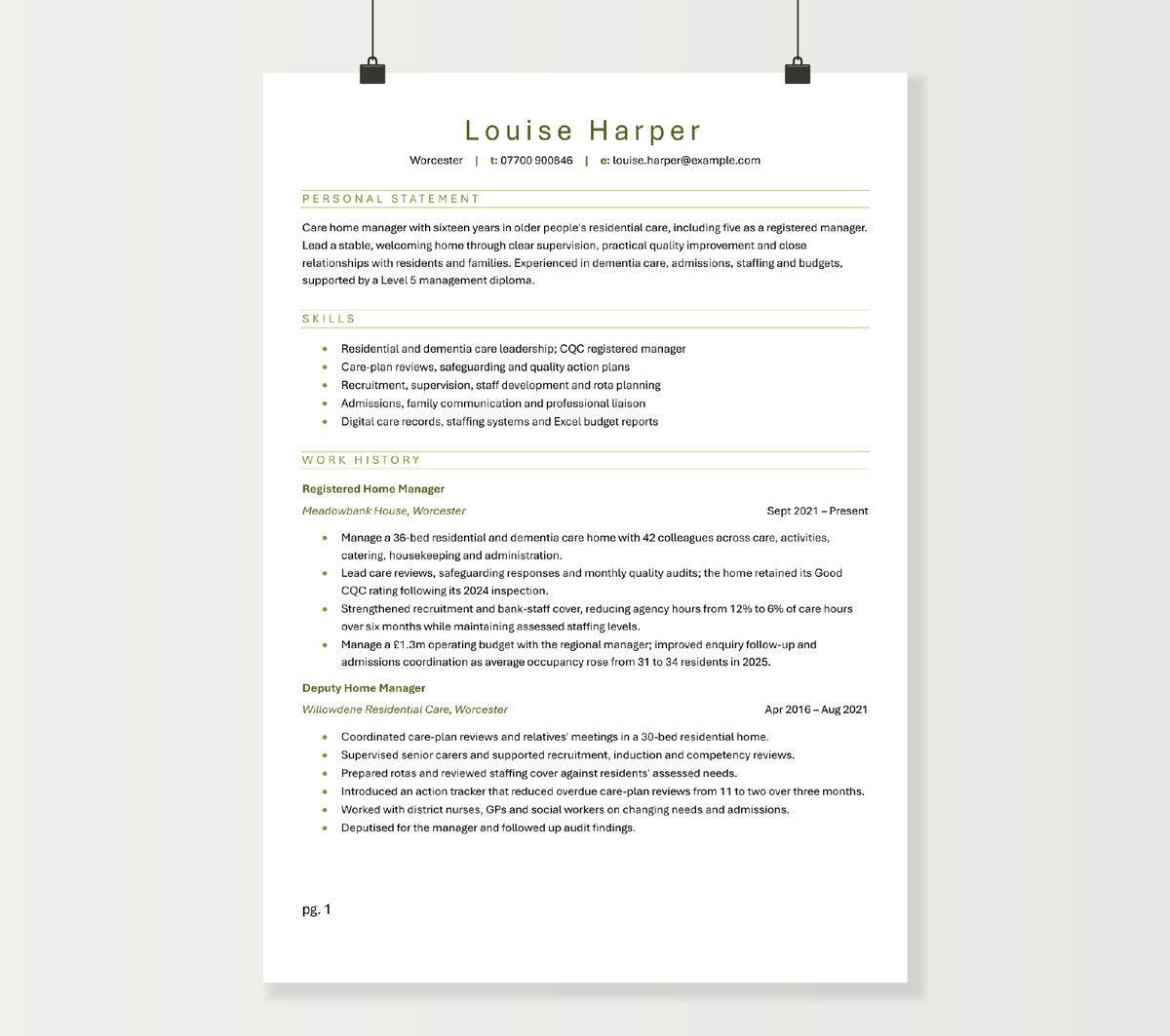
This care home manager CV template follows progression from care assistant to registered manager of an older people's residential home. The Word example brings together care quality, staffing, family relationships and financial responsibility. The guide explains how to present management experience for residential, nursing and specialist care-home applications.
Filename: FreeCVDownload_Care_Home_Manager.docx
Content of this CV template
Louise Harper
Worcester | t: 07700 900846 | e: [email protected]
Personal statement
Care home manager with sixteen years in older people's residential care, including five as a registered manager. Lead a stable, welcoming home through clear supervision, practical quality improvement and close relationships with residents and families. Experienced in dementia care, admissions, staffing and budgets, supported by a Level 5 management diploma.
Skills
- Residential and dementia care leadership; CQC registered manager
- Care-plan reviews, safeguarding and quality action plans
- Recruitment, supervision, staff development and rota planning
- Admissions, family communication and professional liaison
- Digital care records, staffing systems and Excel budget reports
Work history
Registered Home Manager
Meadowbank House, Worcester
Sept 2021 – Present
- Manage a 36-bed residential and dementia care home with 42 colleagues across care, activities, catering, housekeeping and administration.
- Lead care reviews, safeguarding responses and monthly quality audits; the home retained its Good CQC rating following its 2024 inspection.
- Strengthened recruitment and bank-staff cover, reducing agency hours from 12% to 6% of care hours over six months while maintaining assessed staffing levels.
- Manage a £1.3m operating budget with the regional manager; improved enquiry follow-up and admissions coordination as average occupancy rose from 31 to 34 residents in 2025.
Deputy Home Manager
Willowdene Residential Care, Worcester
Apr 2016 – Aug 2021
- Coordinated care-plan reviews and relatives' meetings in a 30-bed residential home.
- Supervised senior carers and supported recruitment, induction and competency reviews.
- Prepared rotas and reviewed staffing cover against residents' assessed needs.
- Introduced an action tracker that reduced overdue care-plan reviews from 11 to two over three months.
- Worked with district nurses, GPs and social workers on changing needs and admissions.
- Deputised for the manager and followed up audit findings.
Care Assistant / Senior Care Assistant
Willowdene Residential Care, Worcester
Sept 2010 – Mar 2016
- Promoted to senior care assistant in 2013, coordinating shifts and supporting new colleagues.
- Supported personal care, meals and activities around residents' preferences.
- Maintained daily records and raised changes in wellbeing with the senior team.
- Built regular communication with residents and relatives.
Qualifications
Level 5 Diploma in Leadership and Management for Adult Care
City & Guilds
2020
- Work-based qualification completed while deputy manager.
- Level 3 Diploma in Health and Social Care (Adults), City & Guilds, 2012.
- 8 GCSEs, including English and Maths at grade C or above, 2010.
Continuing development
Employer and local safeguarding partnership
2025 – 2026
- Safeguarding adults, mental capacity, dementia care, medication oversight, infection prevention and incident review.
Hobbies and interests
- Gardening: Growing vegetables and flowers.
- Walking: Exploring the Malvern Hills.
- Theatre: Visiting local productions.
Registration
CQC registered manager for Meadowbank House since September 2021.
How to write a care home manager CV
A care home manager’s CV needs to show how your leadership shapes the home: the experience of the people living there, the support available to staff and the quality of everyday decisions. Employers also need to understand the scale of your responsibility, your relevant registration and your ability to keep the service financially sustainable.
The strongest evidence connects those areas. A change to recruitment may improve continuity for residents as well as reduce agency use. Better care-plan reviews may help colleagues respond consistently to changing needs. An effective CV explains the management action and what improved, with enough context for another provider to recognise its value.
Establish the kind of home you can lead
Open with your care setting, management experience and the people you have supported. Residential care for older people, nursing care, dementia care and specialist learning-disability services involve different teams and responsibilities. Make your background clear before moving into achievements.
Then give the reader a few useful markers of scope: the home’s capacity, team size, number of locations and whether you held registered-manager responsibility. For example, “Registered manager of a 36-bed residential and dementia care home, leading 42 colleagues across care and support services” is much more informative than “experienced manager in a busy care environment”.
If you have managed several homes, separate permanent appointments from interim cover and regional support. A multi-site improvement assignment can be valuable experience, but its remit differs from day-to-day accountability for one home. A short explanation under the title will make that distinction clear.
Present registration and qualifications in their proper context
For an England-based role, state your CQC registered-manager experience with the relevant service and dates. Link it to the home in your employment history, or use a short registration section. A deputy applying for a first home-manager role can lead with the management duties already undertaken and the relevant qualification, then explain their next step in the application.
CQC assesses qualifications, competence and experience in relation to the service. Its registered-manager guidance is useful when preparing for that separate process. On the CV, distinguish a management diploma, professional registration and experience of leading a regulated service; each supplies different evidence.
Give care and management qualifications their full awarded titles, level, awarding body and dates. This is particularly useful where an older qualification has a different title from the one named in a vacancy. If you are completing a course, show that it is in progress and include the expected completion date. Keep recent safeguarding, dementia, medicines or leadership development together in a smaller section.
For a nursing-home vacancy that requires a registered nurse, make your nursing qualification, registration field and current NMC status easy to find. Include clinical leadership evidence in the employment history. Residential-care management experience should be presented through its own strengths: care leadership, staff competence, external professional relationships and operational oversight.
Connect quality assurance to improvements in residents’ care
Lists of audits and policies tell an employer what you monitored. Examples of what you changed show how you managed. Select one or two areas where you identified a gap, involved the right people, agreed an action and checked that it had made a difference.
Useful subjects include care-plan reviews, medicines records, nutrition and hydration monitoring, incident learning, infection prevention, safeguarding practice or the response to residents’ feedback. Explain the management contribution rather than the full care procedure. “Introduced a review tracker and weekly follow-up with senior carers, reducing overdue care-plan reviews from 11 to two over three months” gives the reader an action, responsibility and result.
Where you worked with nurses, a quality team or external professionals, include that relationship. A residential manager may coordinate with district nurses and GPs; a nursing-home manager may lead a clinical team directly. The CV should help the employer understand how you achieved oversight in that setting.
For specialist services, bring forward the evidence that distinguishes your work: adapting support to communication needs, coordinating multidisciplinary reviews, developing staff competence or improving participation in everyday decisions. Those details explain your suitability more effectively than broad statements about meeting complex needs.
Use inspection outcomes with dates and context
An inspection result can be a useful achievement when the CV identifies the home, outcome, date and your contribution. A sentence such as “Led the home’s quality action plan before its 2024 inspection, at which it retained a Good rating” lets the reader place the result within your tenure.
If you joined during an improvement programme, explain the starting position and the work you led. Examples might include rebuilding supervision arrangements, improving evidence of care reviews or introducing follow-up of audit actions. Where a subsequent inspection has taken place, add that result. Where it has not, use completed actions and current internal evidence to show progress.
Strong applications can come from managers with experience of difficult services as well as consistently well-rated homes. What matters is the clarity of your decisions, your contribution to improvement and the evidence of what happened during your appointment. A brief, factual account gives an interviewer something useful to explore.
Show how you built and supported the team
A care home manager leads more than a rota. Explain your responsibility for recruitment, induction, supervision, appraisal, performance and the development of deputies or senior carers. Include the wider home team where it falls within your remit: activities, catering, housekeeping, maintenance and administration all affect residents’ experience.
Choose a staff example with a clear management intervention. You might have introduced a more structured induction, developed a senior carer into a deputy, improved supervision completion or built a more reliable internal bank. If you use retention figures, identify the period and employee group so the result can be understood.
Agency use is another useful measure when it is presented alongside the staffing context. The example CV records a fall in agency hours as a share of care hours while maintaining assessed staffing levels. That gives the figure a practical meaning. It shows an improvement in how the home was staffed, rather than simply a smaller payroll.
For a deputy moving into home management, bring forward occasions when you took responsibility across the home: leading an audit cycle, coordinating staffing during absence, managing a recruitment round or following through a complaint. Explain the scope and the support structure so the reader can see your readiness for broader accountability.
Make residents’ and relatives’ experience part of the evidence
Values such as dignity, choice and person-centred care become more persuasive when the CV shows how you put them into management practice. You might have changed the way residents contributed to activity planning, introduced more accessible feedback arrangements or improved communication when care needs changed.
Describe the channel and the action. For example, “Established monthly relatives’ meetings and an action log, leading to revised visiting information and a clearer route for care updates” is more useful than “maintained excellent relationships”. Where feedback led to a change, make that connection visible.
Complaints experience can demonstrate listening, coordination and follow-through. Focus on your process and the service improvement that resulted. A concise account of the issue at service level usually provides all the context a CV needs, while leaving the detailed discussion for interview.
Explain budgets, occupancy and admissions together
Providers need managers who understand the resources required to deliver good care. State the budget or cost areas you controlled and your reporting relationship. Managing a whole-home operating budget, monitoring staffing costs and submitting expenditure requests are different responsibilities; the wording should make your level clear.
Occupancy can be relevant, particularly where you managed enquiries, assessments, relationships with referrers or the admission process. Give the home’s capacity and a useful period with any result. “Average occupancy rose from 31 to 34 residents during 2025 in a 36-bed home” is easier to interpret than an isolated growth percentage.
Follow the number with the work behind it: responding to enquiries, coordinating visits, developing professional relationships or improving the transition into the home. Assessment of whether the home can meet a person’s needs is part of the management context, so an admissions achievement should sit alongside evidence of care quality and staffing.
For a not-for-profit or specialist commissioned service, sustainability, contract requirements and delivery against agreed outcomes may be more useful subjects than sales language. Let the service model determine which financial or operational evidence deserves space.
Include systems as evidence of management practice
Digital care records, medicines systems, rotas, training matrices and quality dashboards are useful skills when the CV explains how you used them. Name the system where relevant, then describe the purpose: reviewing overdue care plans, monitoring staffing cover, checking training requirements or analysing incidents.
If you led a system change, give the scale and your contribution. Training colleagues, checking the completeness of migrated records and supporting the team after launch are distinct achievements. For an experienced manager, a short systems line plus one strong implementation example will usually carry more weight than a software list.
Applying across the UK or moving between care settings
Use the registration and regulatory terminology of the service where you worked, and identify the country when necessary. CQC relates to England. For Wales, Scotland and Northern Ireland, present the applicable service-management and professional registration status; the arrangements and qualification routes differ.
The relevant official guidance includes Social Care Wales for adult care-home managers, the SSSC guidance for managers of adult care-home services and RQIA registration guidance. These are useful when checking how your current background relates to a role in another UK nation.
When moving between residential, nursing and specialist services, explain the overlap in leadership experience and the setting-specific knowledge you bring. Team development, care reviews and governance may transfer, while the people supported, clinical responsibilities and registration requirements need their own treatment. A short targeted profile and carefully selected examples can make that fit clear.
Build a career history that shows increasing responsibility
Give the most space to the roles that demonstrate management capability, but retain the dates and progression of earlier care work. A combined entry for care assistant and senior care assistant can show promotion without repeating basic duties. The care assistant example may help you identify the direct-care foundation to retain when describing that progression.
A concise CV and a full employment-history form serve different purposes. Care-sector applications may request detailed dates, reasons for leaving and explanations of gaps. Keep those records available so the CV’s summary can be expanded accurately in the employer’s process.
Finish by checking whether each recent role gives a clear picture of the home, your accountability and an improvement you helped deliver. The template library offers alternative layouts if your clinical qualifications, interim assignments or longer management history need a different balance of space.
Care Home Manager CV FAQs
Use an interim-management entry with the contracting employer or your business, followed by selected assignments and dates. For each, give the home's type and size, the reason for the assignment and the work completed. This helps the reader understand a deliberate interim career and distinguish a stabilisation project, maternity cover and a permanent appointment.
Show the stages you owned: recruiting the initial team, preparing systems and records, coordinating premises readiness, building referral relationships or managing the first admissions. Include dates and the home's capacity so the scale is clear. A new-home opening can provide strong management evidence before there is a long occupancy history or inspection record.
Yes, particularly where it demonstrates care quality, safeguarding, workforce management and relationships with families and commissioners. Explain the scale of the service you managed and bring forward any residential-care experience. A care-home employer will also want to see how your experience relates to a single-site team, premises, hospitality services and the daily community within the home.
Include a relevant award with its awarding organisation and date, alongside the work it recognised. A public review score can add context if you give the platform, date and number of reviews, but a concrete improvement example usually deserves more space. Inspection outcomes, resident feedback and external awards are different forms of evidence, so label each clearly.
Keep the home and continuous employment dates clear, then note the change of provider within the entry. If your responsibilities expanded during the transition, describe that as an achievement: supporting colleagues, introducing new systems or maintaining service continuity. Separate entries are useful where your title or remit changed substantially; otherwise one continuous history is usually easier to follow.




