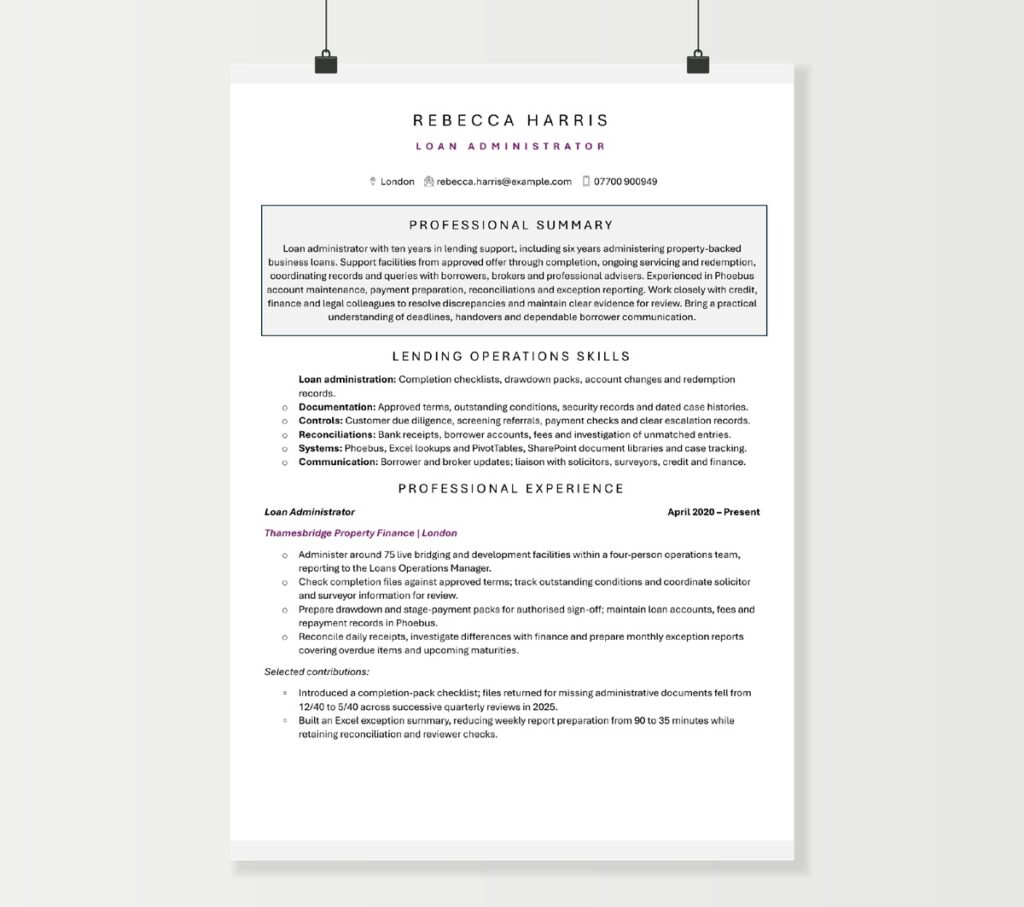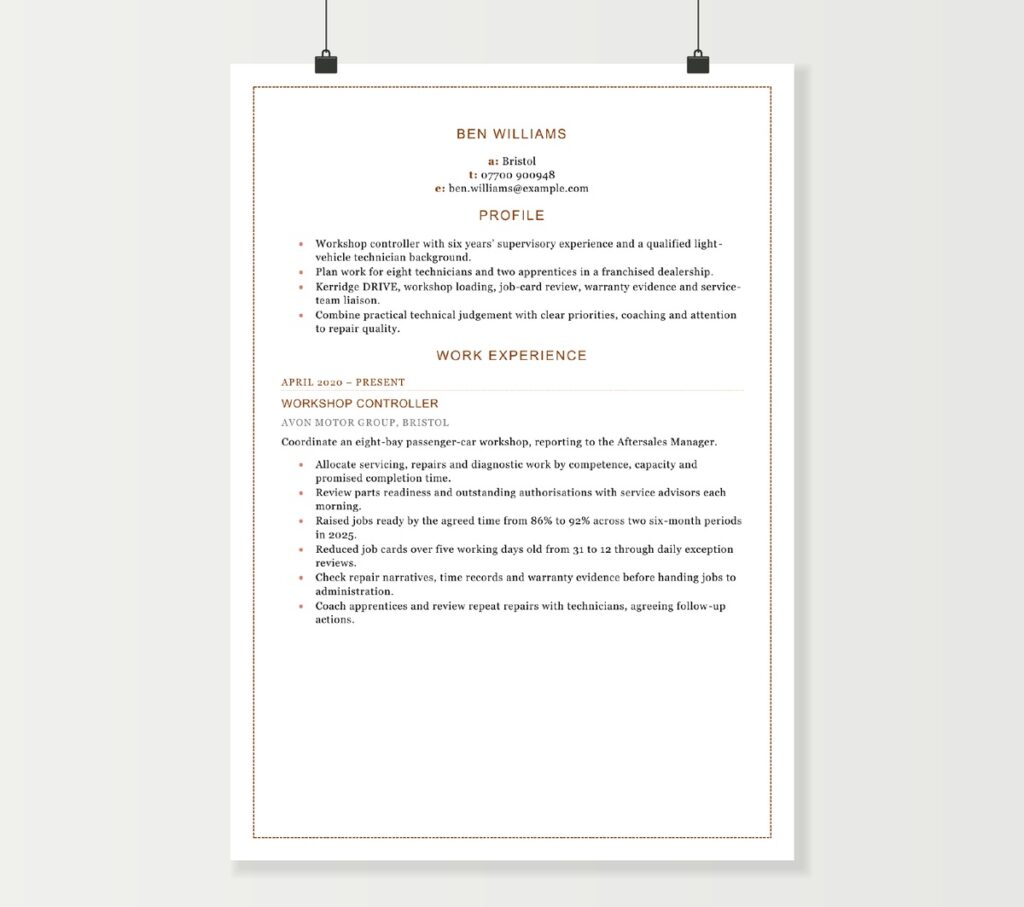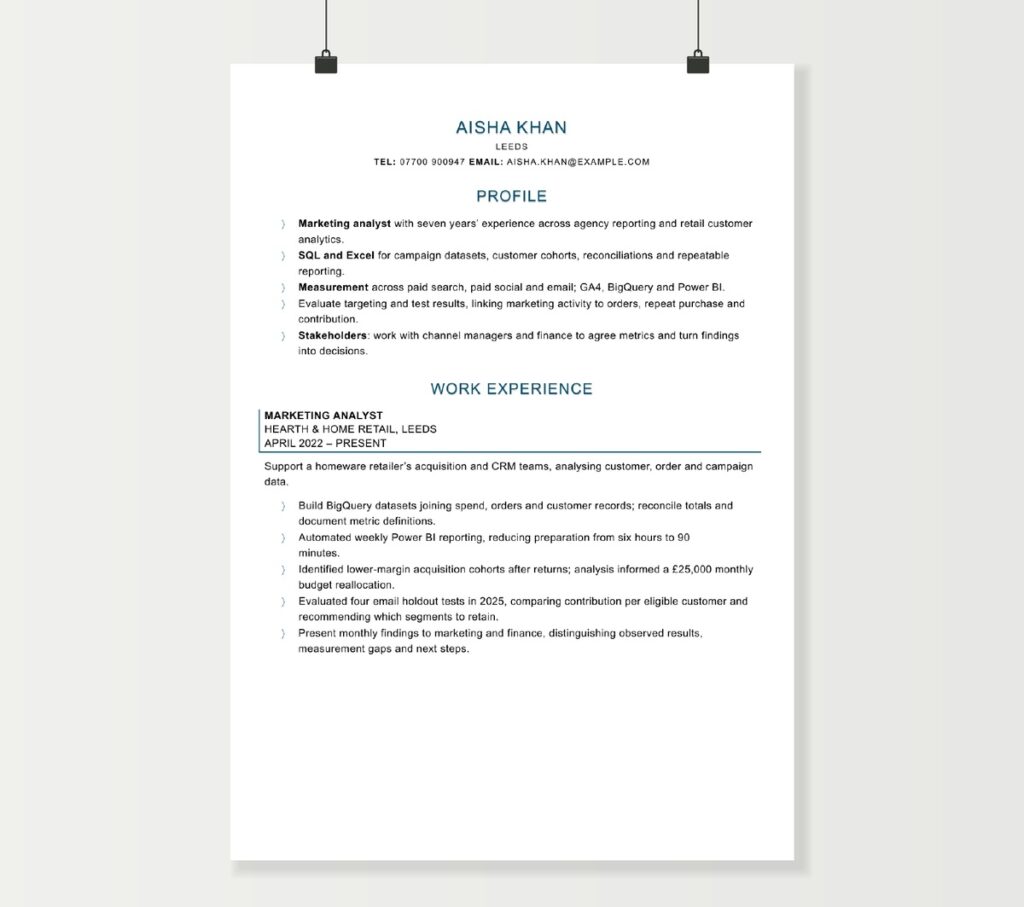
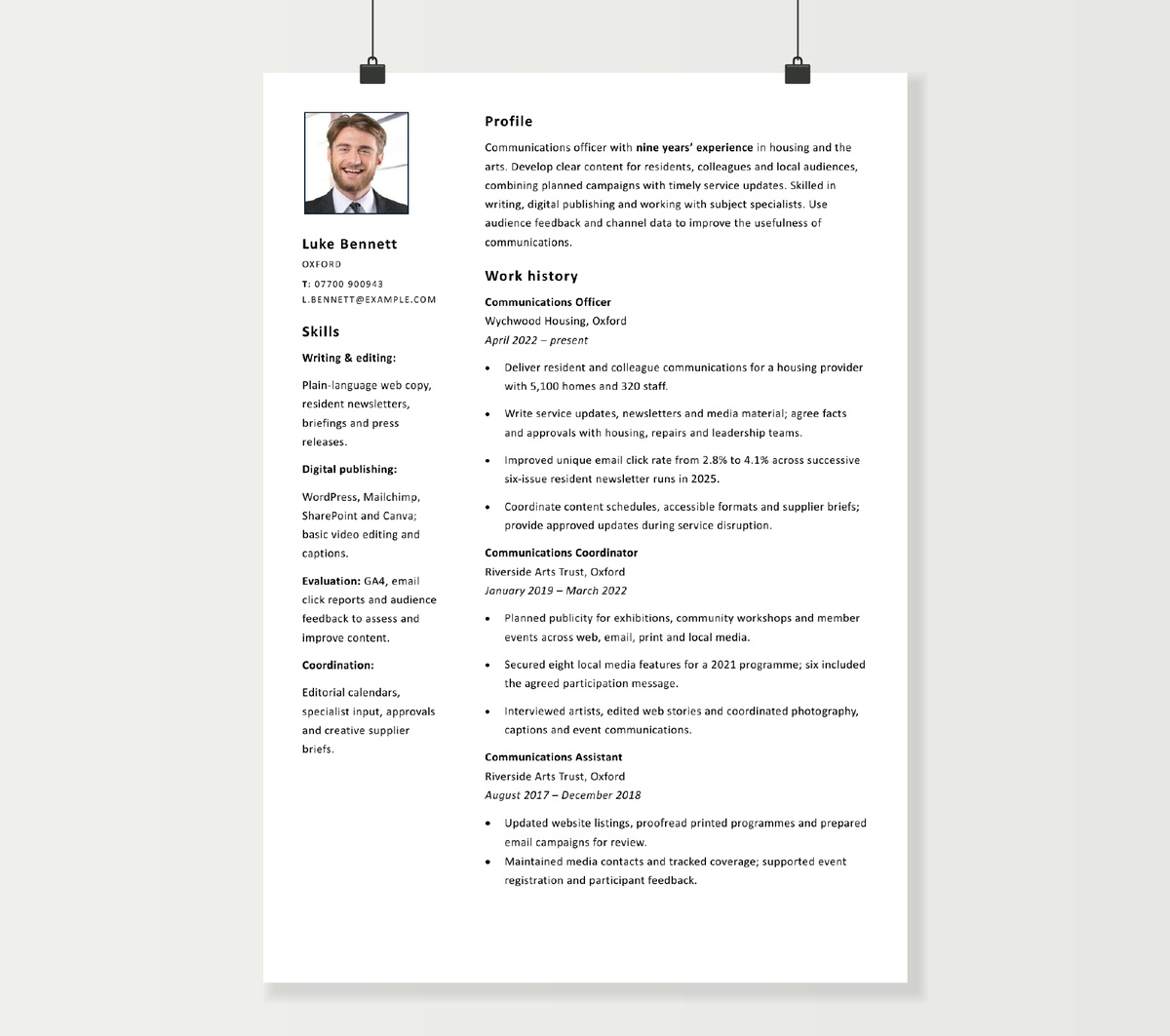
This communications officer CV template shows a career spanning arts and housing communications, with examples of accessible content, resident information and colleague briefings. The Word download includes selected work and practical results. The guide explains how to present your audiences, writing, channels and contribution to successful communications.
Filename: FreeCVDownload_Communications_Officer.docx
Content of this CV template
Luke Bennett
Oxford
t: 07700 900943
[email protected]
Profile
Communications officer with nine years’ experience in housing and the arts. Develop clear content for residents, colleagues and local audiences, combining planned campaigns with timely service updates. Skilled in writing, digital publishing and working with subject specialists. Use audience feedback and channel data to improve the usefulness of communications.
Skills
Writing & editing:
Plain-language web copy, resident newsletters, briefings and press releases.
Digital publishing:
WordPress, Mailchimp, SharePoint and Canva; basic video editing and captions.
Evaluation: GA4, email click reports and audience feedback to assess and improve content.
Coordination:
Editorial calendars, specialist input, approvals and creative supplier briefs.
Work history
Communications Officer
Wychwood Housing, Oxford
April 2022 – present
- Deliver resident and colleague communications for a housing provider with 5,100 homes and 320 staff.
- Write service updates, newsletters and media material; agree facts and approvals with housing, repairs and leadership teams.
- Improved unique email click rate from 2.8% to 4.1% across successive six-issue resident newsletter runs in 2025.
- Coordinate content schedules, accessible formats and supplier briefs; provide approved updates during service disruption.
Communications Coordinator
Riverside Arts Trust, Oxford
January 2019 – March 2022
- Planned publicity for exhibitions, community workshops and member events across web, email, print and local media.
- Secured eight local media features for a 2021 programme; six included the agreed participation message.
- Interviewed artists, edited web stories and coordinated photography, captions and event communications.
Communications Assistant
Riverside Arts Trust, Oxford
August 2017 – December 2018
- Updated website listings, proofread printed programmes and prepared email campaigns for review.
- Maintained media contacts and tracked coverage; supported event registration and participant feedback.
Qualifications
- BA (Hons) English, 2:1
University of Leicester, 2017 - A levels: English Literature, History and Geography, 2014
Professional development
- Accessible content — employer workshop, 2025
- Media enquiries and interview briefing — employer training, 2024
- GA4 reporting — workplace learning programme, 2023
Selected communications work
Repairs information refresh | 2025
Wychwood Housing: clearer routes for reporting repairs.
Rewrote six web pages with repairs colleagues and tested the draft with 12 residents.
Result: Correct route selected by 11/12 participants, up from 8/12 with the original pages.
Used the same three scenarios in both testing rounds.
Colleague service-change briefings | 2026
Wychwood Housing: new appointment-booking process.
Prepared manager slides, intranet updates and a question log with the project lead.
Delivery: Four briefings reached 86 colleagues before launch.
Updated the staff Q&A using questions raised in the sessions.
Interests
Music:
Play guitar and enjoy small live-music venues.
Walking: Weekend walks in the Chilterns with friends.
Cooking:
Enjoy trying new recipes and cooking for family.
How to write a communications officer CV
A communications officer CV is itself a piece of communication: it needs a clear audience, a useful selection of evidence and writing that makes the reader’s job easier. Show how you understand a brief, shape a message and deliver it through appropriate channels, then explain what the work achieved.
The title covers a broad range of posts. A media-focused role, an internal communications vacancy and a digital member-services role will call for different examples. Build the application around the work you would be expected to deliver.
Give your communications experience a clear focus
Use the opening profile to identify your strongest settings, audiences and responsibilities. You might communicate with residents, employees, members, journalists, service users or professional stakeholders. Naming those audiences is more informative than describing yourself as an excellent communicator.
Summarise the relevant balance of planning and delivery. An officer in a small team may develop a campaign plan, write the content and publish it. Someone in a larger organisation may specialise in press, internal channels or digital publishing while contributing to wider campaigns.
Luke’s example establishes housing and arts experience, then supports it with resident information, media work and colleague briefings. For a specialist application, give the most relevant strand more space and keep the other work as supporting evidence.
Build campaign examples around audience and purpose
A campaign entry should help the recruiter understand the brief, your contribution and the result. Start with the audience and the change the organisation wanted to achieve. This could be encouraging participation, explaining a service change, increasing use of a resource or helping colleagues understand a new process.
Then describe the work you owned: gathering insight, developing messages, planning content, commissioning assets, coordinating approvals or delivering the launch. Include the channels that mattered and explain a useful decision, such as adding printed information for people less likely to use the website.
A compact project entry can follow this sequence:
- Brief: the audience, issue and intended outcome.
- Contribution: the content, coordination or advice you provided.
- Evidence: what was delivered, learned or improved.
Use selected projects when they add depth that would be lost in employment bullets. Luke’s repairs-information example explains a specific writing task and a small user test; his service-change example shows internal briefing materials and a feedback loop.
Demonstrate writing and editorial judgement
Identify the forms of writing you produce: news stories, media releases, executive messages, intranet articles, service information, newsletters or consultation material. Give examples of adapting complex information for a particular audience.
Explain how you obtain and check the material. Interviewing a subject specialist, resolving inconsistent information, agreeing an accessible explanation or coordinating factual approval all show the judgement behind the finished copy.
Editing can be strong evidence too. You may have shortened a technical report into a public summary, brought several contributors into one consistent voice or improved the structure of frequently used service pages. Describe the reader’s need and the contribution you made.
The application should demonstrate the same care: precise verbs, consistent dates and readable sentences. Select a few strong examples rather than repeating “created engaging content” across several jobs.
Present media relations through your actual role in the story
For a press-focused vacancy, show news judgement, relationships with journalists and the process of developing a story with internal experts. Relevant evidence includes preparing releases, pitching, responding to enquiries, arranging interviews, briefing spokespeople and monitoring coverage.
Give context for coverage. The type of outlet, audience and presence of the intended message can be more useful than the number of mentions alone. Luke’s arts example records eight local features and notes how many included the participation message.
Reactive work can also be included at an appropriate level of detail. Explain how you gathered confirmed facts, drafted a response, coordinated approval or maintained an update schedule under a deadline. This lets the employer see your role in a press office or incident response without needing a full account of the incident.
If your experience sits mainly in social publishing, the social media manager guide offers more detail on presenting channel management. For a communications officer application, connect that work to the wider message and audience purpose.
Give internal communications its own evidence
Internal communications is more than publishing a staff newsletter. Show how you help colleagues understand decisions, changes or priorities, including people who do not spend their working day at a desk.
Examples might involve manager briefing packs, leadership messages, intranet updates, team meetings, colleague networks or feedback sessions. State the workforce or groups involved and how you worked with HR, operational managers or project leads.
For organisational change, describe your contribution to timing, consistency and questions raised by colleagues. A useful result might be improved understanding in feedback, fewer repeated queries or delivery of briefings before a change took effect. These measures help explain the value of the work.
Connect digital and creative tools to finished work
List the systems you use and the tasks you perform in them. WordPress publishing, SharePoint intranet editing, Mailchimp segmentation, Canva assets and video captioning communicate different capabilities. A short skills section can establish the tools; employment examples should show their use.
For roles involving digital platforms, include your responsibility for content migration, user feedback, supplier coordination, testing or analytics. Explain whether you managed content, briefed technical partners or coordinated delivery of a platform change.
Creative production should be equally clear. Distinguish content you wrote or produced from work you commissioned and approved. Both can be valuable: a well-scoped supplier brief and coordinated delivery demonstrate different strengths from hands-on design or editing.
Accessibility belongs alongside this evidence. Mention practical experience of plain-language editing, captions, alternative text, accessible documents or arranging alternative formats. For bilingual communications, show how language needs fitted into the production and approval schedule.
Choose measures that explain the effect of your work
Outputs, reach, understanding and action answer different questions. Publishing twelve newsletters demonstrates delivery; clicks show a response; feedback may indicate understanding; registrations or service use can show a further action. Choose the measure that fits the original brief.
Give a baseline, period and measurement basis for comparisons. Luke’s email result compares unique click rates across two six-issue runs. His repairs-page example gives the number of participants and the task used, so the reader can understand the scale of the evidence.
For team campaigns, make your contribution visible alongside the shared result. For work with limited analytics, use delivery records, audience feedback, stakeholder acceptance or a specific improvement made after testing. A thoughtful account of what you learned can demonstrate evaluation as well as a headline metric.
Where measurement changed between periods, explain the relevant context briefly. Communications employers value someone who can interpret performance and use it to improve the next piece of work.
Use a portfolio to add evidence of quality
A small, well-chosen portfolio can show writing and judgement more effectively than a large collection of links. Select pieces relevant to the vacancy: a public news article, an accessible service page, a newsletter, a campaign sequence or a briefing extract.
Give each sample a short caption covering the brief, audience, your contribution and any useful result. If several people contributed, explain which elements you handled. A published article alone may not reveal that you interviewed the specialist, wrote the copy and coordinated the final approval.
Provide a straightforward link or indicate that samples are available on request. A short PDF can work well when material has moved or a project needs explanation. The CV should still contain enough evidence for a recruiter who reviews it before opening supporting material.
Present qualifications and entry routes in proportion
Communications, journalism, marketing and English qualifications can all be relevant, alongside experience gained through other routes. Give the qualification, institution and date, then choose any project or training detail that helps establish your suitability.
Professional study through bodies such as CIPR, PRCA or the Institute of Internal Communication can support a particular specialism. State the award or course and completion stage clearly. Recent training in accessibility, evaluation, media handling or digital platforms can also be useful when connected to your work.
For a first communications role, use evidence from student publications, volunteering, an apprenticeship, placements or an earlier job that involved writing and audiences. Explain the brief and the work you completed. Experienced applicants should devote more space to increasingly complex assignments, advice to stakeholders and ownership of delivery.
Choose a layout from the template library that gives your strongest evidence room to breathe. For this occupation, clear writing and a considered selection of work do much of the work of demonstrating your suitability.
Communications Officer CV FAQs
Use material cleared for sharing, a suitably anonymised extract or a short case study explaining the brief, your contribution and the result. You can also offer to discuss the approach at interview. A portfolio can combine public work with case studies; it does not need to reproduce every internal document.
Yes. Describe your role as drafting, editing or developing the message for that leader, with the audience and purpose. If the piece is public, a portfolio caption can explain your contribution. This is useful evidence of adapting voice and working through approval, even when your name is not on the published text.
Lead with transferable evidence such as finding stories, interviewing specialists, checking facts, writing for defined audiences and meeting deadlines. Add any work with campaigns, organisational priorities, digital channels or stakeholder approval. The application should explain how your editorial experience supports the employer’s communications needs.
Use the CV as your evidence bank, then organise the response around the stated criteria and word limits. Develop the most relevant examples with enough detail about your actions and results. The career-history section and supporting statement usually have different purposes, so each should contribute useful information.
Yes, where it is relevant. Explain your experience of briefing translators, coordinating parallel versions, planning approval time and arranging publication. List your own language proficiency separately. The employer can then distinguish production experience from the ability to write or review content in that language.
A photograph is generally optional for a UK communications application. This design includes one, but your writing, relevant experience and work samples provide the professional evidence. Choose the presentation that suits the application and follow any anonymised-recruitment instructions.
It can be useful when the vacancy involves them or you have a concrete example of improving a workflow. Explain the task, your editorial role and the outcome, such as helping organise source material or produce initial format variations for review. Your writing judgement, source checking and final decisions remain the evidence an employer needs to assess.
Yes, if it adds relevant evidence. Group assignments under a freelance entry with dates, client sectors and selected briefs. Show the work you delivered and any ongoing employed role clearly. For several short projects, a small selection with distinct audiences or responsibilities is easier to assess than an exhaustive client list.