
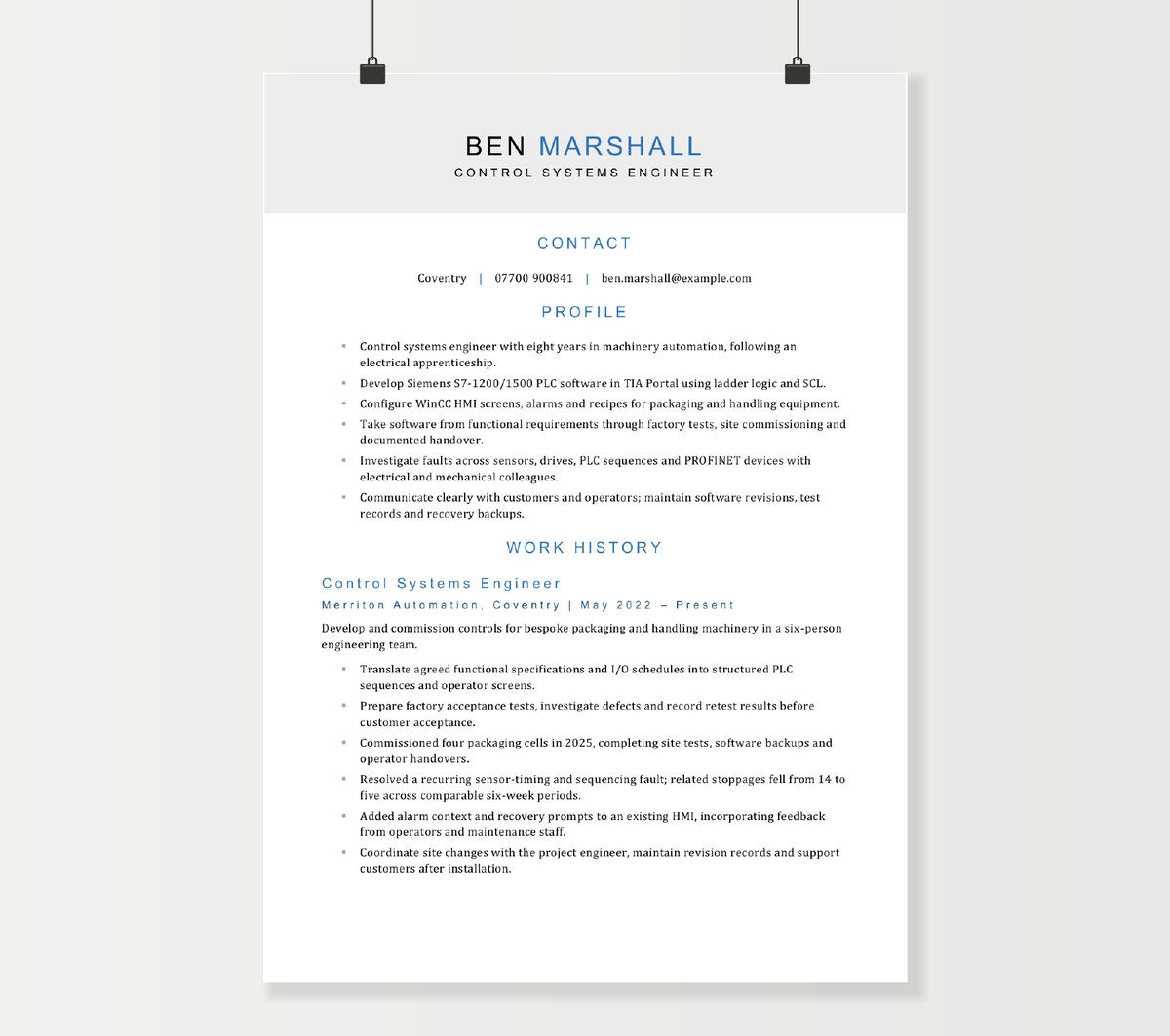
This control systems engineer CV template follows an apprenticeship route into machinery automation. The Word example combines Siemens PLC and HMI development with testing, commissioning and customer support. The guide explains how to present your platforms, project responsibilities and engineering results across machine, process and other control-system applications.
Filename: FreeCVDownload_Control_Systems_Engineer.docx
Content of this CV template
Ben Marshall
Control Systems Engineer
Contact
Coventry | 07700 900841 | [email protected]
Profile
- Control systems engineer with eight years in machinery automation, following an electrical apprenticeship.
- Develop Siemens S7-1200/1500 PLC software in TIA Portal using ladder logic and SCL.
- Configure WinCC HMI screens, alarms and recipes for packaging and handling equipment.
- Take software from functional requirements through factory tests, site commissioning and documented handover.
- Investigate faults across sensors, drives, PLC sequences and PROFINET devices with electrical and mechanical colleagues.
- Communicate clearly with customers and operators; maintain software revisions, test records and recovery backups.
Work history
Control Systems Engineer
Merriton Automation, Coventry | May 2022 – Present
Develop and commission controls for bespoke packaging and handling machinery in a six-person engineering team.
- Translate agreed functional specifications and I/O schedules into structured PLC sequences and operator screens.
- Prepare factory acceptance tests, investigate defects and record retest results before customer acceptance.
- Commissioned four packaging cells in 2025, completing site tests, software backups and operator handovers.
- Resolved a recurring sensor-timing and sequencing fault; related stoppages fell from 14 to five across comparable six-week periods.
- Added alarm context and recovery prompts to an existing HMI, incorporating feedback from operators and maintenance staff.
- Coordinate site changes with the project engineer, maintain revision records and support customers after installation.
Junior Controls Engineer
Eastbrook Machine Systems, Rugby | Sep 2018 – Apr 2022
Supported PLC and HMI development for assembly equipment, working with a senior controls engineer.
- Developed Siemens ladder routines and HMI pages from agreed designs, testing changes before engineering review.
- Investigated CompactLogix faults and made reviewed modifications using Studio 5000 Logix Designer.
- Completed I/O checks, logged commissioning issues and updated electrical drawing mark-ups with the design team.
- Created a software-backup and release checklist adopted for the team's machine handovers.
Apprentice Electrical Technician
Eastbrook Machine Systems, Rugby | Sep 2014 – Aug 2018
Completed an advanced apprenticeship while supporting machine build and test work.
- Wired control panels from drawings and assisted with inspection and testing under supervision.
- Supported sensor installation, fault-finding and accurate build records alongside experienced technicians.
Qualifications and development
HNC Electrical and Electronic Engineering
Coventry College, 2019. Advanced electrical engineering apprenticeship, 2018.
Technical development
Siemens TIA Portal programming course, 2023. Employer training in machinery safety awareness and commissioning procedures, 2025.
Interests and availability
I enjoy cycling, playing guitar and cooking. Full UK driving licence; available for UK commissioning travel.
How to write a control systems engineer CV
A control systems engineer CV should show how your work reaches a functioning machine, process or operational system. Programming platforms matter, but employers also need to see how you interpret requirements, test behaviour, resolve faults and leave a system that other people can operate and maintain.
The example above focuses on machinery automation. A process-control, energy or model-based controls role will need a different selection of projects and technical evidence. Begin with that distinction, then organise the CV around the work you have delivered.
Identify your engineering context early
Use the profile to establish your application area, strongest platforms and level of responsibility. Packaging machinery, water treatment, generator controls and offshore monitoring can all involve control systems, but their operating demands and project evidence differ considerably.
A machinery engineer might lead with PLC sequences, operator interfaces and commissioning. A process engineer could emphasise control philosophies, DCS configuration, instrumentation and plant modifications. An engineer working on renewable-energy infrastructure may need to foreground supplier interfaces, control-centre integration and acceptance evidence.
State whether you develop new systems, modify an installed base, support operational faults or lead technical delivery. If the role combines these activities, choose the two or three that best represent your experience. A profile that establishes this context makes the later software and project details much easier to interpret.
Make the technical skills section describe capability
For each important platform, connect the product name with the controllers, application and work you perform. “Siemens” is a broad label. “S7-1200/1500 development in TIA Portal using ladder logic and SCL” gives the reader a much clearer starting point.
Group skills according to the work rather than placing every name in one line. Useful groupings might be PLC development, HMI/SCADA, industrial communications, drives and instrumentation, and engineering documentation. The right groups depend on your specialism.
Describe depth through the task. Developing a new application, modifying reviewed routines, diagnosing faults and supporting an installed system are distinct capabilities. In Ben’s example, Siemens development is central to his current role, while the earlier CompactLogix entry explains his experience of fault investigation and reviewed modifications. That distinction makes the skills more informative.
Programming languages also benefit from context. Mention ladder, structured text, function blocks or other languages where they connect to delivered work. If your background is model-based development, describe the modelling, implementation and validation stages you handled. Software names become persuasive when the employment history shows what you produced with them.
Choose projects that show the engineering sequence
A selected project should let the reader follow the work from the requirement to the result. You can include short project examples within each job, or use a separate projects section when several substantial assignments deserve attention.
Give each example four elements:
- Application and scope: the machine, plant or system, with a useful scale such as cells, sites, interfaces or control panels.
- Your responsibility: the design, software, integration, testing or commissioning work you owned.
- Engineering challenge: a particular interface, operating constraint, migration requirement or recurring fault.
- Delivery evidence: an accepted test stage, completed handover, resolved defect or measured operational improvement.
For example, a phased PLC migration can demonstrate more than knowledge of the replacement controller. The CV could explain how you prepared the software and test plan, coordinated the change with operations and completed the agreed checks during the outage. A new machine project might instead show how you translated a functional specification into sequences, operator screens and testable behaviour.
Choose the scale that helps the employer understand complexity. An I/O count may be useful for one system; the number of interfaces, operating modes or remote sites may be more revealing for another. Project value belongs on the CV when it explains your responsibility, while a clear technical scope often says more about the engineering itself.
Give testing and commissioning proper space
Factory acceptance testing and site acceptance testing are valuable evidence when the entry explains what you did. Writing the test specification, carrying out simulation, witnessing a supplier test and resolving defects demonstrate different responsibilities.
Use the employment history to show the outputs you produced: test scripts linked to requirements, recorded results, defect lists, retest evidence or commissioning reports. A statement about completing the testing is stronger when the reader can see how outstanding issues were brought to closure.
Commissioning experience should establish the setting and your part in the work. Relevant detail might include I/O checks, sequence verification, interfaces with drives or instruments, operator demonstrations and support during initial production. Explain how you worked with electrical, mechanical, process and customer teams where that coordination affected delivery.
Handover is worth mentioning explicitly. Final software revisions, recovery backups, marked-up drawings, operating information and a clear record of remaining actions can demonstrate that you take work through to usable completion. Ben’s four-cell commissioning result includes site tests, backups and operator handovers, giving more substance than the number of installations alone.
Show what sits behind the HMI or SCADA screens
HMI and SCADA experience can be presented through the behaviour and information you configured: machine states, alarms, recipes, trends, reporting, access levels or interfaces with other systems. Select the features that were important to the application.
A useful achievement might concern clearer alarm information, easier fault diagnosis or improved access to production data. Describe the user need, the change and how it was tested or adopted. This shows that you considered the operators and maintenance team as well as the software.
Where data integration matters, identify the source, destination and purpose at a suitable level. For example, an interface between a control system and a historian can be described through the information made available and the checks you completed. The same principle applies to industrial networking: give the protocol and the integration or diagnostic responsibility, rather than listing every protocol encountered.
Present fault-finding as a completed investigation
“Strong troubleshooting skills” becomes much more credible when followed by a short account of a recurring fault you resolved. Describe the symptom, the evidence you used and the change or recommendation that followed. Relevant evidence may come from alarms, sequence states, trends, drive diagnostics, communications or observations on the machine.
The CV is not a fault-finding tutorial. A few lines are usually enough to show how you narrowed the problem, worked with other disciplines and confirmed the result. Where the root cause crossed software and physical equipment, make that collaboration clear.
Quantified results need an understandable measure and period. Ben’s example compares related stoppage counts over two six-week periods. Other useful measures include time to diagnose a defined fault, completion of a planned upgrade within an agreed outage, fewer repeat call-outs or reduced manual steps in a particular operation.
For a cycle-time or throughput improvement, identify the equipment and conditions that make the comparison meaningful. If mechanical changes, operator training and software all contributed, describe the controls contribution within that project. A precise result from one cell can be more convincing than a sweeping claim about the whole factory.
Explain how you manage changes and technical responsibility
Controls work often continues after the first release. Show how you manage revisions, review modifications and preserve the information needed for support. Version records, backups, peer reviews and documented test results are useful CV evidence when connected to a delivered change.
For an operational plant or installed machine, describe the constraints you worked within: approved maintenance windows, staged migration, coordination with production or agreed recovery arrangements. This helps an employer understand your experience of making changes where equipment availability matters.
Safety-related work should be described through the particular engineering activity and your responsibility. You may have implemented an agreed design, contributed to a review, prepared test evidence or worked alongside a functional-safety specialist. Include relevant training and standards where they formed part of that work. The same approach applies to operational-technology security: explain the configuration, review, access arrangements or testing you handled.
For senior posts, add the decisions that other engineers relied on you to make. Architecture reviews, software checking, interface ownership, estimates, technical risk management and coaching can all demonstrate leadership. Distinguish technical leadership from project coordination by showing the engineering outputs you reviewed or approved.
Make collaboration visible through delivery
Controls engineers frequently connect the work of several disciplines. Give an example of resolving an interface with electrical design, agreeing a sequence with a process engineer, supporting a supplier or explaining a commissioning issue to a customer.
Operator and maintenance communication can be equally valuable. Training sessions, diagnostic guides and clear handovers show how you help other people use the system after the project team leaves. If you support customers remotely, describe the information you gather and the way you coordinate a fix or site visit.
Travel and commissioning availability can sit in a brief additional-information line when relevant. The detailed evidence belongs in the project history: the sites, work packages and customer responsibilities that show what your site experience involved.
Use qualifications to support your practical evidence
Present an apprenticeship, HNC, HND or degree with its subject, provider and completion year. The example shows an electrical apprenticeship followed by an HNC and later platform training. That gives the reader a clear route from machine build into controls development.
Vendor courses and specialist training are most useful when their relevance is clear. Give the course or subject and date, then let the employment history show subsequent use. Professional registration or progress towards it can be listed separately where relevant to the target post.
For a graduate or junior applicant, a placement or academic project can provide evidence of requirements, implementation and testing. Explain the application, your own contribution and the result obtained. An experienced engineer can give more space to commissioned systems, supported installations and technical decisions, keeping older study projects brief.
If you are moving from electrical design or maintenance, connect your existing experience with controls tasks: interpreting schematics, investigating machine faults, testing interfaces or supporting modifications. The electrical engineer example and maintenance engineer example offer useful comparisons for presenting that earlier work. Choose a layout from the CV template library that leaves enough room for your strongest project evidence.
Control Systems Engineer CV FAQs
Yes, when they are relevant to the installed systems or migration work in the vacancy. Experience with older controllers can be useful for maintenance, fault investigation and upgrades. State the platform and the work you performed, with recent use apparent from the employment dates. Put the systems most relevant to the new role first.
It can help, especially for junior applicants or work involving software tools, simulation and reusable libraries. A small self-contained project with its purpose, architecture, test approach and results is easier to assess than an unexplained code archive. A short illustrated project summary can work just as well where the main evidence is commissioning, integration or engineering documentation. Use material you can share, such as personal demonstrations or approved project summaries.
Look at the balance of work in the vacancy. Some posts focus heavily on supervisory systems, interfaces, reporting or integration; others require substantial PLC application development. Make your SCADA responsibilities prominent and describe the PLC work you have done, such as diagnostics, interface testing or reviewed modifications. This gives the recruiter a useful picture of where you could contribute immediately and where further development would fit.
Use a clear sequence of client or employer, assignment, dates and engineering scope. A compact project format can identify the application, platforms, deliverables and completion stage for each contract. If several assignments were through one consultancy, group them under that employment entry and give the most relevant projects their own short descriptions.
Yes, if the vacancy matches the work you have done. Keep the employer’s job title in the employment history and use the profile to explain your wider responsibilities, such as requirements, HMI development, testing and commissioning. That helps the reader assess the engineering scope behind the title and understand its relevance to the advertised position.




