
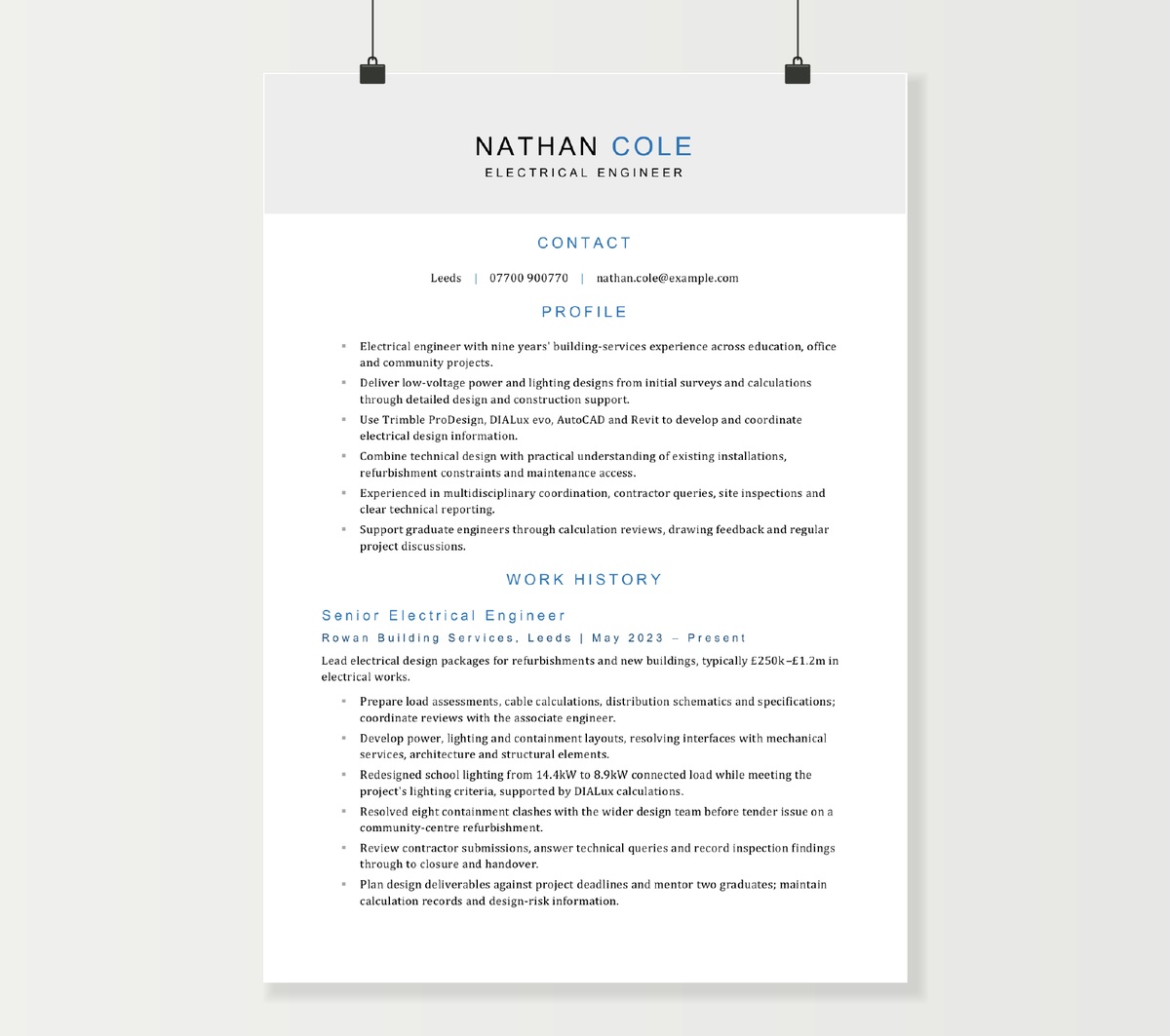
This electrical engineer CV template follows a building-services engineer who has progressed from graduate work to leading electrical design packages. The Word example presents power and lighting design, coordination, site experience and professional development. The guide also explains how to adapt the emphasis for industrial controls, power systems and early-career applications.
Filename: FreeCVDownload_Electrical_Engineer.docx
Content of this CV template
Nathan Cole
Electrical Engineer
Contact
Leeds | 07700 900770 | [email protected]
Profile
- Electrical engineer with nine years' building-services experience across education, office and community projects.
- Deliver low-voltage power and lighting designs from initial surveys and calculations through detailed design and construction support.
- Use Trimble ProDesign, DIALux evo, AutoCAD and Revit to develop and coordinate electrical design information.
- Combine technical design with practical understanding of existing installations, refurbishment constraints and maintenance access.
- Experienced in multidisciplinary coordination, contractor queries, site inspections and clear technical reporting.
- Support graduate engineers through calculation reviews, drawing feedback and regular project discussions.
Work history
Senior Electrical Engineer
Rowan Building Services, Leeds | May 2023 – Present
Lead electrical design packages for refurbishments and new buildings, typically £250k–£1.2m in electrical works.
- Prepare load assessments, cable calculations, distribution schematics and specifications; coordinate reviews with the associate engineer.
- Develop power, lighting and containment layouts, resolving interfaces with mechanical services, architecture and structural elements.
- Redesigned school lighting from 14.4kW to 8.9kW connected load while meeting the project's lighting criteria, supported by DIALux calculations.
- Resolved eight containment clashes with the wider design team before tender issue on a community-centre refurbishment.
- Review contractor submissions, answer technical queries and record inspection findings through to closure and handover.
- Plan design deliverables against project deadlines and mentor two graduates; maintain calculation records and design-risk information.
Electrical Engineer
Calder MEP Consultants, Wakefield | Sep 2020 – Apr 2023
Delivered electrical work packages for schools, offices and small commercial developments following promotion from graduate engineer.
- Produced cable calculations, distribution schedules and lighting designs, incorporating survey findings and project requirements.
- Prepared coordinated Revit layouts and AutoCAD drawings, managing revisions and responding to design-team comments.
- Developed a phased distribution-board replacement proposal with the contractor and school, supporting delivery during the summer closure.
- Attended progress meetings and inspections, recording outstanding items and checking revised technical information.
Graduate Electrical Engineer
Calder MEP Consultants, Wakefield | Sep 2017 – Aug 2020
Developed building-services design experience through supervised calculations, drawing production and site visits.
- Assisted with electrical surveys, lighting calculations and preparation of equipment schedules for senior review.
- Updated drawings from marked-up information and maintained orderly calculation and specification records.
Qualifications and development
BEng (Hons) Electrical and Electronic Engineering
Sheffield Hallam University, 2017 — Upper Second Class
Recent professional development
Employer training: Revit MEP coordination (2023), CDM design risk (2024) and BS 7671 updates (2026).
Hobbies and interests
I enjoy cycling, live music and cooking for friends.
How to write an electrical engineer CV
An electrical engineer CV needs to establish what you engineer. The title can describe someone designing building services, developing industrial control panels, modelling power networks or supporting electrical plant. Your strongest opening gives the reader a recognisable technical setting, then shows the decisions, deliverables and project responsibility you bring to it.
Build the application around the work in the vacancy. A consultancy recruiting for school refurbishments will read your experience differently from a manufacturer seeking machinery controls expertise or an energy team designing grid connections. The same career may support more than one direction, but the most relevant projects should be easy to find.
Define your specialism before listing your skills
Use the profile to connect your level of experience with the systems and environments you know. “Electrical engineer with nine years in building-services design, covering low-voltage distribution and lighting for education and commercial projects” gives a clearer starting point than a broad claim to engineering expertise.
The first line beneath each employer can add useful scale: project types, voltage levels, plant, typical electrical package values or the size of the team. Choose the details that explain the complexity of your work. For a power engineer, network voltage and the nature of the studies may matter more than the building’s floor area. For a controls engineer, the equipment, panel scope and interfaces with software or machinery are likely to be more useful.
The example CV has a consistent building-services focus. Its progression, design tools and project results reinforce that choice. An engineer specialising in industrial systems could use the same layout while giving more space to schematics, component selection, workshop support and testing.
Present design work as engineering decisions and outputs
A statement such as “responsible for electrical design” leaves the reader to guess how much of the process you handled. Name the outputs you produced and the decisions they supported: load assessments, distribution schematics, cable calculations, protection studies, lighting calculations, equipment specifications or technical reports.
Then give a selected example that brings the work to life. Perhaps a survey changed the proposed distribution arrangement, a study identified a constraint on a new load, or a revised panel layout improved access for assembly and maintenance. Explain the situation and your contribution in enough detail for another engineer to understand its significance.
Different routes call for different evidence:
- Building services: power distribution, lighting, containment and specialist-system interfaces; calculations and specifications; coordination with architecture and other services; new-build or refurbishment constraints.
- Industrial equipment and controls: electrical schematics, panel layouts, cable and terminal schedules, bills of materials, component selection, design changes and support during build or testing.
- Power and energy: network or plant context, connection studies, substations, protection, demand or performance modelling, and the recommendations arising from technical analysis.
These are ways to organise relevant experience. A focused account of your own branch of electrical engineering is more useful than a catalogue spanning every branch.
Make project stages and responsibility visible
Employers often need an engineer who can contribute at a particular point in delivery. State whether your work covered feasibility, concept design, detailed design, procurement, construction support, testing or handover. Where the employer uses RIBA stages, include the stages alongside the actual work you delivered.
Show how your responsibility developed. A graduate might prepare calculations and schedules for review. An experienced engineer might own a defined design package, coordinate its interfaces and answer contractor queries. A senior engineer may also check colleagues’ work, plan resources, agree scope with the client and manage technical decisions across a project.
Useful verbs include prepared, developed, checked, coordinated, specified, reviewed and led. Match each to an identifiable output. “Led electrical design” becomes more informative when followed by the package, the team interfaces and the route through review and issue.
For several projects under one employer, a short selection beneath the role can work well. Give each project its setting, your scope and one worthwhile result. Keep routine responsibilities in the main role description so the project entries can concentrate on what made each assignment distinctive.
Show what you produce with the software
A technical-skills section should help the reader assess how quickly you could contribute. Pair software with its application: Trimble ProDesign for cable and distribution calculations; DIALux evo or Relux for lighting calculations; Revit for electrical layouts and coordination; AutoCAD for drawings and schematics. If a vacancy uses the older Amtech name, “Trimble ProDesign (Amtech)” can make the connection clear.
For industrial roles, describe the design pack you create in EPLAN or AutoCAD Electrical. For power-system roles, identify the studies you carry out in the relevant analysis package and how you check or interpret the results. Python or Excel earns space when it supports a useful calculation, data review or repeatable engineering task.
Distinguish modelling and drawing production from engineering design responsibility. Both can be valuable. A Revit modeller who resolves coordination issues offers different evidence from an engineer who defines the electrical system and reviews the model against it. Describe the combination that reflects your role.
Experience descriptions should provide a few concrete examples behind the skills summary. This allows a concise tools section without leaving the reader with an unsupported list or an ambiguous proficiency score.
Use coordination and site experience to show practical judgement
Electrical designs have to work alongside other systems and within real physical constraints. Explain a coordination problem you helped resolve: containment competing with ductwork, an equipment location affecting access, a cable route constrained by structure, or an existing supply limiting a proposed refurbishment.
The useful detail is what you did with the other people involved. You may have compared options with mechanical engineers, agreed a revised route with the architect, obtained equipment information from a supplier or explained the implications to the client. A clear decision and an updated design provide stronger evidence of communication than simply listing stakeholder management.
Site experience can demonstrate that you understand how design information is used. Include surveys, inspection reports, technical queries, review of contractor submissions or follow-up of outstanding items. For machinery and plant roles, factory testing, commissioning support and feedback from installation may be more relevant.
Describe your part in testing precisely: preparing procedures, carrying out specified tests, witnessing results, investigating failures or reviewing documentation for handover. These activities show different capabilities. Where operational appointments or site authorisations are relevant to the vacancy, state their scope and current status in a short separate line.
Connect standards and safety knowledge to your work
Technical standards are most persuasive when connected to design or review activity. Explain which requirements shaped your calculations, specifications or acceptance checks, and how you recorded the resulting decisions. Select the standards relevant to your specialism and the vacancy.
For building-services applicants, design-risk information can be worthwhile evidence. An example might show how you addressed maintenance access, considered installation constraints or communicated a residual risk to the project team. The HSE guidance on designers’ responsibilities gives useful context for choosing this evidence.
Keep this section centred on your contribution. A long list of regulation numbers is less revealing than a short account of the design checks you completed, the review you participated in and the information passed to others. Recent technical development can sit beside qualifications where it explains how you keep your practice current.
Choose results that mean something in electrical engineering
Results can demonstrate technical quality, delivery, resource use or service to the client. Useful measures include the capacity of a system designed, the number of packages delivered, a reduction in connected load, documented testing outcomes or a resolved issue that enabled the next project stage.
Give the measurement enough context. In the example, the lighting redesign compares 14.4kW with 8.9kW of connected load and notes that the lighting criteria were met. That describes a design outcome. Annual energy use would need a different basis, including operating hours and any relevant controls or measured consumption.
Cost evidence works best when the reader can see what the figure represents. Specify whether it is a quotation comparison, an agreed reduction in the electrical package or a forecast over an assumed operating period. Distinguish the value of the electrical works from the value of the whole development, and explain which scope you handled.
Some of the best examples are qualitative. Resolving a technical query before equipment manufacture, identifying a survey discrepancy before design issue or producing a workable installation sequence can demonstrate sound judgement. The result should explain what changed for the project, even where a precise saving was never calculated.
Give qualifications and development the right weight
List the exact degree, HNC, HND, apprenticeship or other relevant award, together with the institution and completion date. An early-career applicant can add a relevant project and a small selection of modules. With more experience, recent engineering work usually deserves the greater share of space.
Professional registration and institution membership can appear in a separate, clearly labelled line. CEng, IEng and EngTech describe professional registration; membership and academic qualifications provide different information. If you are progressing towards registration, a brief statement of the stage reached is more useful than an unexplained aspiration.
Choose professional development that supports your next role: a design package, a relevant standards update, a technical specialism or the move into checking and leading work. Include the provider or employer and the year. This gives the reader a clear distinction between formal qualifications and subsequent training.
For graduate applications, make a small number of projects count
A graduate CV can show engineering judgement through a final-year project, placement or substantial team assignment. Describe the problem, the system or model, your contribution, the method of checking it and the conclusion. The project title alone rarely communicates all of this.
For example, a power-system study could explain the network model and the operating scenarios compared. A controls project could show the electrical design information produced and the testing completed. A lighting or energy project could set out the design criteria, calculation approach and option recommended. Choose the evidence closest to the employer’s work.
Include enough detail about a team project to identify your individual contribution, then mention the collaboration that helped it succeed. A finding that led you to revise the design can be just as useful as a successful final result because it shows how you respond to evidence.
Placements and technician experience can supply valuable practical context: interpreting drawings, collecting survey information, observing testing or helping investigate an issue. Link these experiences to the responsibilities of the advertised engineering role. The graduate CV example offers another way to give academic and placement evidence more prominence.
Keep the final selection aligned with the next job
Before sending the CV, read the profile and the first few experience points together. They should give a consistent picture of the systems you know, the level at which you work and the contribution you could make. Move the closest projects forward and reduce detail on older work that adds little to that picture.
For a senior application, make checking, technical leadership, scope, fees or resources visible wherever they form part of your responsibilities. For a move into a new specialism, foreground the transferable engineering work and add relevant recent learning. If the vacancy primarily concerns installation, inspection or electrical maintenance, the electrician CV or maintenance engineer example may offer a closer starting point.
Electrical Engineer CV FAQs
A short project sheet can help when drawings, design decisions or analysis are central to the role. Two or three well-chosen projects with a brief, your contribution and a result are usually easier to assess than a large drawing set. Use material you can share, such as academic work, public project information or suitably cleared extracts. Keep the main CV understandable on its own and follow the employer's requested submission format.
It depends on the role. Some employers explicitly request an assessed Wiring Regulations qualification, particularly for work closely connected to installations. Other design roles place more emphasis on engineering qualifications and demonstrated application of BS 7671. List a completed qualification by its actual title, awarding body and date, with later update training shown separately. This lets the reader see both the formal award and your more recent development.
Bring forward the work that already involves engineering decisions: calculations, design changes, technical investigations, equipment selection, test planning or improvements supported by evidence. Explain how your practical experience informs those decisions, and include relevant HNC, HND, degree or apprenticeship study. Keep your employment titles and make the developing engineering scope clear beneath them; a progression can be persuasive without a previous job carrying the exact target title.
Label the assignments as contracts and keep the dates easy to follow. For each, identify the employer or consultancy relationship, the project type, your design package and the stage you helped deliver. Similar assignments can be grouped under one contracting period, with selected projects beneath it, while retaining enough detail to explain the chronology. Completed deliverables and handovers help the reader see the purpose of each engagement.
Describe the systems, voltage levels, project stages and technical responsibilities in terms a UK employer can compare with its own work. Name the standards you used and highlight relevant experience with UK project requirements or recent UK-focused development. Give qualification titles with their institution and country, plus any formal recognition already obtained. The strongest connection is usually the engineering work itself: calculations, coordination, review, testing and decisions under comparable constraints.




