
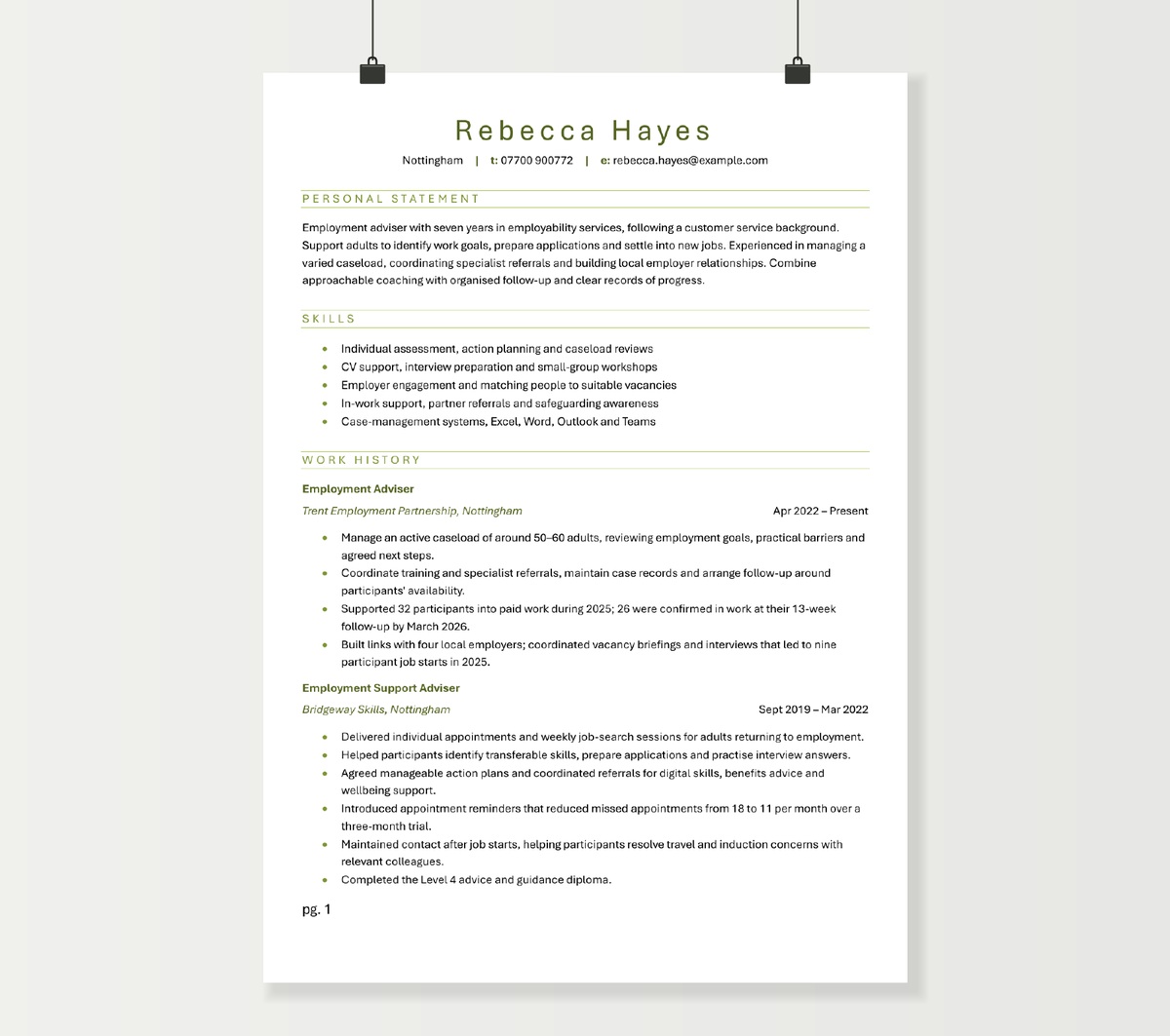
This employment adviser CV template shows progression from customer services into participant support and employment advice. The Word example combines caseload management, employer relationships and follow-up after job starts. The guide covers how to present these responsibilities, with advice for experienced advisers and applicants moving into employability work.
Filename: FreeCVDownload_Employment_Adviser.docx
Content of this CV template
Rebecca Hayes
Nottingham | t: 07700 900772 | e: [email protected]
Personal statement
Employment adviser with seven years in employability services, following a customer service background. Support adults to identify work goals, prepare applications and settle into new jobs. Experienced in managing a varied caseload, coordinating specialist referrals and building local employer relationships. Combine approachable coaching with organised follow-up and clear records of progress.
Skills
- Individual assessment, action planning and caseload reviews
- CV support, interview preparation and small-group workshops
- Employer engagement and matching people to suitable vacancies
- In-work support, partner referrals and safeguarding awareness
- Case-management systems, Excel, Word, Outlook and Teams
Work history
Employment Adviser
Trent Employment Partnership, Nottingham
Apr 2022 – Present
- Manage an active caseload of around 50–60 adults, reviewing employment goals, practical barriers and agreed next steps.
- Coordinate training and specialist referrals, maintain case records and arrange follow-up around participants' availability.
- Supported 32 participants into paid work during 2025; 26 were confirmed in work at their 13-week follow-up by March 2026.
- Built links with four local employers; coordinated vacancy briefings and interviews that led to nine participant job starts in 2025.
Employment Support Adviser
Bridgeway Skills, Nottingham
Sept 2019 – Mar 2022
- Delivered individual appointments and weekly job-search sessions for adults returning to employment.
- Helped participants identify transferable skills, prepare applications and practise interview answers.
- Agreed manageable action plans and coordinated referrals for digital skills, benefits advice and wellbeing support.
- Introduced appointment reminders that reduced missed appointments from 18 to 11 per month over a three-month trial.
- Maintained contact after job starts, helping participants resolve travel and induction concerns with relevant colleagues.
- Completed the Level 4 advice and guidance diploma.
Customer Service Adviser
Willow Home Stores, Nottingham
Aug 2014 – Aug 2019
- Handled telephone and email enquiries for a homewares retailer.
- Resolved delivery and refund queries, keeping clear case notes.
- Adapted explanations for customers needing extra support.
- Coached three new starters in call handling and follow-up.
Qualifications
Level 4 Diploma in Advice and Guidance
City & Guilds
2021
- Completed through workplace assessment alongside advisory duties.
- 3 A levels: English Language, Sociology and Psychology — 2014.
- 9 GCSEs, including English and Maths at grade B — 2012.
Professional development
Workplace learning and supervision
2025 – 2026
- Safeguarding adults, accessible communication and motivational interviewing — employer-led training and reflective practice.
Hobbies and interests
- Running: Regular local parkruns.
- Gardening: Growing vegetables at home.
- Music: Going to live gigs with friends.
Additional information
Full UK driving licence; able to travel to community venues and employers across Nottinghamshire.
How to write an employment adviser CV
An employment adviser CV needs to show how you help people make progress towards work and stay engaged along the way. It should also show that you can organise a caseload, work constructively with employers and keep the records a service needs. The strongest examples connect those responsibilities: a useful assessment leads to an agreed action, a suitable opportunity and support through the next stage.
Start by identifying the kind of employment support the vacancy involves. A community programme, a contracted employability service, a health-linked service and an employer-engagement team may use similar job titles while placing different demands on the adviser. Shape your evidence around the work you would actually be doing.
Make the service and your caseload understandable
In your profile, bring together your advisory experience, the people you support and your strongest contribution. You might have experience helping adults return to work, supporting young people into their first opportunity, or developing employer relationships for a supported-employment service. This is more informative than opening with a general statement about being passionate about helping people.
Under each role, explain the service briefly before listing responsibilities. Include the client group, geographical area and delivery setting where they matter. Name a relevant programme, such as Restart, if you worked on it, and add enough explanation for a reader outside that contract to understand your work.
A typical active caseload is useful context. State whether it is your own caseload, a shared team allocation or an annual number of people supported. Add a short indication of complexity or contact pattern: regular individual appointments, community outreach, remote follow-up or support continuing after a job start. These details explain the workload more effectively than a large number on its own.
Rebecca’s example gives an active range of 50–60 adults. Her annual job-start figure appears separately, so the reader can understand the difference between the people receiving ongoing support and the outcomes recorded over a year.
Show what happens between assessment and progress
“Provided advice and guidance” leaves much of an adviser’s skill unexplained. Use experience points to show how you identified a person’s strengths and priorities, agreed practical next steps and reviewed what happened. This gives the employer evidence of both listening and follow-through.
Choose the aspects most relevant to the vacancy. These may include exploring work preferences, recognising transferable skills, identifying a training need, adapting an appointment for someone who finds written information difficult, or helping a participant restart their search after a setback.
Action planning becomes stronger CV evidence when the reader can see how you used it. Describe setting review dates, adjusting goals as circumstances changed, coordinating another service’s involvement or maintaining contact between appointments. A point about improving appointment attendance can be valuable because it explains how you made support more accessible and consistent.
Short, anonymised examples work well. “Coordinated digital-skills sessions and individual application support for participants moving from paper to online job searches” conveys a clear need and response. The emphasis stays on your contribution and the employment task, with only the context needed to understand it.
Describe coaching and job-search support at the right level
Explain the support you delivered rather than listing “CV writing, interviews, coaching” as three isolated skills. Useful evidence includes helping someone recognise experience from caring or volunteering, preparing for a particular interview format, or breaking an application into manageable stages.
For workshop delivery, give the subject, audience and usual group size. If you adapted materials for different literacy levels, mixed digital confidence or remote attendance, that is worth a sentence. Include how you assessed whether participants could use the learning afterwards, such as completing an application or preparing their own interview examples.
Coaching methods and training can strengthen this section when connected to practice. If you have used motivational interviewing, for instance, describe its place in your one-to-one work and record relevant training separately. The CV needs to show how you support decisions and progress; it does not need a lesson in the technique.
Give employer engagement its own evidence
Working with employers is a substantial part of many employment adviser roles. Show what you did to develop that relationship: researching local recruitment needs, approaching businesses, arranging vacancy briefings, preparing candidates or following up after interviews. “Liaised with employers” can then become a specific account of opportunity development.
Distinguish finding advertised vacancies from creating an ongoing employer relationship. Both are useful, but they demonstrate different experience. If you helped a business consider a wider pool of applicants, explain your contribution to the recruitment process and the resulting opportunities.
Include local labour-market knowledge through examples. You might understand the shift patterns and transport issues affecting warehouse recruitment, the entry requirements for care roles, or seasonal recruitment in hospitality. Show how that knowledge informed matching and preparation rather than presenting a list of local sectors.
For a vacancy centred on employer engagement, move this evidence higher in the CV. Give the number or type of active relationships, the recruitment needs you addressed and relevant interview or job-start results. Applicants arriving from recruitment can also draw on the recruitment consultant CV example for ways to present employer relationships and candidate matching.
Explain job outcomes so the figures mean something
Employment services measure several different things: engagement, completed actions, interviews, job starts and employment sustained over a defined period. Choose the measures that best describe your work and label each one clearly. “Supported 32 participants into paid work during 2025” is readily understood; “achieved 32 outcomes” leaves the reader guessing.
For sustained employment, state the follow-up point or the service’s definition. If you use a percentage, include the group it refers to and the period. Results for one intake, your own caseload and the whole service answer different questions. A brief phrase such as “among participants who started work in…” gives the figure the context it needs.
Connect results with the actions that helped achieve them. Employer briefings, interview preparation, coordinated training or early contact after a start can all explain your contribution. Where several colleagues delivered the service, wording such as “contributed to” or “supported” makes your role easy to understand.
Evidence can also come from service quality: more appointments attended, fewer overdue reviews, quicker referral follow-up or clearer records adopted by colleagues. These are particularly useful when employment takes time or your role concentrates on an earlier stage of the journey. Select a few strong measures and leave room to explain the work behind them.
Include support after a job start
A job start may be only part of your involvement. If you provide in-work support, describe the contact you maintain and the practical issues you help resolve. Examples include checking how induction is going, coordinating support around travel or working hours, and helping participants communicate with an employer.
For retention or return-to-work roles, make that focus explicit. Give evidence of helping someone remain in an existing job or manage a return, as well as any experience finding new work. Describe how you worked alongside other professionals and where your contribution fitted into the wider plan.
The service model matters here. Individual Placement and Support (IPS) and employment advice within NHS Talking Therapies have distinct arrangements. State the model and setting you worked in, then show the relevant employer contact, participant choice, team collaboration and ongoing support. NHS England’s IPS guidance is a useful reference when checking the terminology for that specific experience.
Make partnership work, records and judgement visible
Employment advisers often coordinate support that another organisation delivers. Your CV can show how you identified the need, agreed a referral, passed on the relevant information and checked the next step. Examples might involve training providers, housing services, wellbeing support or specialist benefits advice.
Give practical evidence of accessible communication and sound judgement. That could mean adapting appointment arrangements, arranging language support, discussing a concern through supervision or following the service’s safeguarding process. Recent safeguarding training belongs in professional development; the work history can show how you apply the learning.
Case recording is part of delivering a reliable service. Name the case-management system if useful, and describe the records you maintained: assessments, action plans, review dates, referrals, employer contacts or outcome evidence. Explain reporting responsibilities and any involvement in file checks, quality reviews or preparing information for contract monitoring.
For Microsoft Office and similar tools, connect the software to the task. Excel for reviewing outstanding actions, Word for application support and Teams for remote appointments are more informative than “IT literate”. A short skills section can signpost these abilities while the employment history supplies evidence.
Present qualifications and progression in proportion
List advice and guidance, employability, coaching or training qualifications with their full title, level, awarding body and completion year. Relevant study in progress can include an expected completion date. Short courses are easiest to assess when their subject and recent completion date are clear.
Qualification requirements vary between services. Use the vacancy to decide which award deserves prominence, then support it with evidence of the work you can do. A general degree can be a useful foundation, while a workplace advice qualification may be more directly relevant to case management and guidance responsibilities.
For progression into senior advisory work, include how you supported other advisers, reviewed case quality, contributed to supervision or improved a process. State the size and nature of any team responsibility. A senior practitioner who coaches colleagues has a different role from a manager responsible for allocation, performance and staffing, and the CV should make that distinction easy to see.
Build a convincing first employment adviser application
If you are moving into the sector, start with the closest evidence from your existing work. Customer services may demonstrate listening, sensitive conversations and organised follow-up. Recruitment can show vacancy matching and employer relationships. Community work may show referrals, group delivery and helping people engage with services.
Translate that experience into concrete examples. Training a new colleague, helping a customer work through a difficult process or coordinating a referral can demonstrate relevant skills even when your job title was different. Include useful volunteering or mentoring alongside paid work, with the setting, dates and your responsibilities.
Keep the first application focused on readiness for advisory work: building rapport, organising commitments, adapting explanations and achieving agreed goals. If your background is in direct personal support, the support worker CV example may help you identify evidence of communication and coordinated support that transfers well. Your employment adviser CV can then show why you want to apply those strengths to helping people enter and sustain work.
Employment Adviser CV FAQs
Both spellings appear in UK vacancies. Use the employer's wording in your application heading where helpful, and keep the official titles of your previous jobs in the employment history. You can describe related experience using familiar terms such as employability support or employment coaching without repeating every title variant.
Make the continuous work and the employer change clear. You can give the overall service dates, followed by the provider names and dates within that entry, or use two linked employment entries. Explain a transfer or contract change briefly and concentrate the detail on changes in your caseload, responsibilities or service delivery.
Use evidence you can attribute to your own work: caseload scope, appointments, workshops, employer relationships, referral follow-up or a process improvement. A service-wide result can be included when you identify it as a team result and explain your contribution. Clear responsibility and a well-chosen example are useful evidence even without an individual job-start total.
Some experience overlaps, particularly assessment, guidance and action planning, but the roles can have different purposes and qualification requirements. A careers adviser vacancy may place greater weight on career development, educational choices and a specified guidance qualification. Rework the CV around that person specification, giving the relevant study, guidance experience and client group particular prominence.
Use it to address the employer's person specification with a few fuller examples. An account of re-engaging a participant, coordinating specialist support or developing an employer relationship can explain your decisions and the result in more depth than a CV bullet. Keep the employment chronology in the CV and use the statement to show how your experience meets the service's particular criteria.




